Updated October 13, 2026, by the RB Water Desk. How we research.
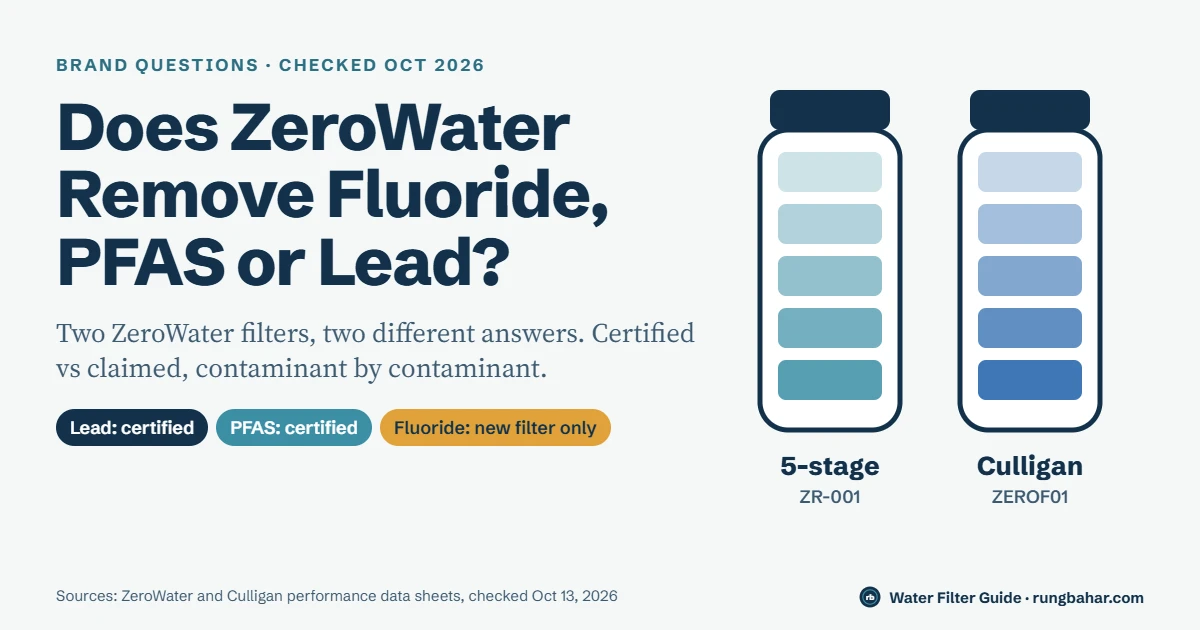
The short answer: It depends on which ZeroWater filter you have. The standard ZeroWater 5-stage filter is certified to reduce lead (98.8 to 98.9 percent) and PFOA/PFOS (99.8 percent), but it is not certified for fluoride, microplastics or nitrate. The newer Culligan with ZeroWater Technology filter adds certified claims for fluoride (99.7 percent), total PFAS (99.7 percent) and nitrate, according to Culligan. Neither filter has a microplastics claim, and neither removes bacteria or viruses. Both strip out nearly all minerals, which is why a TDS meter reads close to zero.
First: which ZeroWater filter do you have?
Most answers online treat “ZeroWater” as one product. In 2026 there are two different ZeroWater filters on US shelves, and they do not carry the same claims. The answer to “does ZeroWater remove fluoride?” is yes for one and no for the other.
- ZeroWater 5-stage filter (replacement ZR-001 or ZF-201). The long-running white filter used in most ZeroWater pitchers and dispensers. Its performance data sheet, dated April 2026, names IAPMO R&T as the certifier and gives a rated life of 15 gallons.
- Culligan with ZeroWater Technology filter (replacement ZEROF01). A newer filter sold under the Culligan name for the new Culligan ZeroWater pitchers and dispensers. Its data sheet lists a longer set of claims and a rated life of 20 gallons. Culligan says it does not fit older ZeroWater pitchers.
Check the model number on the filter or its box before you read on. Everything below comes from each filter’s performance data sheet and the maker’s product pages, checked on October 13, 2026. We have not tested either filter ourselves, and we have no commercial relationship with ZeroWater or Culligan. For each contaminant we say whether it is certified, not certified, or claimed by the brand without a certified result.
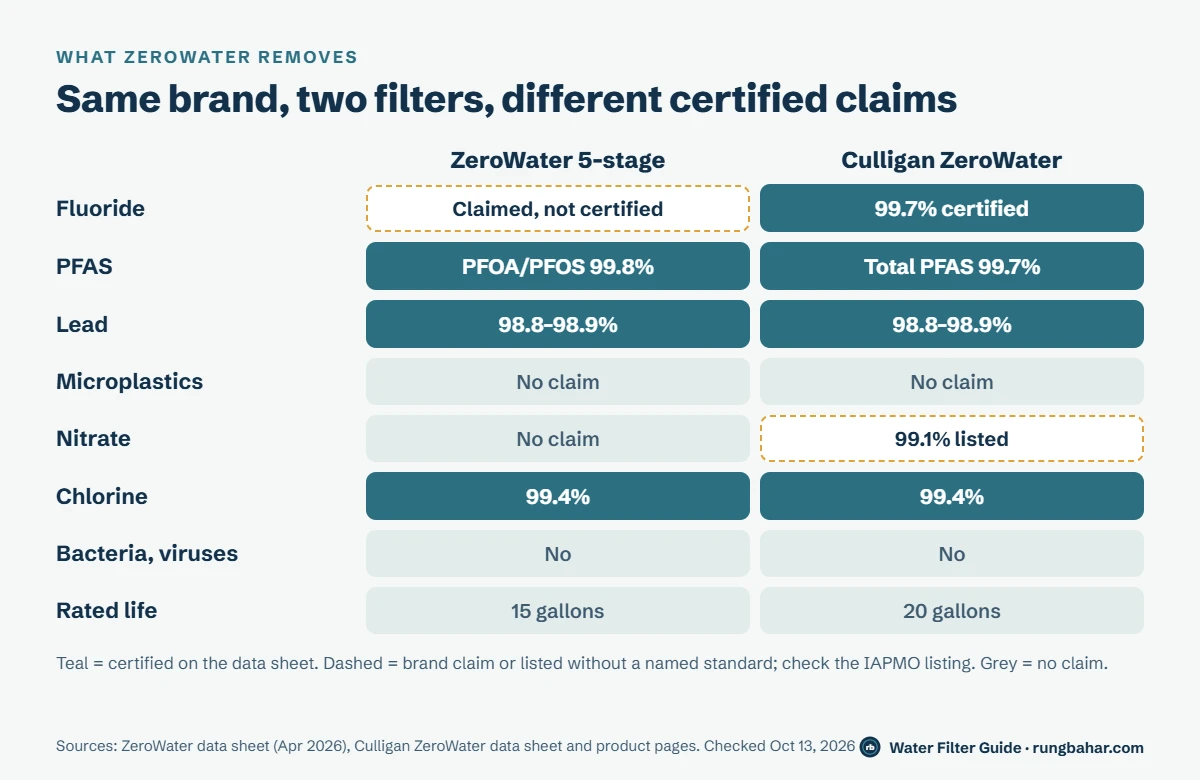
What ZeroWater removes: the full table
| Contaminant | ZeroWater 5-stage (ZR-001) | Culligan ZeroWater (ZEROF01) |
|---|---|---|
| Fluoride | Not certified (brand page claims 99%) | Certified, 99.7% (NSF/ANSI 53) |
| PFAS | PFOA/PFOS certified, 99.8% | Total PFAS certified, 99.7% |
| Lead | Certified, 98.8–98.9% | Certified, 98.8–98.9% |
| Microplastics | No claim | No claim |
| Nitrate | No claim | Listed, 99.1% |
| Chromium-6 | Certified, 99.4–99.5% | Certified, 99.4–99.5% |
| Mercury | Certified, 94.2–96.6% | Certified, 94.2–96.6% |
| Chlorine taste and odor | Certified, 99.4% (NSF/ANSI 42) | Certified, 99.4% (NSF/ANSI 42) |
| Pharmaceuticals, BPA (NSF/ANSI 401) | No claim | Listed (for example BPA 99.3%) |
| Minerals / TDS | Nearly all (brand claim) | Nearly all (brand claim) |
| Bacteria and viruses | No | No |
| Rated life | 15 gallons | 20 gallons |
Two things stand out. First, the newer Culligan filter covers almost everything the old one does plus fluoride, total PFAS and nitrate, and lasts 5 gallons longer on paper. Second, neither filter has a microplastics claim, even though microplastics are one of the most searched ZeroWater questions. If you want to see how a listing is checked, our guide to checking whether a filter is really certified walks through the IAPMO R&T directory.
Does ZeroWater remove fluoride?
The Culligan ZeroWater filter: yes, certified. The standard 5-stage filter: not certified.
Culligan states that its ZeroWater Technology filter is certified by IAPMO to NSF/ANSI 53 to reduce fluoride 99.7 percent, in a test where water containing 8.0 mg/L of fluoride was brought down to 1.0 mg/L or less. That is a strong, specific claim, and 8.0 mg/L is about ten times the 0.7 mg/L the US Public Health Service recommends for community water fluoridation.
The same Culligan page says plainly that older ZeroWater filters are not certified to reduce fluoride. That matters because an older ZeroWater blog post still says its 5-stage filter removes 99 percent of fluoride, without naming a test, a standard or a certifier. Ion exchange resin can take out fluoride, so the claim is plausible, but a number without a certification gives you nothing to rely on, and it tells you nothing about how long the effect lasts as the resin fills up. Treat the 5-stage filter as uncertified for fluoride.
If fluoride is your main reason for filtering, the certified Culligan filter is one option. Reverse osmosis systems certified for fluoride under NSF/ANSI 58 are the other main route, and they keep working on hard water where a ZeroWater filter would run out quickly. Our guide to water filters that remove fluoride compares every method that works.
Does ZeroWater remove PFAS?
Yes. Both filters have a certified PFAS claim, but not the same one.
The 5-stage filter’s data sheet lists PFOA and PFOS under NSF/ANSI 53, with 99.8 percent average reduction from a challenge of 1.5 micrograms per liter. PFOA and PFOS are the two best-known “forever chemicals” and the only two with US drinking water limits that the EPA has proposed keeping, at 4 parts per trillion each.
The Culligan ZeroWater filter is certified for “total PFAS” at 99.7 percent. Total PFAS is the newer, broader test: the water contains a mix of seven PFAS compounds (PFOA, PFOS, PFHxS, PFNA, PFHpA, PFBS and PFDA), and the filter has to keep the combined total at 20 nanograms per liter or less. If you are buying new, that is the more complete claim. Before you buy, check whether your water has PFAS at all: how to find out if your tap water has PFAS lists the free sources.
One caution applies to every pitcher. A certified result holds for the rated life on the data sheet, which is 15 or 20 gallons here. ZeroWater’s own replace-at signal is a TDS reading of 006, and on soft water that can come well after the rated gallons. If PFAS is your reason for buying, change the filter at the rated gallons, not when the meter tells you.
Does ZeroWater remove lead?
Yes, certified. Both ZeroWater filters are certified under NSF/ANSI 53 to reduce lead. In that test, water starts at 150 parts per billion of lead and the filter must keep the output at or below 5 ppb for its rated life. The data sheets show 98.9 percent average reduction at pH 6.5 and 98.8 percent at pH 8.5.
That puts ZeroWater alongside the Brita Elite and PUR PLUS pitcher filters, which pass the same test. The difference is filter life: a Brita Elite is rated for 120 gallons, a ZeroWater filter for 15 or 20. Our ZeroWater vs Brita comparison puts the numbers side by side. If you have lead pipes, a filter is a stopgap, not the fix; see lead in tap water for testing and what else to do.
Does ZeroWater remove microplastics?
No certified claim. Microplastics reduction is certified under NSF/ANSI 401, using particles between 0.5 and 1 micron, and a filter must reduce them by at least 85 percent to pass. Neither ZeroWater data sheet includes that test.
That does not mean ZeroWater lets every particle through. The filter has screens and dense media that will catch some particles. But without a certified result there is no number to quote, and “probably catches some” is not the same as “certified at 99 percent.” If microplastics are your priority, the Brita Elite (99.6 percent) and PUR PLUS pitcher filter (99.8 percent) have certified claims. Our guide to filters for microplastics explains what the test does and does not cover.
Does ZeroWater remove nitrates?
The Culligan filter lists nitrate. The 5-stage filter does not.
Culligan lists nitrate at 99.1 percent and nitrite at 90.2 percent for the ZeroWater Technology filter, and its product page describes nitrate as part of its certified claims. On the data sheet, though, the nitrate rows sit apart from the NSF/ANSI 42, 53 and 401 sections, so confirm nitrate in the IAPMO listing for the model before relying on it. The standard 5-stage filter has no nitrate claim at all.
Nitrate is mainly a concern for private wells near farmland and for formula-fed babies. A pitcher with a 20-gallon life is a short-term measure for a well with a nitrate problem. Test the well, and look at the treatment options in our well water results guide.
Does ZeroWater remove minerals?
Yes, nearly all of them, and that is by design. ZeroWater’s large ion exchange stage pulls out calcium, magnesium, sodium, bicarbonate and other dissolved minerals along with the harmful ions. That is why a ZeroWater pitcher comes with a TDS meter and why filtered water reads 000.
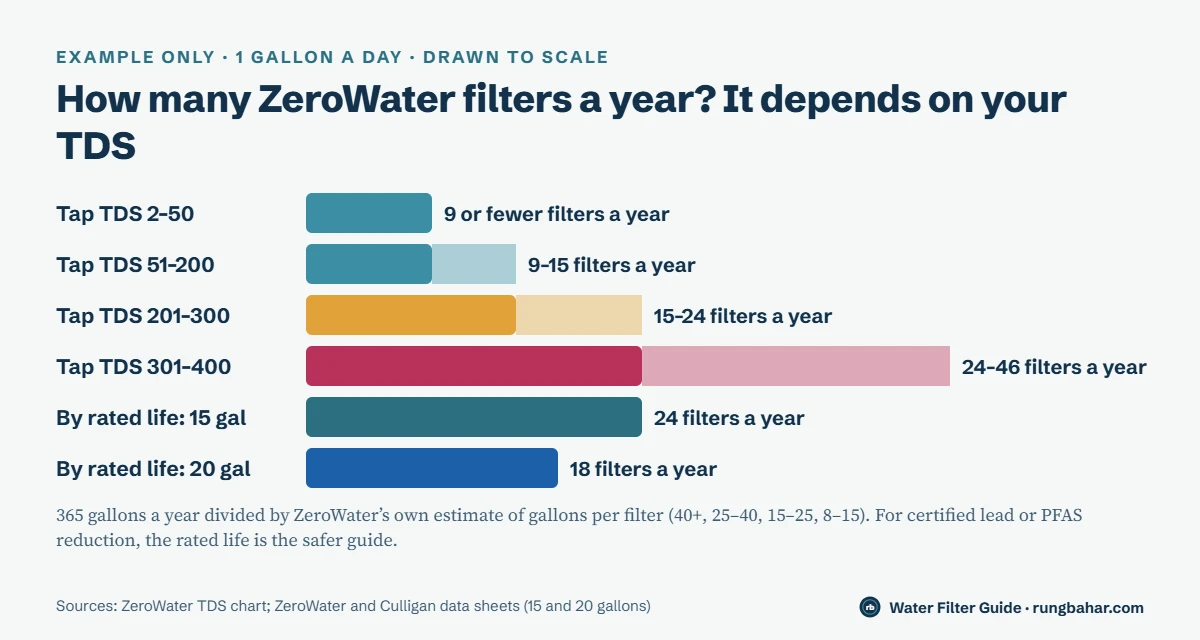
This has two practical effects. Taste: some people love the very clean taste, others find it flat. Filter life: the resin has a fixed capacity, so the more minerals in your tap water, the faster it fills. ZeroWater estimates 40 gallons or more per filter when tap water TDS is under 50, 25 to 40 gallons at 51 to 200, 15 to 25 at 201 to 300, and as little as 8 gallons above 300. On very hard water, an under-sink reverse osmosis system is usually cheaper to run. Our guide to what a TDS reading means explains the numbers, and why a low reading is not the same as safe water.
Does ZeroWater remove chlorine, chloramine and bacteria?
Chlorine: yes, certified. Both filters are certified under NSF/ANSI 42 for chlorine taste and odor, at 99.4 percent.
Chloramine: no claim. Many US cities disinfect with chloramine instead of chlorine. Neither ZeroWater data sheet lists it, so there is no certified result for chloramine taste or odor.
Bacteria and viruses: no. ZeroWater is a filter, not a purifier. The data sheet states that it is intended only for potable water and must not be used with water that is microbiologically unsafe or of unknown quality without adequate disinfection before or after. On a boil-water notice, boil first.
Marketing claims vs certified claims
ZeroWater’s own pages do not always agree with each other or with the data sheet, which is one reason to read the data sheet first:
- An older ZeroWater blog post says the 5-stage filter removes 99 percent of fluoride. Culligan’s current page says older ZeroWater filters are not certified for fluoride, and the data sheet does not list it.
- The same older post gives 94.9 percent for PFOA and PFOS. The April 2026 data sheet gives 99.8 percent. The data sheet is the certified number.
- ZeroWater’s performance results page compares lead and PFOA/PFOS with a Brita Standard filter at different volumes (15 vs 20 gallons). Brand-run side-by-side tests are marketing, not certification.
The rule we use for every brand: a contaminant counts only if it appears on the current data sheet for the exact model, with a standard and a certifier, and the certifier’s directory agrees. Everything else is a claim.
Is ZeroWater the right filter for you?
- Good fit: you want certified lead and PFAS reduction in a pitcher, your tap water TDS is under about 200, and you like the very clean taste. If you are buying new, choose the Culligan version for fluoride and total PFAS.
- Think twice: your water is hard or high in TDS (filters may last only 8 to 15 gallons), you want few filter changes, or microplastics are your main concern.
- Not the right tool: untested well water, any boil-water notice, or a need for whole-house treatment.
Fluoride + total PFAS
Culligan with ZeroWater Technology (ZEROF01)
- Certification: NSF/ANSI 42, 53 and 401 (lead, total PFAS, fluoride), IAPMO
- Best for: Fluoride, PFAS and lead in one pitcher
- Skip if: you own an older ZeroWater pitcher (not compatible)
PFOA/PFOS + lead
ZeroWater 5-stage filter (ZR-001)
- Certification: NSF/ANSI 42 and 53 (lead, PFOA/PFOS, chromium-6, mercury), IAPMO R&T
- Best for: Owners of existing ZeroWater pitchers on low-TDS water
- Skip if: fluoride is your main concern
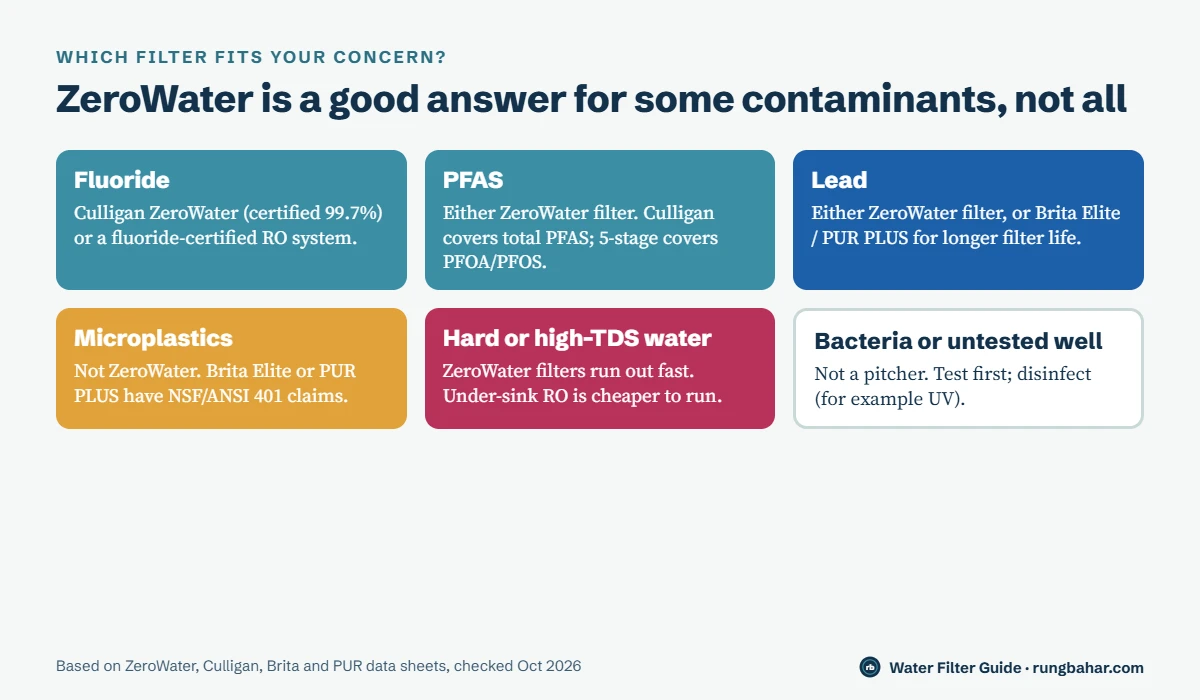
Not sure a pitcher is the right type at all? Answer three questions in the filter finder, check what your utility reports with the ZIP code tap-water check, or compare pitcher brands in what Brita filters remove. For the widest coverage, see what reverse osmosis removes.
ZeroWater: 14 common questions, answered
These are the questions people search most about what ZeroWater removes, answered from the data sheets.
Does ZeroWater remove fluoride?
The newer Culligan with ZeroWater Technology filter is certified under NSF/ANSI 53 to reduce fluoride 99.7 percent. The standard ZeroWater 5-stage filter is not certified for fluoride, according to Culligan.
Does ZeroWater remove PFAS?
Yes. The 5-stage filter is certified for PFOA and PFOS (99.8 percent) and the Culligan ZeroWater filter for total PFAS (99.7 percent), both under NSF/ANSI 53.
Does ZeroWater remove lead?
Yes. Both filters are certified under NSF/ANSI 53 to reduce lead from 150 ppb to 5 ppb or less, with 98.8 to 98.9 percent average reduction.
Does ZeroWater remove microplastics?
There is no certified claim. Neither ZeroWater data sheet includes the NSF/ANSI 401 microplastics test.
Does ZeroWater remove nitrates?
The Culligan ZeroWater filter lists nitrate at 99.1 percent. The standard 5-stage filter has no nitrate claim.
Does ZeroWater remove minerals?
Yes. It removes nearly all dissolved minerals, including calcium and magnesium, which is why filtered water reads close to 0 on a TDS meter.
Does ZeroWater remove chlorine?
Yes. Both filters are certified under NSF/ANSI 42 for chlorine taste and odor at 99.4 percent. Neither lists chloramine.
Does ZeroWater remove bacteria or viruses?
No. ZeroWater says its filters are only for water that is already safe to drink and should not be used on unsafe or untested water without disinfection.
Does ZeroWater remove arsenic?
Neither ZeroWater data sheet lists arsenic. For arsenic, look for a reverse osmosis system with a certified arsenic claim and test your water first.
Does ZeroWater remove hardness?
Yes, it removes calcium and magnesium along with other minerals. On hard water this uses up the filter faster, so it is not a cheap way to soften drinking water.
Is ZeroWater NSF certified?
ZeroWater filters are certified by IAPMO R&T to NSF/ANSI standards. IAPMO R&T is an accredited certifier, so its listings count the same as NSF International’s.
How long does a ZeroWater filter last?
The rated life is 15 gallons (5-stage) or 20 gallons (Culligan). ZeroWater estimates 8 to 40+ gallons in practice, depending on your tap water’s TDS.
Can I use the new Culligan ZeroWater filter in an old ZeroWater pitcher?
No. Culligan says the ZeroWater Technology filter is not compatible with older ZeroWater pitchers and dispensers.
Is ZeroWater better than reverse osmosis?
ZeroWater gets TDS lower, but a certified under-sink RO system usually covers more contaminants and costs less to run, especially on hard water.
Sources and how we checked this page
Every claim on this page comes from ZeroWater’s and Culligan’s performance data sheets and product pages and from the US EPA, checked on October 13, 2026. We do not test filters in a lab, and we have no commercial relationship with ZeroWater or Culligan. Data sheets change, so check the one for the exact filter you buy.
- ZeroWater: performance data sheet, 5-stage filter family (April 2026, PDF)
- Culligan: performance data sheet, Culligan with ZeroWater Technology (PDF)
- Culligan: Does the ZeroWater filter remove fluoride? (Oct 7, 2026)
- Culligan: ZeroWater replacement filter ZEROF01 (claims and compatibility)
- ZeroWater: older blog post on fluoride (uncertified claims)
- ZeroWater: How long will my ZeroWater filter last? (TDS chart)
- ZeroWater: performance results page
- US EPA: PFAS national primary drinking water regulation
- IAPMO R&T product listing directory