Published October 6, 2026. Every claim is checked against the sources listed at the end of this page. How we research.
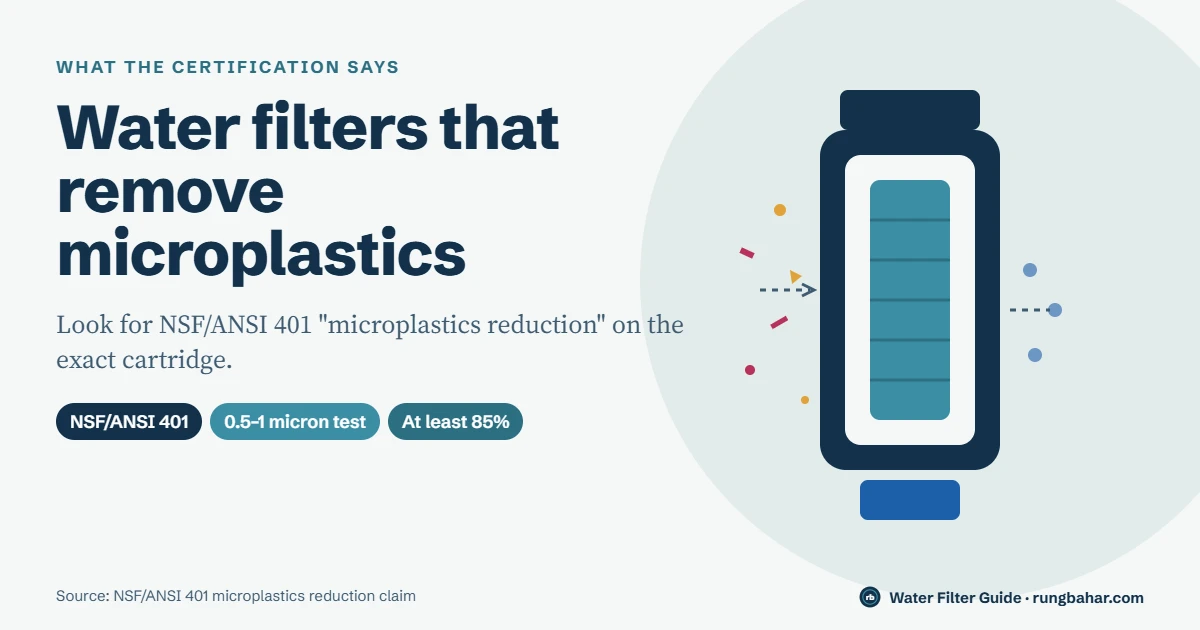
The short answer: The water filters with a verified microplastics claim are certified to NSF/ANSI 401 for “microplastics reduction.” That test requires a filter to remove at least 85% of particles 0.5 to 1 micron across. Certified pitchers, faucet mounts, refrigerator filters and under-sink filters all exist. NSF/ANSI 53 and 58 do not include a microplastics claim, so check the listing or the performance data sheet for the word “microplastics.”
Quick check
What kind of filter do you use or want?
What the microplastics certification actually says
Plenty of filters say “reduces microplastics” on the box. Only some can prove it. The proof is a certified claim for microplastics reduction under NSF/ANSI 401, the standard for emerging and incidental contaminants. Independent certifiers such as NSF, the Water Quality Association (WQA) and IAPMO R&T test filters to it and publish the results.
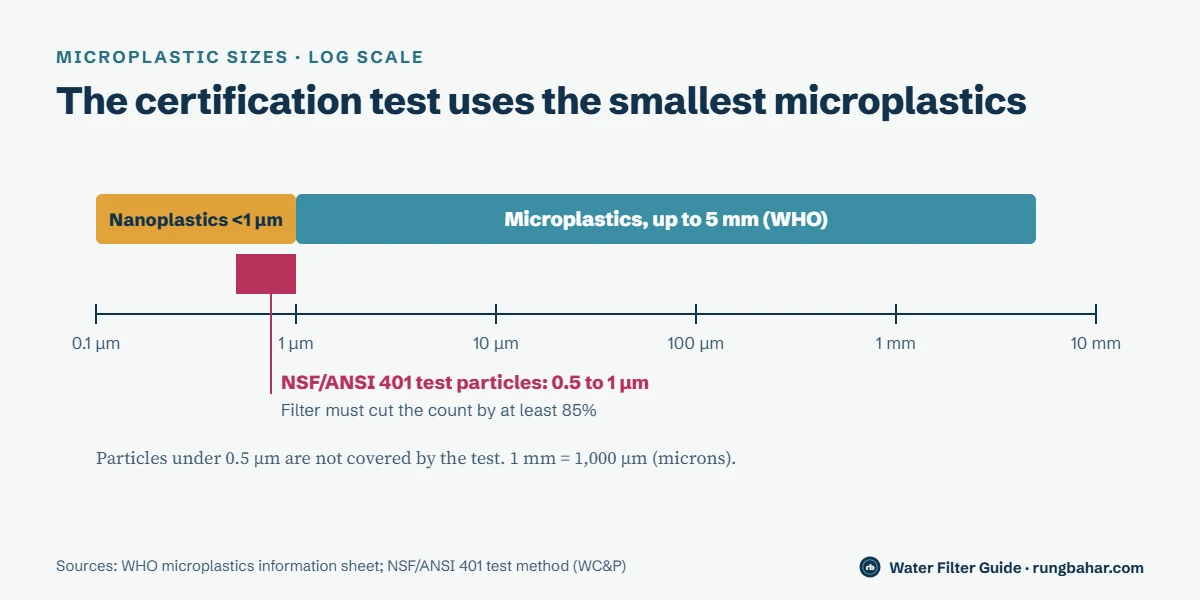
The test itself is specific. The filter is challenged with water containing a high count of particles between 0.5 and 1 micron across, the same particle class used in NSF/ANSI 42 for fine particulates. To pass, it must cut the particle count by at least 85% over its rated life. The claim sits in NSF/ANSI 401 rather than in the taste-and-odor standard because microplastics are invisible and have no taste or odor.
Why such small particles? The World Health Organization defines microplastics as plastic particles smaller than 5 millimeters, and nanoplastics as those smaller than 1 micron. A filter that traps particles at 0.5 to 1 micron will also catch the much larger fibers and fragments that make up most microplastics by size.
There is one honest limit. The test says nothing about particles smaller than 0.5 micron, which is where many nanoplastics sit. No home filter claim currently proves removal at that size, so be wary of any brand that promises “all” plastics. For how the standards fit together, see water filter certifications explained.
Does NSF 53 or NSF 58 cover microplastics?
No. This is one of the most common mix-ups. NSF/ANSI 53 covers health-related contaminants such as lead, cysts and PFOA/PFOS. NSF/ANSI 58 covers reverse osmosis systems. Neither standard has a microplastics claim. In the NSF certified products search, “Microplastics Reduction” appears only under NSF/ANSI 401.
So a filter “certified to NSF 53” may do an excellent job on lead and still have no tested microplastics claim. In practice, many good carbon block filters carry 42, 53 and 401 together. The point is to look for 401 and the word “microplastics” in the same listing. Our comparison of NSF 53 vs 58 explains what each of those two standards does cover.
| Standard | What it covers | Microplastics claim? |
|---|---|---|
| NSF/ANSI 42 | Taste, odor, chlorine, fine particulates | No (the 0.5–1 micron particle test comes from here) |
| NSF/ANSI 53 | Health contaminants: lead, cysts, PFOA/PFOS and more | No |
| NSF/ANSI 58 | Reverse osmosis systems | No |
| NSF/ANSI 401 | Emerging and incidental contaminants | Yes: microplastics reduction |
| NSF/ANSI 55 | UV systems for bacteria and viruses | No |
Certified microplastics filters we verified
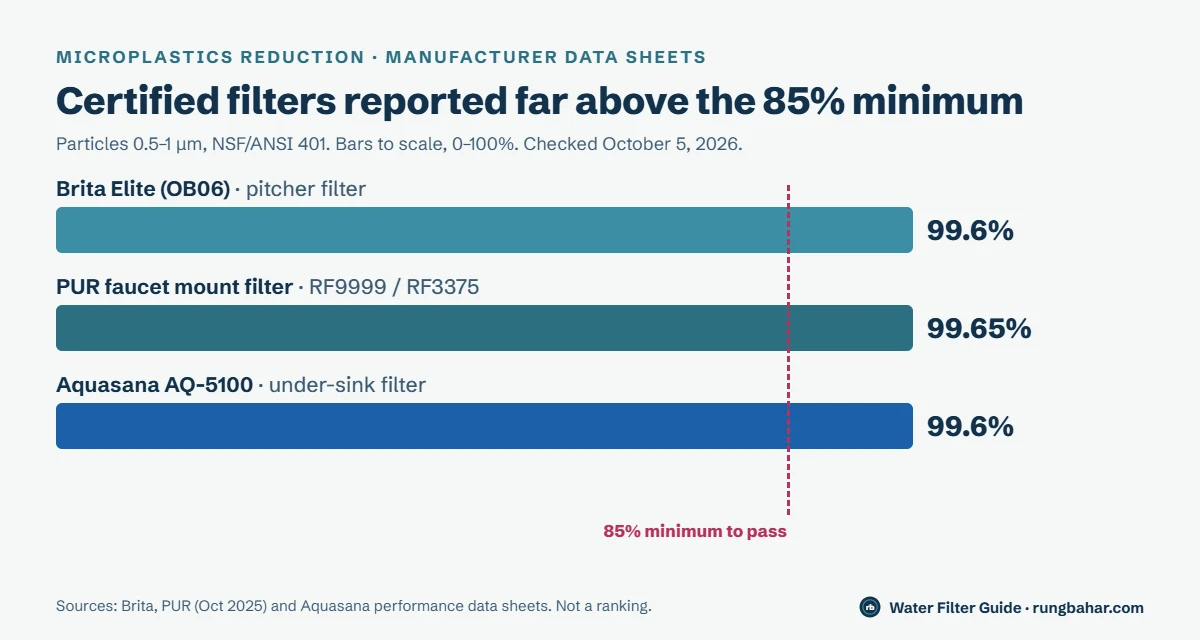
We checked manufacturer performance data sheets on October 5, 2026. These are examples to show what a real claim looks like, not a ranking. Each one is certified to NSF/ANSI 401 for microplastics, and each data sheet also lists lead and PFAS results.
| Filter | Type | Certified by | Microplastics | PFAS claim | Rated life |
|---|---|---|---|---|---|
| Brita Elite (OB06) | Pitcher / dispenser | IAPMO R&T, WQA, NSF (42, 53, 401) | 99.6% | PFOA/PFOS 98.1% | 120 gallons |
| PUR faucet mount filter (RF9999 / RF3375) | Faucet mount | IAPMO R&T (42, 53, 401) | 99.65% | Total PFAS 99.92% | 100 gallons |
| Aquasana AQ-5100 | Under-sink | WQA (42, 53, 401) | 99.6% | PFOA/PFOS 99.7% | See data sheet |
Two cautions. First, the claim belongs to a specific cartridge, not a brand. Brita’s standard pitcher filter is not certified for microplastics, and the PUR pitcher filter data sheet we checked (September 2025) does not list microplastics at all. Second, data sheet percentages are averages from a lab test at the rated capacity. Your results depend on changing the cartridge on time. If you own a Brita, does Brita remove microplastics, lead and PFAS breaks down each filter.
Lowest cost to start
Pitcher with a 401 microplastics claim
- Certification: NSF/ANSI 401 microplastics, ideally plus 53 for lead and PFOA/PFOS
- Best for: Renters, small households, trying a filter for the first time
- Skip if: you need a lot of water a day; pitchers are slow
No plumbing
Faucet mount filter
- Certification: NSF/ANSI 401 microplastics plus 53
- Best for: Renters with a standard faucet thread who want on-demand water
- Skip if: you have a pull-down or sprayer faucet
Longest between changes
Under-sink carbon block filter
- Certification: NSF/ANSI 401 microplastics plus 53 for lead and PFAS
- Best for: Homeowners who want filtered water at the kitchen tap
- Skip if: you cannot fit anything under the sink
Water filters for microplastics, by type
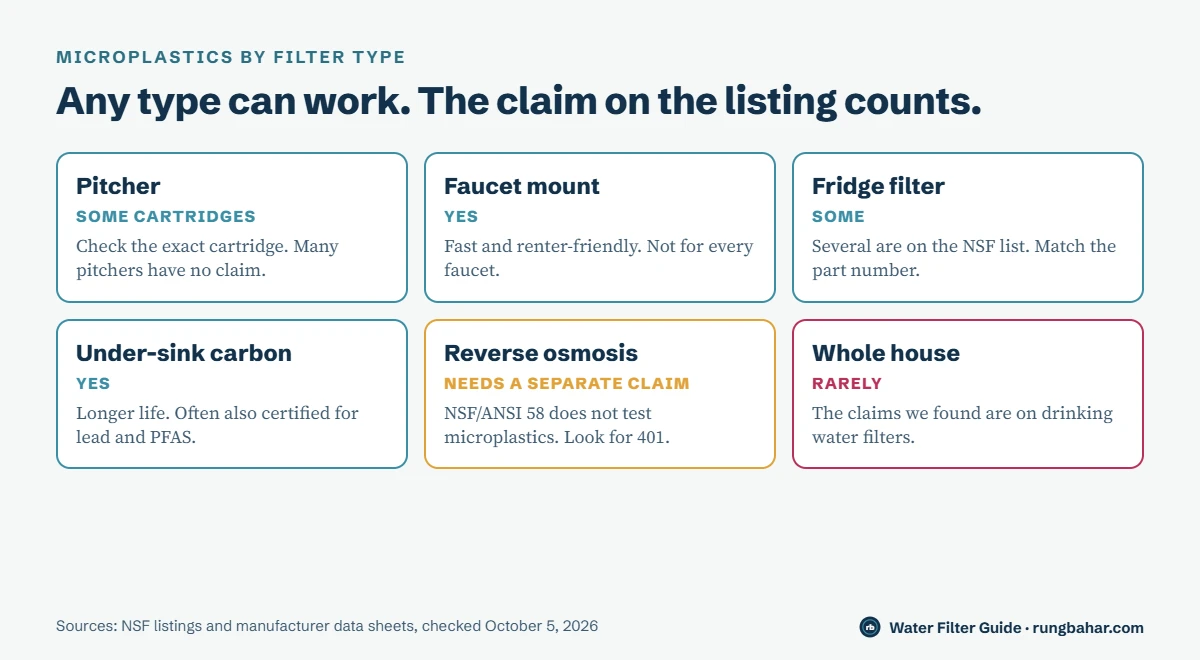
Every common filter type can work if it carries the claim. Here is how they compare in practice.
| Filter type | Can carry a 401 microplastics claim? | Good to know |
|---|---|---|
| Pitcher | Yes, some cartridges | Check the exact cartridge; many pitchers have no microplastics claim |
| Faucet mount | Yes | Fast, cheap, renter-friendly; does not fit every faucet |
| Refrigerator filter | Yes, some | Several fridge filters are on the NSF list; match the part number |
| Under-sink carbon block | Yes | Longer life; often also certified for lead and PFAS |
| Reverse osmosis | Only with a separate claim | NSF/ANSI 58 does not cover microplastics; look for 401 or a named microplastics claim |
| Whole house | Rarely | The claims we found are on drinking water filters |
| Boiling | Not a filter | Helps in hard water if you filter afterward (see below) |
About reverse osmosis: its membrane blocks far smaller particles than a carbon filter, so it very likely removes microplastics well. But “very likely” is not a certified claim, and the RO standard does not test for it. If you want proof, pick an RO system whose listing or data sheet names microplastics. What reverse osmosis removes covers everything else RO is certified to reduce.
Water filters that remove microplastics and PFAS
Many people searching for a microplastics filter also want PFAS gone. The good news is that the two claims often appear on the same product. All three examples above list both: microplastics under NSF/ANSI 401, and PFOA/PFOS or total PFAS under NSF/ANSI 53.
Look for the exact wording. “PFOA/PFOS” means the filter was tested on those two compounds. “Total PFAS” is a broader claim added to the standards more recently. Reverse osmosis systems can also carry PFAS claims under NSF/ANSI 58. Whichever you choose, confirm both claims on one model’s listing, using the steps in how to check if a water filter is really NSF certified.
How to check a microplastics claim in 2 minutes
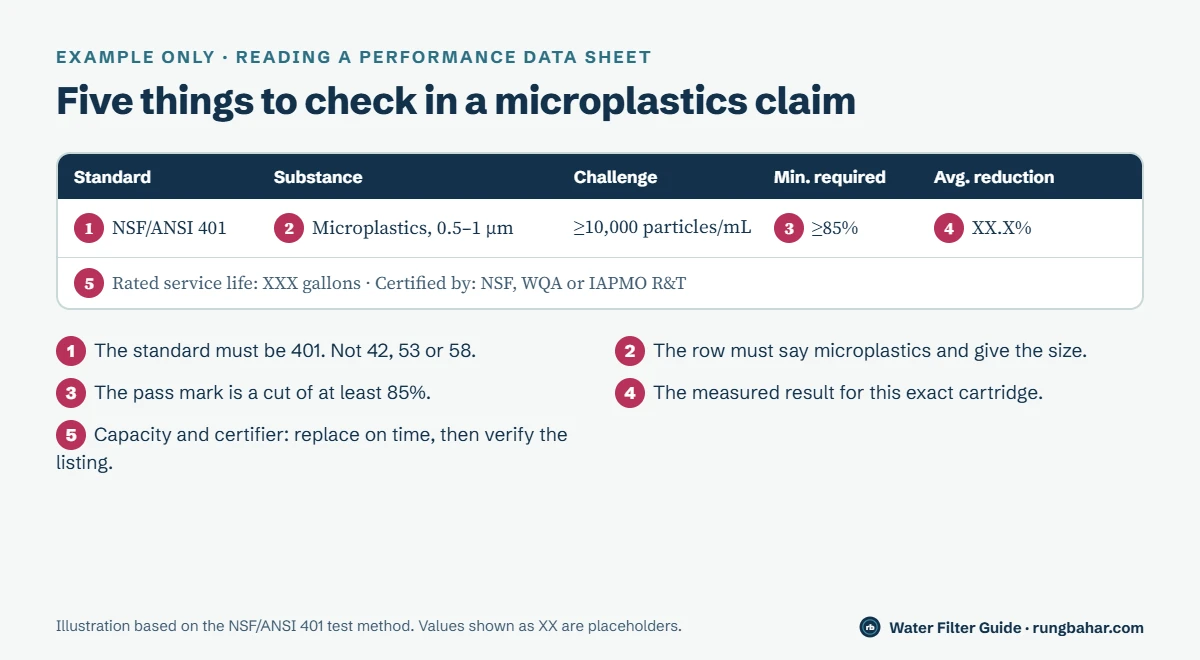
- Find the exact model number of the cartridge, not just the pitcher or housing.
- Open the performance data sheet. Brands usually link it on the product page. Look for a “Microplastics” row with a size range of 0.5 to 1 micron (µm) and a reduction of at least 85%.
- Check the certifier. The data sheet names who certified it: NSF, WQA or IAPMO R&T.
- Confirm in the database. Search the NSF microplastics list, the WQA certified product search or the IAPMO product listing directory. The NSF list shows only NSF-certified products, so a filter certified by WQA or IAPMO will not appear there.
- Note the rated capacity in gallons and set a reminder to replace the cartridge before you reach it.
Red flags: a “tested to NSF standards” line with no certifier named, a percentage with no particle size, or a claim of removing “100% of microplastics.” None of these match how the certified test works.
How much plastic is in US tap water?
Nobody has a complete national picture yet. Researchers measure microplastics in different ways, and results vary widely. Two widely cited studies give a sense of scale:
- Tap water, 2017: an Orb Media investigation found plastic fibers in about 83% of tap water samples worldwide, and in 94% of US samples.
- Bottled water, 2024: Columbia and Rutgers researchers, publishing in PNAS, found about 240,000 plastic particles per liter in bottled water from three brands, and about 90% were nanoplastics.
What does it mean for health? The WHO’s 2019 review found no reliable information that microplastics in drinking water are a health concern at the levels found, while stressing that the data are limited. That is why regulators are now collecting more. California adopted the first legal definition of microplastics in drinking water in 2020 and a testing policy in 2022. In April 2026 the EPA proposed adding microplastics to its draft Contaminant Candidate List 6, the list of unregulated contaminants it may study for future rules. There is no federal limit today. To see what your own utility does report, start with the ZIP code tap water check on our homepage.
Does boiling water remove microplastics?
Partly, in hard water. A 2024 study in Environmental Science & Technology Letters boiled tap water for 5 minutes and then poured it through a coffee filter. In hard water, limescale trapped the plastic as it formed, removing up to about 90%. In soft water only about 25% came out. Boiling does not remove lead, PFAS or fluoride, though, so it is not a substitute for a filter. Our guide to what boiling water does and does not remove has the details.
Common mistakes when buying a microplastics filter
- Trusting the box, not the listing. “Reduces microplastics” on packaging is marketing until a certifier listing or data sheet backs it up with NSF/ANSI 401.
- Buying the right pitcher with the wrong cartridge. Many pitchers accept more than one filter. The microplastics claim belongs to one cartridge model only.
- Assuming NSF 53 or 58 covers it. Those standards are about lead, PFAS, cysts and RO performance. Microplastics sit in 401.
- Running a cartridge past its rated life. The 85% minimum is proven up to the rated capacity in gallons. After that, there is no claim.
- Ignoring what else is in your water. If your utility report shows lead or PFAS, choose a filter that is certified for those too, not just for microplastics.
None of these mistakes cost much to avoid. Two minutes with the data sheet and the certifier database is usually enough.
How to choose a microplastics filter, in 5 steps
- Decide where you need filtered water. For most homes, the kitchen tap is enough.
- Pick a type that fits your home: pitcher or faucet mount for renters, fridge filter if you already use one, under-sink for the longest life.
- Require an NSF/ANSI 401 microplastics claim on the exact cartridge.
- Add the other claims you need, usually lead and PFOA/PFOS or total PFAS under NSF/ANSI 53.
- Budget for replacements using the rated capacity in gallons.
Want a quicker answer for your home? Try the 15-second filter finder, or read our full guide on how to choose a water filter.
Microplastics filters: 14 common questions
Short answers to what people search most, based on certifier listings and data sheets checked October 5, 2026.
Which water filters remove microplastics?
Filters certified to NSF/ANSI 401 for microplastics reduction. Examples we verified include the Brita Elite pitcher filter, the PUR faucet mount filter and the Aquasana AQ-5100 under-sink filter. Check the exact cartridge model.
Does NSF 53 remove microplastics?
NSF/ANSI 53 has no microplastics claim. A filter may still remove them, but the proof comes from a separate NSF/ANSI 401 microplastics claim.
What is NSF 401 microplastics reduction?
It is a certified claim that a filter cut particles 0.5 to 1 micron across by at least 85% in a lab test over its rated life.
Does Brita remove microplastics?
The Brita Elite filter is certified to NSF/ANSI 401 and lists 99.6% microplastics reduction. Brita’s standard filter is not certified for microplastics.
Does PUR remove microplastics?
PUR’s faucet mount filter data sheet lists 99.65% microplastics reduction. The PUR pitcher filter data sheet we checked does not list microplastics.
Do refrigerator water filters remove microplastics?
Some do. The NSF microplastics list includes refrigerator filters from several makers. Look up your exact filter part number.
Does reverse osmosis remove microplastics?
Very likely, because the membrane blocks extremely small particles. But NSF/ANSI 58 does not test for microplastics, so look for a separate certified microplastics claim.
Is there a water filter that removes microplastics and PFAS?
Yes. Many certified filters list both a microplastics claim (NSF/ANSI 401) and a PFOA/PFOS or total PFAS claim (NSF/ANSI 53 or 58). Confirm both on the same model.
Can a filter remove nanoplastics?
No home filter claim currently proves removal below 0.5 micron. The certified test stops there, so treat “removes all nanoplastics” claims with caution.
What micron filter removes microplastics?
Look for a certified claim rather than a micron number. The certification test uses 0.5 to 1 micron particles, and the CDC notes an “absolute” 1-micron rating is stricter than a “nominal” one.
Do whole-house filters remove microplastics?
The NSF/ANSI 401 microplastics claims we found are on drinking water filters, not whole-house systems. Filter at the kitchen tap.
Is bottled water free of microplastics?
No. A 2024 study found about 240,000 plastic particles per liter in bottled water, mostly nanoplastics.
Does boiling water remove microplastics?
Partly, in hard water, if you filter it afterward. A 2024 study removed up to about 90% in hard water and about 25% in soft water.
Are microplastics in tap water regulated?
Not federally. The EPA proposed adding microplastics to its draft Contaminant Candidate List 6 in April 2026, and California requires some utilities to test.
Sources and how we checked this page
Facts on this page come from NSF listings, manufacturer performance data sheets, the WHO, the CDC, the NIH, the California State Water Resources Control Board, the Federal Register and industry trade reporting, checked on October 5, 2026. We do not test filters in a lab. Product examples are not a ranking or an endorsement.
- NSF listings: NSF/ANSI 401 microplastics reduction
- Water Conditioning & Purification: Microplastics reduction testing under NSF/ANSI 401
- Water Conditioning & Purification: Addressing consumer demand for reducing microplastics (2025)
- Brita Elite filter performance data sheet (PDF)
- PUR faucet mount filter performance data sheet, October 2025 (PDF)
- Brita Standard filter performance data sheet (PDF, no microplastics claim)
- PUR pitcher filter performance data sheet, September 2025 (PDF)
- Aquasana AQ-5100 performance data sheet (PDF)
- WHO: Microplastics in drinking water information sheet (PDF)
- WHO: Microplastics in drinking-water (2019 report)
- NIH: Plastic particles in bottled water (2024 PNAS study)
- WaterWorld: Plastic fibers found in most of the world’s tap water (Orb Media, 2017)
- California State Water Resources Control Board: Microplastics
- Federal Register: Drinking Water Contaminant Candidate List 6, draft (April 2026)
- CDC: A guide to water filters (absolute vs nominal pore size)
- Yu et al., Drinking boiled tap water reduces human intake of nanoplastics and microplastics, Environ. Sci. Technol. Lett. (2024)
- WQA: Find certified products
- IAPMO R&T: Product listing directory