Updated October 14, 2026, by the RB Water Desk. How we research.
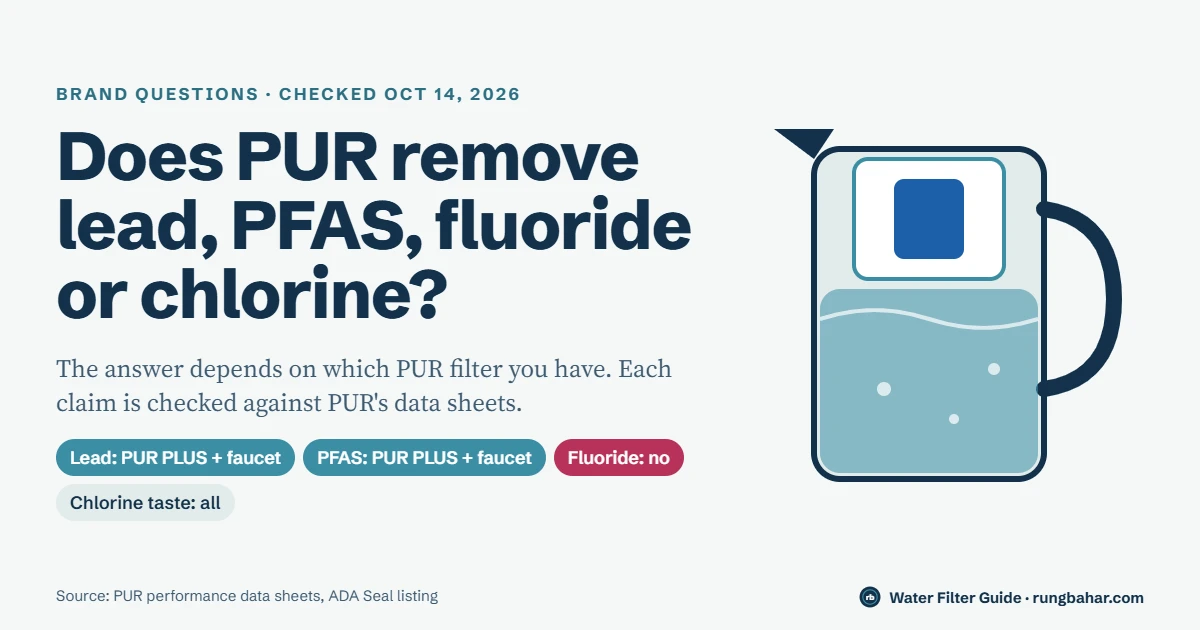
The short answer: It depends on which PUR filter you have. The PUR PLUS pitcher filter (PPF951K) and PUR faucet filters (RF-9999 and RF3375) are certified to reduce lead (99.2 to 99.9 percent), total PFAS (99.75 to 99.92 percent), microplastics and chlorine taste. The cheaper blue PUR pitcher filter (PPF900Z) is certified for chlorine taste and a few metals, but not for lead, PFAS or microplastics. No PUR filter removes fluoride, nitrate or bacteria.
First: which PUR filter do you have?
“PUR” is a brand, not one filter. In October 2026, PUR publishes performance data sheets for two pitcher and dispenser filters and two faucet filters, and they carry different certified claims. The answer to “does PUR remove lead?” is yes for three of them and no for one.
- PUR pitcher filter, model PPF900Z. The basic blue filter. Rated for 40 gallons. Certified for chlorine taste and odor and some metals and chemicals, but not for lead, PFAS or microplastics.
- PUR PLUS pitcher filter, model PPF951K. The upgraded pitcher and dispenser filter. Rated for 40 gallons. Certified for lead, total PFAS, microplastics and a list of pharmaceuticals and chemicals.
- PUR PLUS faucet filter, model RF-9999 (sold as the Mineral Core filter) and PUR faucet filter, model RF3375. Rated for 100 gallons. PUR’s current faucet data sheet covers both cartridges with one set of results, including lead, total PFAS and microplastics.
Look at the model number printed on the filter or its box before you read on. Both pitcher filters fit the same PUR pitchers and dispensers, so a PUR pitcher on your counter could hold either one. Everything on this page comes from PUR’s performance data sheets, its pitcher quick start guide, its product pages and the American Dental Association’s Seal listing, checked on October 14, 2026. We have not tested any PUR filter ourselves, and we have no commercial relationship with PUR or its owner, Helen of Troy. For each contaminant we say whether it is certified, not certified, or claimed by the brand without a certified result.
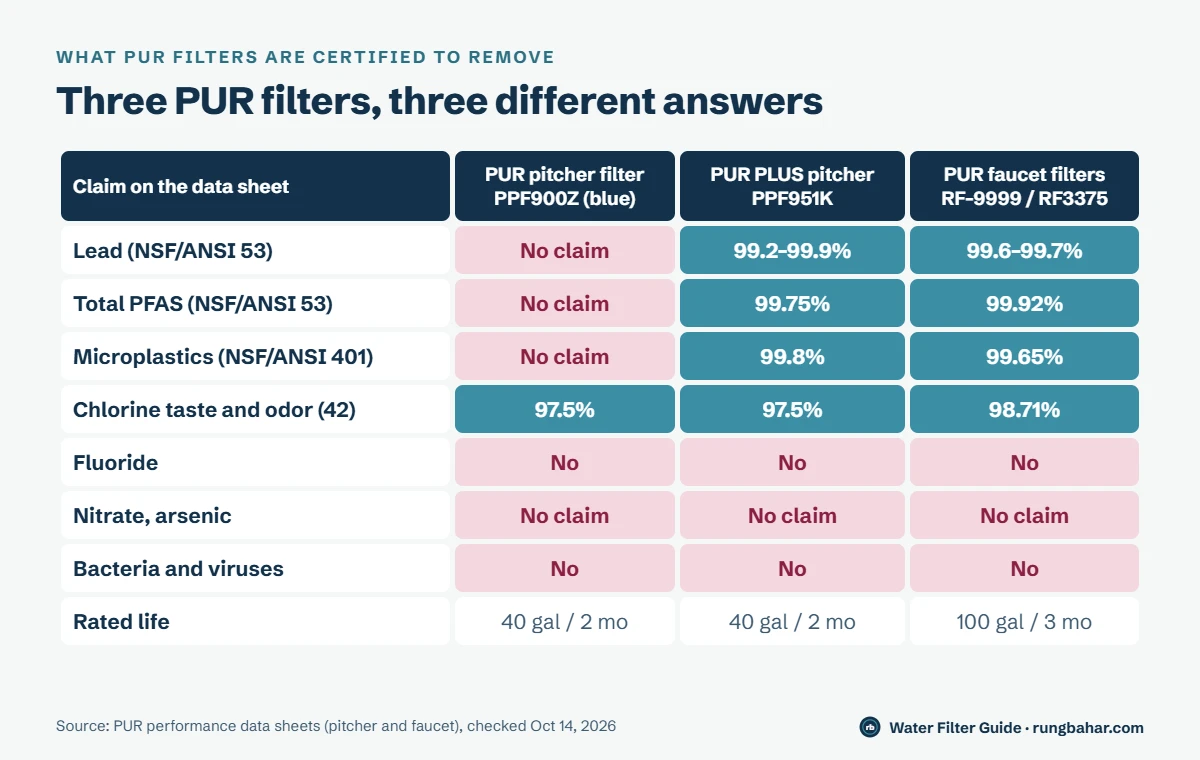
What PUR removes: the full table
| Contaminant | PUR pitcher (PPF900Z) | PUR PLUS pitcher (PPF951K) | PUR faucet (RF-9999 / RF3375) |
|---|---|---|---|
| Lead (NSF/ANSI 53) | Not certified | Certified, 99.2–99.9% | Certified, 99.6–99.7% |
| Total PFAS (NSF/ANSI 53) | Not certified | Certified, 99.75% | Certified, 99.92% |
| Microplastics (NSF/ANSI 401) | Not certified | Certified, 99.8% | Certified, 99.65% |
| Chlorine taste and odor (NSF/ANSI 42) | Certified, 97.5% | Certified, 97.5% | Certified, 98.71% |
| Mercury | Certified, 88.8–96.5% | Certified, over 96.4% | Certified, 78.6–81.6% |
| Copper | Certified, 85.7–90.1% | Certified, 95.9–99.3% | No claim |
| Cadmium | Certified, 86.7–90.2% | Certified, 98.9% to over 99.3% | No claim |
| VOCs and pesticides | Some (benzene 86.4%) | Some (benzene over 96.8%) | About 50 compounds (chloroform surrogate 99.51%) |
| Pharmaceuticals, BPA (NSF/ANSI 401) | Two compounds | Eight compounds, incl. BPA over 99% | Fourteen compounds, incl. BPA 99.5% |
| Fluoride | No | No | No |
| Nitrate, arsenic | No claim | No claim | No claim |
| Bacteria and viruses | No | No | No |
| Rated life | 40 gal or 2 months | 40 gal or 2 months | 100 gal or 3 months |
| Certified by | IAPMO R&T | IAPMO R&T | IAPMO R&T |
Read the table by column, not by brand. The PUR PLUS pitcher filter and the faucet filters cover the three things people search for most: lead, PFAS and microplastics. The blue PPF900Z does not cover any of them, and it is often the cheapest PUR filter on the shelf, which is how it ends up in many pitchers by default. None of the four touches fluoride, nitrate or germs. If you are comparing PUR with its main rival, our Brita vs PUR comparison puts the two brands’ data sheets side by side.
Does PUR remove lead?
Yes for the PUR PLUS pitcher filter and the faucet filters. No for the blue PPF900Z.
Lead reduction is tested under NSF/ANSI 53. The test water starts at about 150 parts per billion (ppb) of lead, and a filter passes only if the water coming out stays at or below 5 ppb across its whole rated life, at two pH levels. The PUR PLUS pitcher filter averaged 99.9 percent reduction at pH 6.5 and 99.2 percent at pH 8.5. PUR’s faucet data sheet shows 99.70 and 99.60 percent. The PPF900Z sheet marks lead as “not certified”.
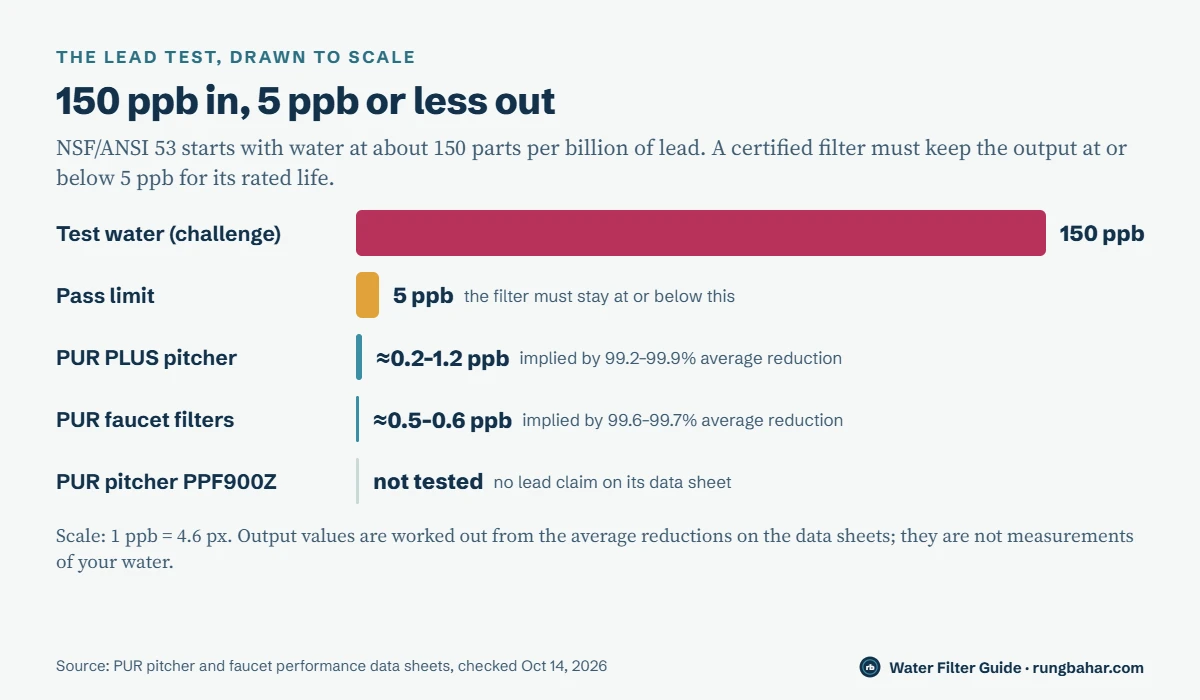
Those percentages are averages from a lab test, not a promise for your tap, but they are well clear of the pass line. In practice the decision is not between 99.2 and 99.9 percent. It is between a certified filter and an uncertified one, and between a filter changed on time and one used past its rating. Michigan’s health department, for example, publishes a how-to sheet for PUR faucet filters that calls them a temporary way to reduce lead and tells households to check the box for NSF/ANSI 53 lead certification. If you rely on any filter for lead, the US EPA keeps a consumer tool for choosing filters certified to reduce lead.
A filter is a stopgap, not the fix, if the lead comes from a service line or old solder. Our guide to lead in tap water covers testing, flushing and what to ask your water utility. If you want a pitcher with fewer filter changes, compare the PUR PLUS with the Brita Elite and ZeroWater in what Brita filters remove and what ZeroWater removes.
Does PUR remove PFAS?
Yes, certified, for the PUR PLUS pitcher filter and the faucet filters on PUR’s current data sheet.
On September 15, 2026, PUR announced that IAPMO R&T had certified its PUR PLUS pitcher and dispenser filter (PPF951K) and its PUR PLUS faucet filter (RF-9999) to reduce “total PFAS” under NSF/ANSI 53. The data sheets list 99.75 percent average reduction for the pitcher filter and 99.92 percent for the faucet filter.
“Total PFAS” is the broader of the two PFAS tests in NSF/ANSI 53. The test water contains a mix of seven compounds (PFOA, PFOS, PFHxS, PFNA, PFHpA, PFBS and PFDA) at about 2,160 nanograms per liter combined, and the filter must keep the total at 20 nanograms per liter or less for its rated life. The older test covers only PFOA and PFOS, so a total PFAS claim tells you more.
Two cautions. First, the claim is new. PUR’s September 2025 faucet data sheet, still linked on its site as a “legacy” sheet, has no PFAS claim, so a faucet filter from older stock may come with a leaflet that does not list PFAS. Check the leaflet in your box and the IAPMO R&T listing for your model. Second, the blue PPF900Z pitcher filter is not certified for PFAS at all. Before buying anything for PFAS, find out whether your water has it; how to check for PFAS in your tap water lists the free sources. The EPA’s own advice is to look for certification to NSF/ANSI 53 or 58 for PFAS.
Does PUR remove fluoride?
No. No PUR data sheet lists fluoride, and PUR’s pitcher quick start guide states that the filter does not remove fluoride from water. The American Dental Association has given its Seal of Acceptance to both the PUR pitcher and dispenser filter and the PUR faucet filter, and the ADA’s listing describes each as an effective filter that does not remove fluoride from tap water.
So if you want to keep the fluoride your utility adds, PUR is a safe choice for that. If you want it out, PUR is the wrong tool. Activated carbon, which is what PUR filters use, does not meaningfully remove fluoride. The options that do are reverse osmosis certified under NSF/ANSI 58 for fluoride, activated alumina, and a small number of pitcher filters with a certified fluoride claim, such as the newer Culligan ZeroWater filter. Our guide to water filters that remove fluoride compares them.
Does PUR remove chlorine and chloramine?
Chlorine taste and odor: yes, certified, for every current PUR filter. Chloramine: no specific claim.
Chlorine is the one claim all four filters share. Under NSF/ANSI 42, both pitcher filters averaged 97.5 percent reduction of chlorine taste and odor from water dosed at 2 mg/L, and the faucet filters 98.71 percent. That is why even the basic PPF900Z makes city water taste better.
Many US utilities now disinfect with chloramine instead of chlorine, because it lasts longer in the pipes. Chloramine is harder for ordinary carbon to remove, and NSF/ANSI 42 has a separate chloramine test. No PUR data sheet includes it. If your utility uses chloramine and the taste bothers you, see which filters actually remove chloramine.
Does PUR remove microplastics?
Yes for the PUR PLUS pitcher filter (99.8 percent) and the faucet filters (99.65 percent). No certified claim for the PPF900Z.
Microplastics reduction is tested under NSF/ANSI 401 with particles between 0.5 and 1 micron, and a filter has to cut them by at least 85 percent. The blue PPF900Z lists a much coarser particle class, 50 to 80 microns, which is about sediment you could almost see. For what the microplastics test does and does not show, read our guide to water filters for microplastics.
Does PUR remove nitrates or arsenic?
No certified claim. None of PUR’s four data sheets lists nitrate, nitrite or arsenic. These are mainly well-water problems, and they usually need reverse osmosis or special media certified for that contaminant. Nitrate is also a contaminant where a lab test after treatment matters, because the health limit (10 mg/L as nitrogen) is tight for infants. Our well water test results guide explains what the numbers mean, and what reverse osmosis removes covers the main alternative.
Does PUR remove minerals or calcium?
PUR makes no certified claim either way. Mineral removal is not part of the NSF/ANSI tests on PUR’s sheets, and PUR does not say its filters remove or keep calcium and magnesium. The faucet filter sold as “Mineral Core” is described by PUR only as filtering water over natural minerals for taste.
One independent review site, Water Filter Guru, sent PUR PLUS pitcher water to a lab in 2025 and reported large drops in calcium and magnesium and a rise in sodium. That was one test on one water source, not a certification, so treat it as a hint rather than a rule. What is clear is that no PUR filter is a water softener. If scale, spots or soap that will not lather are your problem, see hard water vs soft water. If you want to see what a mineral change does to a meter reading, our page on TDS in water explains it.
Does PUR remove bacteria or viruses?
No. PUR states on every data sheet and in its pitcher guide that its filters do not filter microbes, are not intended to purify water, and must not be used on water that is microbiologically unsafe or of unknown quality without disinfection before or after the filter. That rules PUR out during a boil-water notice and for untested private wells. If you are on a well, test first; a lab result will tell you whether you need disinfection such as UV.
Filter life: when the claims stop
Every certified number above applies only within the filter’s rated life. PUR’s pitcher guide says to change pitcher and dispenser filters after 40 gallons or 2 months, whichever comes first, and its faucet filter page says 100 gallons or about 3 months. After that, the certification no longer covers the water you drink, even if the water still tastes fine.
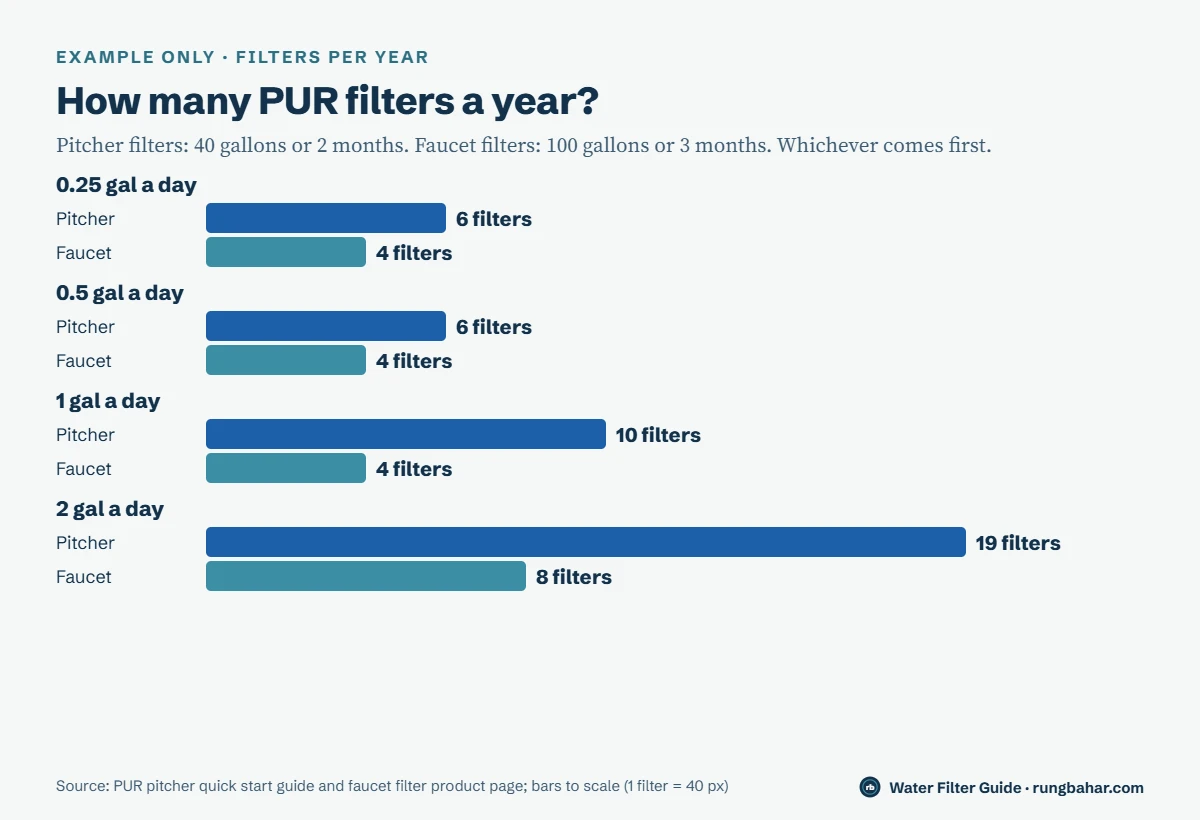
As an example only, a household that filters 1 gallon a day for drinking and cooking uses about 365 gallons a year. That is about 10 pitcher filters a year (365 ÷ 40, rounded up) or 4 faucet filters. A single person filtering half a gallon a day hits the time limit first: 6 pitcher filters or 4 faucet filters a year. At 2 gallons a day, a pitcher needs about 19 filters a year, which is usually the point where a faucet filter makes more sense. Multiply your own count by the price you see for the pack size you would buy; we do not quote prices because they change weekly.
PUR pitchers with an electronic light count pours and flash red when it is time to change. Reset the light every time you fit a new filter, or the count will be wrong. Water temperature matters too: PUR rates its filters for water between 34°F and 82°F, so never run hot water through them.
Marketing claims vs certified claims
PUR’s packaging and press releases use a few big phrases. Here is what each one rests on.
- “First and only” filter certified for lead, microplastics and total PFAS. PUR’s September 2026 release makes this claim for pitchers, dispensers and faucet mounts. We have not checked every brand’s listing, so we cannot confirm “only”. What we can confirm is that the PUR PLUS data sheets show all three claims, certified by IAPMO R&T.
- “Reduces 70 contaminants” (faucet filter). This is plausible on the data sheet: the volatile organic chemical claim alone covers about 50 compounds tested together, plus 14 pharmaceuticals and chemicals under NSF/ANSI 401, lead, mercury, PFAS, microplastics and chlorine. A long list of chemicals you are unlikely to have is less useful than the three or four that matter for your water.
- “5 times more contaminants than the leading pitcher filter.” PUR bases this on the number of contaminants certified, compared with an unnamed rival. Treat it as marketing. The useful comparison is contaminant by contaminant, which is what our tables do.
- “Mineral Core.” PUR says the faucet filter runs water over natural minerals for taste. It is not a certified claim and it says nothing about how much calcium or magnesium ends up in your glass.
The rule we use for every brand: a claim counts if it appears on the performance data sheet with a standard, a test concentration and a result, and the model is in a certifier’s listing. Our guide to checking whether a filter is really certified shows how to look a model up in the IAPMO R&T, NSF and WQA directories.
Is PUR the right filter for you?
PUR is a good fit if your concern is lead, PFAS, microplastics or the taste of city water, and you use the right model. It is the wrong tool for anything on the right-hand side of the chart below.
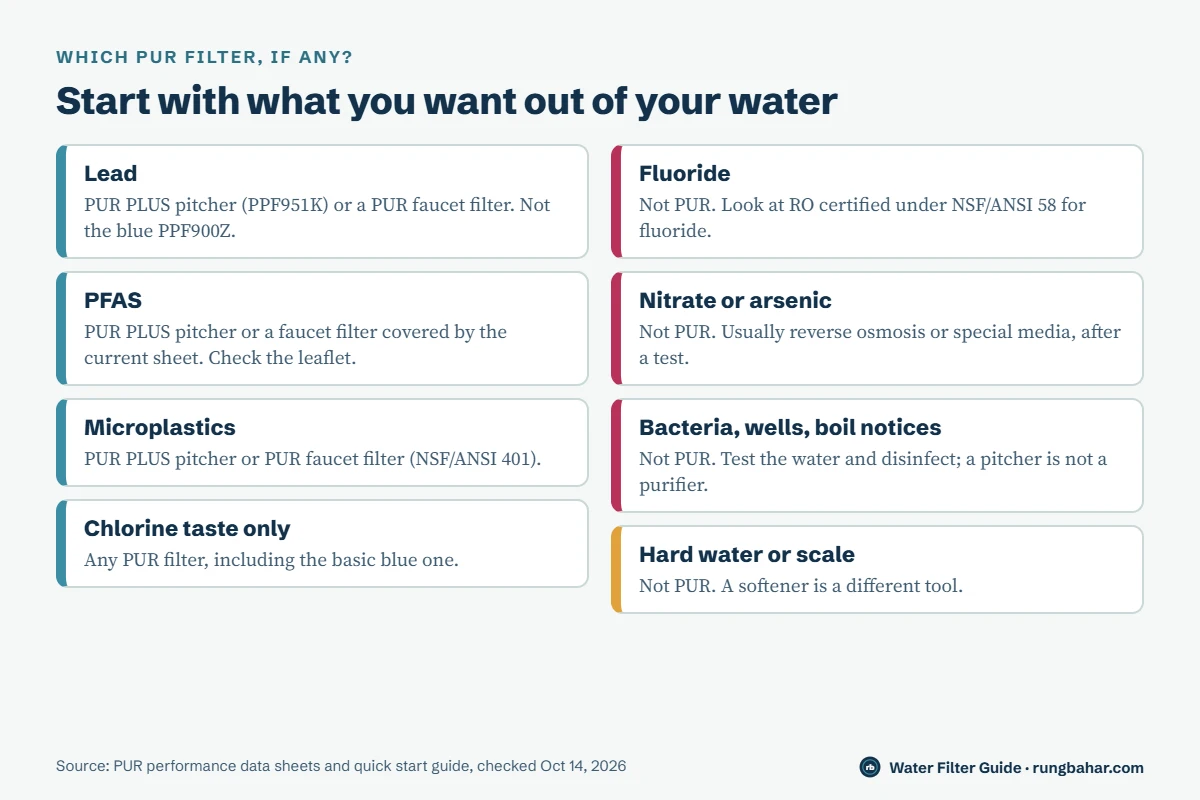
- Good fit: city water with lead service lines or old plumbing (as a stopgap), a utility report that shows PFAS, chlorine taste, renters who cannot install anything under the sink.
- Pick the model carefully: PUR PLUS pitcher filters (PPF951K) or faucet filters, not the blue PPF900Z, for any health claim.
- Not the right tool: fluoride removal, nitrate or arsenic, untested well water, a boil-water notice, hard water and scale.
Lead + PFAS + microplastics
PUR PLUS pitcher and dispenser filter (PPF951K)
- Certification: NSF/ANSI 42, 53 (lead, total PFAS) and 401 (microplastics), IAPMO R&T
- Best for: One pitcher filter covering lead, PFAS and microplastics
- Skip if: you hate changing filters (40 gallons or 2 months)
More water, fewer changes
PUR faucet filter (RF-9999 or RF3375)
- Certification: NSF/ANSI 42, 53 (lead, total PFAS, VOCs) and 401, IAPMO R&T
- Best for: Households filtering 1 to 2 gallons a day or more
- Skip if: your faucet is a pull-down or sprayer type (check PUR’s compatibility notes)
How to check your own PUR filter in two minutes
- Find the model number on the filter or box: PPF900Z, PPF951K, RF-9999 or RF3375.
- Open PUR’s performance data sheet page and match the model. Look for the contaminant you care about, the standard (42, 53 or 401) and the result.
- For PFAS on a faucet filter, check that the leaflet in your box lists total PFAS. If it does not, you may have older stock covered by the 2025 sheet.
- Confirm the model in the IAPMO R&T listing directory, which is the certifier named on the sheets.
- Note the rated life and set a reminder, or reset the filter light when you change it.
Not sure a pitcher or faucet filter is the right type at all? Answer three questions in the filter finder, check what your utility reports with the ZIP code tap-water check, or see how the two biggest pitcher brands compare in Brita vs PUR.
PUR filters: 14 common questions, answered
These are the questions people search most about what PUR filters remove, answered from PUR’s data sheets.
Does PUR remove lead?
Yes, if it is a PUR PLUS pitcher filter (PPF951K) or a PUR faucet filter (RF-9999 or RF3375). Both are certified under NSF/ANSI 53 to reduce lead from 150 ppb to 5 ppb or less. The basic blue PUR pitcher filter (PPF900Z) is not certified for lead.
Does PUR remove PFAS?
The PUR PLUS pitcher filter is certified for total PFAS at 99.75 percent and PUR’s faucet filters at 99.92 percent under NSF/ANSI 53. The blue PPF900Z has no PFAS claim, and faucet filters from older stock may come with a 2025 leaflet that does not list PFAS.
Does PUR remove fluoride?
No. No PUR data sheet lists fluoride, PUR’s pitcher guide says the filter does not remove it, and the ADA Seal for PUR pitcher and faucet filters is based on not removing fluoride.
Does PUR remove chlorine?
Yes. Every current PUR filter is certified under NSF/ANSI 42 to reduce chlorine taste and odor: 97.5 percent for the pitcher filters and 98.71 percent for the faucet filters.
Does PUR remove chloramine?
No PUR data sheet has a chloramine claim. Chloramine needs a filter certified for it, usually one with catalytic carbon.
Does PUR remove microplastics?
Yes for the PUR PLUS pitcher filter (99.8 percent) and the faucet filters (99.65 percent), certified under NSF/ANSI 401. The blue PPF900Z has no microplastics claim.
Does PUR remove nitrates?
No. Nitrate is not listed on any PUR data sheet. For nitrate, look at reverse osmosis certified for it, and test the water after treatment.
Does PUR remove arsenic?
No. Arsenic is not listed on any PUR data sheet. Arsenic usually needs reverse osmosis or special media, chosen after a lab test that shows which form of arsenic you have.
Does PUR remove minerals or calcium?
PUR makes no certified claim either way, and no PUR filter is a water softener. One independent review lab test of the PUR PLUS pitcher reported lower calcium and magnesium and higher sodium, but that is a single test on one water source.
Does PUR remove bacteria?
No. PUR says its filters do not filter microbes and must not be used on unsafe water or water of unknown quality without disinfection.
What is the difference between the PUR and PUR PLUS pitcher filters?
The PUR PLUS filter (PPF951K) is certified for lead, total PFAS, microplastics and more chemicals. The basic PUR filter (PPF900Z) covers chlorine taste and some metals and chemicals, but not lead, PFAS or microplastics. Both are rated for 40 gallons and fit the same pitchers.
Is PUR NSF certified?
PUR’s current filters are certified to NSF/ANSI standards 42, 53 and 401 by IAPMO R&T, an accredited certifier. A listing from IAPMO R&T counts the same as one from NSF; the standard is what matters.
How often should I change a PUR filter?
Pitcher and dispenser filters every 40 gallons or 2 months, whichever comes first. Faucet filters every 100 gallons or about 3 months. The certified claims only apply within those limits.
Is PUR better than Brita?
On certified claims, the PUR PLUS pitcher filter covers lead, total PFAS and microplastics, while the Brita Elite covers lead and microplastics but lasts three times longer. Our Brita vs PUR comparison has the full tables.
Sources and how we checked this page
Every claim on this page comes from PUR’s performance data sheets, its pitcher quick start guide and product pages, PUR’s September 2026 announcement, the American Dental Association’s Seal listings, a Michigan health department leaflet and the US EPA, checked on October 14, 2026. We do not test filters in a lab, and we have no commercial relationship with PUR. Data sheets change, so check the one for the exact filter you buy.
- PUR: Performance data sheets (all current models)
- PUR: Performance data sheet, PUR PLUS pitcher filter PPF951K (PDF)
- PUR: Performance data sheet, PUR pitcher filter PPF900Z (PDF)
- PUR: Performance data sheet, PUR PLUS faucet filter RF-9999 (PDF)
- PUR: Performance data sheet, PUR faucet filter RF3375 (PDF)
- PUR: Legacy faucet filter data sheet, September 2025, no PFAS claim (PDF)
- PUR: Pitcher quick start guide (fluoride, filter life, microbes) (PDF)
- PUR: PUR PLUS Mineral Core faucet filter product page
- PUR via GlobeNewswire: PUR PLUS certified to reduce lead, microplastics and total PFAS (Sept 15, 2026)
- American Dental Association: Seal of Acceptance, PUR pitcher/dispenser filter
- American Dental Association: Seal of Acceptance, PUR faucet mount filter
- Michigan MiLeadSafe: How to use your PUR faucet filter (PDF)
- US EPA: Consumer tool for identifying filters certified to reduce lead
- US EPA: Reducing PFAS in your drinking water with a home filter (PDF)
- Water Filter Guru: PUR PLUS pitcher lab test (minerals, 2025)
- IAPMO R&T product listing directory