Updated October 13, 2026, by the RB Water Desk. How we research.
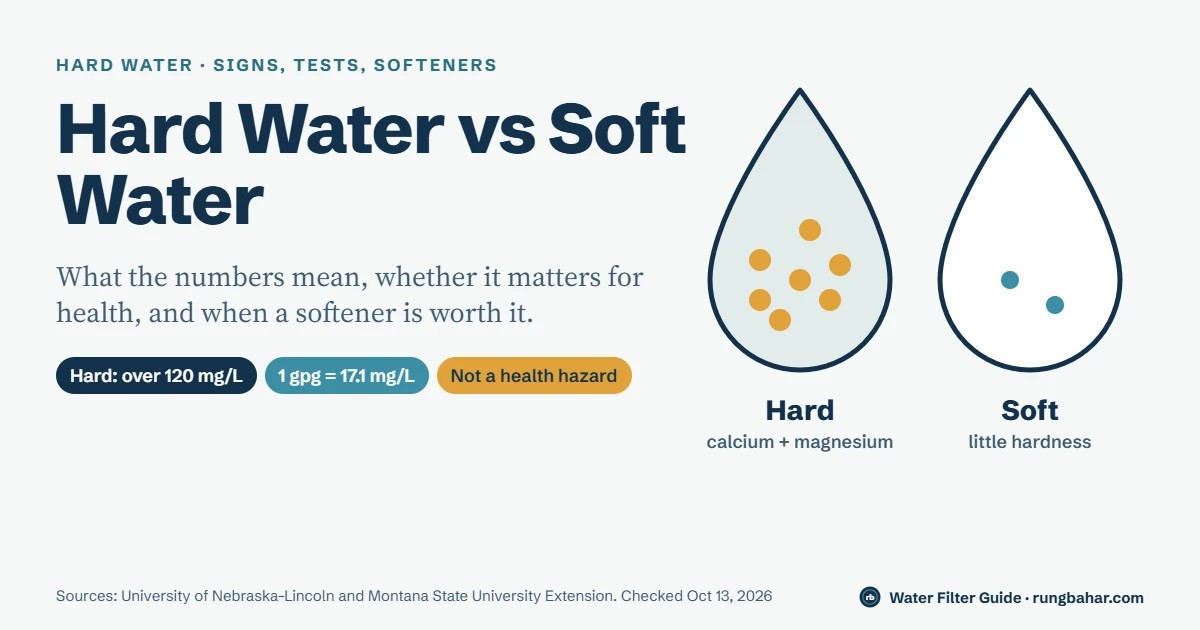
The short answer: Hard water has a lot of dissolved calcium and magnesium; soft water has little. Water over about 120 mg/L (7 grains per gallon) is classed as hard, and over 180 mg/L (10.5 gpg) as very hard. Hard water is not a health hazard, and it is fine to drink. Its problems are practical: scale in kettles, water heaters and fixtures, spots on dishes, and soap that will not lather. A water softener is usually worth it once hardness passes about 7 to 10 gpg and scale is costing you, but softened water carries extra sodium, so many homes keep one unsoftened tap for drinking.
Quick check: how hard is my water?
1. Which unit is your number in?
2. Your hardness number
What makes water hard or soft
Water picks up minerals as it moves through soil and rock. Where it passes through limestone, chalk or gypsum, it dissolves calcium and magnesium, and those two minerals are what “hardness” measures. Water from granite or sandstone areas, or from rain-fed reservoirs, tends to be soft.
Hardness is usually reported as milligrams per liter of calcium carbonate (mg/L as CaCO₃), even though the water contains calcium and magnesium in other forms. Softener makers often use grains per gallon (gpg) instead. The conversion is simple: 1 gpg equals 17.1 mg/L. So 10 gpg is 171 mg/L, and 180 mg/L is about 10.5 gpg.
Soft water is simply water with little calcium and magnesium. It can be naturally soft, or softened in the home by an ion exchange softener, which swaps the calcium and magnesium for sodium or potassium. That difference matters later: naturally soft water and softened water are not the same thing.
Hardness levels: the scale in mg/L and gpg
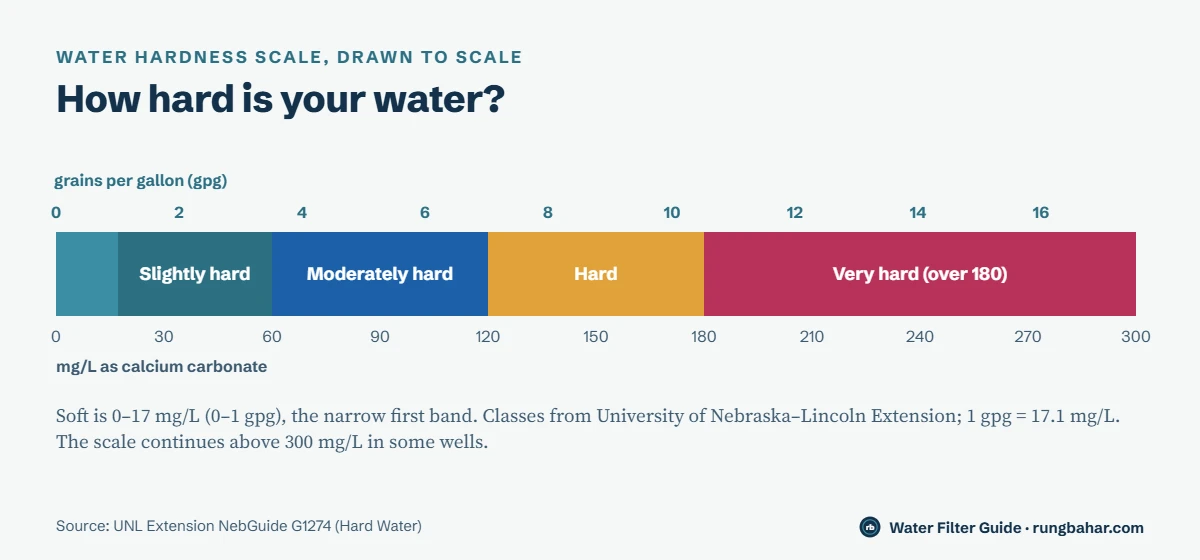
There is no federal hardness limit; the EPA does not regulate hardness in drinking water. University extension services use similar scales. This is the one published by the University of Nebraska–Lincoln Extension:
| Classification | mg/L as calcium carbonate | Grains per gallon | What you usually notice |
|---|---|---|---|
| Soft | 0–17 | 0–1 | Nothing; soap lathers easily |
| Slightly hard | 17–60 | 1–3.5 | Very little |
| Moderately hard | 60–120 | 3.5–7 | Some spotting, slow kettle scale |
| Hard | 120–180 | 7–10.5 | Scale on fixtures, soap scum, spots |
| Very hard | Over 180 | Over 10.5 | Heavy scale, crusted aerators, short appliance life |
Montana State University uses slightly different cut-offs, calling 121 to 300 mg/L hard and anything above 300 very hard. The labels vary between sources, but the practical point is the same: somewhere above about 120 mg/L (7 gpg), most households start to notice and pay for the effects.
Signs you have hard water
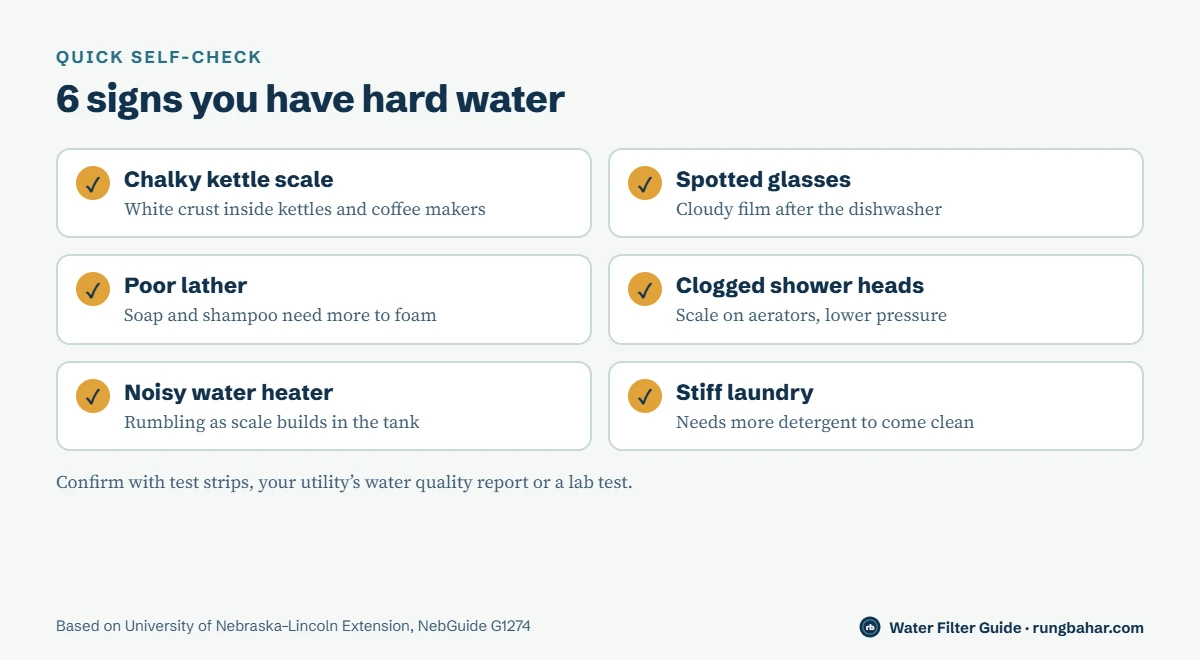
You do not need a test to suspect hard water. The common signs are:
- White, chalky scale inside the kettle, on shower heads and around faucet bases.
- Spots or a cloudy film on glasses and dishes after the dishwasher.
- Soap and shampoo that lather poorly, and a sticky “soap curd” ring in the tub.
- Faucet aerators and shower heads that clog and lose pressure.
- Water heaters that rumble or lose efficiency as scale builds up at the bottom of the tank.
- Laundry that feels stiff and needs more detergent.
The University of Nebraska explains the mechanism: soap combines with calcium and magnesium to form soap curd, so you need more soap or detergent, and heated hard water forms scale that can reduce the efficiency of water-using appliances or make them fail. Signs of soft water are the opposite: rich lather, a slippery feel when rinsing, and no scale.
How to test your water hardness
- City water: check your utility’s annual water quality report (Consumer Confidence Report). Hardness is often listed with the secondary or “other” results, sometimes in mg/L and sometimes in gpg. The ZIP code tap-water check on our homepage helps you find it.
- Test strips: inexpensive hardness strips give a good estimate in under a minute. Dip, wait, compare the color.
- Lab test: for a private well, a lab test is more accurate and should be part of a broader test for bacteria, nitrate and arsenic. Our well water results guide explains how to read it.
- Not a TDS meter: a TDS meter measures all dissolved minerals together, not hardness. A high TDS reading often means hard water, but sodium, chloride or sulfate can raise it too. See what a TDS reading means.
Once you have a number, put it in the quick check at the top of this page to see the class, the conversion and what softening would add.
Is hard water bad for you?
No. The University of Nebraska–Lincoln Extension states plainly that hard water is not a health hazard. Calcium and magnesium are nutrients, and hard drinking water contributes a small share of both to the diet. Some studies have linked harder water with lower rates of cardiovascular disease, but both Nebraska and Montana State describe the evidence as limited, and no firm conclusion has been drawn. Hard water is safe to drink, and some people prefer its taste.
The real costs of hard water are financial and practical: more soap and detergent, more cleaning, and shorter life for water heaters, kettles, dishwashers and fixtures. That is the case for softening, not health.
Hard water vs soft water for skin and hair
This is one of the most searched hardness questions, and the evidence is weaker than the marketing. The largest trial is the Softened Water Eczema Trial (SWET), published in PLOS Medicine in 2011. It installed ion exchange softeners in the homes of 336 children with moderate to severe eczema and compared them with children on usual care. After 12 weeks, eczema severity improved by about the same amount in both groups. Families with a softener felt it had helped, but observers who did not know which homes had one saw no difference.
Hard water does leave soap residue on skin and hair, which some people find makes hair feel dull or skin feel dry, and soft water rinses more cleanly. That is a comfort question, not a medical one. If you are buying a softener mainly for eczema, the best available trial says not to expect a medical benefit. If you want softer-feeling hair and less soap scum, a softener or a shower filter that targets those effects is a reasonable comfort purchase.
What soft water changes, and the sodium question
An ion exchange softener pulls calcium and magnesium onto resin beads and releases sodium in their place (or potassium, if you use potassium chloride instead of salt). The benefits are immediate: no new scale, better lather, cleaner glassware and less detergent.
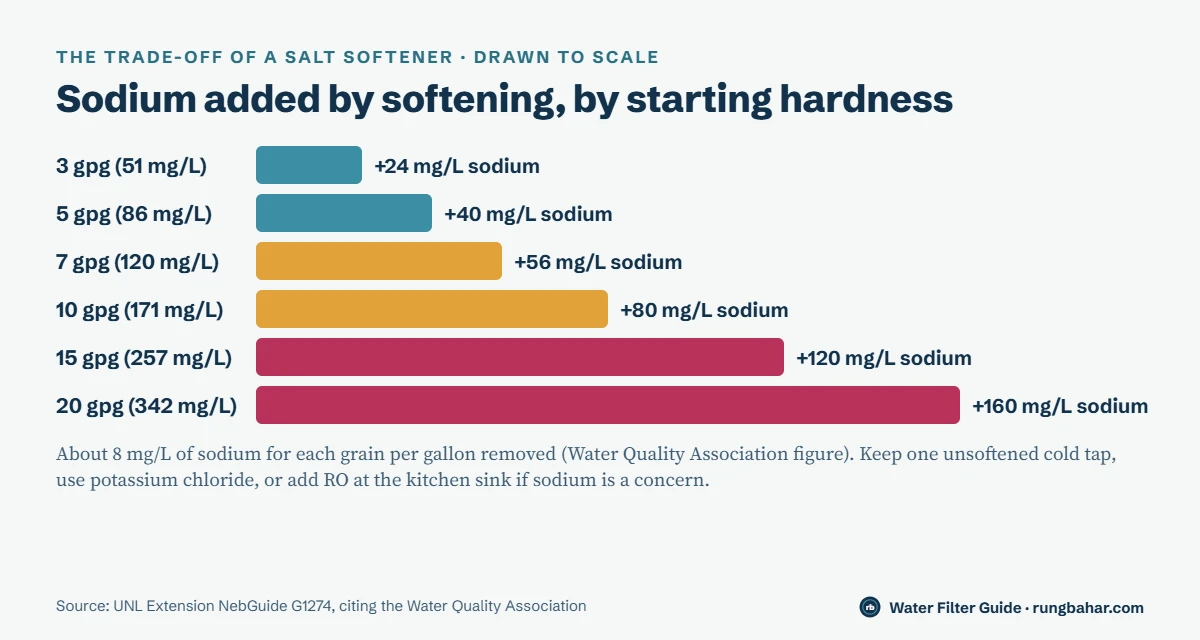
The trade-off is sodium. According to the Water Quality Association figure quoted by Nebraska Extension, softening adds roughly 8 mg of sodium per liter for every grain per gallon of hardness removed. Water at 10 gpg ends up with about 80 mg/L of added sodium; water at 20 gpg, about 160 mg/L. For most people that is a small part of daily sodium intake, but anyone on a doctor-ordered low-sodium diet should ask about it.
There are three common fixes, all recommended by extension services:
- Leave one cold line unsoftened, usually to the kitchen sink, for drinking and cooking.
- Use potassium chloride instead of sodium chloride in the brine tank. It costs more but adds potassium, not sodium.
- Add a reverse osmosis system at the kitchen tap, which removes most of the sodium. Montana State notes that RO can remove sodium and ease concerns about high sodium intake. See what reverse osmosis removes.
One more practical note: softeners do not lower total dissolved solids much, because sodium replaces the hardness minerals. If your goal is lower TDS, a softener is the wrong tool.
When is a water softener worth it?
There is no official threshold, so here is a practical way to decide:
| Your hardness | Usually worth softening? | Why |
|---|---|---|
| Under 3.5 gpg (60 mg/L) | No | Too little hardness to cause scale |
| 3.5–7 gpg (60–120 mg/L) | Rarely | Descaling and rinse aid usually cope |
| 7–10.5 gpg (120–180 mg/L) | Often | Scale starts to cost money in heaters and appliances |
| Over 10.5 gpg (180 mg/L) | Usually yes | Heavy scale, more soap, shorter appliance life |
| Any level, private well with iron | Test first | Iron and manganese change what equipment you need |
Hardness is only part of the decision. Weigh the household size, how much hot water you use, whether you are on a septic system (Montana State notes potassium is an option where sodium can harm clay-soil drainfields), and the yearly cost of salt and regeneration water. If you decide to soften, size the unit properly: our water softener size calculator turns your hardness and household size into a grain capacity.
Worked example: softening a home at 15 gpg
Numbers make the trade-offs concrete. As an example only, take a family of four on city water with a reported hardness of 257 mg/L, which is 15 gpg and clearly “very hard.”
- Daily hardness load: if the household uses about 300 gallons a day (an illustrative 75 gallons per person), the softener has to remove about 4,500 grains a day (300 × 15). That is the number a softener is sized from; our calculator uses your own household size and hardness.
- Sodium: at about 8 mg/L per grain removed, softened water would carry roughly 120 mg/L of added sodium. A 2-liter daily drinking habit would add about 240 mg of sodium, so this family might keep the kitchen cold tap unsoftened or add RO there.
- What they gain: no new scale in the water heater, dishwasher and kettle, much less soap and detergent, and fixtures that stay clear.
- What it costs: the unit, salt or potassium chloride, the water used to regenerate the resin, and occasional service. Compare that with the cost of descaling, replacement aerators and shorter appliance life at 15 gpg.
At 4 gpg the same family would have about one quarter of the scale problem and a quarter of the added sodium, and for many homes the softener would not pay for itself. This is why the hardness number should come first and the purchase second.
Hard water and your water heater, kettle and appliances
Scale forms fastest where water is heated, so the water heater takes the worst of it. A layer of scale at the bottom of a tank heater sits between the burner or element and the water, and Nebraska Extension notes that scale can reduce the efficiency of water-using appliances or cause them to fail. Common signs are popping or rumbling sounds as the heater runs and longer waits for hot water.
If you are not softening, regular maintenance limits the damage: flush the tank heater as the manufacturer’s manual recommends, descale kettles and coffee makers with a citric acid or vinegar solution, soak shower heads and aerators, and use a rinse aid in the dishwasher. If you do soften, keep the brine tank topped up and the regeneration setting matched to your hardness, or the scale returns.
Options other than a softener
- Salt-free conditioners (template-assisted crystallization) aim to stop scale forming without removing hardness and without adding sodium. They do not make water soft, so you keep the minerals and the soap behavior. We compare them in salt-free vs salt softeners.
- Point-of-use fixes: a shower filter, a descaling routine for the kettle and coffee maker, and a dishwasher rinse aid handle much of the nuisance at low cost.
- Reverse osmosis for drinking water: lowers hardness and almost everything else at one tap, but does nothing for the water heater or showers.
- Do nothing: at moderate hardness, many households simply descale a few times a year.
Still deciding what to buy? The filter finder matches your main concern to a treatment type in about 15 seconds, and how to choose a water filter walks through the full decision.
Hard water vs soft water: 14 common questions, answered
These are the questions people search most about hard and soft water, answered from university extension and peer-reviewed sources.
What is the difference between hard water and soft water?
Hard water has high levels of dissolved calcium and magnesium; soft water has little. Water over about 120 mg/L (7 gpg) of hardness is usually classed as hard.
Is hard water or soft water better to drink?
Both are safe. Hard water is not a health hazard and adds a little calcium and magnesium. Softened water carries added sodium, so many homes keep one unsoftened tap for drinking.
Is hard water bad for you?
No. University extension services state that hard water is not a health hazard. Its problems are scale, soap scum and wear on appliances.
Is hard water bad for your hair?
Hard water can leave soap and mineral residue that makes hair feel dull, but there is little strong evidence of lasting harm. Softer water rinses more cleanly.
Is hard water bad for your skin or eczema?
The 2011 SWET trial of 336 children found that installing a water softener did not reduce eczema severity compared with usual care.
How can I tell if I have hard or soft water?
Scale in the kettle, spots on glasses and poor soap lather point to hard water. Confirm with test strips, your utility’s water quality report or a lab test.
What hardness level needs a water softener?
There is no official level. Many homes find a softener worth it above about 7 to 10 gpg (120 to 180 mg/L), especially where scale is damaging the water heater or appliances.
How do I convert grains per gallon to mg/L?
Multiply grains per gallon by 17.1. For example, 10 gpg equals 171 mg/L as calcium carbonate.
How much sodium does a water softener add?
About 8 mg per liter for every grain per gallon removed, according to the Water Quality Association. Water at 10 gpg gains about 80 mg/L of sodium.
Is softened water safe to drink?
For most people, yes. People on a low-sodium diet should ask their doctor, use potassium chloride, or keep an unsoftened or reverse osmosis tap for drinking.
Does a water softener remove contaminants like lead or PFAS?
No. A softener removes hardness minerals. For lead, PFAS or other contaminants you need a filter certified for them.
Is hard water better for plants?
Most plants tolerate hard water. Softened water is a poor choice for watering because of the added sodium.
Is hard water acidic or alkaline?
Hard water is usually neutral to slightly alkaline because the calcium and magnesium often come with carbonate and bicarbonate.
Does boiling water make it soft?
Boiling removes some “temporary” hardness, which drops out as kettle scale, but not all of it. It is not a practical way to soften household water.
Sources and how we checked this page
Every claim on this page comes from university extension publications, the US EPA and a peer-reviewed trial, checked on October 13, 2026. We did not test water or softeners ourselves. This page is general information, not medical advice.
- University of Nebraska–Lincoln Extension: Hard Water (Calcium and Magnesium), NebGuide G1274 (PDF)
- Montana State University Well Educated: Hardness fact sheet
- Thomas et al. (2011), PLOS Medicine: ion-exchange water softeners for eczema in children (SWET)
- University of Nottingham: Water softeners not found to improve childhood eczema (2011)
- US EPA: secondary drinking water standards
- US EPA: Consumer Confidence Reports (find your water quality report)