Published October 10, 2026. Every claim is checked against the sources listed at the end of this page. How we research.
The short answer: Multiply the number of people in your home by the gallons each uses a day, then by your hardness in grains per gallon. That is the hardness load the softener has to remove daily. Multiply by seven and you have the capacity a unit needs to carry a week between regenerations. For a four-person household at 80 gallons each and 10 grains per gallon, that is 3,200 grains a day and 22,400 a week, which is why 24,000 and 32,000 grain units are the common sizes. The calculator below does the arithmetic with your own numbers.
Softener size calculator
Your numbers, and the size they point to
The three numbers that decide the size
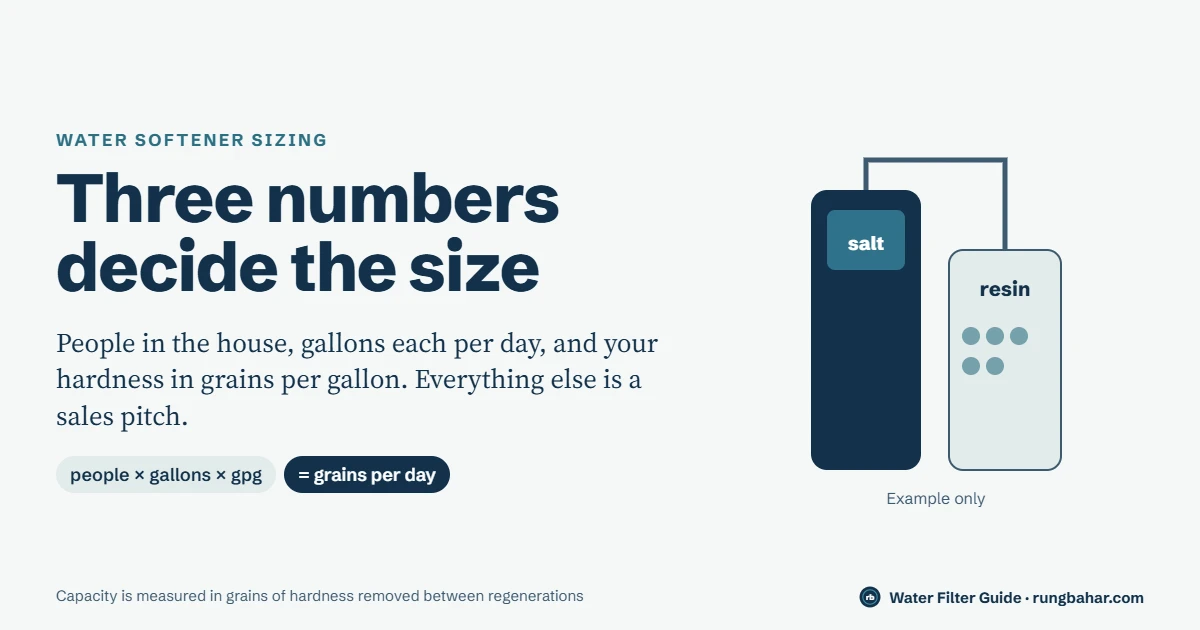
Softener sizing sounds technical and is not. A softener holds a bed of resin that swaps the calcium and magnesium in your water for sodium or potassium. The bed has a finite capacity, measured in grains of hardness, and when it is used up the unit regenerates with brine and starts again. Sizing is the question of how big that bed should be so it regenerates at a sensible interval.
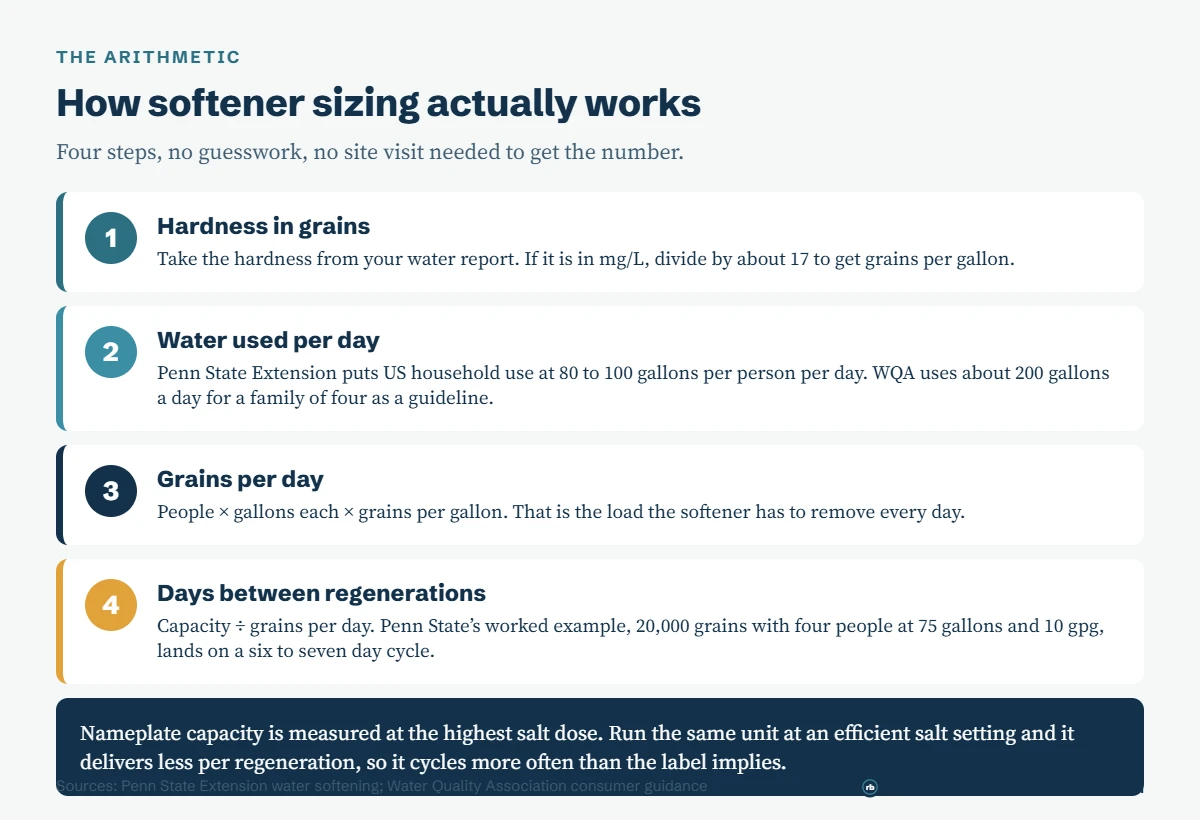
Three numbers get you there: how many people live in the house, how many gallons each uses a day, and how hard the water is in grains per gallon. Penn State Extension sets out the same arithmetic in reverse, dividing capacity by daily use to get the regeneration interval: 20,000 grains, four people, 75 gallons each, 10 grains per gallon, which lands on a six to seven day cycle.
Everything beyond those three numbers, valve brands, resin types, warranty tiers, is a conversation about quality and price, not about size.
Getting your hardness right
Use a number from a lab or a utility report rather than a dealer’s free test. Both are usually honest, but only one of them is independent of a sale.
If your report gives hardness in mg/L as calcium carbonate, divide by about 17 to get grains per gallon. The USGS classification helps you sanity-check the result: up to 60 mg/L is soft, 61 to 120 moderately hard, 121 to 180 hard, and above 180 very hard. In grains, that is roughly 3.5, 7 and 10.5 as the boundaries. Most homes that install a softener are somewhere between 7 and 25 grains per gallon.
Private well owners should take the hardness number from the same lab report that covers the health-based results, and read the rest of it properly while they are there. Our guide to reading well water test results covers what the other rows mean, and hardness is one of the few lines on that report with no health limit attached at all.
Your daily grain load
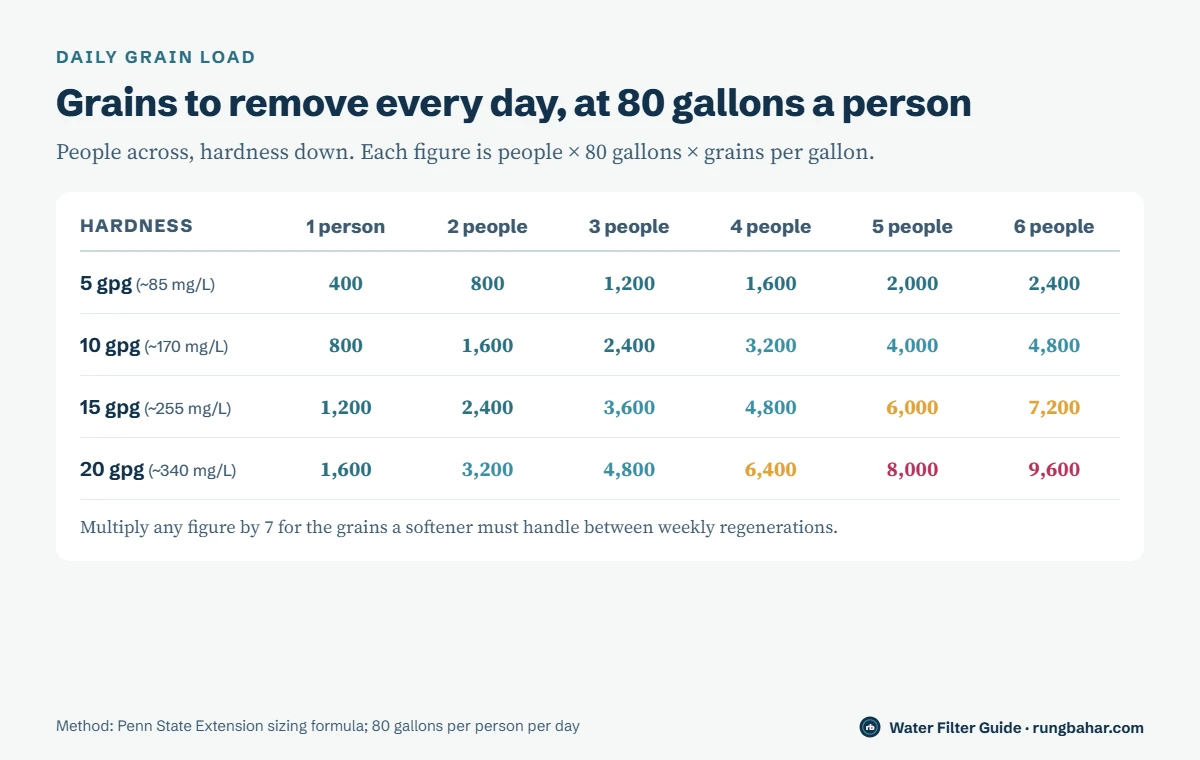
Multiply people by gallons by grains per gallon. Penn State Extension puts US household use at 80 to 100 gallons per person per day, and the Water Quality Association uses about 200 gallons a day for a family of four as its guideline, so anything in that range is defensible. If your household is careful with water, 60 is realistic; if you have teenagers and a long shower habit, use 100.
A few worked examples at 80 gallons a person:
- Two people at 7 grains per gallon: 1,120 grains a day, 7,840 a week.
- Four people at 10 grains per gallon: 3,200 grains a day, 22,400 a week.
- Four people at 20 grains per gallon: 6,400 grains a day, 44,800 a week.
- Six people at 15 grains per gallon: 7,200 grains a day, 50,400 a week.
That last column is the one that matters. A softener is normally sized so it can carry about a week of load between regenerations, which is where the familiar 24,000, 32,000 and 48,000 grain ratings come from.
Turning grains into a capacity
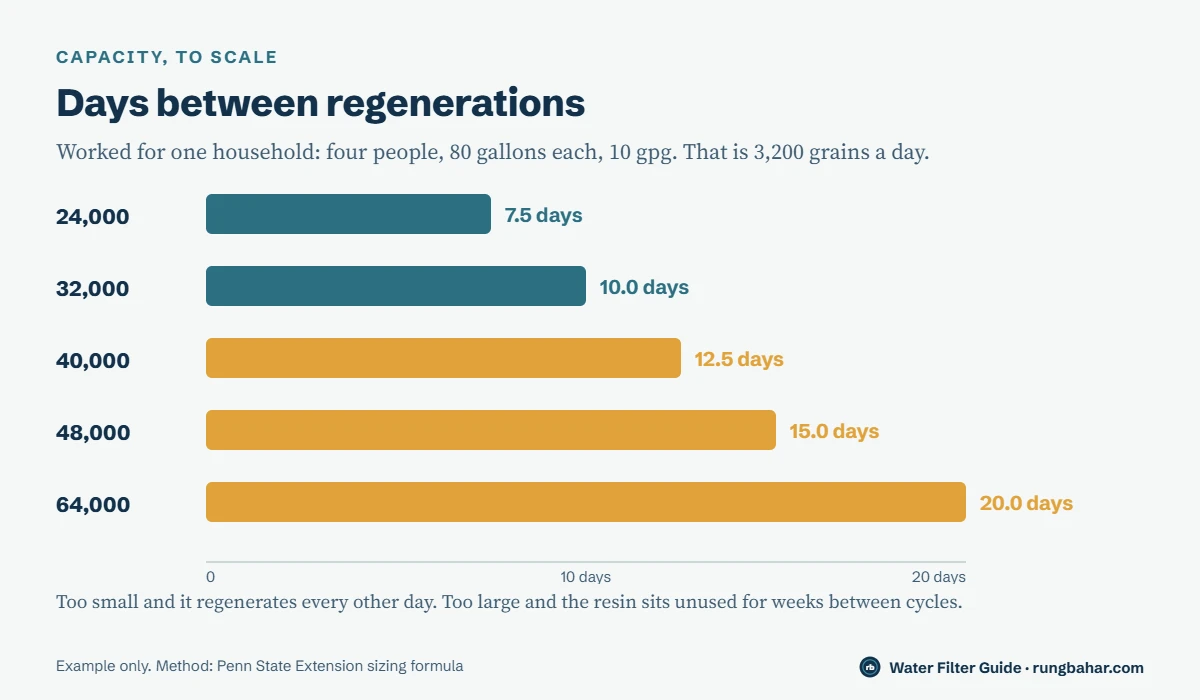
Divide the capacity you are considering by your daily load and you get the regeneration interval in days. For the four-person, 10 grain household using 3,200 grains a day: a 24,000 grain unit regenerates every 7.5 days, a 32,000 every 10, a 48,000 every 15.
There is one wrinkle worth knowing before a dealer explains it to you. The nameplate capacity on a softener is measured at its highest salt dose. Run the same unit at an efficient salt setting and each regeneration delivers less than the nameplate, so the real interval is shorter than the simple division suggests. That is not a defect; it is the trade-off between salt use and capacity, and it is why two units with the same number on the box can behave differently.
The practical target is a cycle of roughly three to ten days. Faster than that and you are regenerating constantly, using salt and water on overhead. Much slower and the resin bed sits idle between cycles.
Why oversizing is not free
The instinct is to buy big and never think about it again. It is the wrong instinct for three reasons.
A bigger unit costs more up front, takes more floor space, and needs a larger brine tank. Each regeneration on a larger bed also uses more salt and more water than a smaller one, so if the control valve is set by days rather than by metered use, you pay for capacity you never touched. And a bed that sits unused for two or three weeks between cycles is not doing anything useful in the meantime.
The other half of the mistake is undersizing to save money, then running the unit at a high salt dose to compensate. That gets you through the week at the cost of salt, water and resin life. Size for the load, then pick the efficiency setting.
Salt and water efficiency
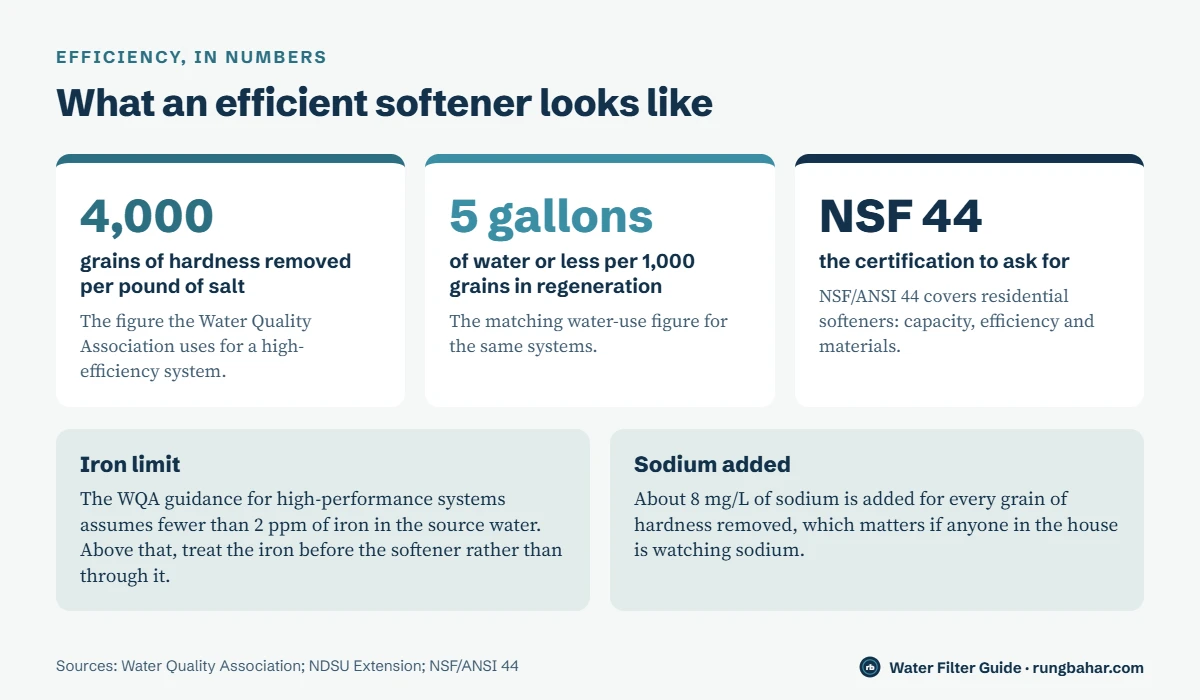
Efficiency has published numbers, which makes it one of the easier things to hold a dealer to. The Water Quality Association describes high-efficiency systems as removing 4,000 grains of hardness per pound of salt while using no more than five gallons of water per 1,000 grains during regeneration, and says equipment should be tested and certified to NSF/ANSI Standard 44.
Those two figures turn into a running cost you can estimate before you buy. The four-person household above removes 22,400 grains a week, so at 4,000 grains per pound that is about 5.6 lb of salt a week, and at five gallons per 1,000 grains it is about 112 gallons of water a week going to the drain. Those numbers are worth asking for in writing, because a cheap unit at half that efficiency costs you twice the salt every week for as long as you own it.
Two more points from the same source. Metered valves, which regenerate based on water actually used rather than on a timer, avoid regenerating a bed that is still half fresh. And about 8 mg/L of sodium is added to the water for each grain of hardness removed, which matters if anyone in the house is watching sodium intake. Many households soften the hot water and the laundry lines and leave the kitchen cold tap unsoftened, or put a reverse osmosis unit at the kitchen sink, which also deals with the contaminants a softener does nothing about.
The default sensible choice
Metered softener, sized to your load
- Certification: NSF/ANSI 44, with the rated capacity and efficiency stated
- Best for: Most homes between 7 and 25 grains per gallon
- Skip if: iron is over 2 ppm and untreated
Well water with staining
Iron filter ahead of the softener
- Certification: ask for performance data for your iron level and form
- Best for: Orange staining, iron above the 0.3 mg/L guidance
- Skip if: the lab found no iron at all
Drinking water, separately
Reverse osmosis at the kitchen tap
- Certification: NSF/ANSI 58 naming the contaminants you care about
- Best for: Households that want softened water but unsoftened-tasting drinking water
- Skip if: hardness is your only complaint
Iron, and when a softener is the wrong tool
A softener is an ion exchange device. It is built for calcium and magnesium, and it copes with small amounts of dissolved iron as a side effect. The WQA’s efficiency guidance assumes source water with fewer than 2 parts per million of iron, and that is a reasonable line to hold.
Above that, or where the iron has already oxidised into rust particles before it reaches the unit, the resin fouls. A fouled bed loses capacity, and the symptom is a softener that suddenly stops keeping up despite the same settings. The fix is an oxidising filter ahead of the softener, sized to the iron level, rather than a bigger softener.
Two other things a softener does not do: it does not remove lead, PFAS, nitrate or bacteria, and it does not make water safe that was not safe before. If your test flagged anything health-based, treat that separately and first. Our lead guide and the certification explainer cover what each claim actually proves.
What to ask before you buy
Five questions, all answerable in writing, that separate a fair quote from a sales pitch.
- What is the rated capacity, and at what salt dose? A capacity figure without the salt dose behind it means little.
- Is it certified to NSF/ANSI 44, and what is the efficiency rating? Compare against 4,000 grains per pound of salt.
- Is the valve metered or on a timer? Metered regeneration tracks real use and wastes less.
- What is the expected salt and water use per week for my hardness and household? You can check their answer against your own calculation above.
- What happens with my iron level? If iron is present, ask what pre-treatment they are proposing and why.
If you are still working out whether a softener is the right purchase at all, hardness is a comfort and appliance-life question rather than a health one, and the five-step buying guide puts it in order against everything else your water might need. The ZIP tap-water check is the quickest route to your utility’s hardness figure if you are on city water.
Water softener sizing: 14 common questions
Short answers to what people search most. Each one matches the sources listed at the bottom of this page.
What size water softener do I need for a family of 4?
Multiply 4 people by about 80 gallons a day by your hardness in grains per gallon. At 10 grains per gallon that is 3,200 grains a day, or 22,400 a week, which points at a 24,000 or 32,000 grain unit. At 20 grains per gallon the same household needs roughly double that.
How do I convert mg/L hardness to grains per gallon?
Divide by about 17. So 170 mg/L is about 10 grains per gallon, and 340 mg/L is about 20. Softeners are sized in grains, so the conversion is the first step in every sizing calculation.
How many grains per gallon is hard water?
Using the USGS classification, up to about 3.5 grains per gallon is soft, 3.5 to 7 is moderately hard, 7 to 10.5 is hard and above 10.5 is very hard. Most households that install a softener are above 7.
How often should a water softener regenerate?
Roughly every three to ten days for most homes. Much more often and you are spending salt and water on overhead; much less often and the resin bed sits idle between cycles.
Is a bigger water softener always better?
No. A larger unit costs more, takes more space, and uses more salt and water per regeneration. If the valve regenerates on a timer rather than on metered use, you pay for capacity you never used.
How much salt should a water softener use?
The Water Quality Association describes high-efficiency systems as removing 4,000 grains of hardness per pound of salt. Divide your weekly grain load by 4,000 for a realistic weekly salt figure, and treat anything far above that as an efficiency problem.
How much water does a softener waste?
High-efficiency systems use no more than five gallons of water per 1,000 grains removed during regeneration, by the WQA figure. For a household removing 22,400 grains a week, that is around 112 gallons a week.
What does NSF/ANSI 44 certify?
It is the standard for residential cation exchange water softeners, covering capacity, efficiency and materials. Asking whether a unit is certified to it, and what efficiency rating it earned, is the cleanest way to compare quotes.
Will a water softener remove iron?
Only small amounts of dissolved iron. The WQA efficiency guidance assumes under 2 ppm of iron in the source water. Above that, or where iron has already oxidised, the resin fouls and you need an oxidising filter ahead of the softener.
Does a water softener remove lead, PFAS or bacteria?
No. A softener exchanges hardness minerals and nothing else. Lead needs a filter certified to NSF/ANSI 53 for lead, PFAS and nitrate usually need reverse osmosis, and bacteria need disinfection.
How much sodium does softened water add?
About 8 mg/L of sodium for every grain of hardness removed. For very hard water that adds up, which is why many homes leave the kitchen cold tap unsoftened or put reverse osmosis on the drinking water line.
Should I size for peak use or average use?
Average daily use, with a sensible gallons-per-person figure. Softeners buffer across days, so a single heavy laundry day does not change the sizing; a permanently higher household does.
Do I need a bigger softener for a well?
Not because it is a well, but well water is often harder and more likely to carry iron. Size on the measured hardness, and deal with iron separately before it reaches the resin.
Is a salt-free conditioner the same thing?
No. Salt-free conditioners aim to stop scale forming rather than to remove hardness minerals, so the grains in your water do not change and sizing in grains does not apply to them in the same way.
Sources and how we checked this page
The sizing method and every figure in the calculator come from the sources below, checked on October 7, 2026: Penn State Extension for the arithmetic and water use, the Water Quality Association for efficiency figures and the iron limit, the USGS for the hardness classification, and NSF for certification. The calculator is an estimate from your own inputs; it does not replace a measured hardness test. We do not test products ourselves and we do not quote prices we have not verified.
- Penn State Extension: water softening, sizing arithmetic and hardness units
- Penn State Extension: estimating household water needs, 80 to 100 gallons per person per day
- Water Quality Association: getting smart with softeners, efficiency figures and NSF/ANSI 44 (PDF)
- NDSU Extension: water softening by ion exchange, sodium added per grain removed
- USGS: hardness of water classification
- EPA WaterSense: how much water a US household uses
- EPA: secondary drinking water standards, including the 0.3 mg/L iron guidance
- NSF: certified drinking water treatment unit listings