Skip to content

Category: Hard water

Hard water causes scale, not health problems. These guides compare softeners and salt-free conditioners and help you size one correctly: salt-free vs salt softener and the water softener size calculator.

  • Water Softener vs Water Filter: Which One Do You Need?

    Water Softener vs Water Filter: Which One Do You Need?

    Updated October 14, 2026, by the RB Water Desk. How we research.

    The short answer: A water softener removes hardness, the calcium and magnesium that cause scale, spots and poor lather. It does not make water safer to drink. A water filter removes contaminants such as chlorine, lead, PFAS or sediment, depending on what it is certified for, and it does not stop scale. If your problem is scale, you need a softener. If it is taste or a test result, you need a filter. Many homes with hard water and a drinking-water concern end up with both: a softener for the house and a certified filter at the kitchen tap.

    Quick check

    What is your main problem?

    Two different jobs

    The confusion comes from the word “treatment”. Softeners and filters both sit on your plumbing, both need upkeep, and both are sold by the same dealers. But they solve different problems, and buying one when you needed the other is a costly mix-up.

    Hardness is the amount of dissolved calcium and magnesium in your water. It is not a health risk. The US Geological Survey classes water as soft up to 60 mg/L (as calcium carbonate), moderately hard from 61 to 120, hard from 121 to 180 and very hard above 180. Softener sellers use grains per gallon (gpg); one grain per gallon is 17.1 mg/L, so 120 mg/L is about 7 gpg and 180 mg/L about 10.5 gpg. Hardness causes practical problems: scale in water heaters, kettles and shower heads, spots on dishes, and soap that will not lather. Our guide to hard water vs soft water explains the signs and how to test.

    Contaminants are things you may not want to drink: chlorine and its taste, lead from old pipes, PFAS, nitrate, arsenic, sediment, or germs in a well. Some are health risks, some are only taste. Each one needs a treatment that is tested for it.

    So the first question is not “softener or filter?” It is “what is actually in my water, and what bothers me about it?” A hardness test strip answers half of that in a minute. A utility water quality report or a lab test answers the rest.
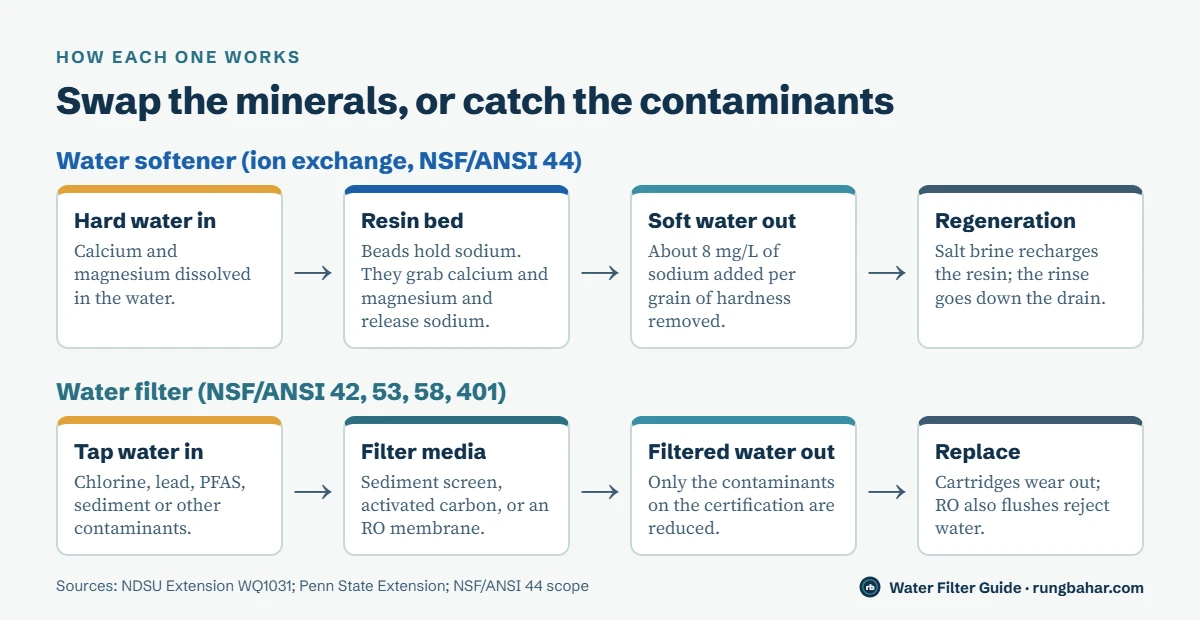
    Flow diagram: softener resin swaps calcium and magnesium for sodium, about 8 mg/L sodium per grain removed, and regenerates with brine; a filter passes water through sediment, carbon or an RO membrane and its cartridges are replaced
    A softener swaps minerals; a filter catches contaminants.

    What a water softener does

    A standard water softener is an ion exchange unit. Water flows through a tank of resin beads that carry sodium. The beads grab calcium and magnesium out of the water and release sodium in their place. When the beads are full of hardness, the softener regenerates: it flushes them with salt brine from a second tank, which pushes the hardness off the beads and sends it down the drain. Penn State Extension estimates about 50 gallons of water per regeneration, which matters if you are on a septic system.

    Residential softeners are certified under NSF/ANSI 44. The standard covers hardness reduction, the softener’s materials and its efficiency. It also allows two optional health claims, barium and radium, which a manufacturer can choose to have tested. Nothing in it covers lead, PFAS, chlorine, nitrate or germs.

    Softeners do handle one common well-water problem. North Dakota State University Extension says a standard softener removes dissolved iron and manganese up to about 10 ppm. Above that, or when the iron is already rusty (oxidized), it clogs the resin and needs its own filter first. Penn State Extension also warns that bacteria can grow in the resin bed, so water that is not microbiologically safe should be disinfected before it reaches a softener.

    What a softener adds is sodium. NDSU puts it at about 8 mg/L of sodium for every grain per gallon of hardness removed. We come back to what that means for drinking water below.

    What a water filter does

    “Water filter” covers several technologies that remove different things. The certification standard tells you which job a particular filter has been tested for.

    • Sediment filters catch sand, rust flakes and silt. They protect plumbing and other equipment but do little for dissolved contaminants.
    • Activated carbon filters (pitchers, faucet mounts, under-sink and whole-house cartridges) remove chlorine taste and odor under NSF/ANSI 42, and some are certified under NSF/ANSI 53 for health contaminants such as lead, PFAS or volatile organic chemicals. Chloramine needs carbon certified specifically for it, usually catalytic carbon.
    • Reverse osmosis (RO) pushes water through a membrane that holds back most dissolved substances, certified under NSF/ANSI 58. It is the main home option for nitrate, arsenic, fluoride and total dissolved solids, and it also lowers sodium.
    • NSF/ANSI 401 covers emerging contaminants such as microplastics and some pharmaceuticals. NSF/ANSI 55 covers UV disinfection, which is not a filter at all but is the usual answer for bacteria in a well.

    Filters wear out on a schedule, not on a salt delivery. A carbon cartridge loses its certified performance after its rated gallons, and an RO membrane and its pre-filters on the schedule in the maker’s manual. None of them removes hardness in a useful way except RO, which does it at one tap and pays for it in membrane life.

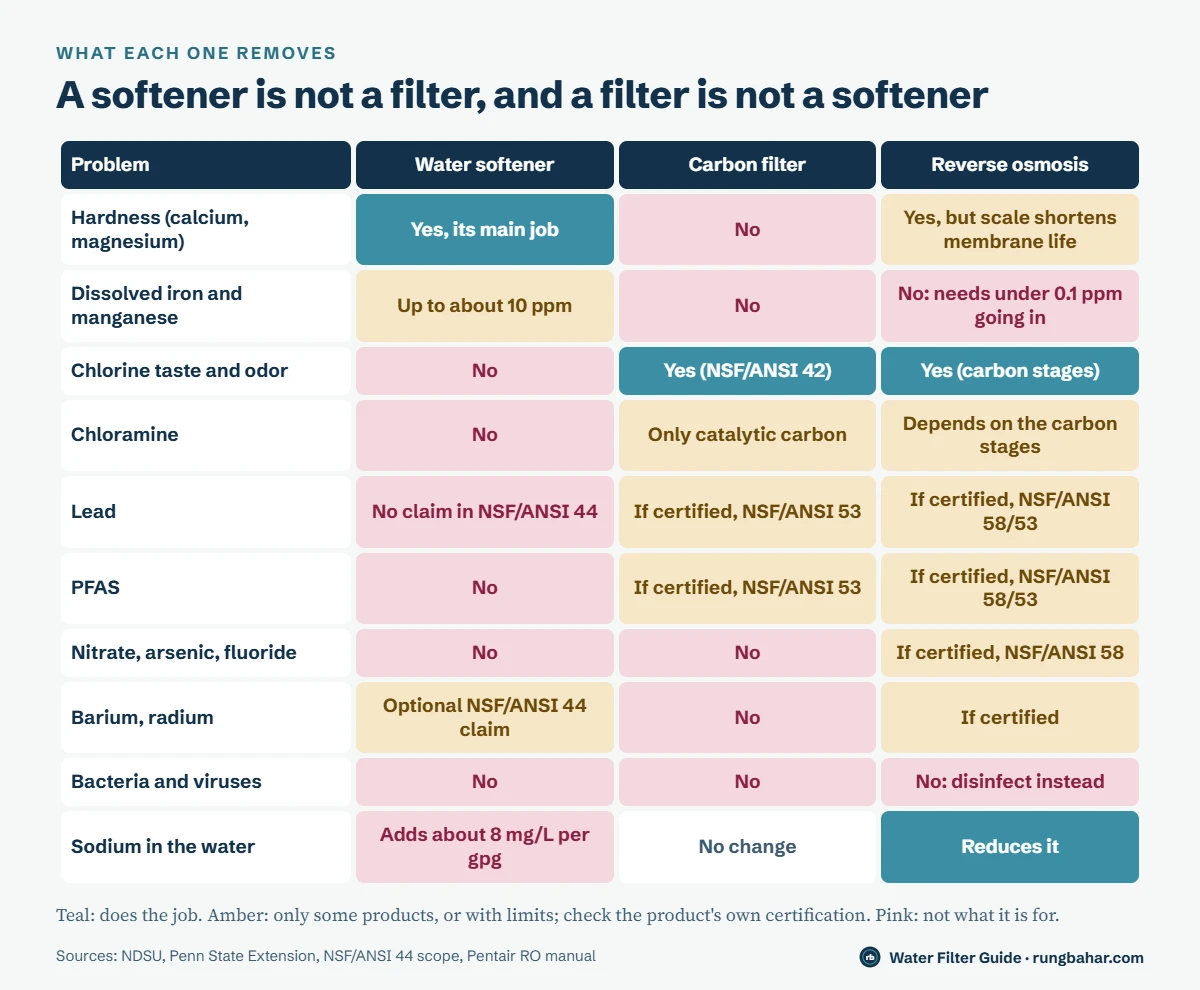
    Water softener vs water filter, side by side

    Water softenerWater filter
    Main jobRemoves hardness (calcium, magnesium)Removes the contaminants it is certified for
    Fixes scale, spots, poor latherYesNo (RO only at one tap)
    Improves chlorine tasteNoYes, carbon (NSF/ANSI 42)
    Lead, PFAS, VOCsNo claimIf certified (NSF/ANSI 53 or 58)
    Nitrate, arsenic, fluorideNoRO if certified (NSF/ANSI 58)
    Iron and manganeseDissolved, up to about 10 ppmNeeds a dedicated iron filter
    Bacteria and virusesNo; can grow in the resinNo; use disinfection (UV, NSF/ANSI 55)
    Changes sodiumAdds about 8 mg/L per gpg removedNo change (carbon) or lowers it (RO)
    Usual locationPoint of entry: whole housePoint of use (one tap) or point of entry
    UpkeepSalt refills; regeneration water to drainCartridge or membrane changes
    CertificationNSF/ANSI 44NSF/ANSI 42, 53, 58, 401
    Comparison table: softener removes hardness and up to about 10 ppm iron but not chlorine, lead, PFAS, nitrate or bacteria and adds sodium; carbon handles chlorine and certified lead or PFAS; RO handles certified nitrate, arsenic, fluoride and lowers sodium
    Neither tool does the other one’s job.

    Two rows deserve a second look. First, a softener is not a health device. It can be certified for barium and radium, but its listing will not say anything about lead or PFAS, so do not buy one for those. Second, a filter is not a scale fix. Pitcher, faucet and whole-house carbon filters leave calcium and magnesium in the water, which is why a house can have an expensive filter and still have a crusted water heater.

    Water softener vs whole house filter

    This is the comparison people most often get wrong, because both are big tanks in the garage or basement. A whole-house filter is usually a large carbon or sediment unit at the main line. It treats every tap, so it is the choice when chlorine or chloramine bothers you in the shower as well as the glass, or when sediment is fouling fixtures. It does nothing for hardness.

    A softener also sits at the main line, but its job is hardness. If you have both problems, you can install both, usually with sediment or iron treatment first so the softener resin stays clean. Follow the order in each maker’s installation manual, because some carbon media and some resins have their own limits on chlorine, iron and pressure. If chlorine taste is only a drinking-water issue, a point-of-use carbon filter at the kitchen tap is a cheaper answer than a whole-house filter. For renters, who usually cannot install either, see renter-friendly water filters.

    Water softener vs reverse osmosis

    Reverse osmosis is the one filter that does remove hardness, which is why the two get compared. But RO and a softener are rarely alternatives. An RO system makes a few gallons a day at one tap, and it is there for drinking and cooking water. A softener treats every gallon the house uses.

    Hard water is actually a problem for RO. The membrane scales up the same way a kettle does. One example: Pentair’s FreshPoint GRO-575 under-sink RO manual says the system is not recommended on water above 10 gpg (171 mg/L) of hardness, and it also wants iron, manganese and sulfide below 0.1 ppm going in. On very hard water, a softener ahead of the RO protects the membrane, and the RO then takes most of the added sodium back out at the drinking tap. That pairing is common in hard-water areas. Check your own RO manual’s feed-water limits before you buy. Our guide to what reverse osmosis removes lists its certified claims, and whether RO water is good for you covers the mineral question.

    Softened water and sodium

    Because a softener swaps hardness for sodium, softened water carries more sodium than the water that went in. Using NDSU’s figure of about 8 mg/L per grain removed:

    • At 5 gpg of hardness, softening adds about 40 mg/L of sodium.
    • At 10 gpg, about 80 mg/L.
    • At 20 gpg, about 160 mg/L.

    For comparison, the US EPA’s drinking water advisory on sodium recommends keeping sodium between 30 and 60 mg/L for taste, and sets a guidance level of 20 mg/L for people on a very low sodium diet of 500 mg a day. The 20 mg/L figure is meant for that group, not for everyone. A liter of water at 80 mg/L adds 80 mg of sodium to the day, which is small next to food for most people, but it is not nothing if your doctor has you on a strict limit.

    There are three simple answers. Leave the kitchen cold tap unsoftened, which NDSU suggests for drinking and cooking. Put an RO system at the kitchen tap. Or regenerate with potassium chloride instead of salt; NDSU notes it costs more and the softener needs about 10 percent more of it. People on sodium-restricted diets should ask their physician. Our salt-free vs salt softener guide looks at the no-salt alternatives.

    When you need both, and in what order

    Plenty of homes have hard water and a drinking-water concern at the same time. The usual layout treats the house for hardness and the drinking tap for contaminants.
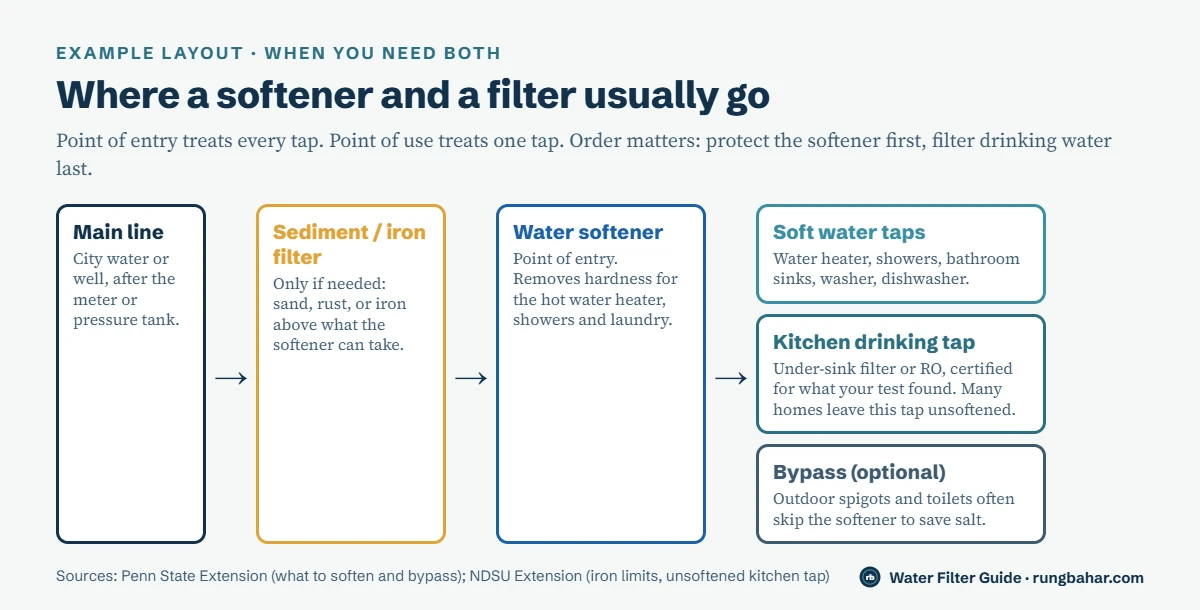
    Example plumbing layout: main line, optional sediment or iron filter, water softener at point of entry, then soft water taps, a kitchen drinking tap with an under-sink filter or RO, and optional bypass for outdoor spigots and toilets
    When you need both, the softener treats the house and a certified filter treats the drinking tap.

    Penn State Extension suggests softening the water that goes to showers, sinks and laundry, and bypassing toilets, outdoor spigots and some basement taps, which saves salt and water. A softener is normally sized for the whole house; our water softener size calculator works out the grain capacity from your hardness and household size.

    Two worked examples

    Example only: a private well at 18 gpg hardness, 2 ppm iron and nitrate at 6 mg/L. The hardness and the dissolved iron are both within what a standard softener handles (iron under about 10 ppm), so a softener at the pressure tank deals with scale and staining. The softener does nothing for nitrate. At 6 mg/L the nitrate is under the 10 mg/L federal limit, but if the household wants it lower at the drinking tap, an under-sink RO system certified under NSF/ANSI 58 for nitrate is the tool, fed with softened water so the membrane is not scaling. The family retests after installation. See well water test results explained for how to read a lab report like this one.

    Example only: city water at 12 gpg, disinfected with chloramine, in a house with an older service line. A softener handles the scale on fixtures and the water heater. For drinking water, the household picks a point-of-use filter certified under NSF/ANSI 53 for lead, and if the chloramine taste bothers them, one also certified for chloramine. A whole-house catalytic carbon filter is only worth it if they also mind chloramine in the shower. While waiting for the service line to be replaced, they follow the steps in lead in tap water.

    What about salt-free conditioners, descalers and shower filters?

    Three other devices get sold as “alternatives” to both, and none of them is a filter or a true softener.

    • Salt-free conditioners (often called salt-free softeners) leave calcium and magnesium in the water and try to change them into a form that is less likely to stick as scale. They do not soften, and they are not filters. Our salt-free vs salt softener comparison covers what the research shows.
    • Electronic and magnetic descalers clamp onto a pipe and claim to change how scale forms. They remove nothing from the water. Look for independent evidence before spending money on one.
    • Shower filters are usually small carbon or KDF cartridges for chlorine. The relevant standard is NSF/ANSI 177, which covers free chlorine reduction. They do not soften water, so they will not fix dry, tight-feeling skin if hardness is the cause.

    Which one do you need?
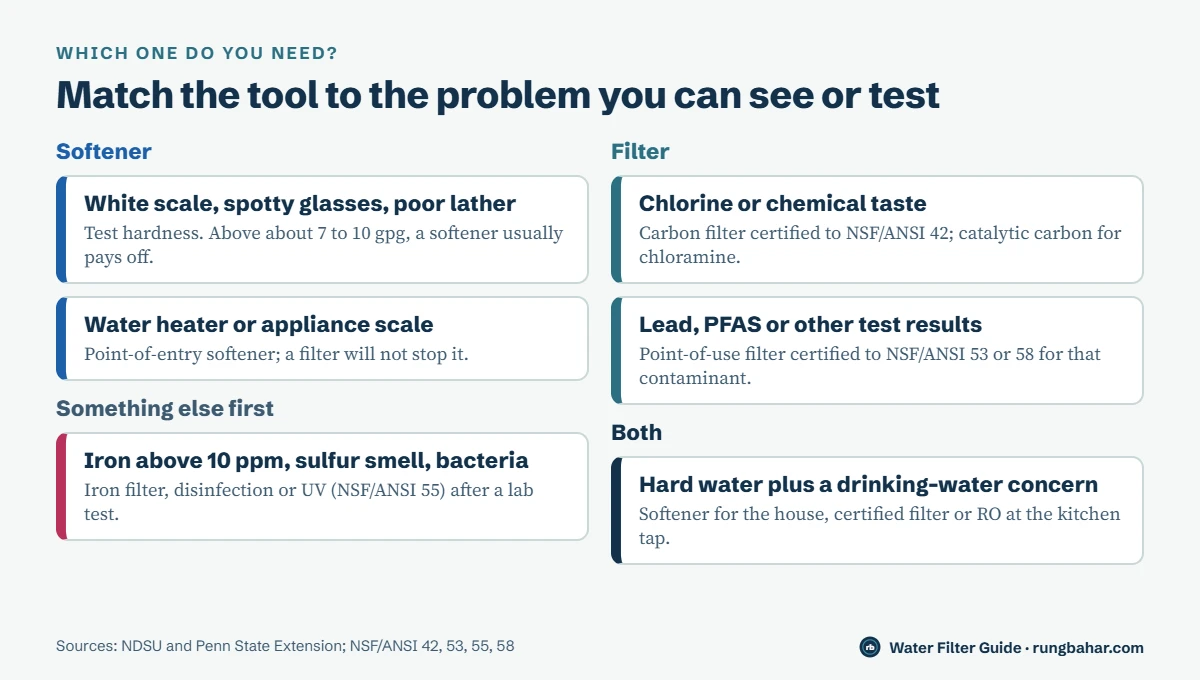
    Decision chart: scale, spots and poor lather point to a softener; chlorine taste, lead or PFAS point to a certified filter; high iron, sulfur smell or bacteria need other treatment first; hard water plus a drinking-water concern needs both
    Pick the tool by the problem you can see or test.
    • Softener only: scale, spots and poor lather; city water that tests fine otherwise.
    • Filter only: soft or moderately hard water with a taste problem or a contaminant on your report.
    • Both: hard water plus a taste or health concern, or a well with hardness and a health contaminant.
    • Something else first: bacteria (disinfection), iron above about 10 ppm or rusty water (iron filter), or no test at all yet.

    For hardness

    A softener certified to NSF/ANSI 44

    • Certification: NSF/ANSI 44 (hardness; optional barium and radium)
    • Best for: Scale, spots and lather on hard water
    • Skip if: your problem is taste, lead or PFAS

    Size a softener first

    For contaminants

    A filter certified for your contaminant

    • Certification: NSF/ANSI 42 (taste), 53 (lead, PFAS) or 58 (RO)
    • Best for: Drinking-water concerns from a test or report
    • Skip if: scale is your only problem

    Search certified filters

    Before you buy anything

    • Test hardness. A test strip gives gpg in a minute; your utility report also lists hardness.
    • Read your water quality report or get a lab test if you are on a well. Use our ZIP code tap-water check to start.
    • Name the problem you want gone: scale, taste, a contaminant, or more than one.
    • Check the certification of any product against that problem: NSF/ANSI 44 for softeners, 42, 53, 58 or 401 for filters. Our guide to checking a certification shows how.
    • Ask about upkeep: salt use and regeneration water for a softener, cartridge and membrane schedules for a filter.
    • Be wary of free “water tests” from sellers. Penn State Extension recommends an independent lab instead.

    Still not sure? Answer three questions in our filter finder or start with the step-by-step guide to choosing a water filter.

    Water softener vs filter: 14 common questions, answered

    These are the questions people search most when choosing between a softener and a filter.

    What is the difference between a water softener and a water filter?

    A softener removes hardness (calcium and magnesium) by ion exchange, which stops scale and spots. A filter removes the contaminants it is certified for, such as chlorine, lead or PFAS. A softener does not make water safer to drink, and most filters do not soften.

    Does a water softener filter water?

    Not in the usual sense. It removes hardness and some dissolved iron and manganese, and it can be certified for barium and radium, but it has no claims for chlorine, lead, PFAS, nitrate or germs.

    Does a water softener remove lead?

    Softeners are not certified for lead under NSF/ANSI 44. For lead, use a filter certified under NSF/ANSI 53 or 58 for lead at the tap you drink from.

    Does a water softener remove chlorine?

    No. Chlorine taste and odor need activated carbon certified under NSF/ANSI 42, and chloramine needs carbon certified for chloramine.

    Can a water filter soften water?

    Only reverse osmosis meaningfully removes hardness, and it does so at one tap. Carbon pitchers, faucet filters and whole-house carbon filters leave hardness in the water.

    Water softener vs whole house filter: which do I need?

    A whole-house filter treats chlorine, chloramine or sediment at every tap. A softener treats hardness at every tap. If you have both problems, many homes install both, with sediment or iron treatment first.

    Water softener vs reverse osmosis: which is better?

    They do different jobs. RO purifies drinking water at one tap; a softener treats the whole house for hardness. On very hard water, a softener ahead of the RO protects the membrane.

    Do I need a water softener if I have reverse osmosis?

    Not for drinking water. You may still want one for the water heater, showers and appliances if your water is hard, and some RO systems are not recommended above about 10 gpg of hardness.

    Water softener vs water conditioner: what is the difference?

    A softener removes calcium and magnesium. A salt-free conditioner leaves them in the water and tries to reduce how much scale they form. Only the softener gives you soft water.

    Water softener vs water purifier: what is the difference?

    A purifier is meant to make unsafe water safe, usually by removing or killing germs, for example with UV or RO plus disinfection. A softener does neither; it only removes hardness.

    Is softened water safe to drink?

    For most people, yes. It contains extra sodium, about 8 mg/L per grain of hardness removed. People on sodium-restricted diets should ask their doctor and can keep an unsoftened tap or use RO for drinking.

    Which comes first, the filter or the softener?

    Usually sediment or iron treatment comes first to protect the softener, then the softener, then any drinking-water filter or RO at the kitchen tap. Follow each maker’s installation order.

    Do Brita or PUR filters soften water?

    No. Pitcher and faucet filters are carbon filters for taste and certified contaminants. They do not remove hardness in a way that prevents scale.

    Is a shower filter the same as a water softener?

    No. Most shower filters reduce chlorine (NSF/ANSI 177 covers this) and do not remove calcium and magnesium.

    Sources and how we checked this page

    Every claim on this page comes from university extension services, NSF/ANSI standard scopes, the US EPA, the US Geological Survey and a manufacturer’s installation manual, checked on October 14, 2026. We do not test softeners or filters, and we have no commercial relationship with any maker named here. Product limits vary, so check the manual and certification for the exact unit you buy.

  • Hard Water vs Soft Water: Signs, Tests and When a Softener Is Worth It

    Hard Water vs Soft Water: Signs, Tests and When a Softener Is Worth It

    Updated October 13, 2026, by the RB Water Desk. How we research.

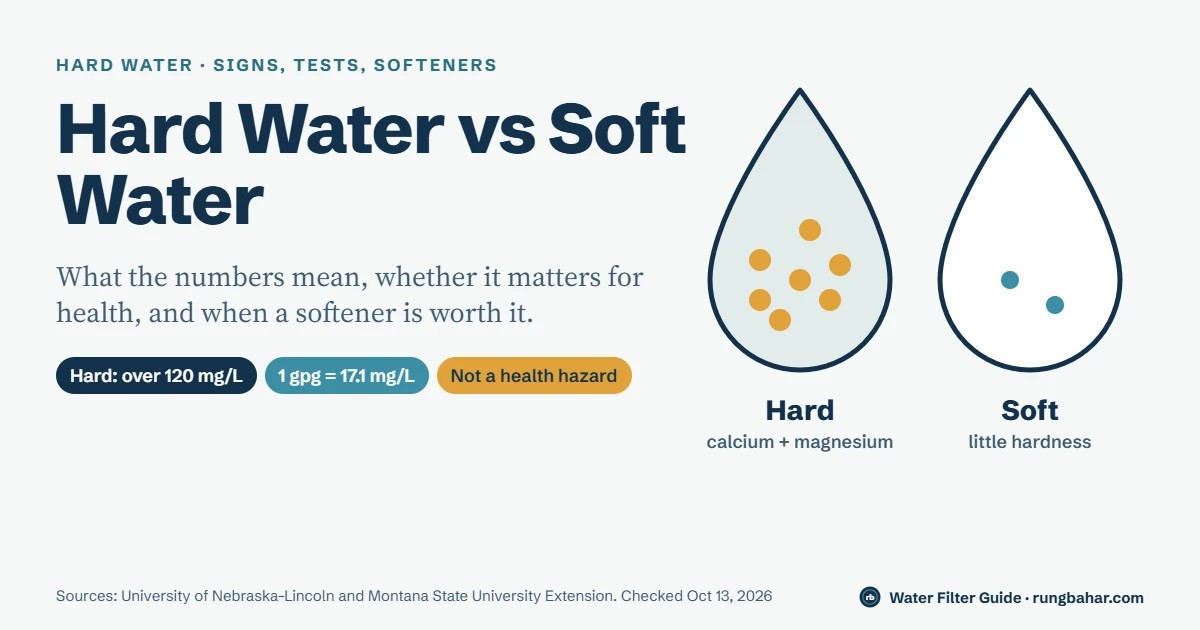
    The short answer: Hard water has a lot of dissolved calcium and magnesium; soft water has little. Water over about 120 mg/L (7 grains per gallon) is classed as hard, and over 180 mg/L (10.5 gpg) as very hard. Hard water is not a health hazard, and it is fine to drink. Its problems are practical: scale in kettles, water heaters and fixtures, spots on dishes, and soap that will not lather. A water softener is usually worth it once hardness passes about 7 to 10 gpg and scale is costing you, but softened water carries extra sodium, so many homes keep one unsoftened tap for drinking.

    Quick check: how hard is my water?

    1. Which unit is your number in?

    2. Your hardness number

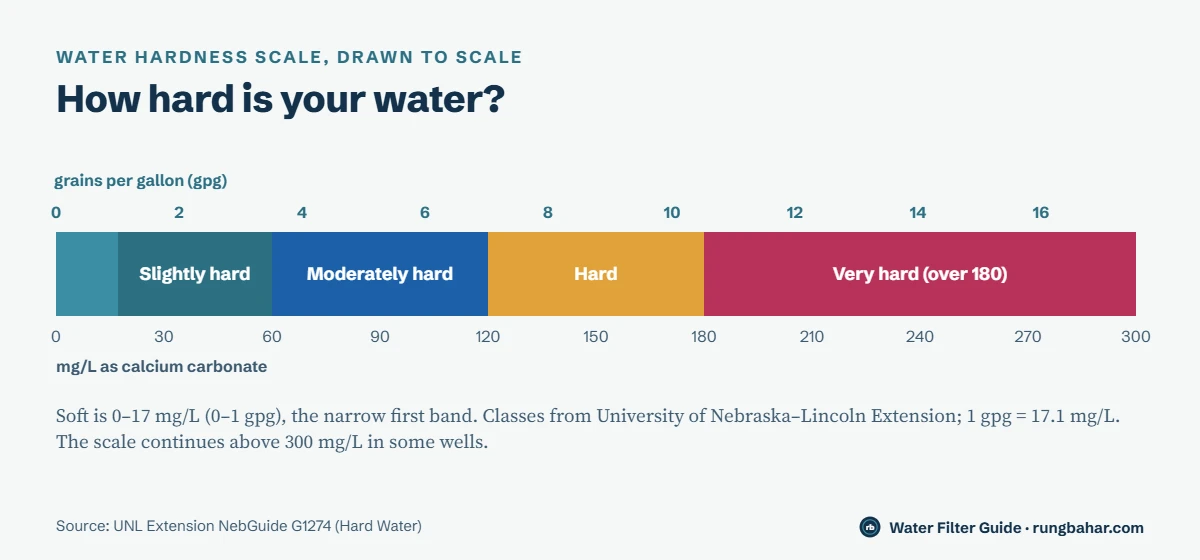
    To-scale water hardness chart: soft 0 to 17 mg/L, slightly hard 17 to 60, moderately hard 60 to 120, hard 120 to 180, very hard over 180 mg/L, with grains per gallon marked above
    Over 120 mg/L (7 gpg) is classed as hard, over 180 mg/L (10.5 gpg) as very hard.

    What makes water hard or soft

    Water picks up minerals as it moves through soil and rock. Where it passes through limestone, chalk or gypsum, it dissolves calcium and magnesium, and those two minerals are what “hardness” measures. Water from granite or sandstone areas, or from rain-fed reservoirs, tends to be soft.

    Hardness is usually reported as milligrams per liter of calcium carbonate (mg/L as CaCO₃), even though the water contains calcium and magnesium in other forms. Softener makers often use grains per gallon (gpg) instead. The conversion is simple: 1 gpg equals 17.1 mg/L. So 10 gpg is 171 mg/L, and 180 mg/L is about 10.5 gpg.

    Soft water is simply water with little calcium and magnesium. It can be naturally soft, or softened in the home by an ion exchange softener, which swaps the calcium and magnesium for sodium or potassium. That difference matters later: naturally soft water and softened water are not the same thing.

    Hardness levels: the scale in mg/L and gpg

    There is no federal hardness limit; the EPA does not regulate hardness in drinking water. University extension services use similar scales. This is the one published by the University of Nebraska–Lincoln Extension:

    Classificationmg/L as calcium carbonateGrains per gallonWhat you usually notice
    Soft0–170–1Nothing; soap lathers easily
    Slightly hard17–601–3.5Very little
    Moderately hard60–1203.5–7Some spotting, slow kettle scale
    Hard120–1807–10.5Scale on fixtures, soap scum, spots
    Very hardOver 180Over 10.5Heavy scale, crusted aerators, short appliance life

    Montana State University uses slightly different cut-offs, calling 121 to 300 mg/L hard and anything above 300 very hard. The labels vary between sources, but the practical point is the same: somewhere above about 120 mg/L (7 gpg), most households start to notice and pay for the effects.

    Signs you have hard water

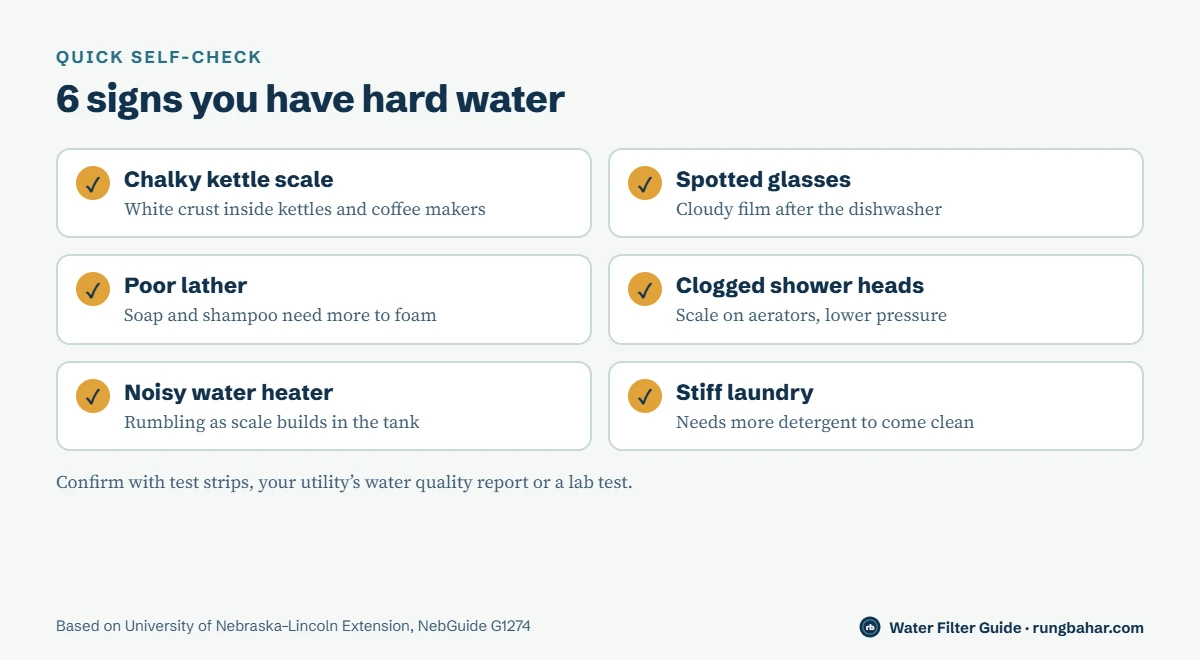
    You do not need a test to suspect hard water. The common signs are:

    • White, chalky scale inside the kettle, on shower heads and around faucet bases.
    • Spots or a cloudy film on glasses and dishes after the dishwasher.
    • Soap and shampoo that lather poorly, and a sticky “soap curd” ring in the tub.
    • Faucet aerators and shower heads that clog and lose pressure.
    • Water heaters that rumble or lose efficiency as scale builds up at the bottom of the tank.
    • Laundry that feels stiff and needs more detergent.

    The University of Nebraska explains the mechanism: soap combines with calcium and magnesium to form soap curd, so you need more soap or detergent, and heated hard water forms scale that can reduce the efficiency of water-using appliances or make them fail. Signs of soft water are the opposite: rich lather, a slippery feel when rinsing, and no scale.

    Checklist of six signs of hard water: kettle scale, spotted glasses, poor lather, clogged shower heads, noisy water heater and stiff laundry
    Scale, spots and poor lather are the classic signs of hard water.

    How to test your water hardness

    • City water: check your utility’s annual water quality report (Consumer Confidence Report). Hardness is often listed with the secondary or “other” results, sometimes in mg/L and sometimes in gpg. The ZIP code tap-water check on our homepage helps you find it.
    • Test strips: inexpensive hardness strips give a good estimate in under a minute. Dip, wait, compare the color.
    • Lab test: for a private well, a lab test is more accurate and should be part of a broader test for bacteria, nitrate and arsenic. Our well water results guide explains how to read it.
    • Not a TDS meter: a TDS meter measures all dissolved minerals together, not hardness. A high TDS reading often means hard water, but sodium, chloride or sulfate can raise it too. See what a TDS reading means.

    Once you have a number, put it in the quick check at the top of this page to see the class, the conversion and what softening would add.

    Is hard water bad for you?

    No. The University of Nebraska–Lincoln Extension states plainly that hard water is not a health hazard. Calcium and magnesium are nutrients, and hard drinking water contributes a small share of both to the diet. Some studies have linked harder water with lower rates of cardiovascular disease, but both Nebraska and Montana State describe the evidence as limited, and no firm conclusion has been drawn. Hard water is safe to drink, and some people prefer its taste.

    The real costs of hard water are financial and practical: more soap and detergent, more cleaning, and shorter life for water heaters, kettles, dishwashers and fixtures. That is the case for softening, not health.

    Hard water vs soft water for skin and hair

    This is one of the most searched hardness questions, and the evidence is weaker than the marketing. The largest trial is the Softened Water Eczema Trial (SWET), published in PLOS Medicine in 2011. It installed ion exchange softeners in the homes of 336 children with moderate to severe eczema and compared them with children on usual care. After 12 weeks, eczema severity improved by about the same amount in both groups. Families with a softener felt it had helped, but observers who did not know which homes had one saw no difference.

    Hard water does leave soap residue on skin and hair, which some people find makes hair feel dull or skin feel dry, and soft water rinses more cleanly. That is a comfort question, not a medical one. If you are buying a softener mainly for eczema, the best available trial says not to expect a medical benefit. If you want softer-feeling hair and less soap scum, a softener or a shower filter that targets those effects is a reasonable comfort purchase.

    What soft water changes, and the sodium question

    An ion exchange softener pulls calcium and magnesium onto resin beads and releases sodium in their place (or potassium, if you use potassium chloride instead of salt). The benefits are immediate: no new scale, better lather, cleaner glassware and less detergent.

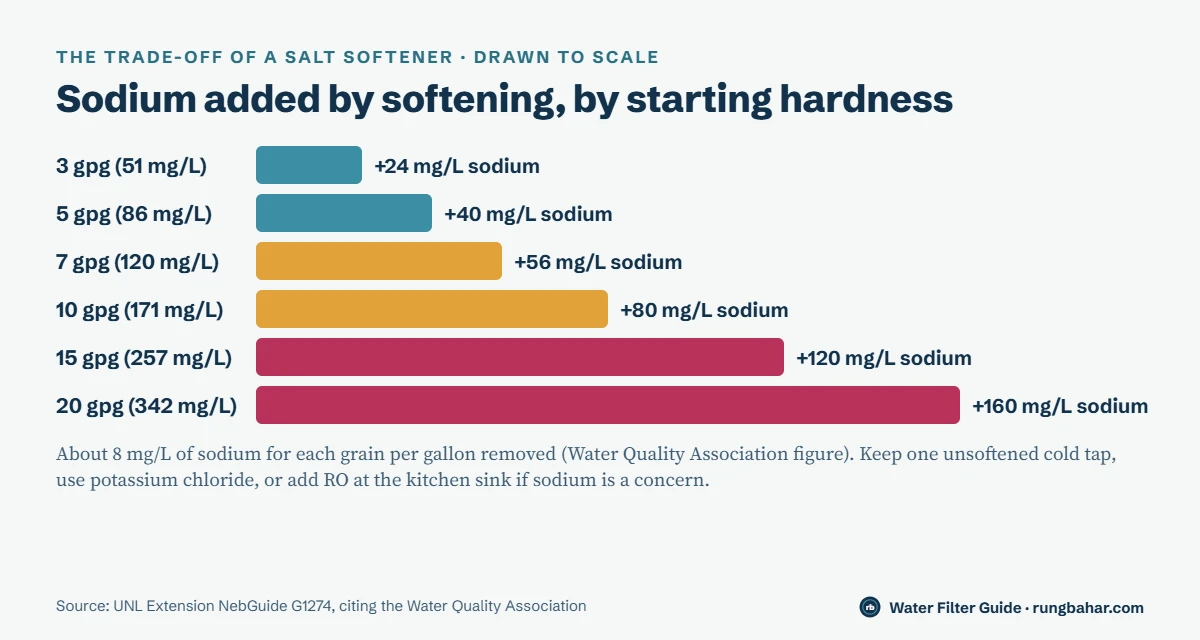
    The trade-off is sodium. According to the Water Quality Association figure quoted by Nebraska Extension, softening adds roughly 8 mg of sodium per liter for every grain per gallon of hardness removed. Water at 10 gpg ends up with about 80 mg/L of added sodium; water at 20 gpg, about 160 mg/L. For most people that is a small part of daily sodium intake, but anyone on a doctor-ordered low-sodium diet should ask about it.

    There are three common fixes, all recommended by extension services:

    • Leave one cold line unsoftened, usually to the kitchen sink, for drinking and cooking.
    • Use potassium chloride instead of sodium chloride in the brine tank. It costs more but adds potassium, not sodium.
    • Add a reverse osmosis system at the kitchen tap, which removes most of the sodium. Montana State notes that RO can remove sodium and ease concerns about high sodium intake. See what reverse osmosis removes.

    One more practical note: softeners do not lower total dissolved solids much, because sodium replaces the hardness minerals. If your goal is lower TDS, a softener is the wrong tool.

    When is a water softener worth it?

    There is no official threshold, so here is a practical way to decide:

    Your hardnessUsually worth softening?Why
    Under 3.5 gpg (60 mg/L)NoToo little hardness to cause scale
    3.5–7 gpg (60–120 mg/L)RarelyDescaling and rinse aid usually cope
    7–10.5 gpg (120–180 mg/L)OftenScale starts to cost money in heaters and appliances
    Over 10.5 gpg (180 mg/L)Usually yesHeavy scale, more soap, shorter appliance life
    Any level, private well with ironTest firstIron and manganese change what equipment you need

    Hardness is only part of the decision. Weigh the household size, how much hot water you use, whether you are on a septic system (Montana State notes potassium is an option where sodium can harm clay-soil drainfields), and the yearly cost of salt and regeneration water. If you decide to soften, size the unit properly: our water softener size calculator turns your hardness and household size into a grain capacity.

    To-scale bars of sodium added by a salt softener: about 24 mg/L at 3 gpg, 56 at 7 gpg, 80 at 10 gpg, 120 at 15 gpg and 160 mg/L at 20 gpg
    A salt softener adds about 8 mg/L of sodium for every grain per gallon it removes.

    Worked example: softening a home at 15 gpg

    Numbers make the trade-offs concrete. As an example only, take a family of four on city water with a reported hardness of 257 mg/L, which is 15 gpg and clearly “very hard.”

    • Daily hardness load: if the household uses about 300 gallons a day (an illustrative 75 gallons per person), the softener has to remove about 4,500 grains a day (300 × 15). That is the number a softener is sized from; our calculator uses your own household size and hardness.
    • Sodium: at about 8 mg/L per grain removed, softened water would carry roughly 120 mg/L of added sodium. A 2-liter daily drinking habit would add about 240 mg of sodium, so this family might keep the kitchen cold tap unsoftened or add RO there.
    • What they gain: no new scale in the water heater, dishwasher and kettle, much less soap and detergent, and fixtures that stay clear.
    • What it costs: the unit, salt or potassium chloride, the water used to regenerate the resin, and occasional service. Compare that with the cost of descaling, replacement aerators and shorter appliance life at 15 gpg.

    At 4 gpg the same family would have about one quarter of the scale problem and a quarter of the added sodium, and for many homes the softener would not pay for itself. This is why the hardness number should come first and the purchase second.

    Hard water and your water heater, kettle and appliances

    Scale forms fastest where water is heated, so the water heater takes the worst of it. A layer of scale at the bottom of a tank heater sits between the burner or element and the water, and Nebraska Extension notes that scale can reduce the efficiency of water-using appliances or cause them to fail. Common signs are popping or rumbling sounds as the heater runs and longer waits for hot water.

    If you are not softening, regular maintenance limits the damage: flush the tank heater as the manufacturer’s manual recommends, descale kettles and coffee makers with a citric acid or vinegar solution, soak shower heads and aerators, and use a rinse aid in the dishwasher. If you do soften, keep the brine tank topped up and the regeneration setting matched to your hardness, or the scale returns.

    Options other than a softener

    • Salt-free conditioners (template-assisted crystallization) aim to stop scale forming without removing hardness and without adding sodium. They do not make water soft, so you keep the minerals and the soap behavior. We compare them in salt-free vs salt softeners.
    • Point-of-use fixes: a shower filter, a descaling routine for the kettle and coffee maker, and a dishwasher rinse aid handle much of the nuisance at low cost.
    • Reverse osmosis for drinking water: lowers hardness and almost everything else at one tap, but does nothing for the water heater or showers.
    • Do nothing: at moderate hardness, many households simply descale a few times a year.

    Still deciding what to buy? The filter finder matches your main concern to a treatment type in about 15 seconds, and how to choose a water filter walks through the full decision.

    Hard water vs soft water: 14 common questions, answered

    These are the questions people search most about hard and soft water, answered from university extension and peer-reviewed sources.

    What is the difference between hard water and soft water?

    Hard water has high levels of dissolved calcium and magnesium; soft water has little. Water over about 120 mg/L (7 gpg) of hardness is usually classed as hard.

    Is hard water or soft water better to drink?

    Both are safe. Hard water is not a health hazard and adds a little calcium and magnesium. Softened water carries added sodium, so many homes keep one unsoftened tap for drinking.

    Is hard water bad for you?

    No. University extension services state that hard water is not a health hazard. Its problems are scale, soap scum and wear on appliances.

    Is hard water bad for your hair?

    Hard water can leave soap and mineral residue that makes hair feel dull, but there is little strong evidence of lasting harm. Softer water rinses more cleanly.

    Is hard water bad for your skin or eczema?

    The 2011 SWET trial of 336 children found that installing a water softener did not reduce eczema severity compared with usual care.

    How can I tell if I have hard or soft water?

    Scale in the kettle, spots on glasses and poor soap lather point to hard water. Confirm with test strips, your utility’s water quality report or a lab test.

    What hardness level needs a water softener?

    There is no official level. Many homes find a softener worth it above about 7 to 10 gpg (120 to 180 mg/L), especially where scale is damaging the water heater or appliances.

    How do I convert grains per gallon to mg/L?

    Multiply grains per gallon by 17.1. For example, 10 gpg equals 171 mg/L as calcium carbonate.

    How much sodium does a water softener add?

    About 8 mg per liter for every grain per gallon removed, according to the Water Quality Association. Water at 10 gpg gains about 80 mg/L of sodium.

    Is softened water safe to drink?

    For most people, yes. People on a low-sodium diet should ask their doctor, use potassium chloride, or keep an unsoftened or reverse osmosis tap for drinking.

    Does a water softener remove contaminants like lead or PFAS?

    No. A softener removes hardness minerals. For lead, PFAS or other contaminants you need a filter certified for them.

    Is hard water better for plants?

    Most plants tolerate hard water. Softened water is a poor choice for watering because of the added sodium.

    Is hard water acidic or alkaline?

    Hard water is usually neutral to slightly alkaline because the calcium and magnesium often come with carbonate and bicarbonate.

    Does boiling water make it soft?

    Boiling removes some “temporary” hardness, which drops out as kettle scale, but not all of it. It is not a practical way to soften household water.

    Sources and how we checked this page

    Every claim on this page comes from university extension publications, the US EPA and a peer-reviewed trial, checked on October 13, 2026. We did not test water or softeners ourselves. This page is general information, not medical advice.

  • Salt-Free Water Softener vs Salt Softener: What’s the Difference?

    Salt-Free Water Softener vs Salt Softener: What’s the Difference?

    Published October 11, 2026. Every claim is checked against the sources listed at the end of this page. How we research.

    The short answer: A salt softener removes hardness: its resin swaps the calcium and magnesium in your water for sodium (or potassium), so the water is truly soft. Most “salt-free softeners” do not soften at all. They are conditioners that change hardness minerals into tiny crystals that are less likely to stick as scale, while the minerals stay in the water. Choose a salt softener if you want spot-free glass, easier lathering and protection on very hard or iron-bearing water. Choose a salt-free conditioner if your main goal is less scale in pipes and the water heater, and you want no salt, no drain line and no added sodium.

    Quick check

    What do you most want from a softener?

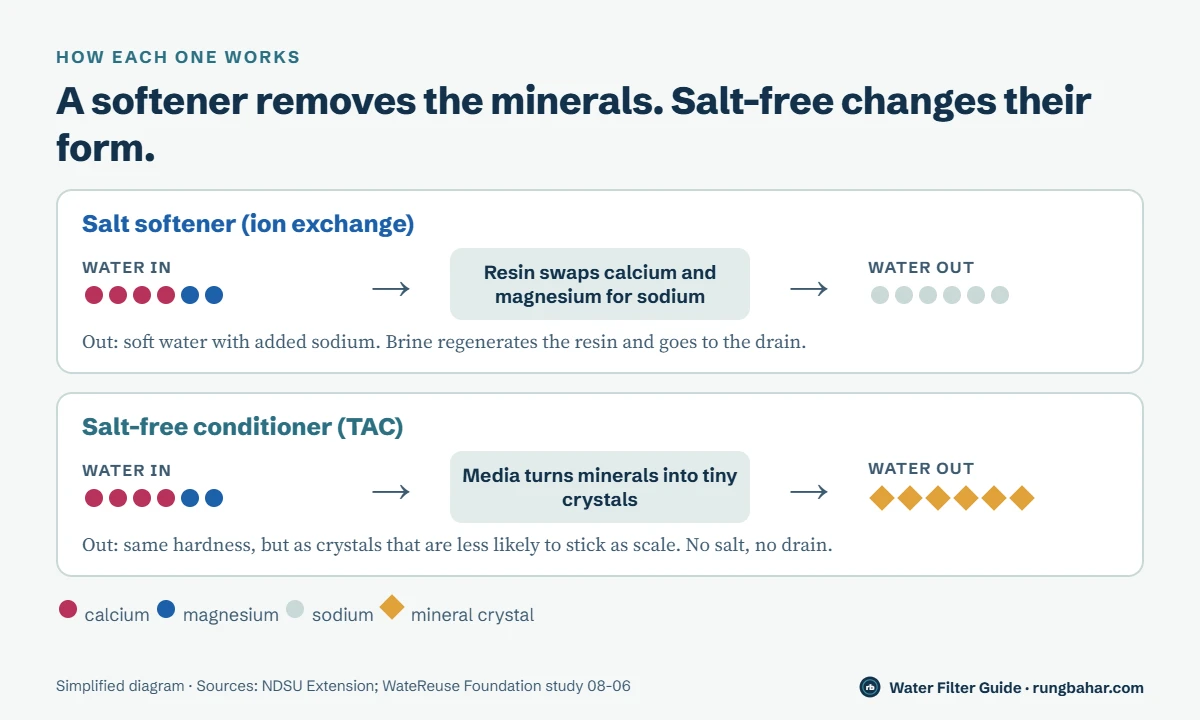
    Diagram: a salt softener’s resin swaps calcium and magnesium for sodium so water leaves soft, while a salt-free TAC conditioner turns the same minerals into tiny crystals that stay in the water
    A softener takes the minerals out; a TAC conditioner leaves them in as crystals that form less scale.

    Salt and salt-free systems do two different jobs

    The name “salt-free water softener” causes most of the confusion. Hard water is water with a lot of dissolved calcium and magnesium. Those minerals cause two separate kinds of trouble. The first is scale: the crusty white deposit that builds up inside water heaters, kettles, shower heads and pipes, mostly when water is heated. The second is everything else: spots on glasses and shower doors, soap that will not lather, scum in the tub and stiff laundry.

    A salt-based softener deals with both, because it takes the calcium and magnesium out of the water. A salt-free conditioner is designed to deal only with the first. It leaves the minerals in the water but changes their form so they are less likely to stick to surfaces as scale. That is why the industry often calls these units “scale reduction” or “anti-scale” systems rather than softeners, and why the comparison is less “which is better” than “which problem do you have”.

    Before you compare equipment, get your hardness number. Your utility’s annual water quality report usually lists it (our ZIP code tap-water check can help you find yours), and private well owners will find it on a lab report. The US Geological Survey classes water up to 60 mg/L as calcium carbonate as soft, 61 to 120 as moderately hard, 121 to 180 as hard and above 180 as very hard. Divide mg/L by about 17 to get grains per gallon (gpg), the unit softener makers use.

    How a salt softener works

    A conventional softener is an ion exchange unit. Water flows through a tank of resin beads coated with sodium. The beads hold calcium and magnesium more strongly than sodium, so they grab the hardness minerals and release sodium in exchange. Water leaving the tank has almost no hardness left.

    The beads fill up over time. When they do, the softener regenerates: it rinses the resin with brine from a second tank (that is where the salt goes), which pushes the calcium and magnesium off the beads, and flushes the salty rinse water to the drain. Then it starts again. How often that happens depends on your hardness, your water use and the size of the unit; our softener size calculator does that arithmetic for your household.

    Three things follow from how it works. It needs a drain for the regeneration water, an electrical outlet for the control valve and a steady supply of salt. It adds sodium to the water in proportion to the hardness it removes. And it can be certified: residential softeners are tested under NSF/ANSI 44, and the Water Quality Association describes high-efficiency units as removing 4,000 grains of hardness per pound of salt while using no more than 5 gallons of water per 1,000 grains during regeneration.

    How salt-free systems work

    “Salt-free” covers several different technologies, and the evidence is not the same for all of them:

    • Template assisted crystallization (TAC): the most common whole-house salt-free type. Water flows through a tank of special beads with sites that encourage calcium and magnesium to form microscopic crystals. The crystals travel through the plumbing suspended in the water instead of sticking to hot surfaces. Some makers sell similar media as nucleation assisted crystallization (NAC).
    • Magnetic and electronic devices: clamp-on magnets or coils wrapped around a pipe that claim to change how minerals behave. They are cheap and need no plumbing, but the evidence is weak (see below).
    • Electrically induced precipitation and capacitive deionization: less common in homes. Capacitive deionization actually removes some minerals, so it is closer to a softener than a conditioner.
    • Salt-free “softeners” that use potassium chloride: these are ordinary ion exchange softeners that use potassium instead of sodium. They are salt-based in every practical sense, just with a different salt.

    For the rest of this page, “salt-free” means TAC-type conditioners, because that is what most whole-house salt-free systems sold in the US are. The key fact to remember is that the calcium and magnesium are still in the water after a TAC unit. In the university study described below, almost all of the calcium that went into the TAC test system came out the other side; it simply did not form scale. A hardness test strip dipped in TAC-treated water will still read hard, and that is expected, not a fault.

    Salt vs salt-free: side-by-side comparison

    QuestionSalt softener (ion exchange)Salt-free conditioner (TAC)
    Removes hardness?Yes, almost all of itNo; minerals stay in the water
    Reduces scale in heaters and pipes?YesYes, in testing (97–99% in one study)
    Stops spots on glass and shower doors?LargelyExpect little change
    Soap lathers more easily?YesExpect little change
    Adds sodium?About 8 mg/L per grain removedNo
    Needs salt?Yes (sodium or potassium chloride)No
    Needs a drain and power?YesUsually no
    Wastewater?Yes, during regenerationNo
    Handles iron and manganese?Small amountsVery little (one maker: 0.3 ppm iron, 0.05 ppm manganese max)
    Hardness limit?Sized to your loadSet by the maker (one leading unit: 30 gpg)
    Performance standardNSF/ANSI 44 certificationUsually DVGW W512 scale test
    Typical upkeepRefill salt, clean brine tankReplace media or cartridge (one maker: every 2 years)

    Read the rows that match your problem. If the complaints in your house are spotty dishes, dull hair and soap scum, the top half of the table already answers the question. If your only goal is to stop the water heater from filling with scale and you have no iron, the bottom half matters more.

    What the evidence says about salt-free systems

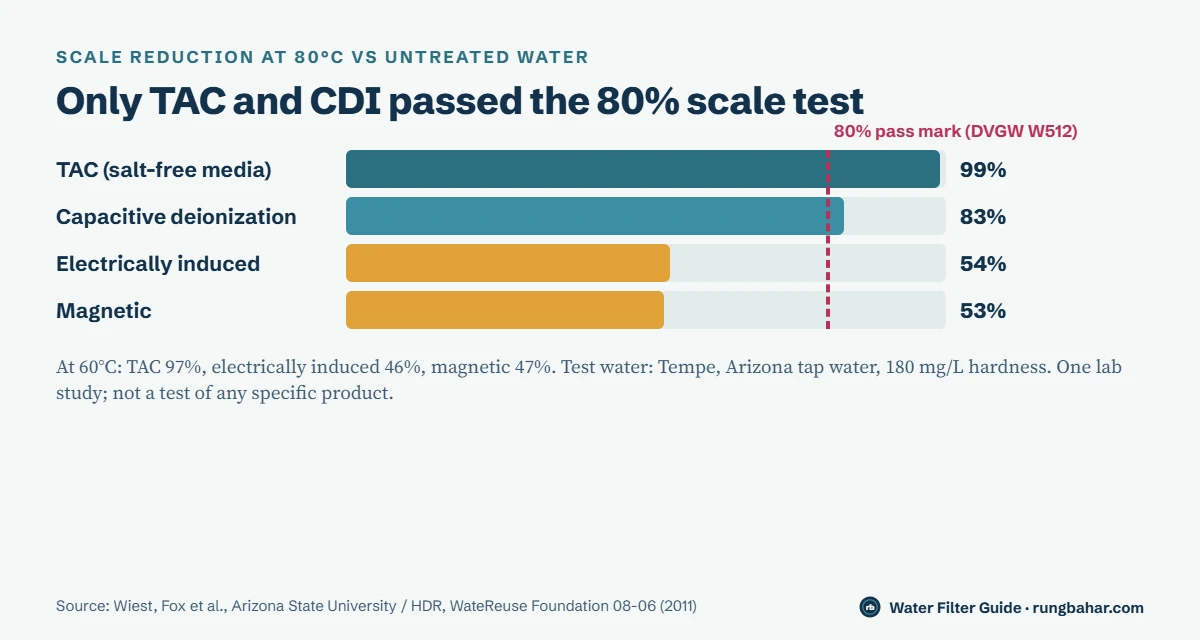
    The most cited independent test of salt-free systems is a 2011 study by Arizona State University and the engineering firm HDR, funded by the WateReuse Foundation with the cities of Phoenix, Scottsdale and Tempe. The researchers ran Tempe tap water, at 180 mg/L of hardness, through four alternatives to a softener and measured how much scale formed on a heating element compared with untreated water. They used a version of the German DVGW W512 test, which requires at least an 80 percent scale reduction to pass.

    Bar chart from a 2011 Arizona State University study: template assisted crystallization reduced scale 99 percent at 80°C, capacitive deionization 83 percent, electrically induced precipitation 54 percent and magnetic treatment 53 percent, against an 80 percent pass mark
    In independent testing, TAC media cut scale by 99 percent; magnetic devices failed the pass mark.

    The results split the technologies clearly. Template assisted crystallization reduced scale by 99 percent at 80°C and 97 percent at 60°C. Capacitive deionization reduced it by 83 percent. Electrically induced precipitation managed 54 and 46 percent, and the magnetic device 53 and 47 percent, below the 80 percent pass mark. The authors called TAC “the most promising technology”, with scale reductions of over 90 percent.

    Two limits keep this in proportion. It was one study, on one water, in a lab, so it tells you what the technology can do rather than what any specific product will do in your house. And it measured scale, not spotting, lather or skin feel, which TAC does not claim to change. The magnetic result matches older findings: North Dakota State University Extension notes that the Water Quality Association has not been able to set standards for magnetic devices and that several research reports found no change in water properties or calcium levels.

    When you shop, ask for scale-reduction results under DVGW W512 for the exact model. One leading US product, the Watts OneFlow, reports more than 95 percent scale reduction under that protocol on its specification sheet. A salt-free unit with no test data at all is asking you to take its claims on trust.

    Sodium, health and drinking water

    Hard water is not a health risk. The Vermont Department of Health puts it plainly: there is no health standard for hardness, and calcium and magnesium can even add to your mineral intake. The health question with softeners is the sodium they add.

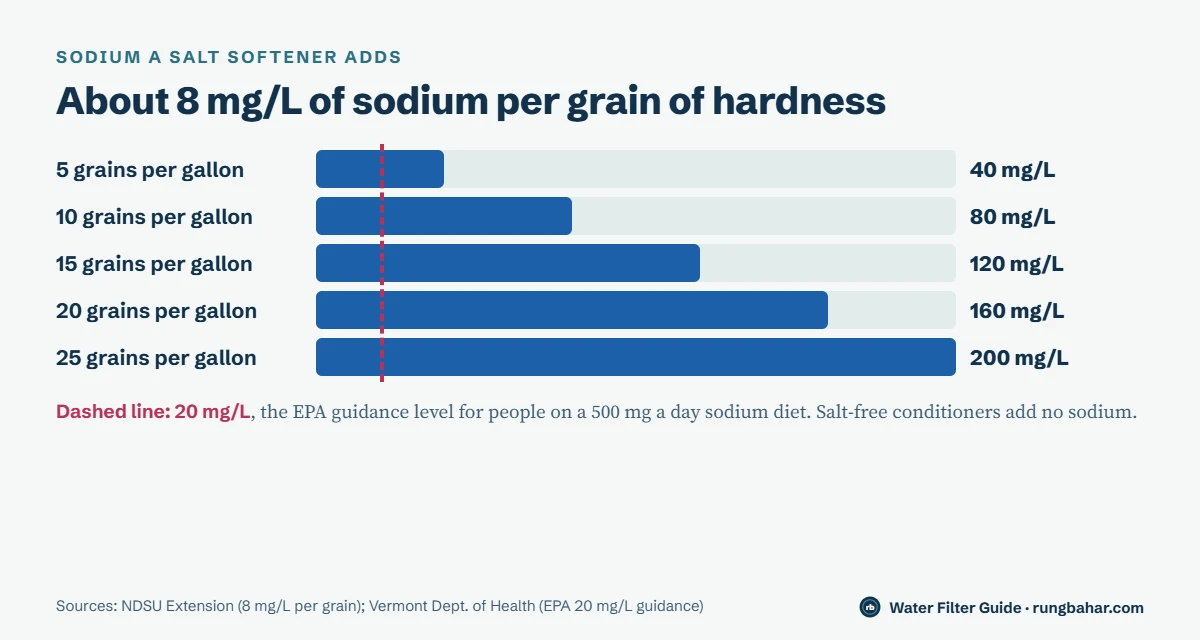
    A salt softener adds about 8 mg/L of sodium for each grain per gallon of hardness it removes. That is a modest amount for most people, but it scales with hardness:

    Bar chart of sodium a salt softener adds at about 8 mg/L per grain: 40 mg/L at 5 grains per gallon up to 200 mg/L at 25, compared with the EPA 20 mg/L guidance for low-sodium diets
    The harder your water, the more sodium a salt softener adds.

    As an example, at 15 grains per gallon a softener adds about 120 mg of sodium per liter. Two liters of that water a day is about 240 mg of sodium, roughly a tenth of the 2,300 mg a day upper limit in the US Dietary Guidelines. For someone on a strict 500 mg a day diet, the US EPA’s guidance is no more than 20 mg/L of sodium in drinking water, and softened water at almost any real hardness exceeds that. People on sodium-restricted diets should ask their doctor; we are not giving medical advice here.

    There are three common fixes if you want soft water anyway. Leave the kitchen cold tap unsoftened, which both NDSU Extension and the Vermont Department of Health suggest. Use potassium chloride instead of sodium chloride in the brine tank; NDSU notes it costs more and about 10 percent more is needed. Or add a reverse osmosis unit at the kitchen sink, which removes most of the sodium along with other dissolved solids; our guide to whether reverse osmosis water is good for you covers the trade-offs. NDSU also advises against using softened water on houseplants, lawns and gardens because of the sodium, so outdoor taps are usually left on hard water.

    Salt-free conditioners avoid this question entirely. They add no sodium and leave the calcium and magnesium in your drinking water.

    Well water, iron and very hard water

    This is where salt-free systems most often disappoint. TAC media works best on clean water. The Watts OneFlow specification sheet, as one example, lists these feed-water limits: hardness up to 30 grains per gallon, iron no more than 0.3 ppm, manganese no more than 0.05 ppm, pH 6.5 to 8.5, free chlorine under 2 ppm, and oil and hydrogen sulfide removed before the unit. Other makers set their own limits, but they are usually in the same range.

    Many private wells exceed at least one of those numbers. Iron and manganese coat the media and stop it working. A conventional softener copes with small amounts of dissolved iron as a side effect, and NDSU notes some can handle more, though high iron is better treated with a dedicated iron filter ahead of the softener. For very hard water above a salt-free unit’s rated limit, ion exchange is usually the only practical choice.

    So for a well, read the lab report before deciding anything. Our guide to well water test results explains the rows that matter here: hardness, iron, manganese, pH and hydrogen sulfide. Neither a softener nor a conditioner treats bacteria, nitrate, arsenic or lead, so a well with health-related results needs other treatment first.

    Upkeep, running needs and local rules

    Running needs are where salt-free systems are strongest. A salt softener needs salt refills, a drain for regeneration water, an outlet for the control valve and occasional brine tank cleaning. Regeneration also uses water. NDSU warns that softener regeneration water may overload or reduce the effectiveness of small septic systems, which is worth discussing with an installer if you are on septic.

    A TAC conditioner has no salt, no regeneration and usually no drain or power. The media or cartridge is replaced on a schedule set by the maker; Watts says every 2 years for its OneFlow cartridge. We do not quote equipment or salt prices because they vary widely by brand, region and installer, but the cost drivers are easy to list: for a softener, the unit, installation, salt and the water used in regeneration; for a salt-free system, the unit, installation and replacement media.

    Local rules can decide the question for you. Some communities restrict self-regenerating softeners because their brine discharge raises chloride levels in rivers and recycled water. In Santa Clarita, California, sanitation district ordinances banned the installation of new self-regenerating softeners in 2003. Check with your sewer or water utility before buying a salt-based unit, especially in parts of California.

    Which one fits your home

    • Choose a salt softener if you want the full soft-water effect (fewer spots, better lather, softer laundry), your water is very hard, or your well has some iron. Size it to your load and look for NSF/ANSI 44 certification.
    • Choose a salt-free conditioner if your main problem is scale in the water heater, fixtures and pipes, your water is within the maker’s limits, and you want no salt, no drain and no added sodium.
    • Choose neither yet if you do not know your hardness, iron and pH. Test first; the result usually makes the choice obvious.
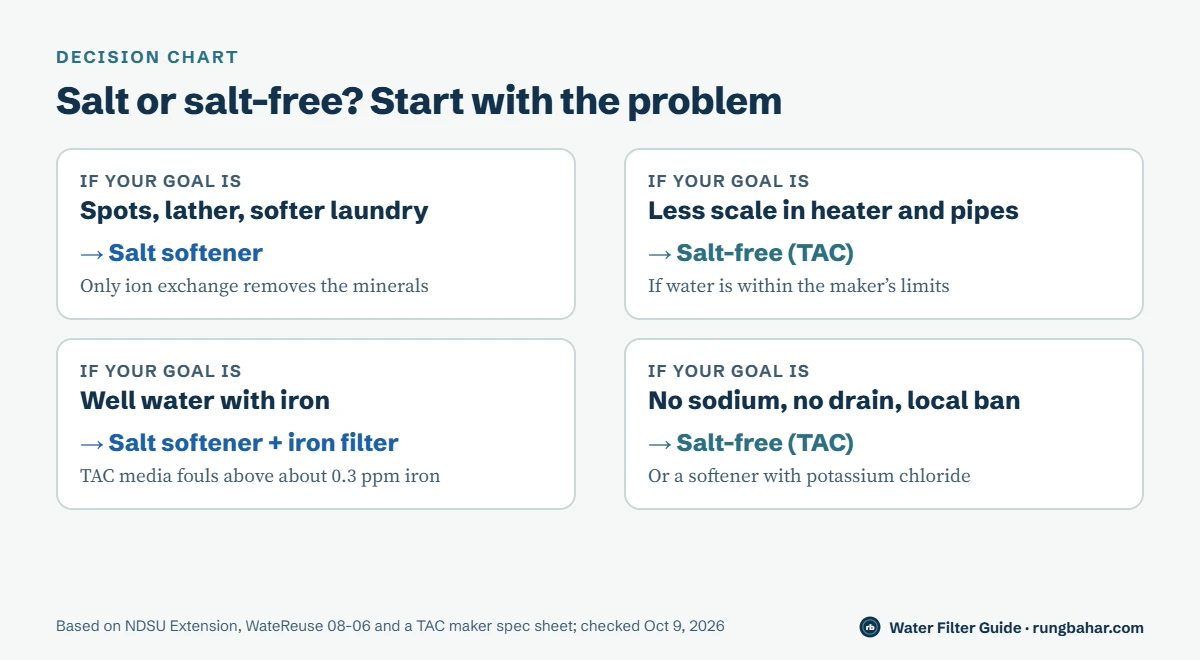
    Decision chart: choose a salt softener for spots, lather and well water with iron; choose a salt-free TAC conditioner for scale in the heater and pipes, no sodium, no drain or local bans
    Match the system to the problem: soft water needs salt, scale control alone does not.

    Full soft water

    Metered salt softener

    • Certification: NSF/ANSI 44, with rated capacity and efficiency stated
    • Best for: Spots, lather, very hard water, some iron
    • Skip if: you are on a strict sodium diet without a drinking-water bypass

    Search NSF/ANSI 44 softeners

    Scale only

    Salt-free TAC conditioner

    • Certification: DVGW W512 scale test results for the exact model
    • Best for: City water within the maker’s limits, scale in the heater
    • Skip if: your water has iron or manganese above the maker’s limit

    Read an example spec sheet

    Drinking water

    Reverse osmosis at the kitchen sink

    • Certification: NSF/ANSI 58 naming your contaminants
    • Best for: Softened homes that want low-sodium drinking water
    • Skip if: hardness is your only concern

    Read: what RO removes

    Questions to ask before you buy

    Water treatment is often sold in the home, after a free water test. Whichever type you lean toward, ask for these in writing:

    • For a softener: the NSF/ANSI 44 certification, the rated capacity at the salt setting you will use, the efficiency in grains per pound of salt, and whether the valve is metered.
    • For a salt-free unit: the DVGW W512 (or similar) scale test results for that model, the maximum hardness, iron, manganese and pH it tolerates, the flow rate, and the media replacement interval.
    • For either: what it does not do. Neither removes lead, PFAS, nitrate or bacteria, and a salesperson who implies otherwise is a reason to walk away.
    • Your own hardness, iron and pH numbers, from your utility report or an independent lab, not only from the seller’s test.

    If you are still working out what your water needs beyond hardness, start with how to choose a water filter in 5 steps, or try the 15-second filter finder.

    Salt-free vs salt softeners: 12 common questions, answered

    These are the questions people search most when choosing between a salt softener and a salt-free system.

    Is a salt-free water softener as good as a salt softener?

    Not for softening. A salt-free conditioner leaves calcium and magnesium in the water, so it does not give soft water. It can be as good at reducing scale: a TAC unit cut scale by 97 to 99 percent in a 2011 Arizona State University study.

    Do salt-free water softeners really work?

    TAC-type units have good independent evidence for reducing scale on heated surfaces. Magnetic and electronic devices have weak evidence; in the same study they reduced scale by only about 46 to 54 percent.

    What is the difference between a water softener and a water conditioner?

    A softener removes hardness minerals by ion exchange. A conditioner changes how those minerals behave so they form less scale, but leaves them in the water.

    Will a salt-free system stop spots on my dishes and shower doors?

    Expect little change. Spots form when water evaporates and leaves its minerals behind, and a salt-free conditioner does not remove those minerals.

    Does a salt-free water softener work on well water?

    Only if the well water is within the maker’s limits. One leading TAC unit lists maximums of 0.3 ppm iron and 0.05 ppm manganese and requires hydrogen sulfide to be removed first. Many wells need an iron filter or a conventional softener.

    How much sodium does a water softener add?

    About 8 mg/L of sodium for each grain per gallon of hardness removed. At 15 grains per gallon, that is about 120 mg/L.

    Can I use potassium instead of salt in my softener?

    Yes. Potassium chloride works in most softeners and adds no sodium. NDSU Extension notes it costs more and about 10 percent more is needed.

    Is softened water safe to drink?

    For most people, yes. People on sodium-restricted diets should ask their doctor; the EPA suggests no more than 20 mg/L of sodium for a 500 mg a day diet. Many homes leave the kitchen cold tap unsoftened.

    How long does a salt-free water softener last?

    The tank lasts years, but the media or cartridge is replaced on a schedule. Watts, for example, says every 2 years for its OneFlow cartridge. Check the maker’s interval for your model.

    Does a salt-free water softener need a drain or electricity?

    TAC conditioners usually need neither, which makes them easier to install. Salt softeners need both for regeneration.

    Are salt softeners banned anywhere?

    Some local agencies restrict them because of chloride in wastewater. Santa Clarita, California, banned new self-regenerating softeners in 2003. Check with your local sewer or water utility.

    Can I use both a salt-free conditioner and a softener?

    There is rarely a reason to. A softener already prevents scale. If you have a softener, a reverse osmosis unit at the kitchen sink is the more common add-on, for low-sodium drinking water.

    Sources and how we checked this page

    Every claim on this page comes from the sources below, checked on October 9, 2026. We do not test water treatment equipment, and we have no commercial relationship with any softener or conditioner maker. The Watts OneFlow is used only as a documented example of a TAC system’s published limits; it is not a recommendation.

  • What Size Water Softener Do I Need? (Calculator)

    What Size Water Softener Do I Need? (Calculator)

    Published October 10, 2026. Every claim is checked against the sources listed at the end of this page. How we research.

    The short answer: Multiply the number of people in your home by the gallons each uses a day, then by your hardness in grains per gallon. That is the hardness load the softener has to remove daily. Multiply by seven and you have the capacity a unit needs to carry a week between regenerations. For a four-person household at 80 gallons each and 10 grains per gallon, that is 3,200 grains a day and 22,400 a week, which is why 24,000 and 32,000 grain units are the common sizes. The calculator below does the arithmetic with your own numbers.

    Softener size calculator

    Your numbers, and the size they point to

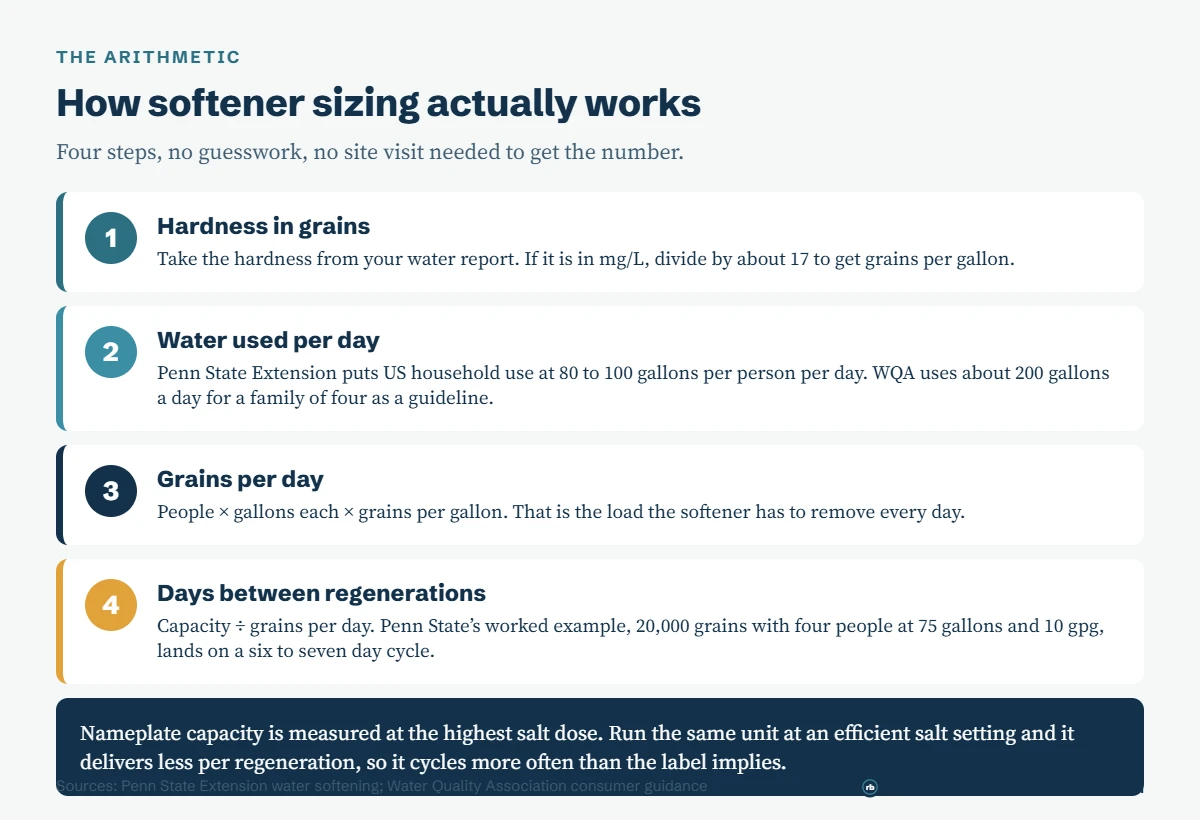
    Four step chart: convert hardness to grains per gallon by dividing mg/L by about 17, use 80 to 100 gallons per person per day, multiply people by gallons by grains per gallon for the daily grain load, then divide capacity by the daily load for days between regenerations
    Four steps give you the number before any dealer visits.

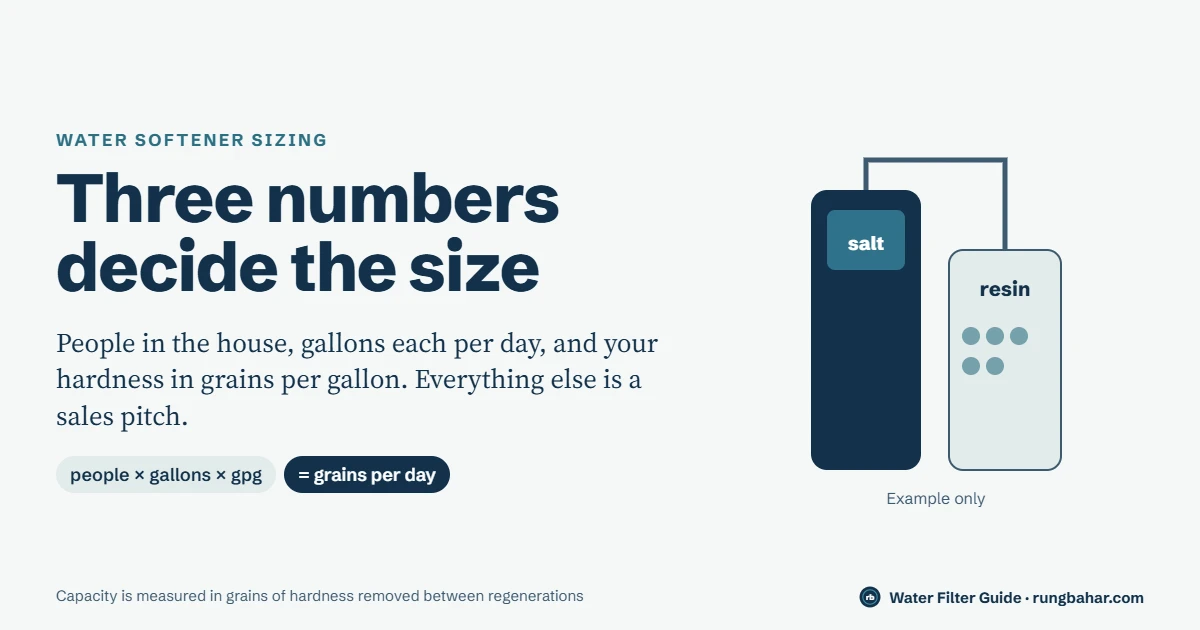
    The three numbers that decide the size

    Softener sizing sounds technical and is not. A softener holds a bed of resin that swaps the calcium and magnesium in your water for sodium or potassium. The bed has a finite capacity, measured in grains of hardness, and when it is used up the unit regenerates with brine and starts again. Sizing is the question of how big that bed should be so it regenerates at a sensible interval.

    Three numbers get you there: how many people live in the house, how many gallons each uses a day, and how hard the water is in grains per gallon. Penn State Extension sets out the same arithmetic in reverse, dividing capacity by daily use to get the regeneration interval: 20,000 grains, four people, 75 gallons each, 10 grains per gallon, which lands on a six to seven day cycle.

    Everything beyond those three numbers, valve brands, resin types, warranty tiers, is a conversation about quality and price, not about size.

    Getting your hardness right

    Use a number from a lab or a utility report rather than a dealer’s free test. Both are usually honest, but only one of them is independent of a sale.

    If your report gives hardness in mg/L as calcium carbonate, divide by about 17 to get grains per gallon. The USGS classification helps you sanity-check the result: up to 60 mg/L is soft, 61 to 120 moderately hard, 121 to 180 hard, and above 180 very hard. In grains, that is roughly 3.5, 7 and 10.5 as the boundaries. Most homes that install a softener are somewhere between 7 and 25 grains per gallon.

    Private well owners should take the hardness number from the same lab report that covers the health-based results, and read the rest of it properly while they are there. Our guide to reading well water test results covers what the other rows mean, and hardness is one of the few lines on that report with no health limit attached at all.

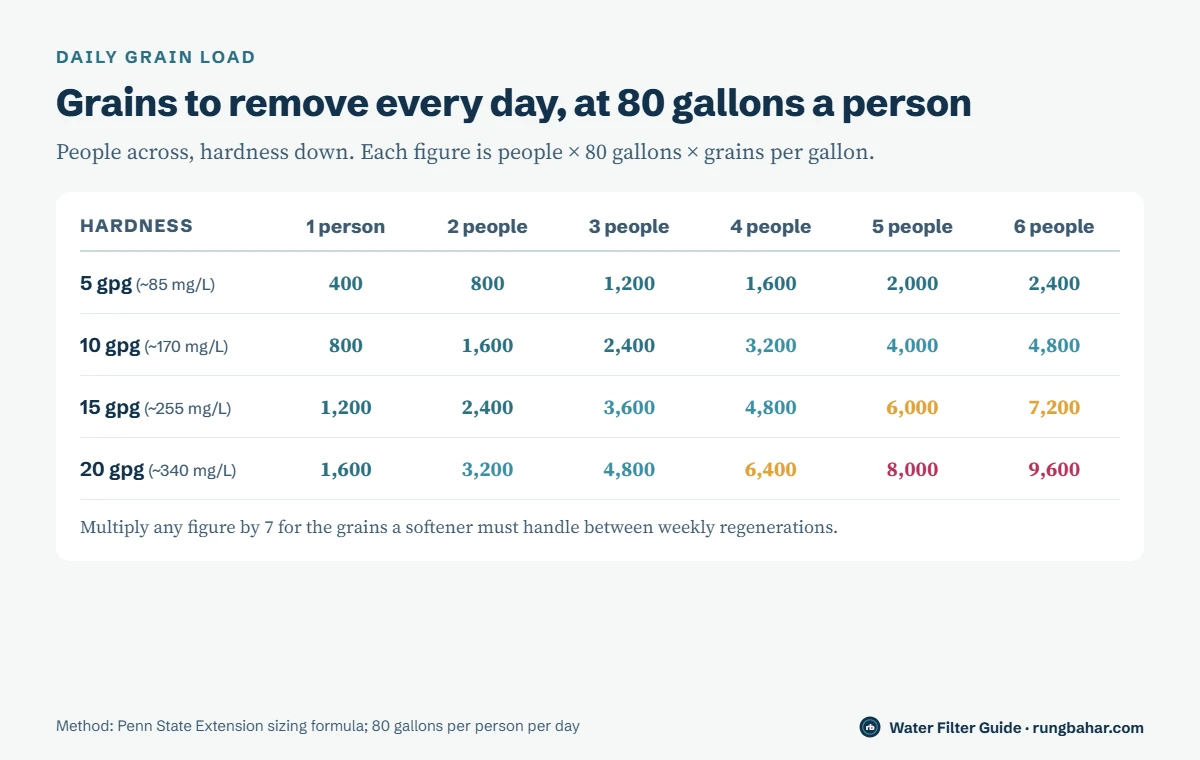
    Table of daily hardness load in grains at 80 gallons per person per day, for households of one to six people at 5, 10, 15 and 20 grains per gallon, ranging from 400 grains a day to 9,600 grains a day
    Find your household size and hardness to get the grains a softener must remove daily.

    Your daily grain load

    Multiply people by gallons by grains per gallon. Penn State Extension puts US household use at 80 to 100 gallons per person per day, and the Water Quality Association uses about 200 gallons a day for a family of four as its guideline, so anything in that range is defensible. If your household is careful with water, 60 is realistic; if you have teenagers and a long shower habit, use 100.

    A few worked examples at 80 gallons a person:

    • Two people at 7 grains per gallon: 1,120 grains a day, 7,840 a week.
    • Four people at 10 grains per gallon: 3,200 grains a day, 22,400 a week.
    • Four people at 20 grains per gallon: 6,400 grains a day, 44,800 a week.
    • Six people at 15 grains per gallon: 7,200 grains a day, 50,400 a week.

    That last column is the one that matters. A softener is normally sized so it can carry about a week of load between regenerations, which is where the familiar 24,000, 32,000 and 48,000 grain ratings come from.

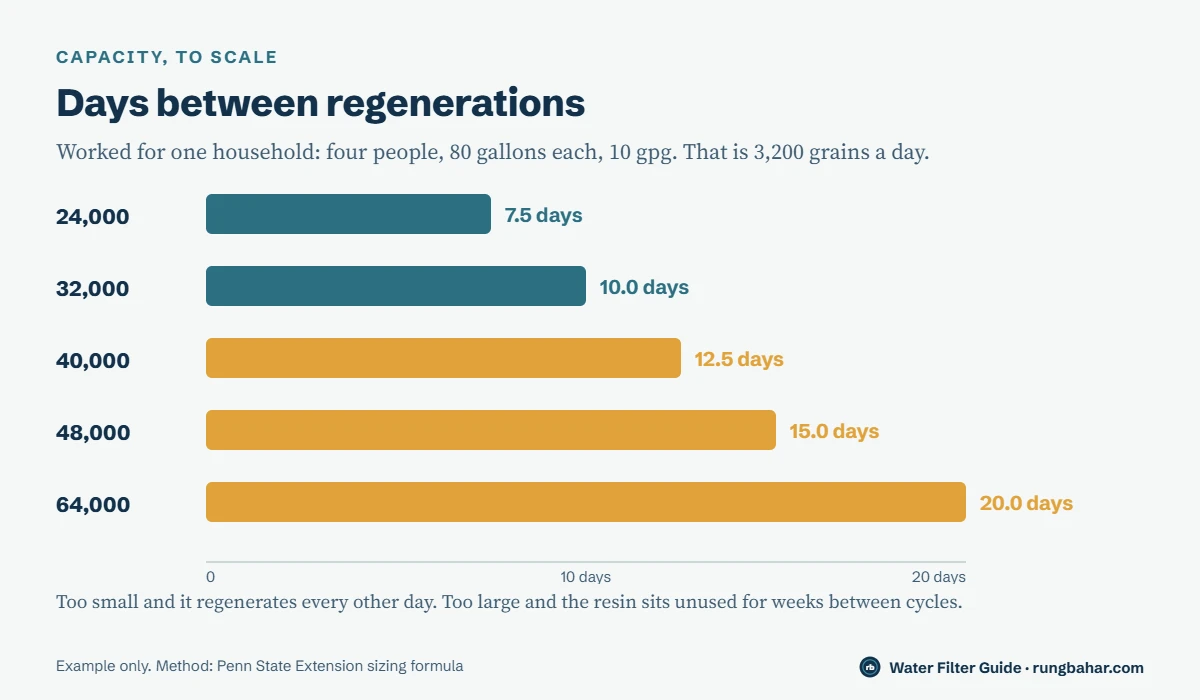
    Bar chart drawn to scale for a four person household at 10 grains per gallon using 3,200 grains a day: a 24,000 grain unit regenerates every 7.5 days, 32,000 every 10 days, 40,000 every 12.5 days, 48,000 every 15 days and 64,000 every 20 days
    Capacity divided by daily load gives the regeneration interval, example only.

    Turning grains into a capacity

    Divide the capacity you are considering by your daily load and you get the regeneration interval in days. For the four-person, 10 grain household using 3,200 grains a day: a 24,000 grain unit regenerates every 7.5 days, a 32,000 every 10, a 48,000 every 15.

    There is one wrinkle worth knowing before a dealer explains it to you. The nameplate capacity on a softener is measured at its highest salt dose. Run the same unit at an efficient salt setting and each regeneration delivers less than the nameplate, so the real interval is shorter than the simple division suggests. That is not a defect; it is the trade-off between salt use and capacity, and it is why two units with the same number on the box can behave differently.

    The practical target is a cycle of roughly three to ten days. Faster than that and you are regenerating constantly, using salt and water on overhead. Much slower and the resin bed sits idle between cycles.

    Why oversizing is not free

    The instinct is to buy big and never think about it again. It is the wrong instinct for three reasons.

    A bigger unit costs more up front, takes more floor space, and needs a larger brine tank. Each regeneration on a larger bed also uses more salt and more water than a smaller one, so if the control valve is set by days rather than by metered use, you pay for capacity you never touched. And a bed that sits unused for two or three weeks between cycles is not doing anything useful in the meantime.

    The other half of the mistake is undersizing to save money, then running the unit at a high salt dose to compensate. That gets you through the week at the cost of salt, water and resin life. Size for the load, then pick the efficiency setting.

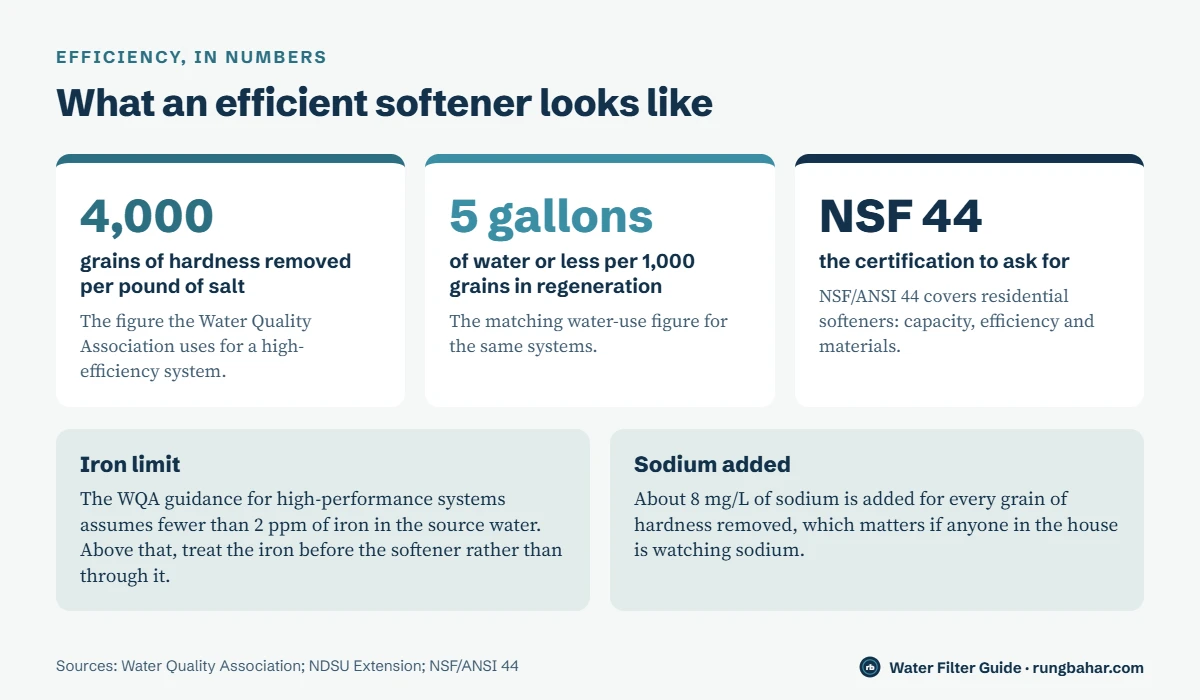
    Three figures for an efficient softener: 4,000 grains of hardness removed per pound of salt, five gallons or less of water per 1,000 grains during regeneration, and NSF/ANSI 44 as the certification to ask for, plus notes that source water should have under 2 ppm iron and that about 8 mg/L of sodium is added per grain of hardness removed
    Efficiency has published numbers; ask for them before you buy.

    Salt and water efficiency

    Efficiency has published numbers, which makes it one of the easier things to hold a dealer to. The Water Quality Association describes high-efficiency systems as removing 4,000 grains of hardness per pound of salt while using no more than five gallons of water per 1,000 grains during regeneration, and says equipment should be tested and certified to NSF/ANSI Standard 44.

    Those two figures turn into a running cost you can estimate before you buy. The four-person household above removes 22,400 grains a week, so at 4,000 grains per pound that is about 5.6 lb of salt a week, and at five gallons per 1,000 grains it is about 112 gallons of water a week going to the drain. Those numbers are worth asking for in writing, because a cheap unit at half that efficiency costs you twice the salt every week for as long as you own it.

    Two more points from the same source. Metered valves, which regenerate based on water actually used rather than on a timer, avoid regenerating a bed that is still half fresh. And about 8 mg/L of sodium is added to the water for each grain of hardness removed, which matters if anyone in the house is watching sodium intake. Many households soften the hot water and the laundry lines and leave the kitchen cold tap unsoftened, or put a reverse osmosis unit at the kitchen sink, which also deals with the contaminants a softener does nothing about.

    The default sensible choice

    Metered softener, sized to your load

    • Certification: NSF/ANSI 44, with the rated capacity and efficiency stated
    • Best for: Most homes between 7 and 25 grains per gallon
    • Skip if: iron is over 2 ppm and untreated

    See certified softeners

    Well water with staining

    Iron filter ahead of the softener

    • Certification: ask for performance data for your iron level and form
    • Best for: Orange staining, iron above the 0.3 mg/L guidance
    • Skip if: the lab found no iron at all

    Read your well results first

    Drinking water, separately

    Reverse osmosis at the kitchen tap

    • Certification: NSF/ANSI 58 naming the contaminants you care about
    • Best for: Households that want softened water but unsoftened-tasting drinking water
    • Skip if: hardness is your only complaint

    Use the filter finder

    Iron, and when a softener is the wrong tool

    A softener is an ion exchange device. It is built for calcium and magnesium, and it copes with small amounts of dissolved iron as a side effect. The WQA’s efficiency guidance assumes source water with fewer than 2 parts per million of iron, and that is a reasonable line to hold.

    Above that, or where the iron has already oxidised into rust particles before it reaches the unit, the resin fouls. A fouled bed loses capacity, and the symptom is a softener that suddenly stops keeping up despite the same settings. The fix is an oxidising filter ahead of the softener, sized to the iron level, rather than a bigger softener.

    Two other things a softener does not do: it does not remove lead, PFAS, nitrate or bacteria, and it does not make water safe that was not safe before. If your test flagged anything health-based, treat that separately and first. Our lead guide and the certification explainer cover what each claim actually proves.

    What to ask before you buy

    Five questions, all answerable in writing, that separate a fair quote from a sales pitch.

    1. What is the rated capacity, and at what salt dose? A capacity figure without the salt dose behind it means little.
    2. Is it certified to NSF/ANSI 44, and what is the efficiency rating? Compare against 4,000 grains per pound of salt.
    3. Is the valve metered or on a timer? Metered regeneration tracks real use and wastes less.
    4. What is the expected salt and water use per week for my hardness and household? You can check their answer against your own calculation above.
    5. What happens with my iron level? If iron is present, ask what pre-treatment they are proposing and why.

    If you are still working out whether a softener is the right purchase at all, hardness is a comfort and appliance-life question rather than a health one, and the five-step buying guide puts it in order against everything else your water might need. The ZIP tap-water check is the quickest route to your utility’s hardness figure if you are on city water.

    Water softener sizing: 14 common questions

    Short answers to what people search most. Each one matches the sources listed at the bottom of this page.

    What size water softener do I need for a family of 4?

    Multiply 4 people by about 80 gallons a day by your hardness in grains per gallon. At 10 grains per gallon that is 3,200 grains a day, or 22,400 a week, which points at a 24,000 or 32,000 grain unit. At 20 grains per gallon the same household needs roughly double that.

    How do I convert mg/L hardness to grains per gallon?

    Divide by about 17. So 170 mg/L is about 10 grains per gallon, and 340 mg/L is about 20. Softeners are sized in grains, so the conversion is the first step in every sizing calculation.

    How many grains per gallon is hard water?

    Using the USGS classification, up to about 3.5 grains per gallon is soft, 3.5 to 7 is moderately hard, 7 to 10.5 is hard and above 10.5 is very hard. Most households that install a softener are above 7.

    How often should a water softener regenerate?

    Roughly every three to ten days for most homes. Much more often and you are spending salt and water on overhead; much less often and the resin bed sits idle between cycles.

    Is a bigger water softener always better?

    No. A larger unit costs more, takes more space, and uses more salt and water per regeneration. If the valve regenerates on a timer rather than on metered use, you pay for capacity you never used.

    How much salt should a water softener use?

    The Water Quality Association describes high-efficiency systems as removing 4,000 grains of hardness per pound of salt. Divide your weekly grain load by 4,000 for a realistic weekly salt figure, and treat anything far above that as an efficiency problem.

    How much water does a softener waste?

    High-efficiency systems use no more than five gallons of water per 1,000 grains removed during regeneration, by the WQA figure. For a household removing 22,400 grains a week, that is around 112 gallons a week.

    What does NSF/ANSI 44 certify?

    It is the standard for residential cation exchange water softeners, covering capacity, efficiency and materials. Asking whether a unit is certified to it, and what efficiency rating it earned, is the cleanest way to compare quotes.

    Will a water softener remove iron?

    Only small amounts of dissolved iron. The WQA efficiency guidance assumes under 2 ppm of iron in the source water. Above that, or where iron has already oxidised, the resin fouls and you need an oxidising filter ahead of the softener.

    Does a water softener remove lead, PFAS or bacteria?

    No. A softener exchanges hardness minerals and nothing else. Lead needs a filter certified to NSF/ANSI 53 for lead, PFAS and nitrate usually need reverse osmosis, and bacteria need disinfection.

    How much sodium does softened water add?

    About 8 mg/L of sodium for every grain of hardness removed. For very hard water that adds up, which is why many homes leave the kitchen cold tap unsoftened or put reverse osmosis on the drinking water line.

    Should I size for peak use or average use?

    Average daily use, with a sensible gallons-per-person figure. Softeners buffer across days, so a single heavy laundry day does not change the sizing; a permanently higher household does.

    Do I need a bigger softener for a well?

    Not because it is a well, but well water is often harder and more likely to carry iron. Size on the measured hardness, and deal with iron separately before it reaches the resin.

    Is a salt-free conditioner the same thing?

    No. Salt-free conditioners aim to stop scale forming rather than to remove hardness minerals, so the grains in your water do not change and sizing in grains does not apply to them in the same way.

    Sources and how we checked this page

    The sizing method and every figure in the calculator come from the sources below, checked on October 7, 2026: Penn State Extension for the arithmetic and water use, the Water Quality Association for efficiency figures and the iron limit, the USGS for the hardness classification, and NSF for certification. The calculator is an estimate from your own inputs; it does not replace a measured hardness test. We do not test products ourselves and we do not quote prices we have not verified.