Published October 12, 2026. Every claim is checked against the sources listed at the end of this page. How we research.
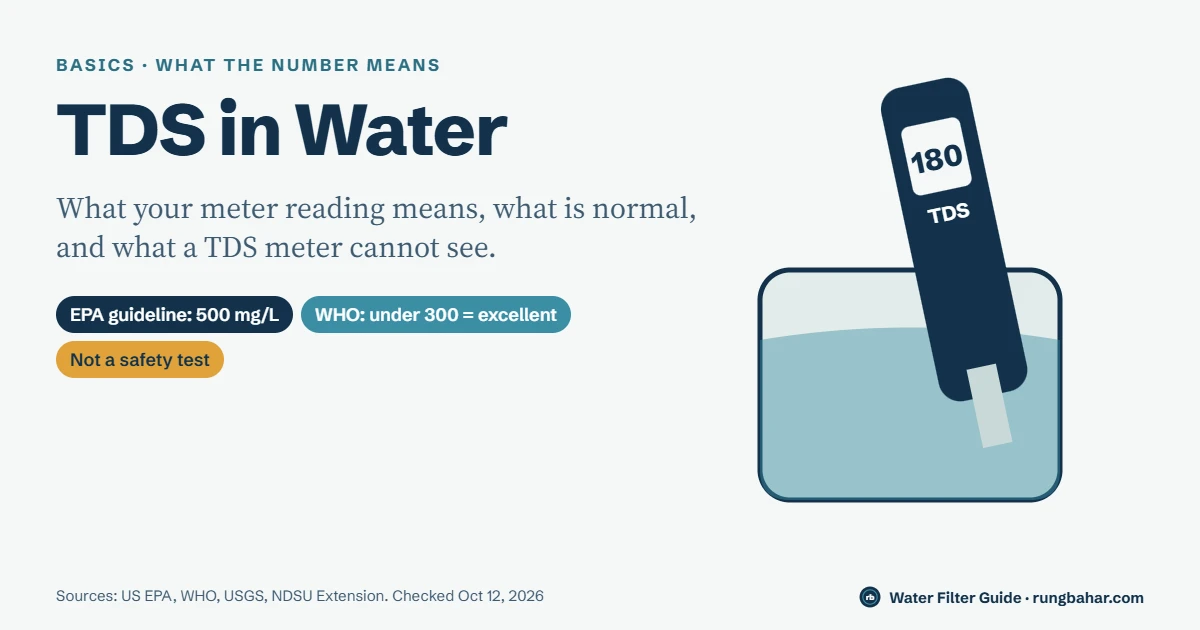
The short answer: TDS (total dissolved solids) is the total amount of minerals, salts and other substances dissolved in water, measured in milligrams per liter (mg/L), which is about the same as parts per million (ppm). Most US tap water reads somewhere between 50 and 400. The US EPA’s guideline is 500 mg/L or less, but it is a non-enforceable taste and staining guideline, not a health limit, and the World Health Organization rates water under 300 mg/L as excellent for taste. A TDS number tells you how mineral-rich your water is. It does not tell you whether your water is safe: lead, PFAS and bacteria are far too small, or the wrong kind of substance, to show up on a TDS meter.
Quick check: what does my reading mean?
1. Where did the water come from?
2. Your TDS reading (ppm or mg/L)
What TDS in water means
Total dissolved solids is a simple idea: if you evaporated a liter of water, the residue left behind is roughly its TDS. In natural and tap water, most of that weight is ordinary minerals picked up as water moves through soil and rock. The World Health Organization lists the main ones as calcium, magnesium, sodium and potassium (the positive ions) and bicarbonate, chloride, sulfate and nitrate (the negative ions).
TDS is reported in milligrams per liter (mg/L). For drinking water, 1 mg/L is close enough to 1 part per million (ppm) that meters and reports use the two interchangeably. So a reading of 180 means about 180 milligrams of dissolved material in every liter.
Two things are not part of TDS. Particles you can see, such as sand, rust flakes or cloudiness, are “suspended” solids, not dissolved ones, and a filter or a settling glass deals with them. Dissolved gases such as chlorine or radon are not counted either. That matters when people use TDS as a shortcut for “how clean is my water”: it is a measure of dissolved minerals and salts, not of everything that can be wrong with water.
Natural water varies enormously. The WHO notes TDS in natural waters ranging from under 30 mg/L to as much as 6,000 mg/L, depending on how soluble the local rock is. For scale, the US Geological Survey classes water under 1,000 ppm as fresh, and seawater holds about 35,000 ppm.
What is a normal TDS level for drinking water?
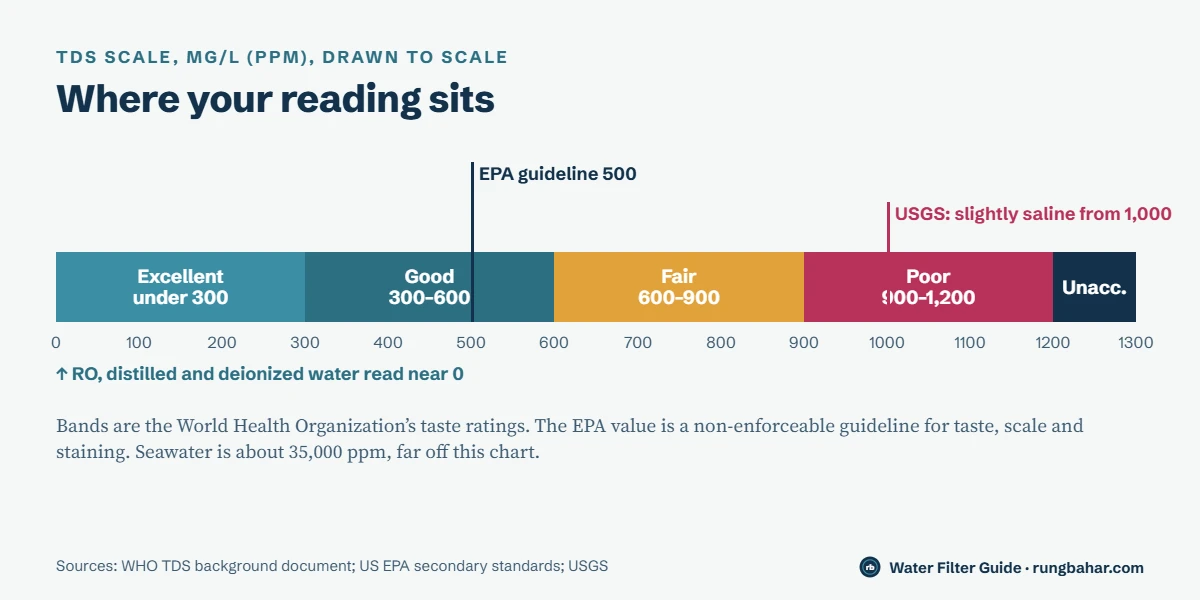
There is no single “normal” number, but there are two official reference points: the US EPA’s secondary guideline of 500 mg/L, and the WHO’s taste ratings, which come from panels of people tasting water at different TDS levels. Together they give a practical scale:
| TDS (mg/L or ppm) | WHO taste rating | What it usually means at home |
|---|---|---|
| Under 50 | Excellent (may taste flat) | Reverse osmosis, distilled or deionized water, or very soft surface water |
| 50–300 | Excellent | Common for US city water; little scale |
| 300–500 | Good | Normal; some scale on kettles; within the EPA guideline |
| 500–900 | Fair (300–600 good, 600–900 fair) | Above the EPA guideline; often hard water, sodium, chloride or sulfate |
| 900–1,200 | Poor | Noticeable mineral or salty taste, heavy scale |
| Over 1,200 | Unacceptable | Common only in some wells and arid regions; lab test advised |
| Over 1,000 | — | USGS: “slightly saline” water starts here |
The EPA guideline is one of its “secondary” standards. The agency describes these as non-enforceable guidelines for cosmetic and aesthetic effects, things like taste, color and staining, and lists the effects of high TDS as hardness, deposits, colored water, staining and a salty taste. Federal rules do not require utilities to meet it, though some states set their own requirements.
If you are on city water, your utility’s annual water quality report (the Consumer Confidence Report) often lists TDS or conductivity in its table of secondary or “other” results. The ZIP code tap-water check on our homepage helps you find yours.
Is high TDS bad for you? Is low TDS bad?
High TDS on its own is mostly a taste and nuisance problem. The WHO states that it does not propose a health-based guideline value for TDS, because the common minerals that make up TDS are not toxic at the levels found in drinking water. What high TDS does cause is practical: scale in kettles, water heaters and on glass, spots on dishes, and a salty or bitter taste.
The catch is that a high number can hide a specific problem. A TDS of 800 made mostly of calcium and magnesium (hard water) is very different from a TDS of 800 with high nitrate from a farm field, or high sodium for someone on a low-salt diet. TDS cannot tell those apart. If your reading is high, the next step is a test that names the components: hardness, sodium, chloride, sulfate and, for wells, nitrate. Hard water, meaning high calcium and magnesium, is the most common cause.
Low TDS is not harmful either. Reverse osmosis and ZeroWater-type filters produce water with a TDS close to zero, and people drink it every day. The WHO notes that very low-TDS water can taste flat and insipid, and that it tends to be corrosive to pipes, which is a concern for water utilities rather than for a glass of filtered water. Most of the minerals people need come from food, not water. We cover the evidence in more depth in is reverse osmosis water good for you?
What a TDS meter measures, and what it misses
A handheld TDS meter does not weigh anything. It measures electrical conductivity: dissolved minerals are charged ions, and the more ions in the water, the better it conducts electricity. The meter then multiplies conductivity by a conversion factor to estimate TDS. North Dakota State University Extension notes that the right factor changes with the water, from about 0.5 for low-mineral water to about 0.8 for very salty water, which is why two meters can disagree and why a meter reading is always an estimate.
This method has two big blind spots:
- Things that are not charged ions do not register. Many organic chemicals, including many pesticides, solvents and PFAS at the levels found in tap water, add essentially nothing to conductivity. Bacteria and viruses do not register at all.
- Things that are dangerous at tiny amounts are too small to see. The EPA’s maximum contaminant level for PFOA and PFOS is 4 parts per trillion, and lead is a concern at a few parts per billion. A tap reading of 200 ppm is about 50 million times larger than 4 parts per trillion. Even a lead level that would alarm a utility changes a TDS reading by a fraction of one digit.
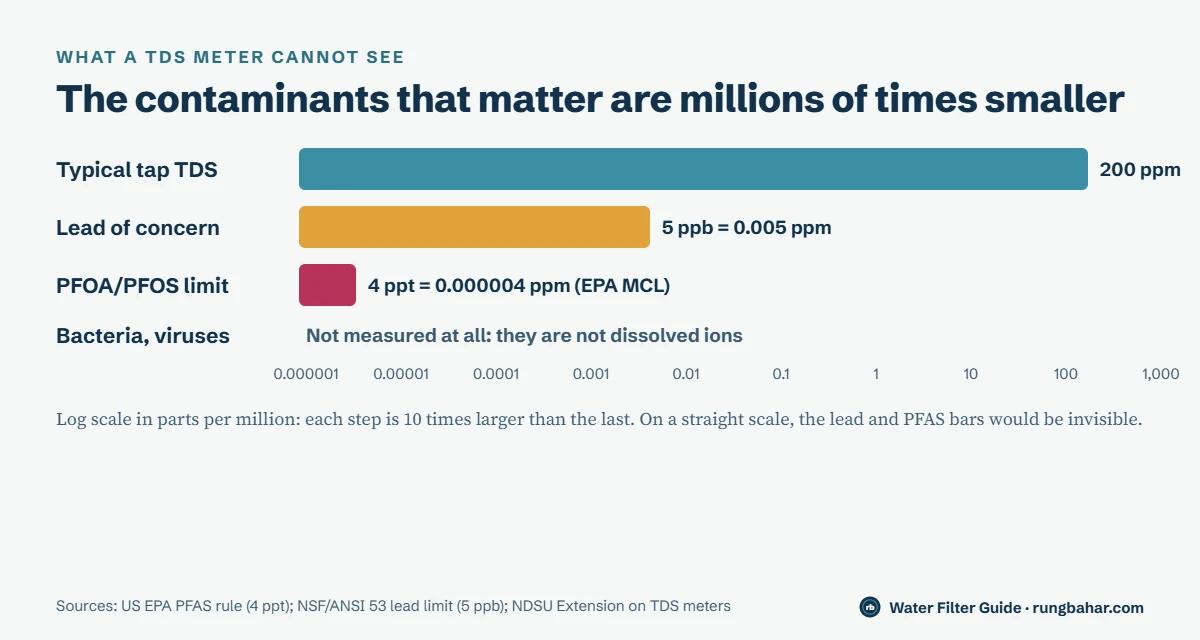
So a TDS meter is useful for three jobs: seeing how mineral-rich your water is, checking whether a reverse osmosis system or ZeroWater-type filter is still doing its job, and tracking changes in a well over time. It is not a safety test, and a low reading is not proof that water is free of lead, PFAS or germs. Be wary of anyone selling a filter by showing a TDS meter drop on a carbon filter, or claiming that a high reading proves your water is unsafe. For lead, see how to test for lead in tap water; for PFAS, how to find out if your water has PFAS.
TDS and water filters: which ones change the number
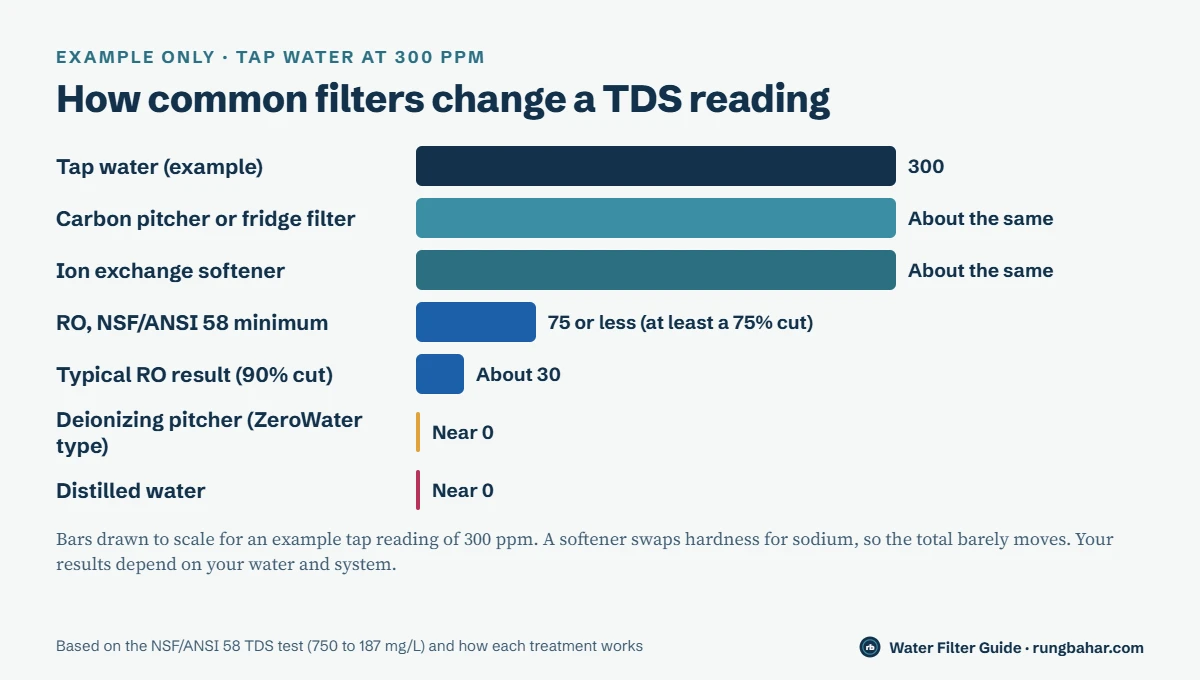
Different filter types change TDS very differently, which is useful to know when you test before and after:
| Treatment | Effect on TDS | Why |
|---|---|---|
| Activated carbon (most pitchers, fridge filters, faucet filters) | Little change | Carbon targets chlorine and organic chemicals, not dissolved minerals |
| Reverse osmosis (NSF/ANSI 58) | Large drop | The membrane rejects most dissolved ions; the certification test requires at least a 75% cut |
| Deionizing pitcher (for example ZeroWater) | Near zero | Ion exchange resin removes almost all ions until it is used up |
| Distillation | Near zero | Minerals stay behind when water is boiled off |
| Ion exchange water softener | Little change | Swaps calcium and magnesium for sodium or potassium; the total stays similar |
| Salt-free conditioner | No meaningful change | Changes how minerals form scale, does not remove them |
| Remineralizing cartridge after RO | Small rise | Adds calcium and magnesium back on purpose |
Two consequences follow. First, if your carbon pitcher reads the same before and after, the filter is not broken; TDS is simply the wrong test for it. Our comparison of ZeroWater vs Brita shows why the two pitchers read so differently. Second, a water softener will not fix a high TDS reading, even though it fixes hard-water scale. If your TDS is high because of hardness, see salt vs salt-free softeners and the softener size calculator; if it is high because of sodium, chloride or sulfate, reverse osmosis is the household fix.
What is a good TDS for RO water?
Under NSF/ANSI 58, the certification standard for home reverse osmosis systems, the test water has a TDS of 750 mg/L and the system must bring it down to 187 mg/L or less, a cut of at least 75 percent. Certified systems often do better: one current under-sink data sheet, for example, reports a 91 percent reduction. In practice, RO output is usually a small fraction of your tap reading.
An easy way to judge your own system is to compare the two numbers, not to aim for a magic value. As an example only: tap water at 300 ppm and RO water at 20 ppm is a 93 percent reduction, which is healthy. If, months later, the RO reads 60 with the same tap water, rejection has dropped to 80 percent, and it is time to check the prefilters and membrane. A remineralizing stage will raise the reading on purpose, so measure before it if you can. For what RO removes besides minerals, see what reverse osmosis removes.
How to test TDS at home
- Use a TDS or conductivity meter with automatic temperature compensation; readings change with water temperature.
- Run the cold tap for a few seconds, then fill a clean glass. Do not test hot water.
- Dip the probe to the marked depth, stir gently to clear air bubbles, and wait for the number to settle.
- Rinse the probe with the water you are about to test, and dry it after use.
- For a filter check, test tap water and filtered water within a few minutes of each other and compare.
- Write the number down with the date. For a well or an RO system, the trend over months matters more than one reading.
If your reading looks odd, check the meter in a known sample. Bottled water labels sometimes list TDS or “dissolved solids at 180°C”, and distilled water should read close to zero.
When to get a lab test instead of a TDS reading
A TDS meter is a starting point. Use a certified laboratory when:
- You are on a private well. Test at least for bacteria, nitrate and arsenic, then add what local conditions call for. Our well water results chart explains the numbers.
- Your TDS is over 500 and you want to know why, or over 1,000 at any time.
- The reading jumps suddenly, for example after flooding, nearby drilling or a change in taste or color.
- Someone in the home is an infant, pregnant, or on a low-sodium diet, and you need sodium or nitrate numbers, not a total.
- You are worried about lead, PFAS or bacteria. No home TDS meter can detect them.
If you are trying to decide on a filter, the filter finder matches your concern to the right filter type in about 15 seconds, and how to choose a water filter walks through it step by step.
TDS in water: 14 common questions, answered
These are the questions people search most about TDS, answered from EPA, WHO, USGS and university extension sources.
What does TDS mean in water?
TDS stands for total dissolved solids: the combined amount of minerals, salts and other substances dissolved in water, measured in mg/L or ppm. It is mostly calcium, magnesium, sodium, bicarbonate, chloride and sulfate.
What is a good TDS level for drinking water?
Under 300 mg/L is rated excellent for taste by the WHO, and under 500 meets the US EPA’s non-enforceable guideline. Water below 50 is also fine to drink but may taste flat.
What is the normal range of TDS in tap water?
Most US tap water reads somewhere between about 50 and 400 ppm, but it depends on local geology. Your utility’s annual water quality report often lists TDS or conductivity.
Is TDS in water good or bad?
Neither on its own. TDS mostly reflects harmless minerals. Very high TDS causes taste and scale problems; very low TDS can taste flat. Neither number tells you whether harmful contaminants are present.
Is high TDS water harmful?
The WHO does not set a health-based limit for TDS. High TDS is mainly an aesthetic problem, but it can hide specific issues such as high sodium or nitrate, so a high reading is worth a lab test that names the components.
Is 0 TDS water safe to drink?
Yes. Reverse osmosis, distilled and deionized water read near zero and are safe to drink. Some people find the taste flat, and you still get most minerals from food.
Does a TDS meter detect lead?
No. Lead is a concern at a few parts per billion, far too small to change a TDS reading, so a normal TDS reading says nothing about lead. Use a lead test.
Does a TDS meter detect PFAS or bacteria?
No. PFAS matter at parts per trillion and add almost nothing to conductivity, and bacteria do not register at all. Use a lab test or your utility’s reports.
Why does my Brita filter not lower TDS?
Carbon pitcher filters like Brita target chlorine and certain contaminants, not dissolved minerals, so TDS stays about the same. It does not mean the filter has stopped working.
What is a good TDS for RO water?
Certified RO systems must cut a 750 mg/L test water to 187 or less, and many do better. Compare your RO reading with your tap reading; a reduction well above that 75 percent minimum is a good sign.
Does a water softener reduce TDS?
Not much. An ion exchange softener swaps calcium and magnesium for sodium or potassium, so the total dissolved solids stay about the same even though scale stops.
Does boiling water reduce TDS?
No. Boiling drives off water, so dissolved minerals become slightly more concentrated. Distillation, which collects the steam, is what removes them.
How accurate are cheap TDS meters?
They estimate TDS from conductivity with a fixed conversion factor, so readings can differ from a lab result by a noticeable margin. They are best for comparing two samples with the same meter.
What TDS is too high for a well?
Over 500 mg/L exceeds the EPA guideline and over 1,000 is considered slightly saline by the USGS. Either is a reason for a full lab test, which a TDS meter cannot replace.
Sources and how we checked this page
Every claim on this page comes from the US EPA, the World Health Organization, the US Geological Survey, North Dakota State University Extension and manufacturer data sheets, checked on October 12, 2026. We did not test water or meters ourselves. This page is general information, not medical advice.
- US EPA: secondary drinking water standards (TDS 500 mg/L)
- World Health Organization: total dissolved solids in drinking-water, WHO/SDE/WSH/03.04/16 (PDF)
- US Geological Survey: saline water and salinity
- NDSU Extension: using EC and TDS meters to field-test water quality (WQ1923)
- US EPA: PFAS national primary drinking water regulation
- A. O. Smith: example NSF/ANSI 58 performance data sheet with the 750 mg/L TDS test (PDF)
- ZeroWater: How long will my ZeroWater filter last? (TDS chart)
- US EPA: Consumer Confidence Reports (find your water quality report)