Published October 9, 2026. Every claim is checked against the sources listed at the end of this page. How we research.
The short answer: You cannot see, taste or smell lead in tap water, and most people have no symptoms, so the only way to know is to test. Lead usually comes from your own plumbing: a lead service line, lead solder or old brass fixtures. Test with a certified lab using water that sat in the pipes for 6 hours. If lead shows up, drink and cook with cold water through a filter certified to NSF/ANSI 53 for lead, and ask your utility about your service line.
Quick check
What is your situation with lead?
Where lead in tap water comes from
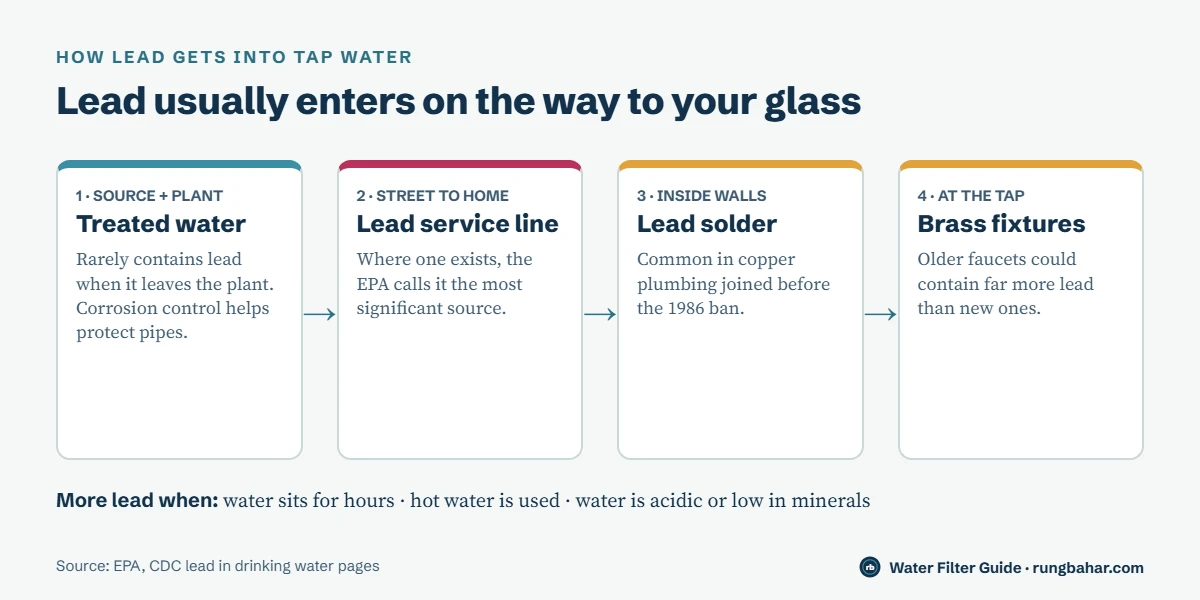
Lead rarely starts in the river, lake or aquifer your utility draws from. It usually enters water on the way to your glass, as water sits in or flows through plumbing that contains lead. The EPA names three main sources:
- Lead service lines. The pipe that connects the water main in the street to your home. Where one exists, the EPA says it is typically the most significant source of lead in the water.
- Lead solder. Used to join copper pipes in many homes before the federal ban took effect in 1986.
- Brass and chrome-plated brass faucets and fittings. Older fixtures could legally contain far more lead than new ones.
How much lead dissolves depends on the water and the pipes. The EPA and CDC list acidity, low mineral content, temperature, pipe wear and, above all, how long water sits still. That is why the first glass in the morning, or after a vacation, tends to carry the most lead, and why hot water from the tap is riskier than cold.
The age of your home is the best quick clue. The 1986 Safe Drinking Water Act amendments banned plumbing that was not “lead free” from that June on, although “lead free” then still allowed up to 8% lead in pipes and 0.2% in solder. A 2011 law, in force since January 4, 2014, cut the limit to a 0.25% weighted average across the surfaces water touches. So a home built before 1986 has the highest odds of lead parts, a home from 1986 to 2013 can still have leaded brass fixtures, and the newest plumbing contains very little.
Many utilities treat water to make it less corrosive, which keeps lead from leaching. That protection works well most of the time, but a change in treatment or source can undo it. Flint, Michigan is the best-known case. Flint has been below the federal action level since July 2016, and the state reports about 98% of its residential lead lines replaced.
Signs and symptoms: what you can and cannot notice
People search for “signs of lead in water” hoping for a color, a taste or a smell. There isn’t one. The CDC states plainly that lead cannot be seen, tasted or smelled in drinking water. Rusty or discolored water points to iron or sediment, not lead, though old galvanized pipes that rust can also hold lead picked up from upstream lead pipe. Clear water can still contain lead.
Lead in the body is also quiet. The CDC says most children with lead exposure have no obvious immediate symptoms, and that no safe blood lead level in children has been identified. The effects it lists build over time:
| Who | Effects reported by the CDC and EPA |
|---|---|
| Children | Damage to the brain and nervous system, slowed growth and development, learning and behavior problems, lower IQ, hearing and speech problems, anemia |
| Pregnancy | Lead stored in the mother’s bones can be released, which is linked to reduced fetal growth and premature birth |
| Adults | Higher blood pressure and heart problems, reduced kidney function |
The only way to know whether someone has been exposed is a blood lead test, which most doctors and health departments offer. The CDC uses a blood lead reference value of 3.5 micrograms per deciliter to flag children with more lead than most kids their age. If you have a young child or are pregnant and your water tests positive for lead, ask your doctor about a blood test. Water is one source among several. Old lead paint and dust are another major one.
For questions about symptoms or treatment, talk to a doctor. This page covers the water side: how to find lead, how to measure it, and how to remove it.
Check your service line in 2 minutes
You can often identify your service line yourself. The EPA’s Protect Your Tap guide needs only a coin or key and a magnet. Find where the water pipe enters your home, usually near the water meter in a basement, crawl space or utility closet. Look at the few inches of pipe before the meter or shutoff valve. If it is painted, sand a small spot first.
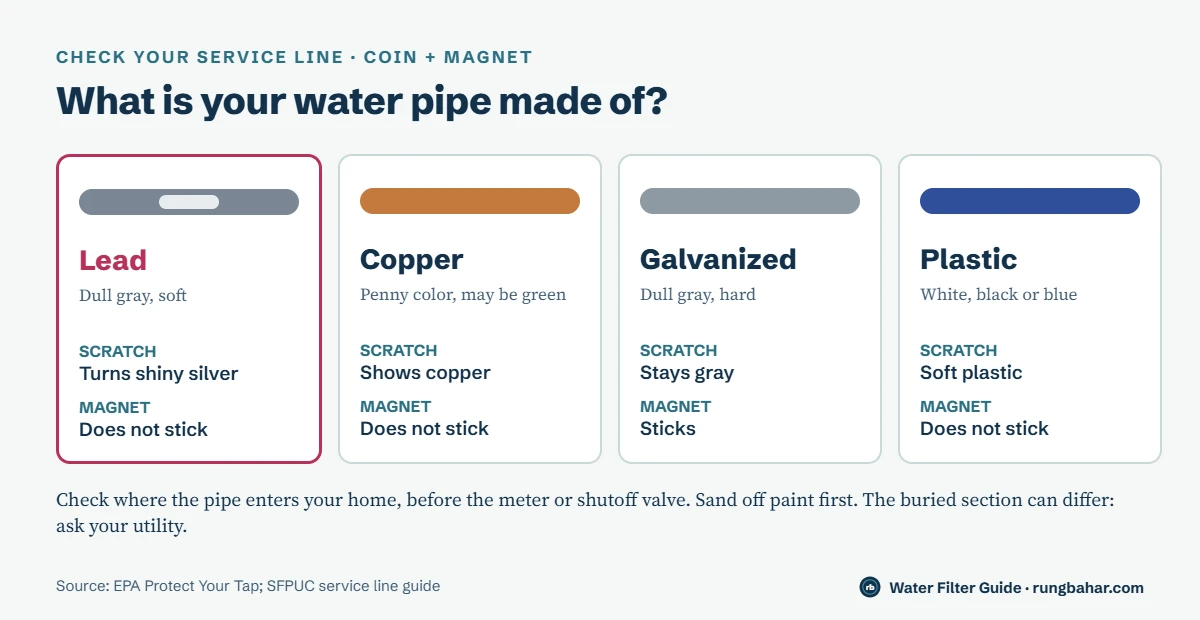
- Lead: dull gray, soft. Scratching it gently with a coin or key leaves a shiny silver mark. A magnet does not stick.
- Copper: the color of a penny, sometimes with green spots. Scratching shows copper. A magnet does not stick.
- Galvanized steel: dull gray, hard. A scratch stays gray, and a magnet sticks. Galvanized pipe that sat downstream of a lead line can hold lead too.
- Plastic: usually white, black or blue, often with printing on it.
The pipe inside your home is only part of the line. The section under the street or yard can be a different material. Your utility’s records help fill that gap. Under federal rules, every community water system had to build a service line inventory and make it public by October 16, 2024. Homes with a lead, galvanized-requiring-replacement or “unknown” line had to be told so, and those notices continue every year. If you never saw one, call your utility and ask what its inventory lists for your address. Our ZIP code water check tells you which system serves you and its recent lead results from EPA records.
How to test your water for lead
A test of your own tap is the only way to know your lead level. A utility’s average says little about one home, because the lead usually comes from that home’s pipes and fixtures.
Take a first-draw sample
- Do not use water from that tap for at least 6 hours. Overnight is easiest.
- Use the cold kitchen or bathroom tap you drink from. Do not run the water first.
- Fill the lab’s bottle (usually 1 liter) right away, close it and follow the lab’s shipping instructions.
- Write down the date, the time of the last use, and whether you have removed the aerator. Labs and utilities may ask.
A first-draw sample shows the worst-case water sitting in your fixture and nearby pipe. Some labs or utilities also ask for a second sample after running the water, to see whether the lead comes from the faucet or from farther back in the line. New federal rules for homes with lead lines use a similar idea: utilities collect both the first and the fifth liter and use the higher result.
Certified lab or home test kit?
| Option | What it costs | How reliable | Use it for |
|---|---|---|---|
| Free utility test | Free where offered | Lab analysis | Your first step: many public systems test on request |
| State-certified lab | About $15 to $100 (EPA estimate) | Measures in ppb, catches low levels | The result you act on |
| Home test strip | Varies | Often misses lead at levels that matter | A rough screen at most; confirm with a lab |
The doubts about strips come from evidence. A 2021 Virginia Tech study in Environmental Science & Technology checked 16 consumer kits. Twelve had detection limits of 5 to 20 milligrams per liter, which is hundreds to over a thousand times above the 15 parts per billion action level. Simple yes/no strips picked up dissolved lead better but missed lead particles. The San Francisco utility also rated kit results for lead as mixed and advises confirming any worrying reading with a certified lab.
To find a certified lab, use the EPA’s list of state lab certification programs. The EPA itself does not test home water on request. On a private well, testing is fully your job, and your state health department can point you to labs.
How to read a lead result
Lead results are usually in parts per billion (ppb), the same as micrograms per liter (µg/L). Some labs report milligrams per liter (mg/L). To convert, multiply mg/L by 1,000: 0.015 mg/L is 15 ppb. “ND” or “<” means below what the lab can measure, not proof of zero.
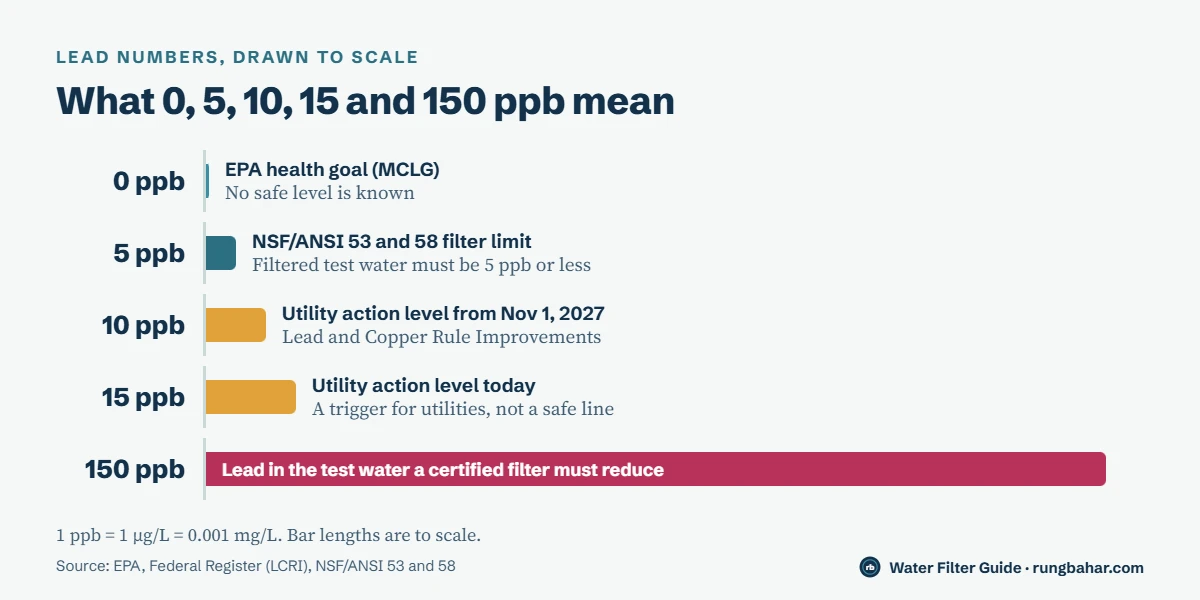
The numbers in the chart mean different things, and mixing them up causes a lot of confusion:
- 0 ppb, the health goal. The EPA’s maximum contaminant level goal for lead is zero, because no safe level is known.
- 5 ppb, the filter test. To earn an NSF/ANSI 53 or 58 lead claim, a filter must cut test water spiked to 150 ppb down to 5 ppb or less. The bar was 10 ppb until a 2019 update.
- 10 ppb, the new action level. Starting November 1, 2027, utilities must act if more than 10% of homes they sample exceed 10 ppb.
- 15 ppb, today’s action level. The current trigger for utility action. It is a treatment trigger, not a safety line for your glass.
So a 6 ppb result does not mean your water is “safe” because it is under 15. It means there is lead in your water, at a level a certified filter is built to handle. Retest after changes such as plumbing work, a new filter, or a utility notice about treatment changes.
What federal lead rules say now
The EPA finalized the Lead and Copper Rule Improvements (LCRI) in October 2024, and it took effect December 30, 2024. Its main changes for households:
- The lead action level drops from 15 to 10 ppb, with compliance starting November 1, 2027.
- Utilities must replace lead and certain galvanized service lines under their control, generally within 10 years. Cities with very many lead lines can get longer deadlines.
- Sampling in homes with lead lines uses the higher of the first- and fifth-liter results, which catches more lead from the line itself.
- Utilities must keep updating service line inventories and notifying affected homes.
The rule is being challenged in court by the American Water Works Association. The EPA said in August 2025 that it would defend the rule, and oral argument was held on September 30, 2026. A decision has not been issued. The EPA now estimates about 4 million lead service lines in the US, down from an earlier estimate of about 9 million, as utilities have identified more of their pipes. Chicago alone has more than 400,000 confirmed or suspected lead lines.
Replacement takes years even where funding exists. A filter is the practical protection in the meantime.
What to do today if you might have lead
- Use only cold water for drinking, cooking and baby formula. Hot water dissolves more lead.
- Flush pipes before drinking by running the tap, showering or running a load of laundry or dishes. The EPA does not give one fixed time, because it depends on whether you have a lead line and how long it is. Ask your utility how long to flush.
- Clean faucet aerators regularly. Lead particles can collect in the screen.
- Do not boil water to remove lead. It stays behind and can concentrate slightly. See what boiling does and does not remove.
- Use a filter certified for lead at the tap you drink from, and change cartridges on time.
- Ask about replacement. If you have a lead line, ask your utility about its replacement program and any help with the private side of the line.
What about showers? The EPA says bathing and showering should be safe even if water contains lead above the action level, because human skin does not absorb lead in water. The concern is water you drink or cook with.
Filters that work for lead
Look for a certification, not marketing words. The certification that matters for lead is NSF/ANSI 53 (or NSF/ANSI 58 for reverse osmosis) with lead listed as a certified reduction claim. The EPA’s consumer tool for lead filters also advises looking for NSF/ANSI 42 Class I particulate reduction, because some lead travels as tiny particles. Our guide to NSF 53 vs 58 explains how the two health standards differ.
Watch for one common mix-up. NSF/ANSI/CAN 372 certifies that a product’s own parts are low in lead (no more than 0.25% weighted average). It says nothing about removing lead from water. A filter that shows only “372” has not been shown to reduce lead. Our certifications explainer covers all the numbers you will see on a box.
| Filter type | Can be certified for lead? | Good to know |
|---|---|---|
| Pitcher | Yes, some models | Cheapest start. Small volume and slow; only some cartridges carry a lead claim |
| Faucet-mount | Yes, many models | Filters on demand at the kitchen tap; does not fit every faucet |
| Refrigerator | Some cartridges | Depends on the exact part number |
| Under-sink carbon | Yes, many models | More capacity; needs a cold-water connection |
| Reverse osmosis | Yes (NSF/ANSI 58) | Also reduces fluoride, nitrate, arsenic and more; wastes some water |
| Whole-house | Rarely the right tool | Lead usually enters at fixtures and the line; filter at the tap you drink from |
A few examples we checked on manufacturer pages on October 7, 2026. These are examples, not tested picks:
- Brita Elite pitcher filter: Brita says it is certified to NSF/ANSI 53 for lead, reduces 99% of lead, and should be replaced every 120 gallons, about 6 months for an average family.
- PUR faucet filters: PUR sells a faucet filter it calls its “Lead Reducing Faucet Filter” and rates its faucet filters for 100 gallons or 3 months.
- Refrigerator cartridges: some carry NSF/ANSI 53 lead claims, such as the everydrop Filter 1, which its listings rate at 200 gallons or 6 months. Many cheaper look-alike cartridges carry no lead claim.
Lowest cost to start
Pitcher or faucet filter certified for lead
- Certification: NSF/ANSI 53 with lead listed, ideally 42 Class I too
- Best for: Renters, small households, low or occasional lead
- Skip if: you need lots of water or have a confirmed lead line
Most homes
Under-sink filter certified for lead
- Certification: NSF/ANSI 53 for lead
- Best for: Families who drink and cook from one kitchen tap
- Skip if: you cannot connect to the cold line under the sink
Lead plus more
Reverse osmosis system
- Certification: NSF/ANSI 58 with lead listed
- Best for: Lead plus fluoride, nitrate, arsenic or PFAS
- Skip if: you have no space under the sink
Not sure which type fits your kitchen and budget? The filter finder asks a few quick questions, and our water filter buying guide walks through the full decision.
How to verify a lead claim in 3 minutes
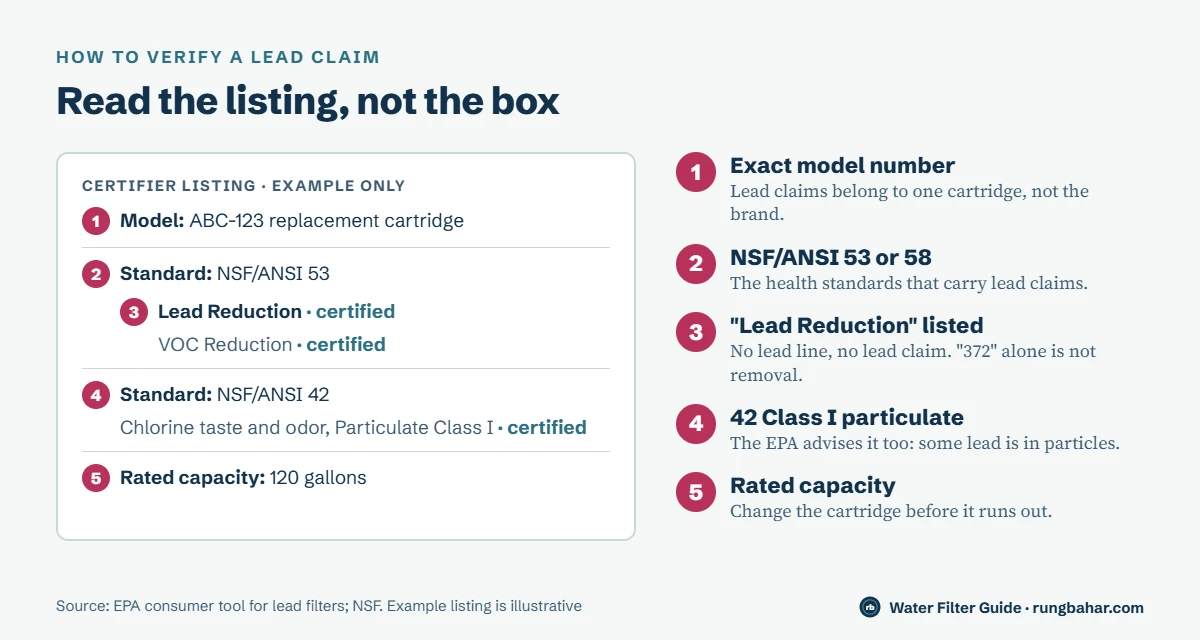
- Find the exact model or cartridge number on the box or product page.
- Open the certifier’s listing: NSF, IAPMO R&T, WQA, UL Solutions or CSA. The EPA accepts all five.
- Search the model number and look for “Lead Reduction” under NSF/ANSI 53 or 58.
- Open the performance data sheet and note the rated capacity in gallons. That is when the lead claim stops being backed.
“Tested to” or “meets the standard” wording is weaker than “certified.” It may mean a single lab test the brand paid for, without ongoing audits. Our step-by-step guide shows how to check if a filter is really NSF certified, with screenshots of what a real listing looks like.
Lead in tap water: 14 common questions
Short answers to what people search most, based on EPA and CDC sources checked October 7, 2026.
What are the signs of lead in tap water?
There are none you can detect. The CDC says lead cannot be seen, tasted or smelled in water. Only a lab test of your tap shows it.
What are the symptoms of lead in water in adults?
Often none at first. Over time the EPA and CDC link lead to higher blood pressure, heart problems and reduced kidney function. A blood test is the only way to check exposure; ask your doctor.
What are the symptoms of lead exposure in kids?
Most children have no obvious symptoms. Lead is linked to learning and behavior problems, slowed growth, and hearing and speech problems. Ask your pediatrician about a blood lead test.
How do I test my water for lead?
Collect a first-draw sample from the cold tap after the water sits at least 6 hours, and send it to a state-certified lab. Ask your utility first: many test for free.
Are lead in water test kits accurate?
Often not at the levels that matter. A 2021 study found most of 16 kits could not detect lead near 15 ppb. Use a certified lab for a result you act on.
What level of lead in water is safe?
The EPA’s health goal is zero. The 15 ppb action level (10 ppb from November 2027) is a trigger for utilities, not a safe level for your glass.
Does a Brita filter remove lead?
The Brita Elite filter is certified to NSF/ANSI 53 for lead, according to Brita. Its standard filter is a different product. Check the exact cartridge on the certifier’s listing.
Does ZeroWater remove lead?
ZeroWater says its 5-stage filter is IAPMO certified to reduce lead under NSF/ANSI 53. Its rated capacity is small, so change it on schedule.
Does boiling water remove lead?
No. Lead stays in the water and can concentrate slightly as water evaporates. Use a certified filter instead.
Can you shower in water with lead?
Yes. The EPA says bathing and showering should be safe even above the action level, because human skin does not absorb lead in water.
How do I know if I have lead pipes?
Scratch the pipe where it enters your home with a coin. Lead is soft and turns shiny silver, and a magnet will not stick. Your utility’s service line inventory may also list it.
Who pays to replace a lead service line?
It depends on your utility and state. Many programs now replace the public side and help with the private side. Ask your utility about its program.
Is lead in well water a concern?
Yes. Well owners must test on their own, and lead can come from the well pump, fittings or home plumbing. Use a state-certified lab.
Does a refrigerator filter remove lead?
Only if that exact cartridge is certified to NSF/ANSI 53 for lead. Many are not. Look up the part number on the certifier’s listing.
Sources and how we checked this page
Facts on this page come from the EPA, the CDC, the Federal Register, NSF and peer-reviewed research, checked on October 7, 2026. Product details come from manufacturer pages on the same date. We do not test water or filters in a lab.
- EPA: Basic information about lead in drinking water
- CDC: Lead in drinking water
- CDC: About childhood lead poisoning prevention
- CDC: Symptoms and complications of lead exposure
- EPA: Protect Your Tap, a quick check for lead
- EPA: Lead and Copper Rule Improvements
- Federal Register: Lead and Copper Rule Improvements final rule (Oct 30, 2024)
- Louisiana Department of Health: LCRI FAQ, compliance dates (May 2026)
- NRDC: AWWA v. EPA, Lead and Copper Rule Improvements case
- EPA: 7th Drinking Water Infrastructure Needs Survey update, 4 million lead lines (Nov 2025)
- EPA: Service line inventory requirements (Nov 2025)
- EPA: Use of lead-free pipes, fittings, fixtures, solder and flux
- EPA: Consumer tool for identifying filters certified to reduce lead
- EPA: Certified laboratories for drinking water
- Water Online: Stricter lead reduction requirements for NSF/ANSI 53 and 58 (2020)
- WC&P: A closer look at NSF/ANSI/CAN 372 low-lead certification (2024)
- Virginia Tech: Kriss et al., evaluation of consumer lead test kits (2021)
- SFPUC: Home test kits
- SFPUC: How to check your water service line for lead
- Michigan EGLE: Flint enters 10th year of lead compliance (Feb 2026)
- Inside Climate News: Chicago lead service lines (Sep 2025)
- Brita: Lead reduction and Elite filter
- PUR: Faucet filter
- ZeroWater: Certified results
- NSF: Certified drinking water treatment units listing