Published October 6, 2026. Every claim is checked against the sources listed at the end of this page. How we research.
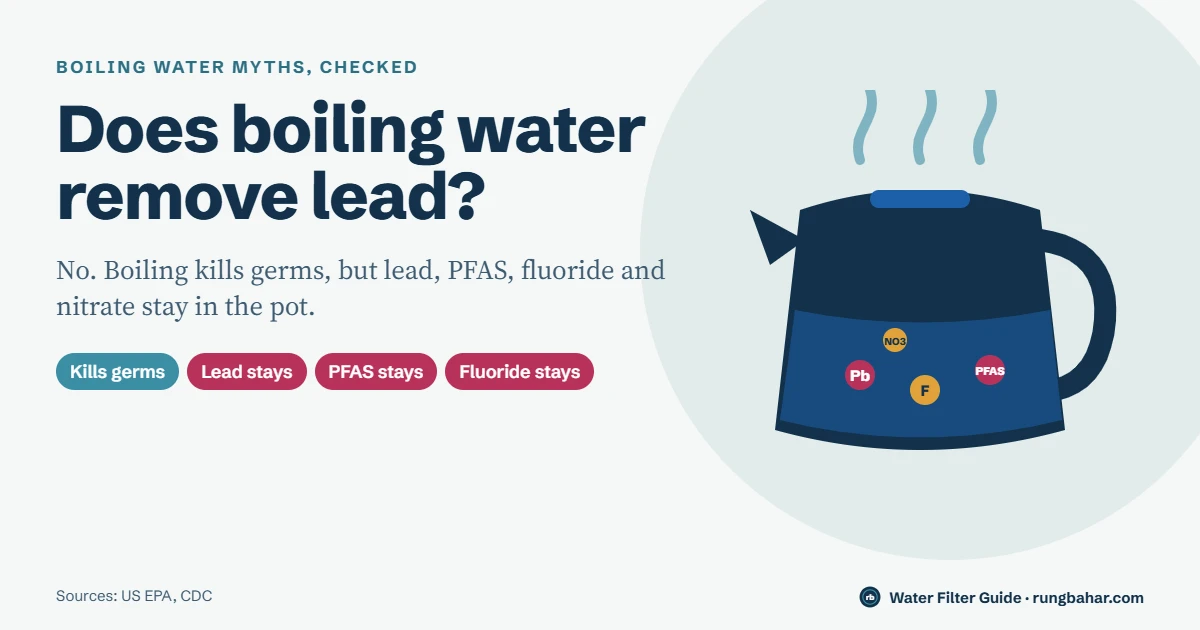
The short answer: No. Boiling water does not remove lead, and the US EPA and CDC both say so. Because some water evaporates while the lead stays behind, boiling can leave slightly more lead in each glass. Boiling kills bacteria, viruses and parasites, but it does not remove PFAS, fluoride, nitrate or arsenic either. For lead, use cold water and a filter certified to NSF/ANSI 53 for lead reduction.
Quick check
What are you worried about in your water?
Does boiling water remove lead?
No. The EPA answers this question with one word: no. The CDC is just as direct and says boiling water will not reduce the amount of lead in it. Lead is a metal. It does not turn into steam at the temperature of a kettle, so it stays in the pot while some of the water leaves.
Some state health agencies go a step further. The Massachusetts Department of Public Health warns that if there is lead in your water, boiling it will increase lead levels. That happens because the same amount of lead ends up in less water. The effect is small for a quick boil, but it never works in your favor.
This matters most for anyone who boils water for a baby. Infant formula, cereal and baby food made with tap water can carry lead from old pipes, solder or brass fixtures. Boiling may make the water free of germs, but it does nothing about the metal. The EPA advises using only cold water for drinking, cooking and making baby formula, because hot water tends to pick up more lead from plumbing.
What actually lowers lead at the tap
- Use cold water only for drinking, cooking and formula. Heat what you need on the stove after you draw it cold.
- Flush the pipes when water has been sitting for several hours. The EPA suggests running the tap, taking a shower or doing a load of laundry first.
- Use a certified filter. The CDC points to filters certified to NSF/ANSI 53 for lead and NSF/ANSI 42 for particulates. Our guide to NSF 53 vs 58 explains which standard covers what.
- Verify the claim yourself. A box that says “reduces lead” is not proof. Look the model up in the certifier’s database, as shown in how to check if a filter is really NSF certified.
- Test if in doubt. Your utility can tell you whether your home has a lead service line, and many offer or can recommend lead testing.
The federal lead action level is 15 parts per billion (ppb) today. Under the EPA’s Lead and Copper Rule Improvements, finalized in October 2024, it drops to 10 ppb starting November 1, 2027, and most water systems must replace lead service lines within 10 years. As of fall 2026 the rule remains in effect while water industry groups challenge it in federal court. None of this changes the advice at home: a utility’s action level is a trigger for that utility to act, not a safe level for your glass.
Why boiling concentrates some contaminants
Boiling separates water from anything that does not evaporate at the same temperature. Pure water leaves as steam. Metals, salts and most man-made chemicals stay behind. The Kansas Department of Health and Environment puts it plainly for nitrate: excessive boiling can make nitrates more concentrated, because they remain when the water evaporates.
The math is simple. Imagine one liter of water with 10 ppb of lead. Boil it long enough that 20% of the water turns to steam. You now have 0.8 liters holding the same amount of lead, which works out to 12.5 ppb. Nothing was removed. The lead just has less water to hide in.
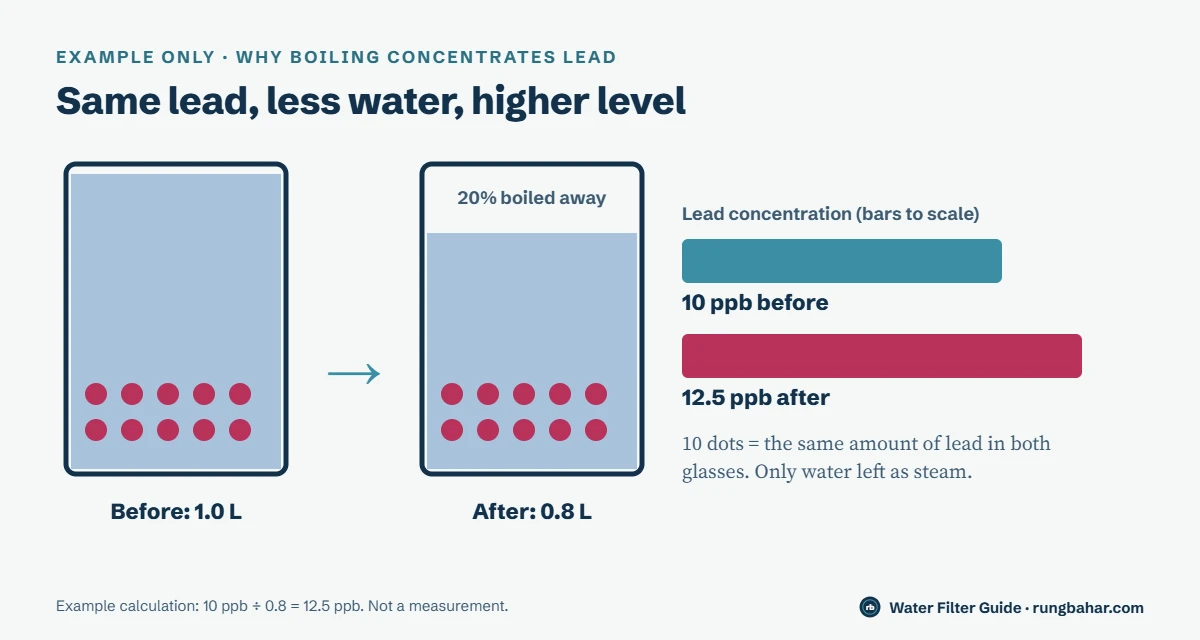
A short boil to make tea loses little water, so the change is small. A pot left simmering for 20 minutes, or water boiled again and again in the same kettle, loses much more. Either way the direction is the same. For lead, PFAS, fluoride, nitrate and arsenic, boiling can only keep the level the same or raise it.
Distillation works on the same physics, but in reverse. A distiller boils the water and then collects the steam and condenses it into a clean container. NSF describes distillers as heating water to the boiling point and collecting the water vapor as it condenses, leaving contaminants such as heavy metals behind. A pot on a stove keeps the wrong part.
Does boiling water remove it? Contaminant by contaminant
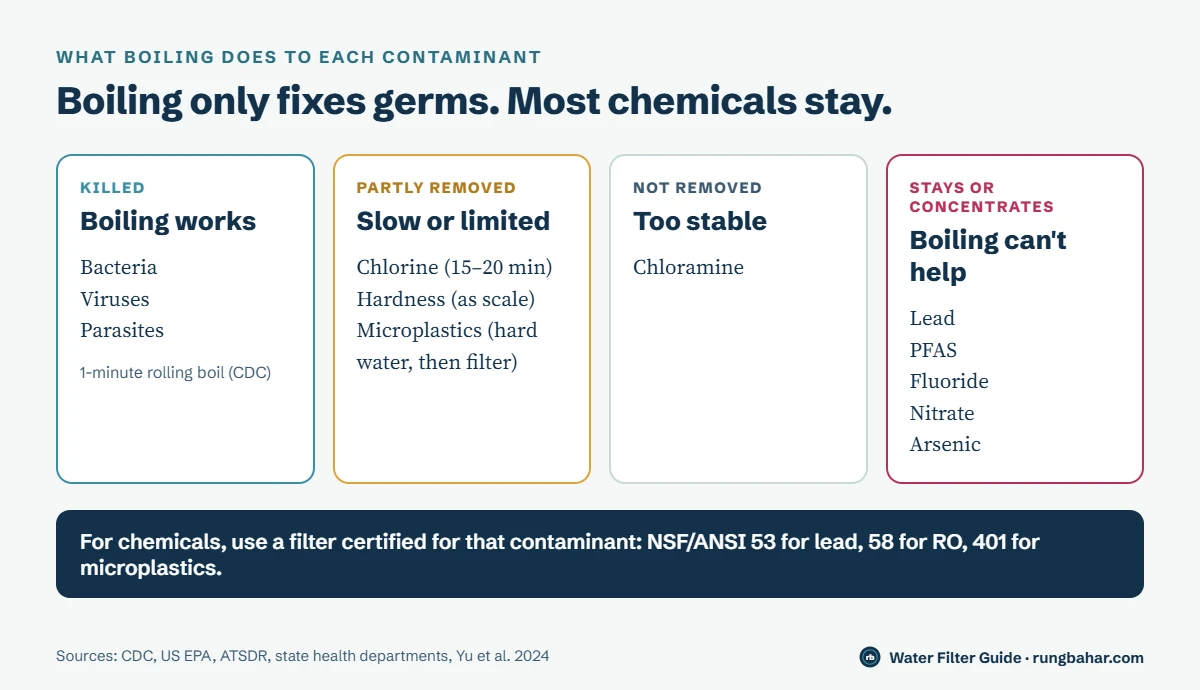
Here is the short version for everything people ask about. Each row is based on federal or state health agency guidance or a published study, listed in the sources at the bottom of this page.
| Contaminant | Does boiling remove it? | What happens | What works instead |
|---|---|---|---|
| Lead | No | Stays in the water; can concentrate | Filter certified to NSF/ANSI 53 for lead; cold water; flushing |
| Bacteria, viruses, parasites | Yes | Killed by a 1-minute rolling boil | Boiling, or UV certified to NSF/ANSI 55 for ongoing well problems |
| PFAS (forever chemicals) | No | Do not boil off | Reverse osmosis or carbon with a certified PFOA/PFOS claim |
| Fluoride | No | Stays in the water | Reverse osmosis certified for fluoride; distiller |
| Nitrate | No | Becomes more concentrated | Reverse osmosis or another certified nitrate treatment |
| Arsenic | No | Stays in the water | Treatment with a certified arsenic claim; test first |
| Chlorine | Partly, slowly | Evaporates over 15 to 20 minutes | Carbon filter certified to NSF/ANSI 42 |
| Chloramine | Not effectively | Too stable to boil off quickly | Filter with a listed chloramine reduction claim |
| Hardness (calcium carbonate) | Partly | Some drops out as scale in the kettle | Water softener for whole-home hardness |
| Microplastics | Partly, in hard water | Trapped in scale, then must be filtered out | Filter certified to NSF/ANSI 401 for microplastics |
Notice the pattern. Boiling is excellent at one job, killing living things, and a weak or harmful choice for nearly everything else. If you are not sure which group your concern falls into, the quick check at the top of this page gives a one-line answer for each.
When boiling is the right answer: germs and boil water notices
Boiling is the best tool you have when the problem is biological. The CDC calls boiling the surest way to kill disease-causing organisms, including viruses, bacteria and parasites. That is why utilities issue boil water advisories after a main break, a pressure drop or a positive test for bacteria such as E. coli.
The CDC’s instructions are short:
- If the water is cloudy, let it settle and filter it through a clean cloth, paper towel or coffee filter first.
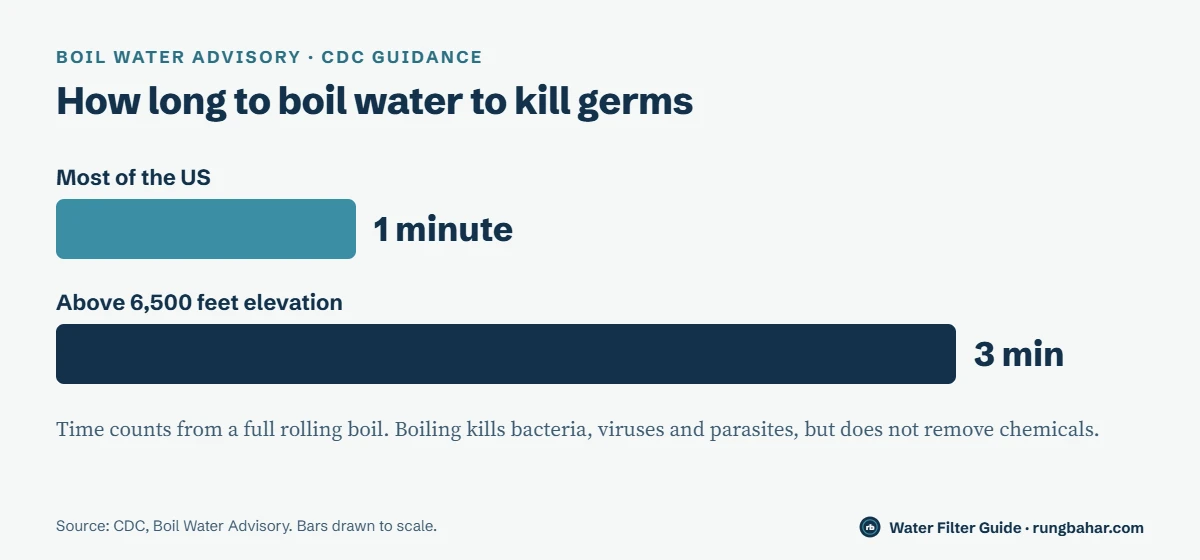
- Bring the clear water to a rolling boil for 1 minute. At elevations above 6,500 feet, boil for 3 minutes.
- Let it cool, then store it in clean, covered containers.
- Use boiled or bottled water for drinking, cooking, brushing teeth, making ice and mixing formula until the advisory is lifted.
The same CDC page adds an important line: boiling does not remove chemicals. If your utility issues a “do not drink” or “do not use” order instead of a boil notice, the problem is usually chemical, and boiling will not help. Follow the utility’s instructions exactly.
Private well owners face a different situation. If a well tests positive for coliform bacteria again and again, boiling every glass is not a long-term plan. Find and fix the source, then consider ongoing disinfection such as an ultraviolet system certified to NSF/ANSI 55. Our guide to choosing a water filter walks through matching treatment to a test result.
PFAS, fluoride, nitrate and arsenic: boiling will not help
Does boiling water remove PFAS?
No. The New Mexico Department of Health says it directly: boiling water does not remove PFAS. These “forever chemicals” are built to resist heat, which is why they were used in nonstick coatings and firefighting foam. A kettle does not touch them.
In 2024 the EPA set limits of 4.0 parts per trillion each for PFOA and PFOS, plus limits for several other PFAS. In May 2026 the EPA proposed keeping the PFOA and PFOS limits, dropping the others, and moving the compliance deadline from 2029 to 2031. As of this update that proposal is not final. To see whether your own water has PFAS, check your utility’s PFAS results. To lower PFAS at home, look for reverse osmosis or a carbon filter whose listing shows a PFOA/PFOS or total PFAS reduction claim. What reverse osmosis removes covers the details.
Does boiling water remove fluoride?
No. A CDC Agency for Toxic Substances and Disease Registry (ATSDR) report states that heating or boiling water does not remove fluoride. The EPA’s enforceable limit for fluoride is 4.0 mg/L. Reverse osmosis systems certified for fluoride reduction and countertop distillers are the reliable options; see water filters that remove fluoride.
Does boiling water remove nitrates?
No, and this is the case where boiling does the most harm. Kansas health officials warn that boiling, freezing or letting water stand does not reduce nitrate, and that excessive boiling makes it more concentrated. The EPA limit is 10 mg/L (as nitrogen). The EPA warns that infants under six months who drink water above that limit could become seriously ill, a condition known as blue-baby syndrome. Nitrate is mostly a private well issue, often near farmland or septic systems.
Does boiling water remove arsenic?
No. The Virginia Department of Health says heating or boiling your water will not remove arsenic. The EPA limit is 10 ppb. Arsenic occurs naturally in groundwater in parts of the country, so well owners should test for it rather than assume.
Chlorine vs chloramine: one boils off, one mostly does not
Chlorine is the one chemical that boiling does remove, given time. Local health departments say boiling water for about 15 to 20 minutes lets the chlorine evaporate. Leaving a pitcher uncovered in the fridge also lets some chlorine escape. Both are slow, and neither is needed: a basic carbon pitcher or faucet filter certified to NSF/ANSI 42 for chlorine taste and odor does the job in seconds.
Many US cities now use chloramine, a mix of chlorine and ammonia that lasts longer in the pipes. Utilities that use it say boiling is not an effective way to remove it. If your water report lists chloramine, choose a filter whose certification listing names chloramine reduction specifically. A chlorine claim alone does not cover it. Your utility’s annual water quality report says which disinfectant it uses.
Not sure what is in your water? The ZIP code tap water check on our homepage points you to your utility’s report.
Microplastics: the hard-water exception
Here boiling does more than you might expect, but only under the right conditions. A 2024 study in Environmental Science & Technology Letters by researchers at Guangzhou Medical University and Jinan University boiled tap water for 5 minutes, let it cool, and poured it through a simple filter such as a coffee filter.
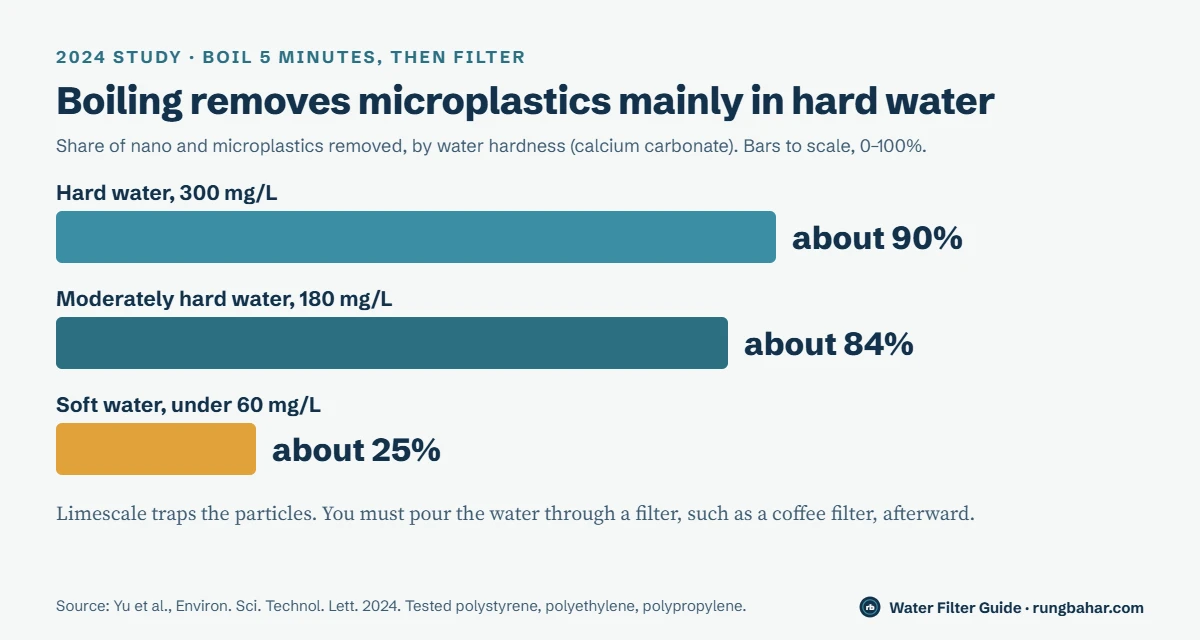
In hard water, the calcium carbonate that forms limescale crystallized around the tiny plastic particles and trapped them. Results depended on hardness:
- About 90% removed in hard water at 300 mg/L of calcium carbonate.
- About 84% removed at 180 mg/L.
- About 25% removed in soft water under 60 mg/L.
Three limits are worth knowing. First, the filtering step is essential; boiling alone just leaves the trapped particles in the scale. Second, the researchers tested only three types of plastic (polystyrene, polyethylene and polypropylene). Third, most people in soft-water areas will see little benefit. If microplastics are your main concern, a filter certified to NSF/ANSI 401 for microplastics reduction is the more dependable route. That claim is tested on particles from 0.5 to 1 micron, and the model’s listing will say so.
Is boiled water the same as distilled or filtered water?
No, and the difference explains everything above. Boiled water is the same water, minus most living germs and some chlorine, with dissolved minerals and chemicals still in it. Distilled water is the condensed steam, so most minerals, metals and salts are left behind in the distiller. Filtered water depends entirely on the filter: a carbon pitcher mainly improves taste, while a certified reverse osmosis system reduces a long list of dissolved contaminants.
| Boiled | Distilled | Filtered (certified) | |
|---|---|---|---|
| Kills germs | Yes | Yes | Only with a cyst or microbial claim, or UV |
| Removes lead | No | Yes | Yes, if certified to NSF/ANSI 53 for lead |
| Removes PFAS | No | Varies; check the claim | Yes, if the listing shows a PFAS claim |
| Removes fluoride | No | Yes | Only RO or special media with a tested claim |
| Removes minerals | Some hardness | Nearly all | RO removes most; carbon keeps them |
| Cost and effort | Energy, time | Slow, uses power | Filter price plus replacements |
For a deeper look at the standards in the last column, see water filter certifications explained. And if you use a pitcher today, does Brita remove lead, PFAS and fluoride lists exactly what each Brita filter is certified for.
What to use instead of boiling
Match the fix to the problem. Here are three common situations.
Old pipes or lead line
Point-of-use lead filter
- Certification: NSF/ANSI 53 with lead reduction listed
- Best for: Older homes, homes with a known lead service line, families with babies
- Skip if: your water tests at non-detect and your plumbing is newer
Several chemicals at once
Under-sink reverse osmosis
- Certification: NSF/ANSI 58, plus claims for the contaminants you need
- Best for: PFAS, fluoride, nitrate or arsenic, especially on well water
- Skip if: you rent and cannot add a drain connection
Recurring bacteria in a well
UV disinfection system
- Certification: NSF/ANSI 55
- Best for: Private wells with repeat coliform results after the source is fixed
- Skip if: you are on city water under a short boil notice
Not sure which applies to you? Answer a few quick questions in the 15-second filter finder and it will point you to the right type and certification.
A simple plan, in 4 steps
- Find out what is in your water. Read your utility’s annual report, or test a private well through a certified lab.
- Boil only for germs. Use the CDC’s 1-minute rule during a boil notice, and stop once it is lifted.
- Filter for chemicals. Pick the certification that names your contaminant, then confirm the model in the certifier’s database.
- Replace cartridges on time. A certified claim only holds up to the rated capacity on the performance data sheet.
Does boiling water remove it? 14 common questions
Short answers to what people search most. Each answer matches the sources listed at the bottom of the page.
Does boiling water remove lead?
No. The EPA and CDC both say boiling does not remove lead. It can raise the concentration slightly because some water evaporates while the lead stays. Use cold water and a filter certified to NSF/ANSI 53 for lead.
How long do you have to boil water to make it safe?
For germs, the CDC says a rolling boil for 1 minute, or 3 minutes at elevations above 6,500 feet. No length of boiling makes water safe from lead, PFAS, nitrate or arsenic.
Does boiling water remove chlorine?
Yes, slowly. Health agencies say about 15 to 20 minutes of boiling lets chlorine evaporate. A carbon filter certified to NSF/ANSI 42 is quicker.
Does boiling water remove fluoride?
No. The CDC’s ATSDR states that heating or boiling water does not remove fluoride. Reverse osmosis certified for fluoride or a distiller does.
Does boiling water remove PFAS?
No. State health departments say boiling does not remove PFAS. Use reverse osmosis or a filter with a certified PFOA/PFOS or total PFAS claim.
Does boiling water remove nitrates?
No. It makes nitrate more concentrated as water evaporates. Do not boil high-nitrate well water for infant formula; use another water source and ask your pediatrician.
Does boiling water remove microplastics?
Partly, in hard water, if you filter it afterward. A 2024 study removed up to about 90% in hard water but only about 25% in soft water.
Does boiling water remove bacteria and viruses?
Yes. The CDC calls boiling the surest way to kill disease-causing organisms, including bacteria, viruses and parasites.
Does boiling water remove arsenic?
No. The Virginia Department of Health says heating or boiling will not remove arsenic. Test your well and use treatment with a certified arsenic claim.
Is boiled water the same as distilled water?
No. Distillers collect the condensed steam and leave minerals and metals behind. Boiling in a pot keeps everything except germs and some chlorine.
Is it safe to boil tap water for baby formula?
Boiling handles germs, not lead or nitrate. The EPA advises using cold water for formula. If you have lead pipes or a high-nitrate well, use a certified filter or another source and ask your pediatrician.
Does boiling water remove minerals or hardness?
Some. Part of the calcium carbonate drops out as scale in the kettle. Boiling does not remove most other dissolved minerals.
Does a Brita filter remove lead?
Some Brita filters are certified for lead and some are not. Check the exact filter model in our guide, does Brita remove lead, PFAS and fluoride.
Can I boil water instead of using a filter?
Only if your only concern is germs. For lead, PFAS, fluoride, nitrate, arsenic and chloramine, boiling does not help and a certified filter does.
Sources and how we checked this page
Every fact on this page comes from the US EPA, the CDC and its ATSDR, NSF, state health departments, a water utility, and a peer-reviewed 2024 study, checked on October 5, 2026. We do not test water or filters in a lab. The lead example is a calculation to show the effect, not a measurement.
- US EPA: Does boiling water remove lead?
- US EPA: Basic information about lead in drinking water
- CDC: Lead in drinking water
- Massachusetts DPH: Lead in drinking water FAQ
- US EPA: National Primary Drinking Water Regulations (limits for lead, nitrate, fluoride, arsenic)
- Louisiana Department of Health: Lead and Copper Rule Improvements FAQ (2026)
- CDC: Boil water advisory
- New Mexico Department of Health: PFAS fact sheet
- Congressional Research Service: PFAS drinking water regulation (June 2026)
- CDC ATSDR: Health consultation stating boiling does not remove fluoride (PDF)
- Kansas Department of Health and Environment: Nitrate in private wells
- Virginia Department of Health: Arsenic in private wells (PDF)
- Fayette County (GA) Health Department: Chlorination (PDF)
- City of Englewood, CO: Chloramine FAQs
- Yu et al., Drinking boiled tap water reduces human intake of nanoplastics and microplastics, Environ. Sci. Technol. Lett. (2024)
- Smithsonian Magazine: Boiling tap water could help remove microplastics
- NSF: Standards for water treatment systems
- NSF listings: NSF/ANSI 53 systems with lead reduction