Published October 5, 2026. Every claim is checked against the sources listed at the end of this page. How we research.
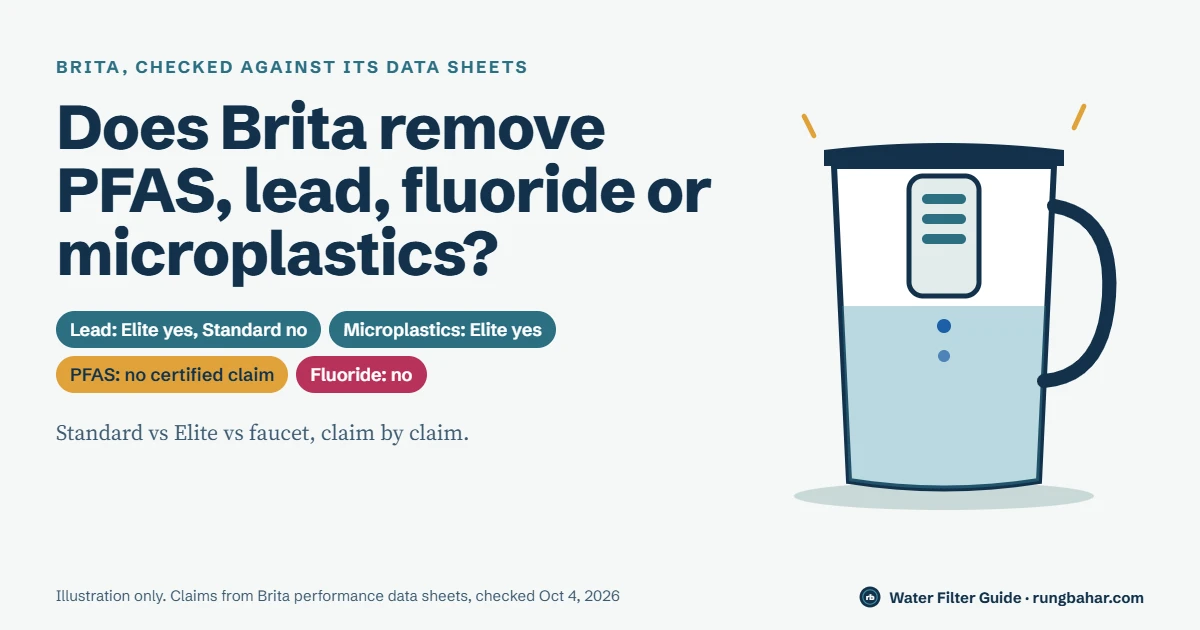
The short answer: It depends on which Brita filter you use. The Brita Standard pitcher filter is certified for chlorine taste and odor, copper, cadmium, mercury and zinc, but not for lead, PFAS, fluoride or microplastics. The Brita Elite filter is certified to reduce lead (by more than 99 percent in testing) and microplastics, plus chlorine and a long list of other chemicals, but it has no certified PFAS claim. No Brita filter is designed to remove fluoride.
Quick check
What do you want your Brita to remove?
Which Brita filter do you have?
“Brita” is a brand, not a single filter. The answer to almost every “does Brita remove…” question changes depending on which filter is inside the pitcher or on the faucet. In the US, the three you are most likely to have are:
- Brita Standard filter (model OB03): the basic pitcher and dispenser filter. Brita rates it for 40 gallons, or about every 2 months for an average family.
- Brita Elite filter (model OB06, sold for years as Longlast+): the longer-life pitcher filter. Brita rates it for 120 gallons, or about every 6 months, and no more than 2 gallons a day.
- Brita faucet filters: the cartridges that clip onto a kitchen tap. Brita rates them for about 4 months of use.
The easiest way to tell is to read the name printed on the filter or its box. If you cannot see it, look at your replacement order history. Everything below is based on each filter’s performance data sheet: the document that lists what the filter was tested and certified to reduce, at what concentration and by how much. That sheet is the only place a claim counts. Packaging slogans, review sites and “reduces 60 contaminants” headlines do not tell you which contaminants were tested.
Brita claims at a glance
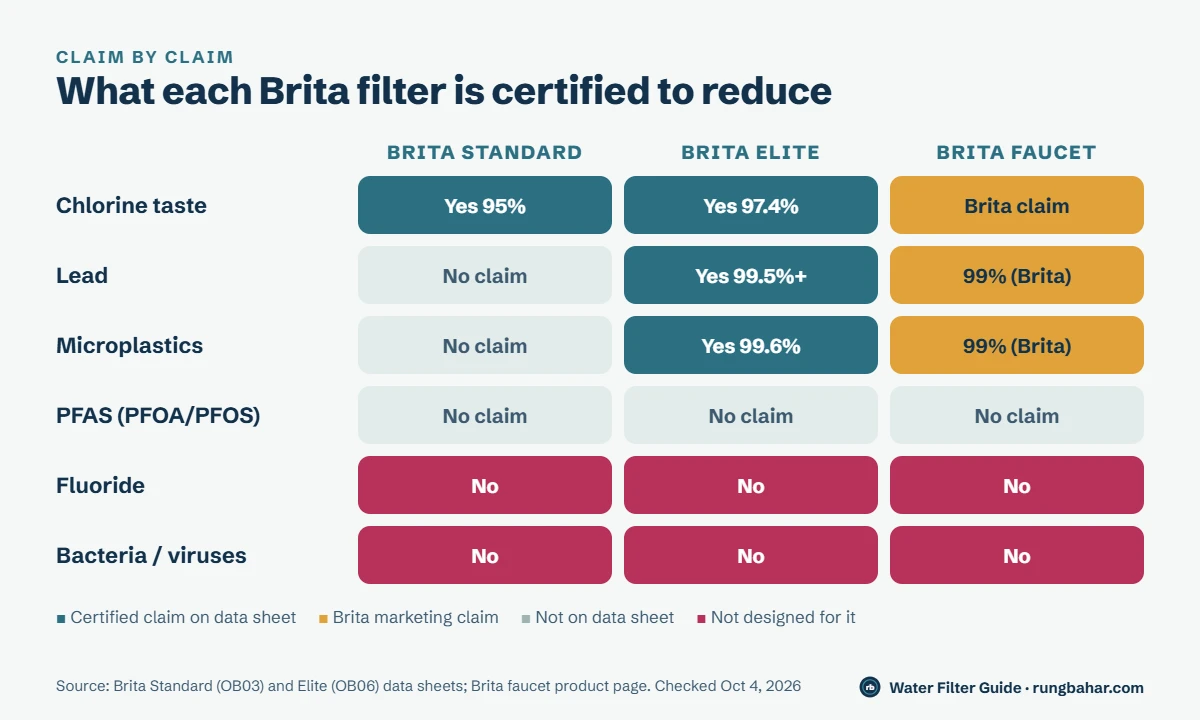
This table summarizes the certified claims on the Standard and Elite data sheets and Brita’s published faucet claims, checked on October 4, 2026. “No claim” means the contaminant does not appear on the data sheet. It does not prove the filter removes zero percent; it means nobody certified that it does.
| Contaminant | Brita Standard | Brita Elite | Brita faucet |
|---|---|---|---|
| Chlorine taste and odor | Yes, 95% (NSF/ANSI 42) | Yes, 97.4% (NSF/ANSI 42) | Yes (Brita claim) |
| Lead | No claim | Yes, 99.5–99.6% (NSF/ANSI 53) | 99% (Brita claim) |
| PFAS (PFOA, PFOS) | No claim | No claim | No claim found |
| Fluoride | No | No | No |
| Microplastics | No claim | Yes, 99.6% (NSF/ANSI 401) | 99% (Brita claim) |
| Mercury | Yes, 82–86% | Yes, 95.5–95.9% | See data sheet |
| Cadmium | Yes, 91–94% | Yes, 96.9–99.2% | See data sheet |
| Copper | Yes, 73–89% | No claim | See data sheet |
| Benzene and other VOCs | No claim | Yes (several, NSF/ANSI 53) | Benzene (Brita claim) |
| Bacteria and viruses | No | No (not a purifier) | No |
| Rated life | 40 gallons / about 2 months | 120 gallons / about 6 months | About 4 months |
Two patterns stand out. First, the Elite is a much more capable filter than the Standard on paper: it adds lead, microplastics, asbestos, several pesticides and solvents, and a set of “emerging” compounds such as bisphenol A and some pharmaceuticals under NSF/ANSI 401. Second, neither pitcher filter has a PFAS claim, which is the question people search most. For a side-by-side with PUR’s listings, see Brita vs PUR.
Does Brita remove PFAS?
Not as a certified claim. We checked the current Brita Elite data sheet (dated December 2025) and the Brita Standard data sheet. Neither lists PFOA, PFOS or total PFAS. So Brita does not claim, and no certifier has confirmed, that either pitcher filter reduces PFAS to a stated level.
That does not mean the filters do nothing. Activated carbon, the main ingredient in both, can adsorb some PFAS. The question is how much, for how long and for which types. A 2024 peer-reviewed study from the Université de Montréal, published in Frontiers in Environmental Chemistry, ran naturally contaminated Canadian tap water through five pitcher filters for up to 160 liters. Its results for Brita were modest and inconsistent:
- Brita Elite: about 20 percent average PFAS reduction with one water source and 48 percent with another.
- Brita Standard: about 38 percent average PFAS reduction with the one water source tested.
- Two other pitchers in the same study, ZeroWater and Clearly Filtered, reduced PFAS by roughly 99 to 100 percent (see ZeroWater vs Brita for the certified claims).
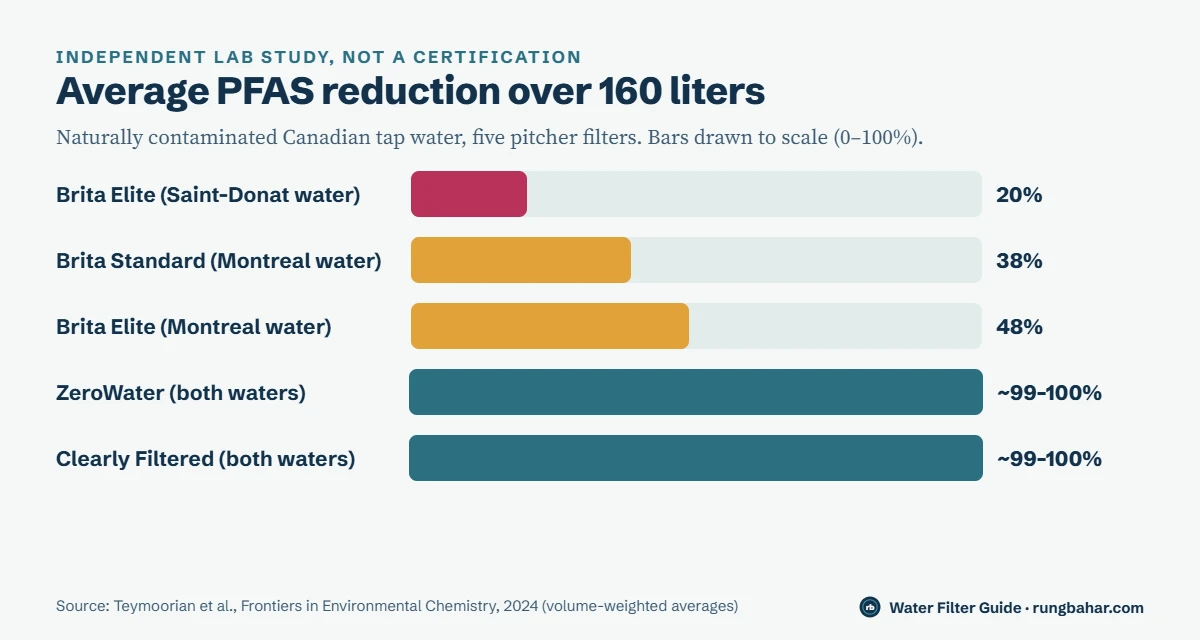
One study is not a certification, and the results depended on the water chemistry and the length of the PFAS molecules. But it lines up with what the data sheets imply: Brita filters are not built for PFAS. The US EPA’s advice for home filters is simple. If PFAS is your concern, check the packaging or data sheet for certification to NSF/ANSI 53 or NSF/ANSI 58 that names PFAS reduction, from an accredited certifier. Our guide to NSF 53 vs 58 explains the difference, and reverse osmosis is one of the most effective home options for PFAS.
What to do first: find out whether your water actually has PFAS. Your utility’s annual water quality report (Consumer Confidence Report) lists detected contaminants, and many utilities have started PFAS monitoring. If your levels are low or not detected, you may not need a PFAS filter at all.
Does Brita remove lead?
The Brita Elite does. The Brita Standard does not. This is the most important difference between the two pitcher filters.
The Elite data sheet lists lead reduction under NSF/ANSI 53, tested at two pH levels. In both tests, water started at 150 parts per billion (ppb) of lead and had to come out at 5 ppb or less. The Elite averaged 99.5 percent reduction at pH 6.5 and 99.6 percent at pH 8.5. That 5 ppb limit is the stricter rule NSF introduced in 2019; before that, filters only had to reach 10 ppb.
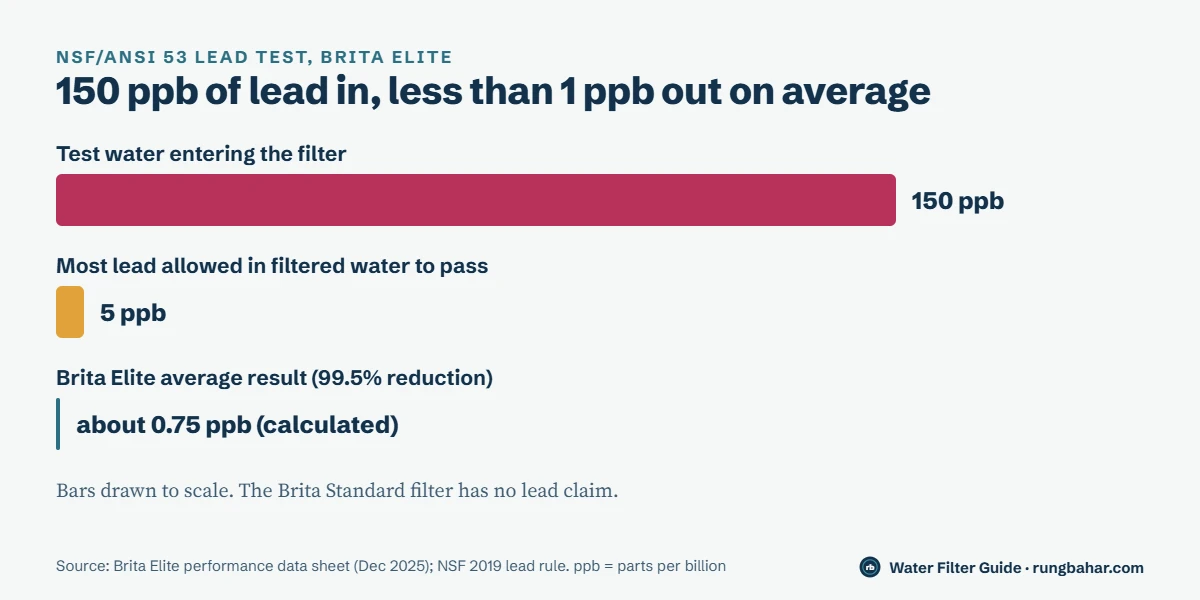
The Standard filter’s data sheet does not list lead at all. Its metal claims are copper, cadmium, mercury and zinc. If you bought a Brita pitcher years ago because of lead pipes, check which filter you are buying now, because the difference matters.
Brita also advertises its faucet filters as removing 99 percent of lead. If you prefer a faucet mount, read the data sheet for the exact faucet cartridge before you rely on it, since Brita sells more than one faucet filter.
Three practical points for lead. Use the filter for drinking and cooking water, not just occasionally. Replace it on time, because a lead claim only applies within the rated capacity. And if you are in a home with a lead service line, our guide to checking whether a filter is really certified shows how to confirm the exact model number on the certifier’s listing.
Does Brita remove fluoride?
No. Brita states in its own FAQ that its cartridges are not designed to remove fluoride, and neither the Standard nor the Elite data sheet lists fluoride. That is not a flaw in Brita specifically. Activated carbon, the medium most pitcher and faucet filters rely on, is not a fluoride treatment; the Water Quality Association’s fluoride fact sheet does not list it among the methods that work.
If you want less fluoride, the methods that work are reverse osmosis, activated alumina, bone char, some anion exchange media and distillation. Reverse osmosis is the most common home choice, and many reverse osmosis systems carry a certified fluoride reduction claim under NSF/ANSI 58. In that test, water starting at 8.0 milligrams per liter must come out at 1.5 mg/L or less. See what reverse osmosis removes for the full list.
Does Brita remove microplastics?
The Brita Elite has a certified microplastics claim; the Standard does not. Microplastics reduction is tested under NSF/ANSI 401. The Elite data sheet lists “microplastics, particles 0.5–1 µm” with 99.6 percent average reduction, against a pass mark of 85 percent. That size range is tiny: a micron is a thousandth of a millimeter, so these particles are far smaller than anything you could see.
Brita also says its faucet filters remove 99 percent of microplastics. The Standard pitcher filter makes no microplastics claim. For a deeper explanation of what the 401 standard covers, see our guide to water filter certifications.
Chlorine, chloramine, nitrate and bacteria
Chlorine: yes, every Brita filter
Chlorine taste and odor reduction under NSF/ANSI 42 is what every Brita filter does well. The Standard averaged 95 percent and the Elite 97.4 percent in testing, starting from 2 parts per million. If your main complaint is that tap water tastes like a swimming pool, a Standard filter is usually enough.
Chloramine: no certified claim
Many US utilities disinfect with chloramine, a mix of chlorine and ammonia, instead of chlorine. Chloramine is harder for carbon to remove and needs its own NSF/ANSI 42 chloramine claim. Neither Brita pitcher data sheet lists it. Your utility’s water quality report usually says which disinfectant it uses.
Nitrate, arsenic and minerals: no
Neither data sheet lists nitrate, nitrite or arsenic. These are common concerns on private wells and are usually handled with reverse osmosis or specialized media. Brita filters also have no hardness claim in the US, so they will not fix scale on your kettle in a meaningful way, and they do not strip out the calcium and magnesium that are naturally in water.
Bacteria and viruses: not a purifier
The Elite data sheet says the filter is not intended to purify water and should not be used with water that is microbiologically unsafe or of unknown quality without disinfection before or after. The filter media contains a small amount of silver to support filter hygiene, and some silver may pass into the water. If you are under a boil-water notice or your well has tested positive for bacteria, a Brita is not the answer.
Brita Standard vs Brita Elite: which should you use?
For most people deciding between the two, the Elite is the more useful filter. It covers lead and microplastics, it lasts three times as long per filter, and you change it twice a year instead of about six times.
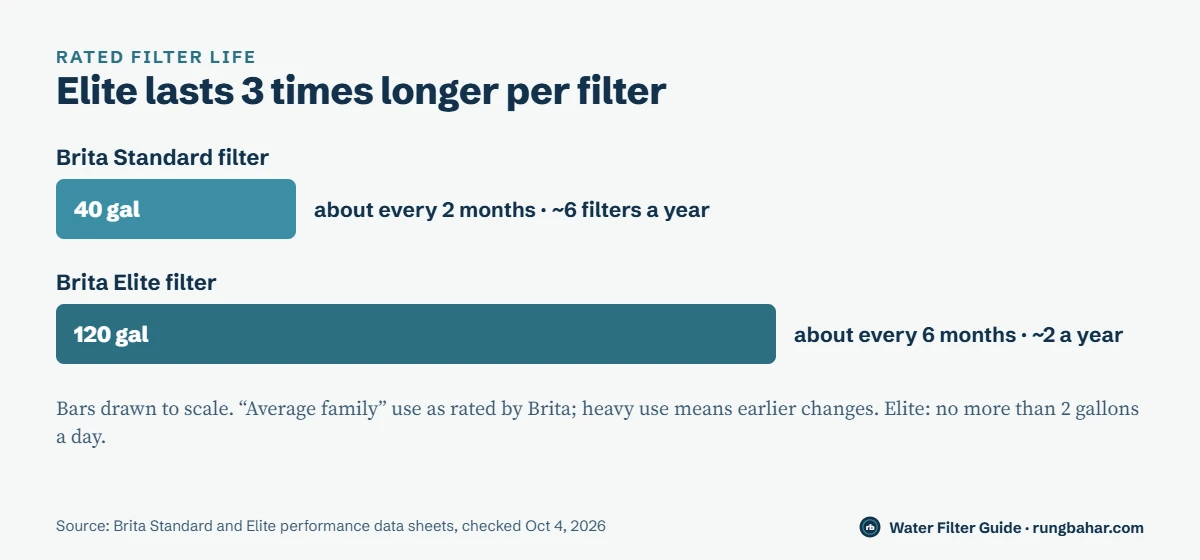
The Standard filter still makes sense in a narrow case: your water is from a utility with no lead concerns, you mainly want better-tasting water, and you go through more than 2 gallons of filtered water a day, which is the Elite’s stated daily limit. Whichever you pick, the price per gallon depends on the store and the pack size, so compare the cost of a year’s worth of filters, not a single cartridge.
If you need PFAS, fluoride, nitrate or arsenic reduced, the honest answer is that neither Brita pitcher filter is the right tool. Here are the three directions that usually fit:
Lead and microplastics
Brita Elite pitcher filter
- Certification: NSF/ANSI 42, 53 and 401 (lead, microplastics)
- Best for: Utility water, lead concerns, better taste
- Skip if: you need PFAS or fluoride reduction
PFAS in a pitcher
A pitcher certified for PFOA/PFOS
- Certification: NSF/ANSI 53 with a PFOA/PFOS or total PFAS claim
- Best for: Renters who want PFAS reduction without plumbing
- Skip if: you also need fluoride removed
Widest coverage
Under-sink reverse osmosis
- Certification: NSF/ANSI 58 with your contaminants listed
- Best for: PFAS, fluoride, nitrate, arsenic, high TDS
- Skip if: you cannot install under the sink
How to check a Brita claim yourself
Brita filters are certified by more than one organization. The current Elite data sheet names IAPMO R&T, NSF International and the Water Quality Association (WQA). The Standard data sheet names WQA. That is normal, and all three are accredited certifiers. Here is how to check any claim in about five minutes:
- Find the exact filter name and model number on the box or cartridge.
- Open the performance data sheet. Brita links them from each product page, and a printed copy is in the box.
- Look for your contaminant in the table. Check the influent (starting) level, the maximum allowed in filtered water and the average reduction.
- Check the rated capacity. The claim only holds up to that number of gallons.
- Confirm the listing on the certifier’s website, such as the NSF certified product listings, using the model number.
If a contaminant is missing from the data sheet, treat it as not covered, however the packaging is worded. Our step-by-step guide on how to check whether a filter is really NSF certified covers the common traps, like “tested to NSF standards” wording that does not mean certified.
When Brita is enough, and when it is not
A Brita filter is a reasonable choice when you are on city water, your annual water quality report shows no violations, and your main goal is better taste or a lead backstop. In that situation the Elite covers more ground than the Standard for not much extra effort.
Brita is not enough when:
- Your water report or a lab test shows PFAS you want reduced. Look for a certified PFAS claim under NSF/ANSI 53 or 58.
- You want less fluoride. You will need reverse osmosis or another fluoride-specific method.
- You are on a private well. Test first for bacteria, nitrate and arsenic, then choose treatment to match the results.
- Your utility uses chloramine and the taste bothers you. Look for a specific chloramine claim.
- You live in an older home with a known lead service line and want the strongest protection. A certified under-sink filter or reverse osmosis system can treat more water with less refilling.
If you are not sure what your water needs, start with our guide to choosing a water filter in 5 steps, or answer three quick questions in the filter finder to get a filter type that matches your water.
Brita: 14 common questions, answered
These are the questions people search most about what Brita filters remove, answered from the data sheets.
Does Brita remove PFAS?
Not as a certified claim. Neither the Brita Standard nor the Brita Elite data sheet lists PFOA, PFOS or total PFAS. An independent 2024 lab study found only partial reduction (about 20 to 48 percent for the Elite). For PFAS, the EPA says to look for NSF/ANSI 53 or 58 certification for PFAS reduction.
Does Brita remove lead?
The Brita Elite filter is certified under NSF/ANSI 53 to reduce lead, averaging 99.5 to 99.6 percent in testing. The Brita Standard filter has no lead claim. Brita also advertises 99 percent lead removal for its faucet filters.
Does Brita remove fluoride?
No. Brita says its filters are not designed to remove fluoride, and fluoride does not appear on either pitcher data sheet. Reverse osmosis, activated alumina, bone char and distillation are the methods that reduce fluoride.
Does Brita remove microplastics?
The Brita Elite is certified under NSF/ANSI 401 to reduce microplastics (0.5 to 1 micron particles) by 99.6 percent on average. The Standard filter has no microplastics claim.
Does Brita remove chlorine?
Yes. Every Brita filter reduces chlorine taste and odor under NSF/ANSI 42. The Standard averaged 95 percent and the Elite 97.4 percent in certification testing.
Does Brita remove nitrates?
No. Neither Brita pitcher data sheet lists nitrate or nitrite. Reverse osmosis systems certified for nitrate under NSF/ANSI 58 are the usual choice.
Does Brita remove minerals like calcium and magnesium?
Not in any certified way. The US data sheets have no hardness claim, so most natural minerals pass through. A Brita is not a water softener.
What is the difference between Brita Elite and Brita Standard?
The Elite adds certified lead, microplastics, asbestos and many chemical claims, and lasts 120 gallons (about 6 months) versus 40 gallons (about 2 months) for the Standard. The Standard mainly covers chlorine taste, copper, cadmium, mercury and zinc.
Is Brita NSF certified?
Brita filters are certified by accredited bodies. The current Elite data sheet lists IAPMO R&T, NSF International and WQA; the Standard data sheet lists WQA. Always check the specific claim, not just the certification mark.
Does Brita remove bacteria or make water safe to drink?
No. Brita says the Elite is not intended to purify water. Do not use it on water that is microbiologically unsafe or of unknown quality without disinfection.
Does Brita remove chloramine?
Neither Brita pitcher data sheet lists chloramine. If your utility uses chloramine, look for a filter with a specific NSF/ANSI 42 chloramine claim.
How often should I change a Brita filter?
Brita rates the Standard filter for 40 gallons (about every 2 months) and the Elite for 120 gallons (about every 6 months). Faucet filters are rated for about 4 months. Claims only apply within that rated life.
Is Brita better than nothing for PFAS?
The Montreal study suggests Brita filters may reduce some PFAS, but the amount varied widely and is not certified. If you know your water has PFAS, a filter with a certified PFAS claim is the more reliable choice.
Does boiling water and then using Brita remove more contaminants?
Boiling does not remove lead, PFAS or fluoride and can concentrate them as water evaporates. Boiling is for killing germs, and filtering is for the specific contaminants on the data sheet.
Sources and how we checked this page
Every claim on this page comes from Brita’s own performance data sheets and FAQ, the US EPA, NSF and a peer-reviewed study, checked on October 4, 2026. We do not test filters in a lab, and we have no commercial relationship with Brita. Data sheets change, so check the one for the exact filter you buy.
- Brita: Performance data sheet, Brita Elite filter (Dec 2025, PDF)
- Brita: Performance data sheet, Brita Standard filter, model OB03 (PDF)
- Brita: FAQ on filters and fluoride
- Brita: Basic faucet filtration system product page
- Teymoorian et al. (2024), Frontiers in Environmental Chemistry: PFAS removal by pitcher filters
- US EPA: Reducing PFAS in your drinking water with a home filter (fact sheet, PDF)
- NSF: Stricter requirements for lead reduction certification (2019)
- NSF: NSF/ANSI 42, 53 and 401 filtration systems standards
- NSF certified drinking water treatment unit listings
- Water Quality Association: Fluoride fact sheet (PDF)
- US EPA: Protect your home’s water (private wells)