Skip to content

Category: Brand questions

Brand claims checked against official certification listings and each manufacturer’s own performance data sheet. Compare ZeroWater vs Brita and Brita vs PUR, or check what Brita filters are certified to remove. We do not lab-test products; every page lists the sources it was checked against.

  • Does PUR Remove Lead, PFAS, Fluoride or Chlorine?

    Does PUR Remove Lead, PFAS, Fluoride or Chlorine?

    Updated October 14, 2026, by the RB Water Desk. How we research.

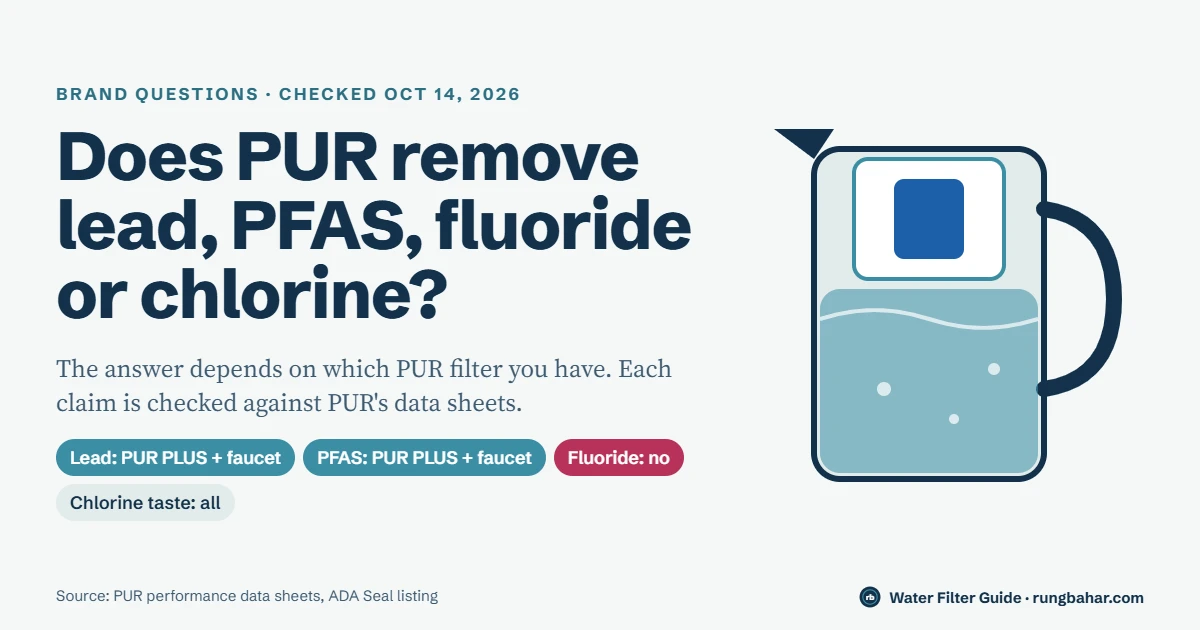
    The short answer: It depends on which PUR filter you have. The PUR PLUS pitcher filter (PPF951K) and PUR faucet filters (RF-9999 and RF3375) are certified to reduce lead (99.2 to 99.9 percent), total PFAS (99.75 to 99.92 percent), microplastics and chlorine taste. The cheaper blue PUR pitcher filter (PPF900Z) is certified for chlorine taste and a few metals, but not for lead, PFAS or microplastics. No PUR filter removes fluoride, nitrate or bacteria.
    Quick check

    Does PUR remove…

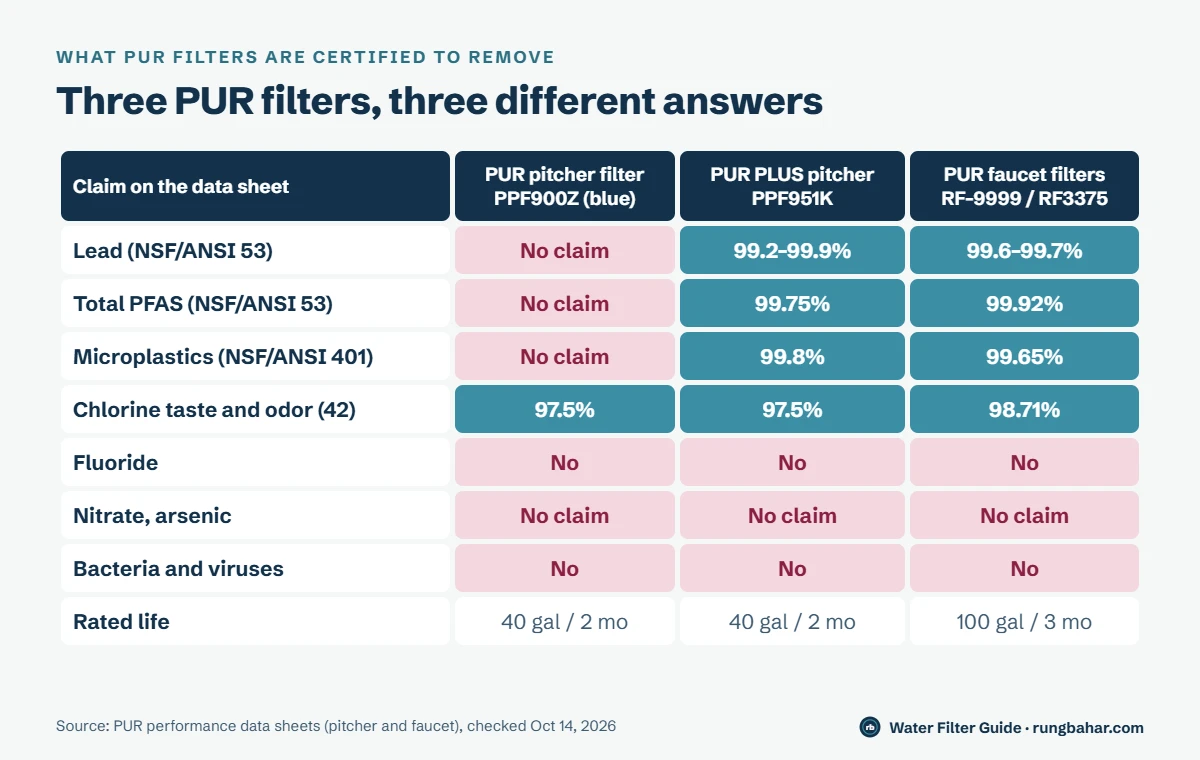
    Table of PUR data sheet claims: PPF900Z has no lead, PFAS or microplastics claim; PUR PLUS PPF951K lead 99.2-99.9%, total PFAS 99.75%, microplastics 99.8%; faucet RF-9999 and RF3375 lead 99.6-99.7%, total PFAS 99.92%; none remove fluoride, nitrate or bacteria
    The blue PUR pitcher filter only covers taste and a few metals; PUR PLUS and the faucet filters add lead, PFAS and microplastics.

    First: which PUR filter do you have?

    “PUR” is a brand, not one filter. In October 2026, PUR publishes performance data sheets for two pitcher and dispenser filters and two faucet filters, and they carry different certified claims. The answer to “does PUR remove lead?” is yes for three of them and no for one.

    • PUR pitcher filter, model PPF900Z. The basic blue filter. Rated for 40 gallons. Certified for chlorine taste and odor and some metals and chemicals, but not for lead, PFAS or microplastics.
    • PUR PLUS pitcher filter, model PPF951K. The upgraded pitcher and dispenser filter. Rated for 40 gallons. Certified for lead, total PFAS, microplastics and a list of pharmaceuticals and chemicals.
    • PUR PLUS faucet filter, model RF-9999 (sold as the Mineral Core filter) and PUR faucet filter, model RF3375. Rated for 100 gallons. PUR’s current faucet data sheet covers both cartridges with one set of results, including lead, total PFAS and microplastics.

    Look at the model number printed on the filter or its box before you read on. Both pitcher filters fit the same PUR pitchers and dispensers, so a PUR pitcher on your counter could hold either one. Everything on this page comes from PUR’s performance data sheets, its pitcher quick start guide, its product pages and the American Dental Association’s Seal listing, checked on October 14, 2026. We have not tested any PUR filter ourselves, and we have no commercial relationship with PUR or its owner, Helen of Troy. For each contaminant we say whether it is certified, not certified, or claimed by the brand without a certified result.

    What PUR removes: the full table

    ContaminantPUR pitcher (PPF900Z)PUR PLUS pitcher (PPF951K)PUR faucet (RF-9999 / RF3375)
    Lead (NSF/ANSI 53)Not certifiedCertified, 99.2–99.9%Certified, 99.6–99.7%
    Total PFAS (NSF/ANSI 53)Not certifiedCertified, 99.75%Certified, 99.92%
    Microplastics (NSF/ANSI 401)Not certifiedCertified, 99.8%Certified, 99.65%
    Chlorine taste and odor (NSF/ANSI 42)Certified, 97.5%Certified, 97.5%Certified, 98.71%
    MercuryCertified, 88.8–96.5%Certified, over 96.4%Certified, 78.6–81.6%
    CopperCertified, 85.7–90.1%Certified, 95.9–99.3%No claim
    CadmiumCertified, 86.7–90.2%Certified, 98.9% to over 99.3%No claim
    VOCs and pesticidesSome (benzene 86.4%)Some (benzene over 96.8%)About 50 compounds (chloroform surrogate 99.51%)
    Pharmaceuticals, BPA (NSF/ANSI 401)Two compoundsEight compounds, incl. BPA over 99%Fourteen compounds, incl. BPA 99.5%
    FluorideNoNoNo
    Nitrate, arsenicNo claimNo claimNo claim
    Bacteria and virusesNoNoNo
    Rated life40 gal or 2 months40 gal or 2 months100 gal or 3 months
    Certified byIAPMO R&TIAPMO R&TIAPMO R&T

    Read the table by column, not by brand. The PUR PLUS pitcher filter and the faucet filters cover the three things people search for most: lead, PFAS and microplastics. The blue PPF900Z does not cover any of them, and it is often the cheapest PUR filter on the shelf, which is how it ends up in many pitchers by default. None of the four touches fluoride, nitrate or germs. If you are comparing PUR with its main rival, our Brita vs PUR comparison puts the two brands’ data sheets side by side.

    Does PUR remove lead?

    Yes for the PUR PLUS pitcher filter and the faucet filters. No for the blue PPF900Z.

    Lead reduction is tested under NSF/ANSI 53. The test water starts at about 150 parts per billion (ppb) of lead, and a filter passes only if the water coming out stays at or below 5 ppb across its whole rated life, at two pH levels. The PUR PLUS pitcher filter averaged 99.9 percent reduction at pH 6.5 and 99.2 percent at pH 8.5. PUR’s faucet data sheet shows 99.70 and 99.60 percent. The PPF900Z sheet marks lead as “not certified”.
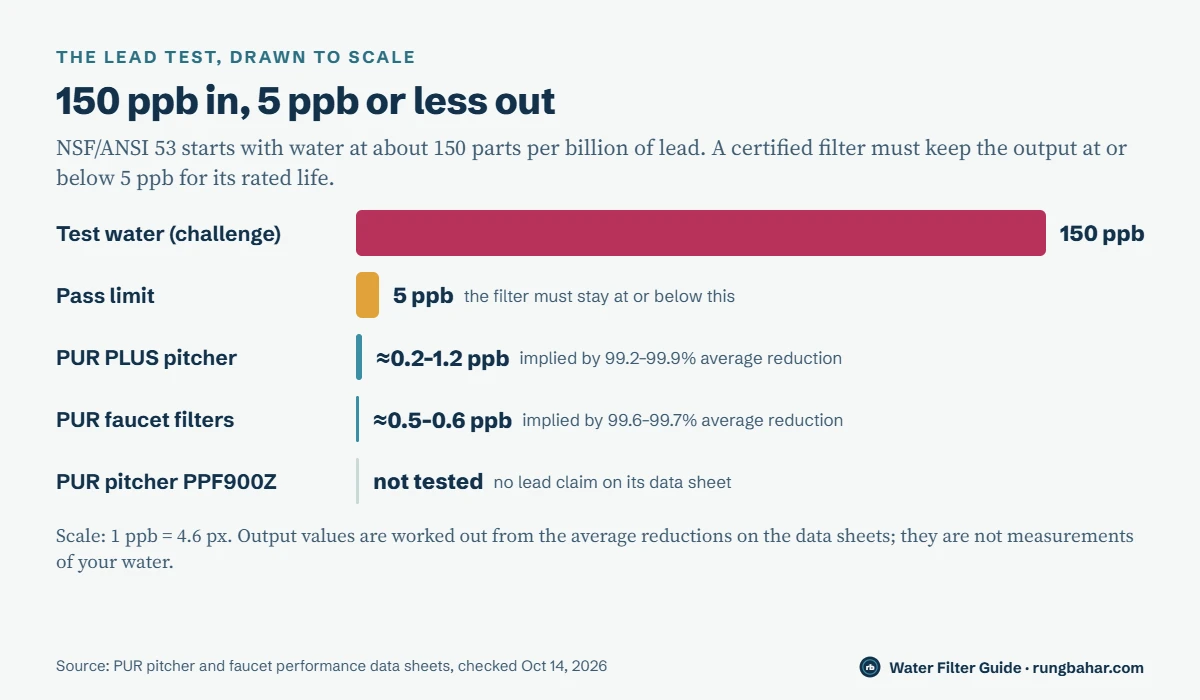
    To-scale bars: NSF/ANSI 53 lead test water at 150 ppb, pass limit 5 ppb, PUR PLUS pitcher about 0.2 to 1.2 ppb and PUR faucet about 0.5 to 0.6 ppb implied by average reductions, PPF900Z not tested for lead
    Certified PUR filters bring 150 ppb test water far below the 5 ppb limit.

    Those percentages are averages from a lab test, not a promise for your tap, but they are well clear of the pass line. In practice the decision is not between 99.2 and 99.9 percent. It is between a certified filter and an uncertified one, and between a filter changed on time and one used past its rating. Michigan’s health department, for example, publishes a how-to sheet for PUR faucet filters that calls them a temporary way to reduce lead and tells households to check the box for NSF/ANSI 53 lead certification. If you rely on any filter for lead, the US EPA keeps a consumer tool for choosing filters certified to reduce lead.

    A filter is a stopgap, not the fix, if the lead comes from a service line or old solder. Our guide to lead in tap water covers testing, flushing and what to ask your water utility. If you want a pitcher with fewer filter changes, compare the PUR PLUS with the Brita Elite and ZeroWater in what Brita filters remove and what ZeroWater removes.

    Does PUR remove PFAS?

    Yes, certified, for the PUR PLUS pitcher filter and the faucet filters on PUR’s current data sheet.

    On September 15, 2026, PUR announced that IAPMO R&T had certified its PUR PLUS pitcher and dispenser filter (PPF951K) and its PUR PLUS faucet filter (RF-9999) to reduce “total PFAS” under NSF/ANSI 53. The data sheets list 99.75 percent average reduction for the pitcher filter and 99.92 percent for the faucet filter.

    “Total PFAS” is the broader of the two PFAS tests in NSF/ANSI 53. The test water contains a mix of seven compounds (PFOA, PFOS, PFHxS, PFNA, PFHpA, PFBS and PFDA) at about 2,160 nanograms per liter combined, and the filter must keep the total at 20 nanograms per liter or less for its rated life. The older test covers only PFOA and PFOS, so a total PFAS claim tells you more.

    Two cautions. First, the claim is new. PUR’s September 2025 faucet data sheet, still linked on its site as a “legacy” sheet, has no PFAS claim, so a faucet filter from older stock may come with a leaflet that does not list PFAS. Check the leaflet in your box and the IAPMO R&T listing for your model. Second, the blue PPF900Z pitcher filter is not certified for PFAS at all. Before buying anything for PFAS, find out whether your water has it; how to check for PFAS in your tap water lists the free sources. The EPA’s own advice is to look for certification to NSF/ANSI 53 or 58 for PFAS.

    Does PUR remove fluoride?

    No. No PUR data sheet lists fluoride, and PUR’s pitcher quick start guide states that the filter does not remove fluoride from water. The American Dental Association has given its Seal of Acceptance to both the PUR pitcher and dispenser filter and the PUR faucet filter, and the ADA’s listing describes each as an effective filter that does not remove fluoride from tap water.

    So if you want to keep the fluoride your utility adds, PUR is a safe choice for that. If you want it out, PUR is the wrong tool. Activated carbon, which is what PUR filters use, does not meaningfully remove fluoride. The options that do are reverse osmosis certified under NSF/ANSI 58 for fluoride, activated alumina, and a small number of pitcher filters with a certified fluoride claim, such as the newer Culligan ZeroWater filter. Our guide to water filters that remove fluoride compares them.

    Does PUR remove chlorine and chloramine?

    Chlorine taste and odor: yes, certified, for every current PUR filter. Chloramine: no specific claim.

    Chlorine is the one claim all four filters share. Under NSF/ANSI 42, both pitcher filters averaged 97.5 percent reduction of chlorine taste and odor from water dosed at 2 mg/L, and the faucet filters 98.71 percent. That is why even the basic PPF900Z makes city water taste better.

    Many US utilities now disinfect with chloramine instead of chlorine, because it lasts longer in the pipes. Chloramine is harder for ordinary carbon to remove, and NSF/ANSI 42 has a separate chloramine test. No PUR data sheet includes it. If your utility uses chloramine and the taste bothers you, see which filters actually remove chloramine.

    Does PUR remove microplastics?

    Yes for the PUR PLUS pitcher filter (99.8 percent) and the faucet filters (99.65 percent). No certified claim for the PPF900Z.

    Microplastics reduction is tested under NSF/ANSI 401 with particles between 0.5 and 1 micron, and a filter has to cut them by at least 85 percent. The blue PPF900Z lists a much coarser particle class, 50 to 80 microns, which is about sediment you could almost see. For what the microplastics test does and does not show, read our guide to water filters for microplastics.

    Does PUR remove nitrates or arsenic?

    No certified claim. None of PUR’s four data sheets lists nitrate, nitrite or arsenic. These are mainly well-water problems, and they usually need reverse osmosis or special media certified for that contaminant. Nitrate is also a contaminant where a lab test after treatment matters, because the health limit (10 mg/L as nitrogen) is tight for infants. Our well water test results guide explains what the numbers mean, and what reverse osmosis removes covers the main alternative.

    Does PUR remove minerals or calcium?

    PUR makes no certified claim either way. Mineral removal is not part of the NSF/ANSI tests on PUR’s sheets, and PUR does not say its filters remove or keep calcium and magnesium. The faucet filter sold as “Mineral Core” is described by PUR only as filtering water over natural minerals for taste.

    One independent review site, Water Filter Guru, sent PUR PLUS pitcher water to a lab in 2025 and reported large drops in calcium and magnesium and a rise in sodium. That was one test on one water source, not a certification, so treat it as a hint rather than a rule. What is clear is that no PUR filter is a water softener. If scale, spots or soap that will not lather are your problem, see hard water vs soft water. If you want to see what a mineral change does to a meter reading, our page on TDS in water explains it.

    Does PUR remove bacteria or viruses?

    No. PUR states on every data sheet and in its pitcher guide that its filters do not filter microbes, are not intended to purify water, and must not be used on water that is microbiologically unsafe or of unknown quality without disinfection before or after the filter. That rules PUR out during a boil-water notice and for untested private wells. If you are on a well, test first; a lab result will tell you whether you need disinfection such as UV.

    Filter life: when the claims stop

    Every certified number above applies only within the filter’s rated life. PUR’s pitcher guide says to change pitcher and dispenser filters after 40 gallons or 2 months, whichever comes first, and its faucet filter page says 100 gallons or about 3 months. After that, the certification no longer covers the water you drink, even if the water still tastes fine.
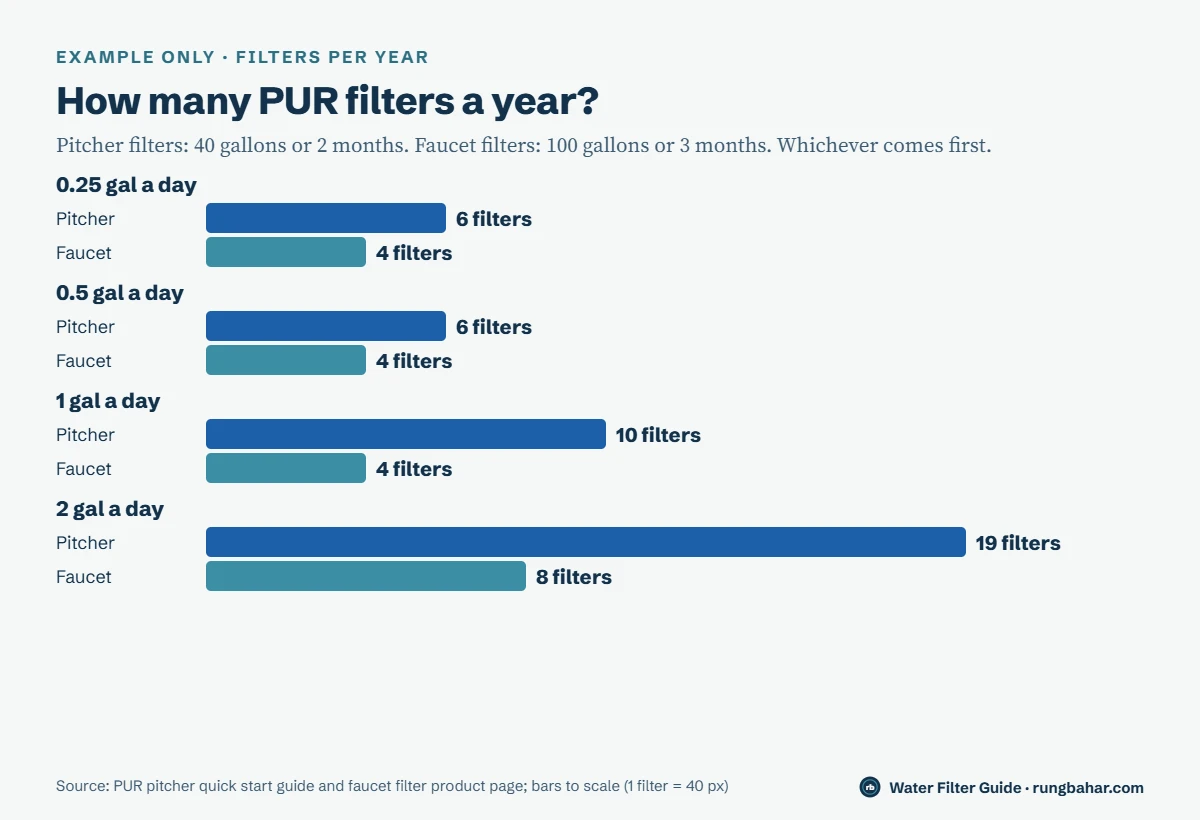
    Example bars of PUR filters per year: at 0.25 or 0.5 gallons a day, 6 pitcher or 4 faucet filters; at 1 gallon a day, 10 pitcher or 4 faucet; at 2 gallons a day, 19 pitcher or 8 faucet filters
    At a gallon a day, a PUR pitcher needs about 10 filters a year and a faucet filter 4.

    As an example only, a household that filters 1 gallon a day for drinking and cooking uses about 365 gallons a year. That is about 10 pitcher filters a year (365 ÷ 40, rounded up) or 4 faucet filters. A single person filtering half a gallon a day hits the time limit first: 6 pitcher filters or 4 faucet filters a year. At 2 gallons a day, a pitcher needs about 19 filters a year, which is usually the point where a faucet filter makes more sense. Multiply your own count by the price you see for the pack size you would buy; we do not quote prices because they change weekly.

    PUR pitchers with an electronic light count pours and flash red when it is time to change. Reset the light every time you fit a new filter, or the count will be wrong. Water temperature matters too: PUR rates its filters for water between 34°F and 82°F, so never run hot water through them.

    Marketing claims vs certified claims

    PUR’s packaging and press releases use a few big phrases. Here is what each one rests on.

    • “First and only” filter certified for lead, microplastics and total PFAS. PUR’s September 2026 release makes this claim for pitchers, dispensers and faucet mounts. We have not checked every brand’s listing, so we cannot confirm “only”. What we can confirm is that the PUR PLUS data sheets show all three claims, certified by IAPMO R&T.
    • “Reduces 70 contaminants” (faucet filter). This is plausible on the data sheet: the volatile organic chemical claim alone covers about 50 compounds tested together, plus 14 pharmaceuticals and chemicals under NSF/ANSI 401, lead, mercury, PFAS, microplastics and chlorine. A long list of chemicals you are unlikely to have is less useful than the three or four that matter for your water.
    • “5 times more contaminants than the leading pitcher filter.” PUR bases this on the number of contaminants certified, compared with an unnamed rival. Treat it as marketing. The useful comparison is contaminant by contaminant, which is what our tables do.
    • “Mineral Core.” PUR says the faucet filter runs water over natural minerals for taste. It is not a certified claim and it says nothing about how much calcium or magnesium ends up in your glass.

    The rule we use for every brand: a claim counts if it appears on the performance data sheet with a standard, a test concentration and a result, and the model is in a certifier’s listing. Our guide to checking whether a filter is really certified shows how to look a model up in the IAPMO R&T, NSF and WQA directories.

    Is PUR the right filter for you?

    PUR is a good fit if your concern is lead, PFAS, microplastics or the taste of city water, and you use the right model. It is the wrong tool for anything on the right-hand side of the chart below.
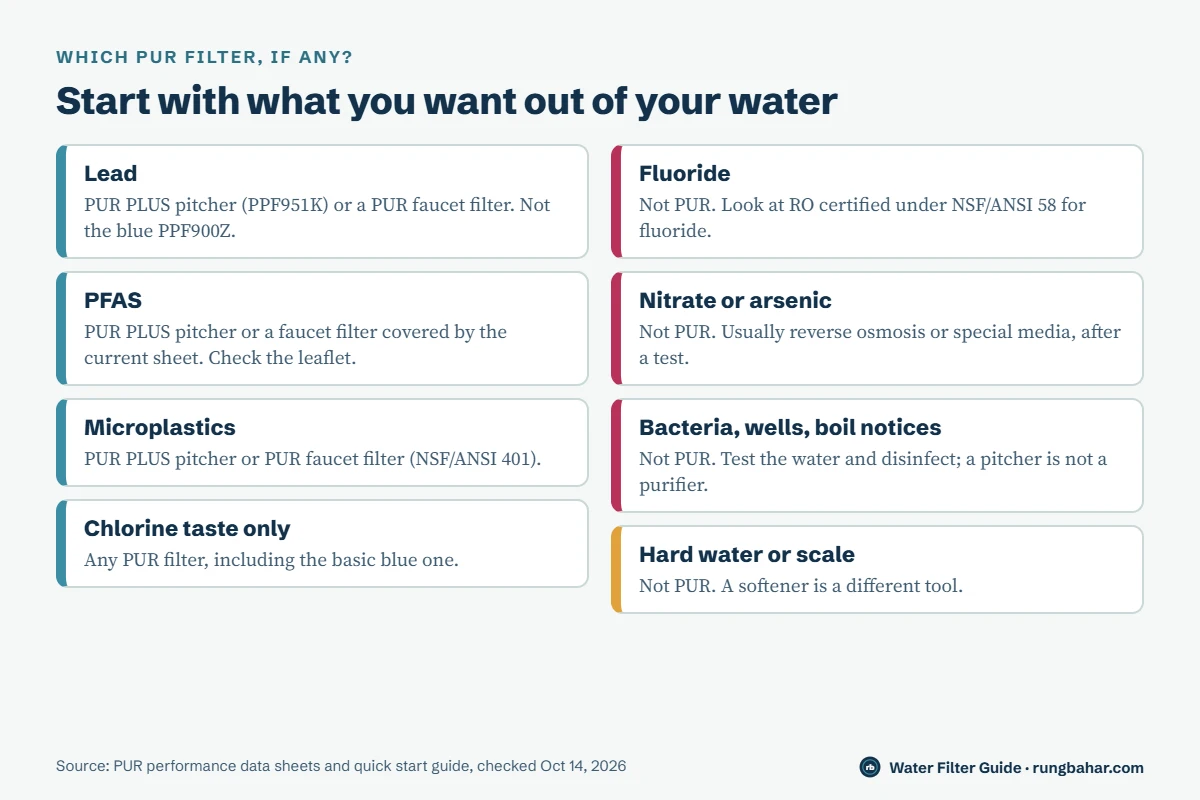
    Decision chart: PUR PLUS pitcher or faucet for lead, PFAS and microplastics; any PUR filter for chlorine taste; not PUR for fluoride, nitrate, arsenic, bacteria or hard water
    PUR fits lead, PFAS, microplastics and taste; fluoride, nitrate and germs need a different system.
    • Good fit: city water with lead service lines or old plumbing (as a stopgap), a utility report that shows PFAS, chlorine taste, renters who cannot install anything under the sink.
    • Pick the model carefully: PUR PLUS pitcher filters (PPF951K) or faucet filters, not the blue PPF900Z, for any health claim.
    • Not the right tool: fluoride removal, nitrate or arsenic, untested well water, a boil-water notice, hard water and scale.

    Lead + PFAS + microplastics

    PUR PLUS pitcher and dispenser filter (PPF951K)

    • Certification: NSF/ANSI 42, 53 (lead, total PFAS) and 401 (microplastics), IAPMO R&T
    • Best for: One pitcher filter covering lead, PFAS and microplastics
    • Skip if: you hate changing filters (40 gallons or 2 months)

    Read the PUR PLUS pitcher data sheet

    More water, fewer changes

    PUR faucet filter (RF-9999 or RF3375)

    • Certification: NSF/ANSI 42, 53 (lead, total PFAS, VOCs) and 401, IAPMO R&T
    • Best for: Households filtering 1 to 2 gallons a day or more
    • Skip if: your faucet is a pull-down or sprayer type (check PUR’s compatibility notes)

    Read the PUR faucet data sheet

    How to check your own PUR filter in two minutes

    • Find the model number on the filter or box: PPF900Z, PPF951K, RF-9999 or RF3375.
    • Open PUR’s performance data sheet page and match the model. Look for the contaminant you care about, the standard (42, 53 or 401) and the result.
    • For PFAS on a faucet filter, check that the leaflet in your box lists total PFAS. If it does not, you may have older stock covered by the 2025 sheet.
    • Confirm the model in the IAPMO R&T listing directory, which is the certifier named on the sheets.
    • Note the rated life and set a reminder, or reset the filter light when you change it.

    Not sure a pitcher or faucet filter is the right type at all? Answer three questions in the filter finder, check what your utility reports with the ZIP code tap-water check, or see how the two biggest pitcher brands compare in Brita vs PUR.

    PUR filters: 14 common questions, answered

    These are the questions people search most about what PUR filters remove, answered from PUR’s data sheets.

    Does PUR remove lead?

    Yes, if it is a PUR PLUS pitcher filter (PPF951K) or a PUR faucet filter (RF-9999 or RF3375). Both are certified under NSF/ANSI 53 to reduce lead from 150 ppb to 5 ppb or less. The basic blue PUR pitcher filter (PPF900Z) is not certified for lead.

    Does PUR remove PFAS?

    The PUR PLUS pitcher filter is certified for total PFAS at 99.75 percent and PUR’s faucet filters at 99.92 percent under NSF/ANSI 53. The blue PPF900Z has no PFAS claim, and faucet filters from older stock may come with a 2025 leaflet that does not list PFAS.

    Does PUR remove fluoride?

    No. No PUR data sheet lists fluoride, PUR’s pitcher guide says the filter does not remove it, and the ADA Seal for PUR pitcher and faucet filters is based on not removing fluoride.

    Does PUR remove chlorine?

    Yes. Every current PUR filter is certified under NSF/ANSI 42 to reduce chlorine taste and odor: 97.5 percent for the pitcher filters and 98.71 percent for the faucet filters.

    Does PUR remove chloramine?

    No PUR data sheet has a chloramine claim. Chloramine needs a filter certified for it, usually one with catalytic carbon.

    Does PUR remove microplastics?

    Yes for the PUR PLUS pitcher filter (99.8 percent) and the faucet filters (99.65 percent), certified under NSF/ANSI 401. The blue PPF900Z has no microplastics claim.

    Does PUR remove nitrates?

    No. Nitrate is not listed on any PUR data sheet. For nitrate, look at reverse osmosis certified for it, and test the water after treatment.

    Does PUR remove arsenic?

    No. Arsenic is not listed on any PUR data sheet. Arsenic usually needs reverse osmosis or special media, chosen after a lab test that shows which form of arsenic you have.

    Does PUR remove minerals or calcium?

    PUR makes no certified claim either way, and no PUR filter is a water softener. One independent review lab test of the PUR PLUS pitcher reported lower calcium and magnesium and higher sodium, but that is a single test on one water source.

    Does PUR remove bacteria?

    No. PUR says its filters do not filter microbes and must not be used on unsafe water or water of unknown quality without disinfection.

    What is the difference between the PUR and PUR PLUS pitcher filters?

    The PUR PLUS filter (PPF951K) is certified for lead, total PFAS, microplastics and more chemicals. The basic PUR filter (PPF900Z) covers chlorine taste and some metals and chemicals, but not lead, PFAS or microplastics. Both are rated for 40 gallons and fit the same pitchers.

    Is PUR NSF certified?

    PUR’s current filters are certified to NSF/ANSI standards 42, 53 and 401 by IAPMO R&T, an accredited certifier. A listing from IAPMO R&T counts the same as one from NSF; the standard is what matters.

    How often should I change a PUR filter?

    Pitcher and dispenser filters every 40 gallons or 2 months, whichever comes first. Faucet filters every 100 gallons or about 3 months. The certified claims only apply within those limits.

    Is PUR better than Brita?

    On certified claims, the PUR PLUS pitcher filter covers lead, total PFAS and microplastics, while the Brita Elite covers lead and microplastics but lasts three times longer. Our Brita vs PUR comparison has the full tables.

    Sources and how we checked this page

    Every claim on this page comes from PUR’s performance data sheets, its pitcher quick start guide and product pages, PUR’s September 2026 announcement, the American Dental Association’s Seal listings, a Michigan health department leaflet and the US EPA, checked on October 14, 2026. We do not test filters in a lab, and we have no commercial relationship with PUR. Data sheets change, so check the one for the exact filter you buy.

  • Does ZeroWater Remove Fluoride, PFAS, Lead or Microplastics?

    Does ZeroWater Remove Fluoride, PFAS, Lead or Microplastics?

    Updated October 13, 2026, by the RB Water Desk. How we research.

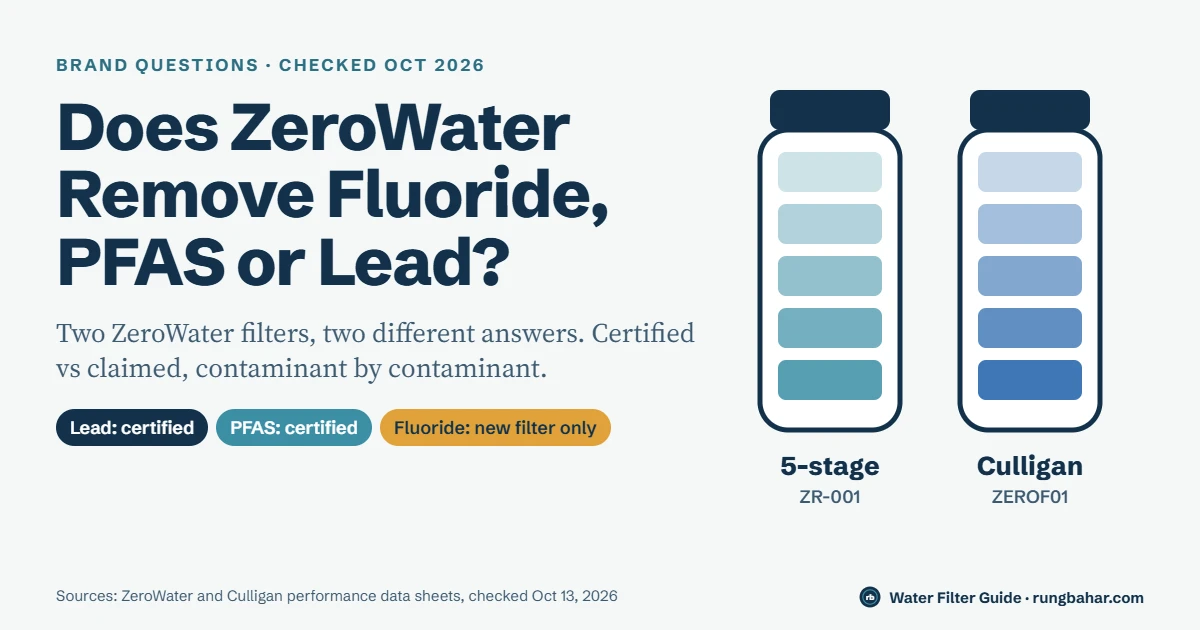
    The short answer: It depends on which ZeroWater filter you have. The standard ZeroWater 5-stage filter is certified to reduce lead (98.8 to 98.9 percent) and PFOA/PFOS (99.8 percent), but it is not certified for fluoride, microplastics or nitrate. The newer Culligan with ZeroWater Technology filter adds certified claims for fluoride (99.7 percent), total PFAS (99.7 percent) and nitrate, according to Culligan. Neither filter has a microplastics claim, and neither removes bacteria or viruses. Both strip out nearly all minerals, which is why a TDS meter reads close to zero.

    Quick check

    Does ZeroWater remove…

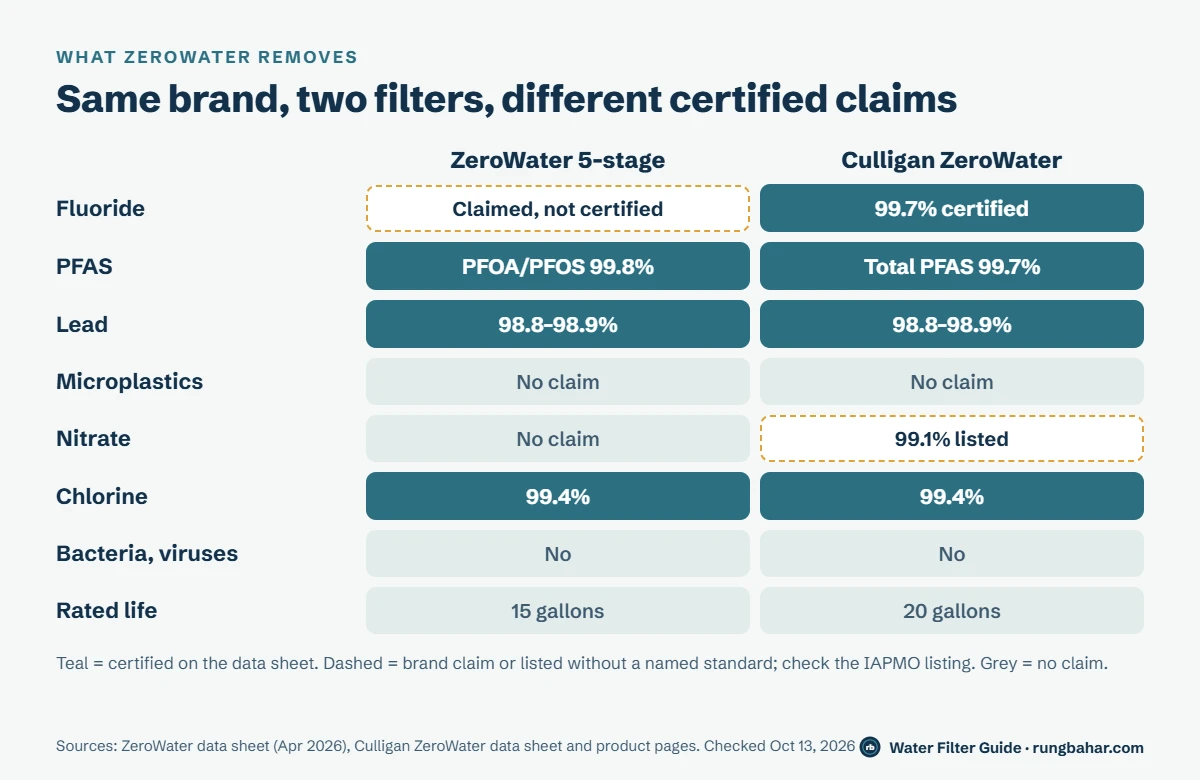
    Chart comparing ZeroWater 5-stage and Culligan ZeroWater: fluoride certified 99.7 percent only for Culligan, PFAS and lead certified for both, no microplastics claim for either, rated life 15 and 20 gallons
    The newer Culligan filter adds certified fluoride and total PFAS claims; neither covers microplastics.

    First: which ZeroWater filter do you have?

    Most answers online treat “ZeroWater” as one product. In 2026 there are two different ZeroWater filters on US shelves, and they do not carry the same claims. The answer to “does ZeroWater remove fluoride?” is yes for one and no for the other.

    • ZeroWater 5-stage filter (replacement ZR-001 or ZF-201). The long-running white filter used in most ZeroWater pitchers and dispensers. Its performance data sheet, dated April 2026, names IAPMO R&T as the certifier and gives a rated life of 15 gallons.
    • Culligan with ZeroWater Technology filter (replacement ZEROF01). A newer filter sold under the Culligan name for the new Culligan ZeroWater pitchers and dispensers. Its data sheet lists a longer set of claims and a rated life of 20 gallons. Culligan says it does not fit older ZeroWater pitchers.

    Check the model number on the filter or its box before you read on. Everything below comes from each filter’s performance data sheet and the maker’s product pages, checked on October 13, 2026. We have not tested either filter ourselves, and we have no commercial relationship with ZeroWater or Culligan. For each contaminant we say whether it is certified, not certified, or claimed by the brand without a certified result.

    What ZeroWater removes: the full table

    ContaminantZeroWater 5-stage (ZR-001)Culligan ZeroWater (ZEROF01)
    FluorideNot certified (brand page claims 99%)Certified, 99.7% (NSF/ANSI 53)
    PFASPFOA/PFOS certified, 99.8%Total PFAS certified, 99.7%
    LeadCertified, 98.8–98.9%Certified, 98.8–98.9%
    MicroplasticsNo claimNo claim
    NitrateNo claimListed, 99.1%
    Chromium-6Certified, 99.4–99.5%Certified, 99.4–99.5%
    MercuryCertified, 94.2–96.6%Certified, 94.2–96.6%
    Chlorine taste and odorCertified, 99.4% (NSF/ANSI 42)Certified, 99.4% (NSF/ANSI 42)
    Pharmaceuticals, BPA (NSF/ANSI 401)No claimListed (for example BPA 99.3%)
    Minerals / TDSNearly all (brand claim)Nearly all (brand claim)
    Bacteria and virusesNoNo
    Rated life15 gallons20 gallons

    Two things stand out. First, the newer Culligan filter covers almost everything the old one does plus fluoride, total PFAS and nitrate, and lasts 5 gallons longer on paper. Second, neither filter has a microplastics claim, even though microplastics are one of the most searched ZeroWater questions. If you want to see how a listing is checked, our guide to checking whether a filter is really certified walks through the IAPMO R&T directory.

    Does ZeroWater remove fluoride?

    The Culligan ZeroWater filter: yes, certified. The standard 5-stage filter: not certified.

    Culligan states that its ZeroWater Technology filter is certified by IAPMO to NSF/ANSI 53 to reduce fluoride 99.7 percent, in a test where water containing 8.0 mg/L of fluoride was brought down to 1.0 mg/L or less. That is a strong, specific claim, and 8.0 mg/L is about ten times the 0.7 mg/L the US Public Health Service recommends for community water fluoridation.

    The same Culligan page says plainly that older ZeroWater filters are not certified to reduce fluoride. That matters because an older ZeroWater blog post still says its 5-stage filter removes 99 percent of fluoride, without naming a test, a standard or a certifier. Ion exchange resin can take out fluoride, so the claim is plausible, but a number without a certification gives you nothing to rely on, and it tells you nothing about how long the effect lasts as the resin fills up. Treat the 5-stage filter as uncertified for fluoride.

    If fluoride is your main reason for filtering, the certified Culligan filter is one option. Reverse osmosis systems certified for fluoride under NSF/ANSI 58 are the other main route, and they keep working on hard water where a ZeroWater filter would run out quickly. Our guide to water filters that remove fluoride compares every method that works.

    Does ZeroWater remove PFAS?

    Yes. Both filters have a certified PFAS claim, but not the same one.

    The 5-stage filter’s data sheet lists PFOA and PFOS under NSF/ANSI 53, with 99.8 percent average reduction from a challenge of 1.5 micrograms per liter. PFOA and PFOS are the two best-known “forever chemicals” and the only two with US drinking water limits that the EPA has proposed keeping, at 4 parts per trillion each.

    The Culligan ZeroWater filter is certified for “total PFAS” at 99.7 percent. Total PFAS is the newer, broader test: the water contains a mix of seven PFAS compounds (PFOA, PFOS, PFHxS, PFNA, PFHpA, PFBS and PFDA), and the filter has to keep the combined total at 20 nanograms per liter or less. If you are buying new, that is the more complete claim. Before you buy, check whether your water has PFAS at all: how to find out if your tap water has PFAS lists the free sources.

    One caution applies to every pitcher. A certified result holds for the rated life on the data sheet, which is 15 or 20 gallons here. ZeroWater’s own replace-at signal is a TDS reading of 006, and on soft water that can come well after the rated gallons. If PFAS is your reason for buying, change the filter at the rated gallons, not when the meter tells you.

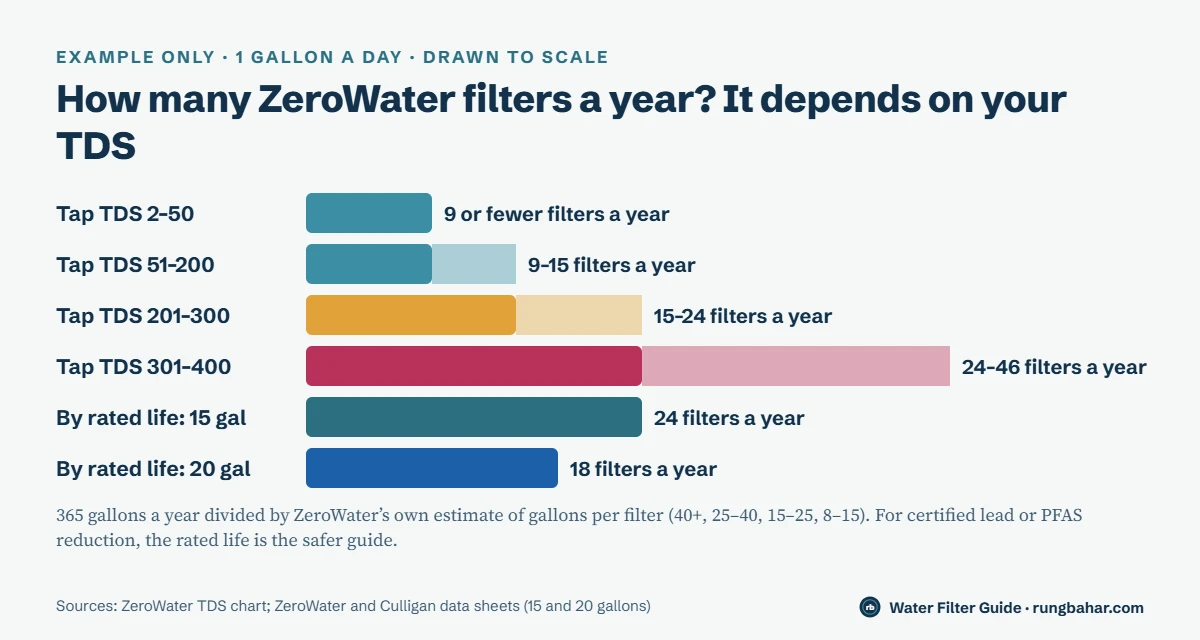
    To-scale example bars at 1 gallon a day: 9 or fewer ZeroWater filters a year at TDS 2 to 50, 9 to 15 at 51 to 200, 15 to 24 at 201 to 300, 24 to 46 at 301 to 400; 24 or 18 a year by rated life
    At 1 gallon a day, harder tap water can mean 24 or more ZeroWater filters a year.

    Does ZeroWater remove lead?

    Yes, certified. Both ZeroWater filters are certified under NSF/ANSI 53 to reduce lead. In that test, water starts at 150 parts per billion of lead and the filter must keep the output at or below 5 ppb for its rated life. The data sheets show 98.9 percent average reduction at pH 6.5 and 98.8 percent at pH 8.5.

    That puts ZeroWater alongside the Brita Elite and PUR PLUS pitcher filters, which pass the same test. The difference is filter life: a Brita Elite is rated for 120 gallons, a ZeroWater filter for 15 or 20. Our ZeroWater vs Brita comparison puts the numbers side by side. If you have lead pipes, a filter is a stopgap, not the fix; see lead in tap water for testing and what else to do.

    Does ZeroWater remove microplastics?

    No certified claim. Microplastics reduction is certified under NSF/ANSI 401, using particles between 0.5 and 1 micron, and a filter must reduce them by at least 85 percent to pass. Neither ZeroWater data sheet includes that test.

    That does not mean ZeroWater lets every particle through. The filter has screens and dense media that will catch some particles. But without a certified result there is no number to quote, and “probably catches some” is not the same as “certified at 99 percent.” If microplastics are your priority, the Brita Elite (99.6 percent) and PUR PLUS pitcher filter (99.8 percent) have certified claims. Our guide to filters for microplastics explains what the test does and does not cover.

    Does ZeroWater remove nitrates?

    The Culligan filter lists nitrate. The 5-stage filter does not.

    Culligan lists nitrate at 99.1 percent and nitrite at 90.2 percent for the ZeroWater Technology filter, and its product page describes nitrate as part of its certified claims. On the data sheet, though, the nitrate rows sit apart from the NSF/ANSI 42, 53 and 401 sections, so confirm nitrate in the IAPMO listing for the model before relying on it. The standard 5-stage filter has no nitrate claim at all.

    Nitrate is mainly a concern for private wells near farmland and for formula-fed babies. A pitcher with a 20-gallon life is a short-term measure for a well with a nitrate problem. Test the well, and look at the treatment options in our well water results guide.

    Does ZeroWater remove minerals?

    Yes, nearly all of them, and that is by design. ZeroWater’s large ion exchange stage pulls out calcium, magnesium, sodium, bicarbonate and other dissolved minerals along with the harmful ions. That is why a ZeroWater pitcher comes with a TDS meter and why filtered water reads 000.

    This has two practical effects. Taste: some people love the very clean taste, others find it flat. Filter life: the resin has a fixed capacity, so the more minerals in your tap water, the faster it fills. ZeroWater estimates 40 gallons or more per filter when tap water TDS is under 50, 25 to 40 gallons at 51 to 200, 15 to 25 at 201 to 300, and as little as 8 gallons above 300. On very hard water, an under-sink reverse osmosis system is usually cheaper to run. Our guide to what a TDS reading means explains the numbers, and why a low reading is not the same as safe water.

    Does ZeroWater remove chlorine, chloramine and bacteria?

    Chlorine: yes, certified. Both filters are certified under NSF/ANSI 42 for chlorine taste and odor, at 99.4 percent.

    Chloramine: no claim. Many US cities disinfect with chloramine instead of chlorine. Neither ZeroWater data sheet lists it, so there is no certified result for chloramine taste or odor.

    Bacteria and viruses: no. ZeroWater is a filter, not a purifier. The data sheet states that it is intended only for potable water and must not be used with water that is microbiologically unsafe or of unknown quality without adequate disinfection before or after. On a boil-water notice, boil first.

    Marketing claims vs certified claims

    ZeroWater’s own pages do not always agree with each other or with the data sheet, which is one reason to read the data sheet first:

    • An older ZeroWater blog post says the 5-stage filter removes 99 percent of fluoride. Culligan’s current page says older ZeroWater filters are not certified for fluoride, and the data sheet does not list it.
    • The same older post gives 94.9 percent for PFOA and PFOS. The April 2026 data sheet gives 99.8 percent. The data sheet is the certified number.
    • ZeroWater’s performance results page compares lead and PFOA/PFOS with a Brita Standard filter at different volumes (15 vs 20 gallons). Brand-run side-by-side tests are marketing, not certification.

    The rule we use for every brand: a contaminant counts only if it appears on the current data sheet for the exact model, with a standard and a certifier, and the certifier’s directory agrees. Everything else is a claim.

    Is ZeroWater the right filter for you?

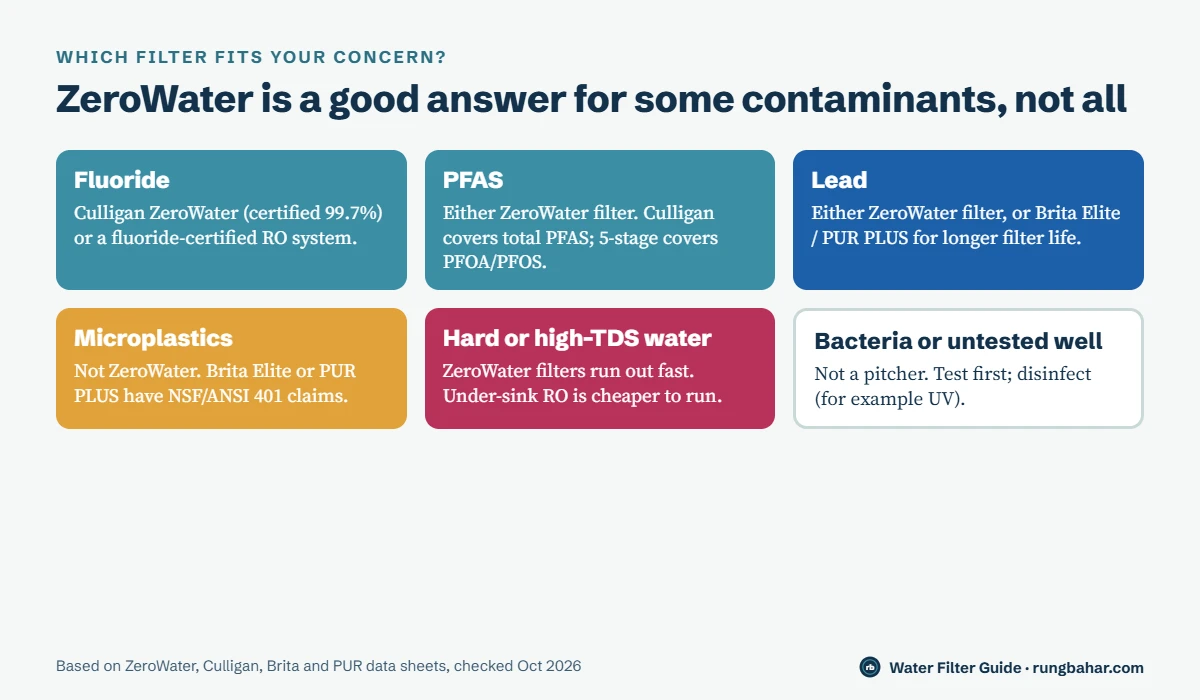
    • Good fit: you want certified lead and PFAS reduction in a pitcher, your tap water TDS is under about 200, and you like the very clean taste. If you are buying new, choose the Culligan version for fluoride and total PFAS.
    • Think twice: your water is hard or high in TDS (filters may last only 8 to 15 gallons), you want few filter changes, or microplastics are your main concern.
    • Not the right tool: untested well water, any boil-water notice, or a need for whole-house treatment.

    Fluoride + total PFAS

    Culligan with ZeroWater Technology (ZEROF01)

    • Certification: NSF/ANSI 42, 53 and 401 (lead, total PFAS, fluoride), IAPMO
    • Best for: Fluoride, PFAS and lead in one pitcher
    • Skip if: you own an older ZeroWater pitcher (not compatible)

    Read the Culligan ZeroWater data sheet

    PFOA/PFOS + lead

    ZeroWater 5-stage filter (ZR-001)

    • Certification: NSF/ANSI 42 and 53 (lead, PFOA/PFOS, chromium-6, mercury), IAPMO R&T
    • Best for: Owners of existing ZeroWater pitchers on low-TDS water
    • Skip if: fluoride is your main concern

    Read the ZeroWater data sheet

    Decision chart: ZeroWater fits fluoride (Culligan version), PFAS and lead; Brita Elite or PUR PLUS for microplastics; RO for hard water; testing and disinfection for wells
    ZeroWater covers fluoride, PFAS and lead, but not microplastics or bacteria.

    Not sure a pitcher is the right type at all? Answer three questions in the filter finder, check what your utility reports with the ZIP code tap-water check, or compare pitcher brands in what Brita filters remove. For the widest coverage, see what reverse osmosis removes.

    ZeroWater: 14 common questions, answered

    These are the questions people search most about what ZeroWater removes, answered from the data sheets.

    Does ZeroWater remove fluoride?

    The newer Culligan with ZeroWater Technology filter is certified under NSF/ANSI 53 to reduce fluoride 99.7 percent. The standard ZeroWater 5-stage filter is not certified for fluoride, according to Culligan.

    Does ZeroWater remove PFAS?

    Yes. The 5-stage filter is certified for PFOA and PFOS (99.8 percent) and the Culligan ZeroWater filter for total PFAS (99.7 percent), both under NSF/ANSI 53.

    Does ZeroWater remove lead?

    Yes. Both filters are certified under NSF/ANSI 53 to reduce lead from 150 ppb to 5 ppb or less, with 98.8 to 98.9 percent average reduction.

    Does ZeroWater remove microplastics?

    There is no certified claim. Neither ZeroWater data sheet includes the NSF/ANSI 401 microplastics test.

    Does ZeroWater remove nitrates?

    The Culligan ZeroWater filter lists nitrate at 99.1 percent. The standard 5-stage filter has no nitrate claim.

    Does ZeroWater remove minerals?

    Yes. It removes nearly all dissolved minerals, including calcium and magnesium, which is why filtered water reads close to 0 on a TDS meter.

    Does ZeroWater remove chlorine?

    Yes. Both filters are certified under NSF/ANSI 42 for chlorine taste and odor at 99.4 percent. Neither lists chloramine.

    Does ZeroWater remove bacteria or viruses?

    No. ZeroWater says its filters are only for water that is already safe to drink and should not be used on unsafe or untested water without disinfection.

    Does ZeroWater remove arsenic?

    Neither ZeroWater data sheet lists arsenic. For arsenic, look for a reverse osmosis system with a certified arsenic claim and test your water first.

    Does ZeroWater remove hardness?

    Yes, it removes calcium and magnesium along with other minerals. On hard water this uses up the filter faster, so it is not a cheap way to soften drinking water.

    Is ZeroWater NSF certified?

    ZeroWater filters are certified by IAPMO R&T to NSF/ANSI standards. IAPMO R&T is an accredited certifier, so its listings count the same as NSF International’s.

    How long does a ZeroWater filter last?

    The rated life is 15 gallons (5-stage) or 20 gallons (Culligan). ZeroWater estimates 8 to 40+ gallons in practice, depending on your tap water’s TDS.

    Can I use the new Culligan ZeroWater filter in an old ZeroWater pitcher?

    No. Culligan says the ZeroWater Technology filter is not compatible with older ZeroWater pitchers and dispensers.

    Is ZeroWater better than reverse osmosis?

    ZeroWater gets TDS lower, but a certified under-sink RO system usually covers more contaminants and costs less to run, especially on hard water.

    Sources and how we checked this page

    Every claim on this page comes from ZeroWater’s and Culligan’s performance data sheets and product pages and from the US EPA, checked on October 13, 2026. We do not test filters in a lab, and we have no commercial relationship with ZeroWater or Culligan. Data sheets change, so check the one for the exact filter you buy.

  • ZeroWater vs Brita: TDS, Lead and PFAS Compared

    ZeroWater vs Brita: TDS, Lead and PFAS Compared

    Published October 12, 2026. Every claim is checked against the sources listed at the end of this page. How we research.

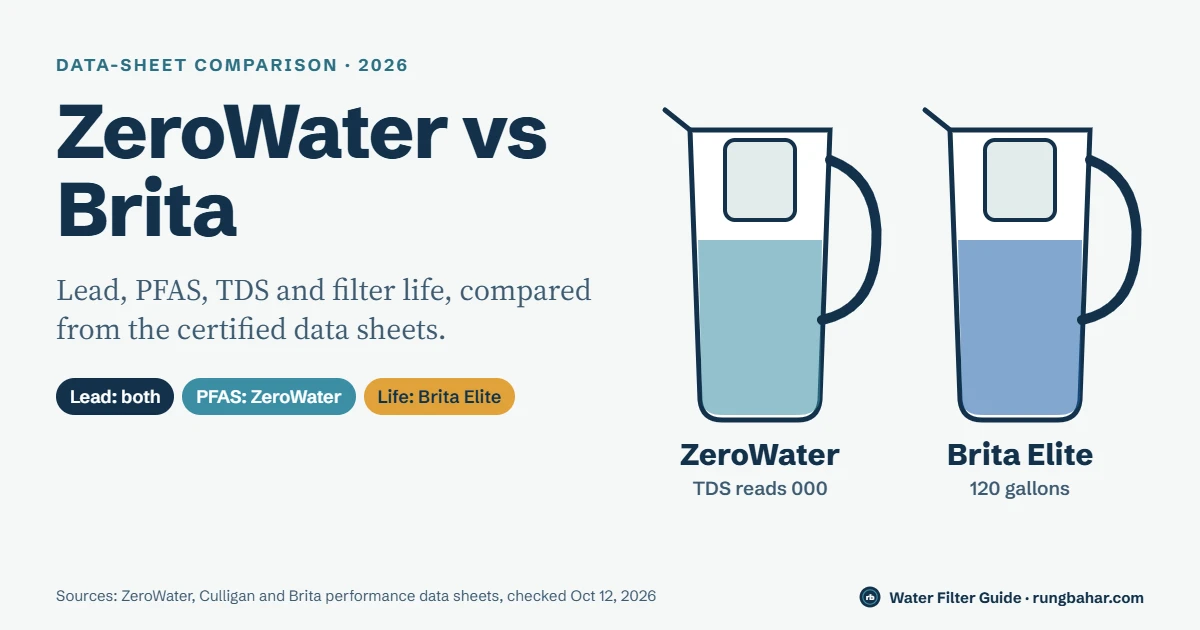
    The short answer: ZeroWater and the Brita Elite are both certified to reduce lead, but they win on different things. ZeroWater’s 5-stage filter is also certified for PFOA and PFOS (99.8 percent on its data sheet) and strips out nearly all dissolved minerals, so a TDS meter reads close to zero. The Brita Elite has no PFAS claim but is certified for microplastics and is rated for 120 gallons, against ZeroWater’s rated 15 gallons (8 to 40+ in practice, depending on your tap water’s TDS). Choose ZeroWater for PFAS and the lowest-TDS water; choose the Brita Elite for fewer filter changes. The basic Brita Standard filter is not certified for lead.

    Quick check: filters per year

    1. What is your tap water’s TDS?

    2. How much filtered water do you use a day?

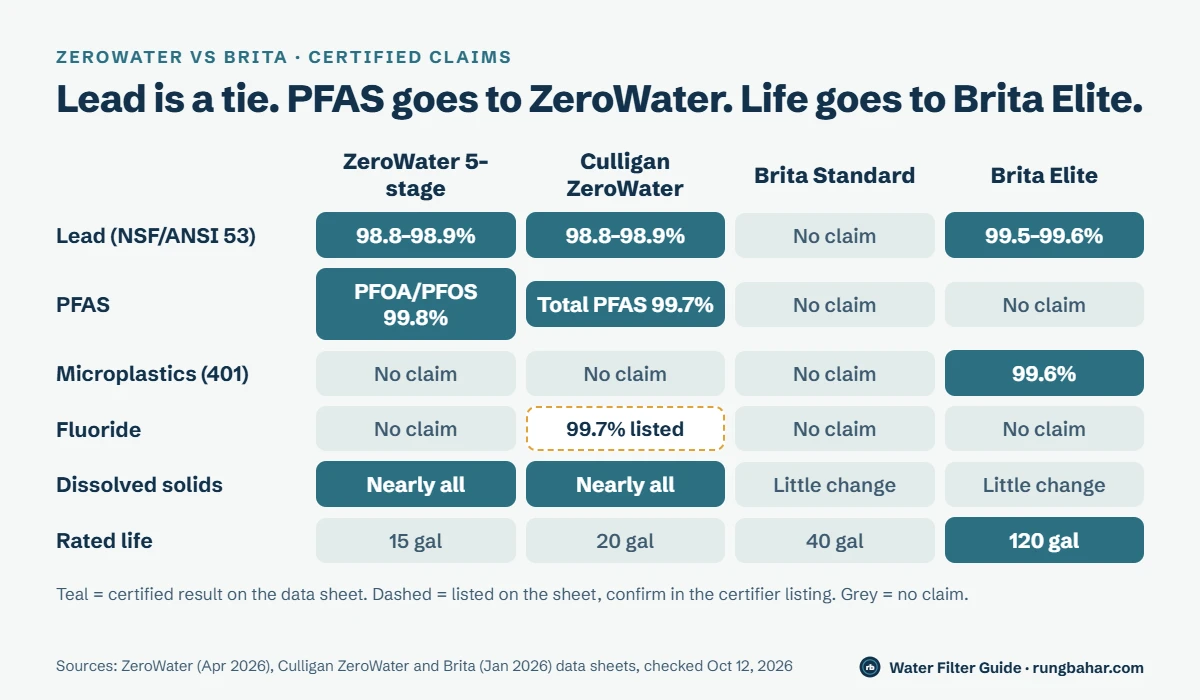
    Chart comparing ZeroWater 5-stage, Culligan ZeroWater, Brita Standard and Brita Elite: both ZeroWater filters and Brita Elite certified for lead, only ZeroWater for PFAS, only Brita Elite for microplastics
    Lead is a tie, PFAS goes to ZeroWater and filter life goes to the Brita Elite.

    Which ZeroWater and which Brita are you comparing?

    “ZeroWater vs Brita” sounds like a two-product question, but there are four filters that matter, and two of them changed recently. If you compare the wrong pair, the answer flips.

    • ZeroWater 5-stage filter (replacement ZR-001 / ZF-201): the filter most ZeroWater pitchers and dispensers on store shelves use. Its April 2026 data sheet names IAPMO R&T as the certifier and a rated life of 15 gallons.
    • Culligan with ZeroWater Technology filter (ZEROF01): a newer filter sold under the Culligan name. Its data sheet lists more claims, including total PFAS and fluoride, and a rated life of 20 gallons. It does not fit older ZeroWater pitchers, and older filters do not fit the new pitchers.
    • Brita Standard (OB03): Brita’s basic white filter, rated for 40 gallons. Certified for chlorine taste and a few metals, not for lead.
    • Brita Elite (OB06, formerly Longlast+): rated for 120 gallons. Certified for lead, microplastics and a long list of chemicals, but no PFAS on its current data sheet.

    So the useful comparisons are ZeroWater 5-stage vs Brita Elite (the two filters most people are choosing between) and, if you are buying a new pitcher anyway, Culligan ZeroWater vs Brita Elite. Everything below comes from each filter’s performance data sheet, the document that lists what was tested, at what concentration and with what result. We checked them on October 12, 2026. We did not test any filter ourselves, and packaging slogans and review-site scores were not used as evidence.

    ZeroWater vs Brita: certified claims side by side

    “No claim” means the contaminant is not on that filter’s data sheet. It does not prove the filter removes none of it; it means nobody certified a result you can rely on.

    ContaminantZeroWater 5-stageCulligan ZeroWaterBrita StandardBrita Elite
    Lead (NSF/ANSI 53, 5 ppb limit)98.8–98.9%98.8–98.9%No claim99.5–99.6%
    PFOA / PFOS (NSF/ANSI 53)99.8%Total PFAS 99.7%No claimNo claim
    Microplastics (NSF/ANSI 401)No claimNo claimNo claim99.6%
    Chromium-699.4–99.5%99.4–99.5%No claimNo claim
    Mercury94.2–96.6%94.2–96.6%82–86%95.5–95.9%
    FluorideNo claim99.7% (listed)NoNo
    NitrateNo claim99.1% (listed)NoNo
    Chlorine taste and odor (NSF/ANSI 42)99.4%99.4%95%97.4%
    Dissolved solids (TDS)Nearly all (brand claim)Nearly all (brand claim)Not listedNot listed
    Bacteria and virusesNoNoNoNo
    Rated life15 gallons20 gallons40 gallons120 gallons
    Certifier namedIAPMO R&TIAPMO (product page)WQAIAPMO R&T, NSF, WQA

    Read the table by row. On lead, it is a tie between the certified models. On PFAS, ZeroWater has a certified claim and Brita does not. On microplastics, Brita Elite has a certified claim and ZeroWater does not. On filter life, Brita wins by a wide margin. Our guide to checking whether a filter is really certified explains why an IAPMO R&T or WQA listing counts the same as one from NSF International.

    How each filter works, in plain terms

    Both brands use activated carbon, which grabs chlorine and many organic chemicals by sticking them to its huge internal surface. Both also use ion exchange resin, tiny beads that swap one dissolved ion for another. The difference is how much resin, and what it is designed to do.

    Brita’s filters are built mainly for taste and a targeted list of contaminants. They leave most of the natural minerals (calcium, magnesium, bicarbonate) in the water, so the water tastes like your tap water without the chlorine.

    ZeroWater calls its design a “5-stage ion exchange” filter, and the key stage is a large bed of mixed resin that pulls out almost every charged particle in the water: the harmful ones like lead, and the harmless ones like calcium and sodium. That is why ZeroWater ships a TDS meter with its pitchers and promises a reading of 000. It is also why the filter wears out faster: the resin has a fixed capacity, and every milligram of ordinary minerals uses some of it up.

    Lead: both certified models pass the same test

    If lead is why you are buying a filter, either brand works, as long as you buy the right model. Under NSF/ANSI 53, the test water starts at 150 parts per billion (ppb) of lead and the filter must keep the output at or below 5 ppb for its whole rated life. ZeroWater’s data sheet shows 98.9 percent average reduction at pH 6.5 and 98.8 percent at pH 8.5. The Brita Elite sheet shows 99.5 and 99.6 percent.

    Do not read much into the gap. Both filters passed the same pass-or-fail limit, and a fraction of a percent between averages in a lab run tells you little about your kitchen. The real risk is buying the Brita Standard by mistake: it is usually the cheaper filter on the shelf and has no lead claim. If you have lead pipes or an older home, see lead in tap water: testing and filters that work for what to do besides filtering.

    One more point for ZeroWater users: the lead claim applies within the rated life on the data sheet, which is 15 gallons for the 5-stage filter. ZeroWater’s own advice is to change the filter when the TDS meter reads 006, which on low-TDS water can be well past 15 gallons. If lead is your main concern, the conservative choice is to follow the rated gallons, not the meter.

    PFAS: ZeroWater has a certified claim, Brita does not

    This is the clearest difference between the brands. The ZeroWater 5-stage data sheet lists PFOA and PFOS together under NSF/ANSI 53, with 99.8 percent average reduction from a challenge of about 1.5 micrograms per liter (1,500 nanograms per liter). The newer Culligan ZeroWater sheet goes further and lists “total PFAS” at 99.7 percent, the newer test that covers a mix of seven PFAS compounds, not just PFOA and PFOS.

    The Brita Elite data sheet dated January 2026 lists no PFOA, PFOS or total PFAS, and the Brita Standard sheet does not either. Some older articles cite a 2023 Canadian Elite sheet with a PFOA/PFOS claim; the current sheet does not carry it, so we treat Brita pitcher filters as having no certified PFAS reduction. Our page on what Brita filters remove covers the history.

    Before you buy for PFAS, check whether your water has it. Many utilities have now tested for PFAS, and results are free to look up; how to find out if your tap water has PFAS shows where. If it does, a certified pitcher is one option. An under-sink reverse osmosis system certified under NSF/ANSI 58 is the other, with wider coverage and lower cost per gallon over time.

    TDS: why ZeroWater reads 000 and Brita does not

    Total dissolved solids (TDS) is the combined weight of everything dissolved in water, mostly harmless minerals and salts, measured in milligrams per liter (about the same as parts per million). Most US tap water sits somewhere between 50 and a few hundred. The US EPA’s non-enforceable guideline for TDS is 500 mg/L, set for taste, scaling and staining, not for health. Our guide to what a TDS reading means explains the scale in more detail.

    ZeroWater’s 0 reading is real: the resin removes nearly all of those minerals. A Brita filter barely changes TDS, because it was never designed to remove calcium and magnesium. That is why “zero water vs brita TDS” videos always look like a knockout for ZeroWater.

    But a low TDS number does not mean safer water, and a high one does not mean dangerous water. Lead at a worrying level is a few parts per billion, thousands of times too small to move a TDS meter. PFAS are measured in parts per trillion. A TDS meter tells you how many minerals are in the water and whether a ZeroWater filter is exhausted. It cannot tell you whether a Brita filter is working. The World Health Organization notes that water with very low TDS can taste flat; some people love ZeroWater’s clean taste for exactly that reason, and others find it bland. Our guide to whether low-mineral RO water is good for you covers the mineral question in more depth, and it applies equally to ZeroWater water.

    Filter life: the biggest practical difference

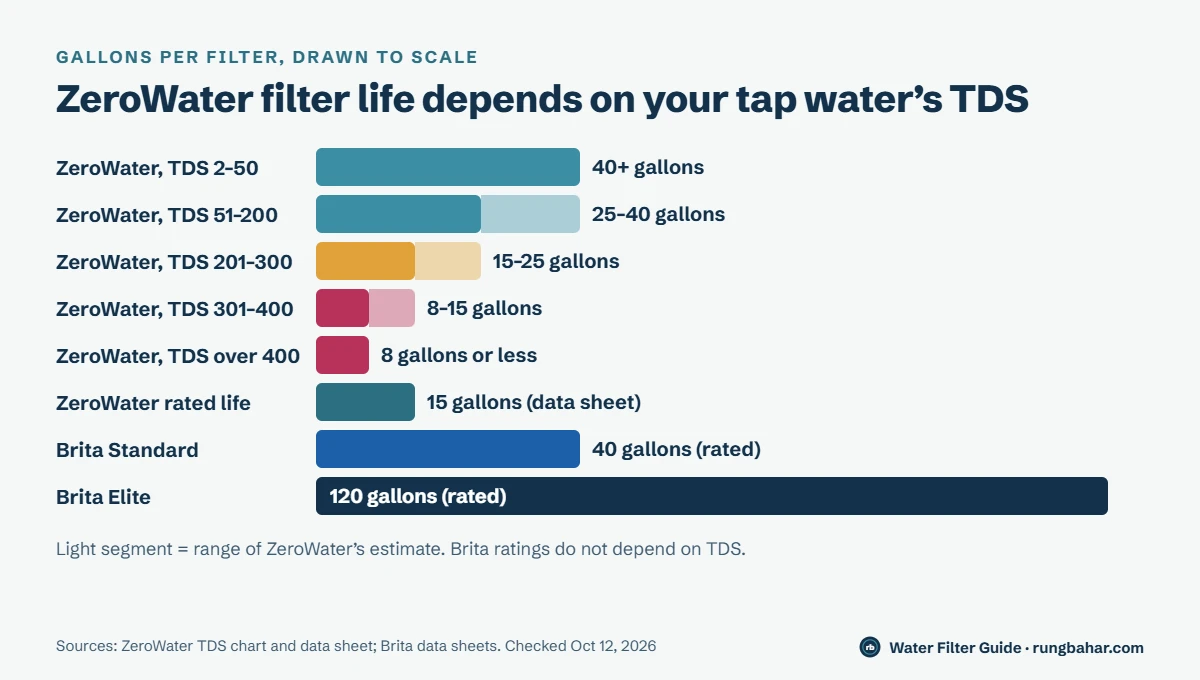
    Brita filters are rated by volume: 40 gallons for the Standard and 120 for the Elite, whatever your water is like. ZeroWater’s rated life is 15 gallons on its data sheet, but in practice the filter lasts until its resin is full of minerals, so the life depends on your tap water’s TDS. ZeroWater says each filter removes about 18,000 milligrams of dissolved solids and publishes this estimate:

    Tap water TDSZeroWater’s estimate per filterFilters a year at 1 gallon a day
    2–50 (low)40 gallons or moreAbout 9 or fewer
    51–200 (typical, per ZeroWater)25–40 gallonsAbout 9 to 15
    201–300 (high)15–25 gallonsAbout 15 to 24
    301–400 (very high)8–15 gallonsAbout 24 to 46
    Over 4008 gallons or less46 or more
    Brita Elite (any TDS)120 gallons (rated)About 3
    Brita Standard (any TDS)40 gallons (rated)About 9 to 10
    To-scale bars: ZeroWater lasts 40+ gallons at TDS 2 to 50, 25 to 40 at 51 to 200, 15 to 25 at 201 to 300, 8 to 15 at 301 to 400; Brita Standard 40 gallons and Brita Elite 120 gallons
    On typical tap water a ZeroWater filter lasts 25 to 40 gallons; a Brita Elite is rated for 120.

    The worked example uses 365 gallons a year, a household that filters 1 gallon a day for drinking and cooking. That is an example only; use the quick check at the top of this page with your own numbers. For a typical tap water around 150 to 200 mg/L, a ZeroWater user changes filters roughly every 3 to 6 weeks, while a Brita Elite user changes about 3 times a year.

    This is why cost-per-gallon claims vary so much between review sites: the answer depends on your water. We do not quote prices here, because filter prices change weekly and differ by pack size. Take the number of filters a year from the table, multiply by today’s price per filter, and you have a fair yearly cost for your home. If your TDS is above about 300, the math usually favors an under-sink reverse osmosis system, whose membrane and filters last months rather than weeks.

    Fluoride, microplastics, nitrate and bacteria

    Fluoride

    Neither Brita filter lists fluoride. The ZeroWater 5-stage data sheet does not list fluoride either, although ion exchange resin can remove some fluoride; without a certified result, you cannot know how much or for how long. The newer Culligan ZeroWater sheet lists fluoride at 99.7 percent average reduction. If fluoride is your reason to filter, check that the claim appears in the certifier’s listing for the exact model, or look at the proven options in water filters that remove fluoride.

    Microplastics

    The Brita Elite is certified under NSF/ANSI 401 for microplastics, with 99.6 percent reduction of particles in the 0.5 to 1 micron range. Neither ZeroWater data sheet lists microplastics. That does not mean ZeroWater lets them through, only that there is no certified number. If microplastics are your priority, the Elite is the documented choice; see what the microplastics certification says.

    Nitrate

    Nitrate matters mostly for private wells near farmland and for formula-fed infants. The Culligan ZeroWater sheet lists nitrate at 99.1 percent, but it sits outside the NSF/ANSI 42, 53 and 401 sections on the sheet, so treat it as a manufacturer result until you see it in a certifier listing. No Brita filter lists nitrate. For a well with nitrate, start with our well water results guide.

    Bacteria and viruses

    Neither brand is a purifier. Both data sheets say the filters are for water that is already microbiologically safe and should not be used on water of unknown quality without disinfection.

    ZeroWater vs PUR, and ZeroWater vs reverse osmosis

    ZeroWater vs PUR: the PUR PLUS pitcher filter is certified for lead, total PFAS and microplastics and is rated for 40 gallons, so it covers the three headline contaminants in one filter and lasts longer than ZeroWater on most tap water. ZeroWater’s advantages are chromium-6 and the near-zero TDS. Our Brita vs PUR comparison has the PUR data sheet numbers.

    ZeroWater vs reverse osmosis: both lower TDS sharply. An under-sink RO system certified under NSF/ANSI 58 must cut TDS from a 750 mg/L test water to 187 mg/L or less, and many systems do much better; ZeroWater gets closer to zero. The difference is in running cost and coverage. RO membranes last months or years, RO systems are often certified for fluoride, arsenic and nitrate as well, and they work on high-TDS water where ZeroWater filters run out in days. ZeroWater needs no installation, which matters for renters. See what reverse osmosis removes for the full list.

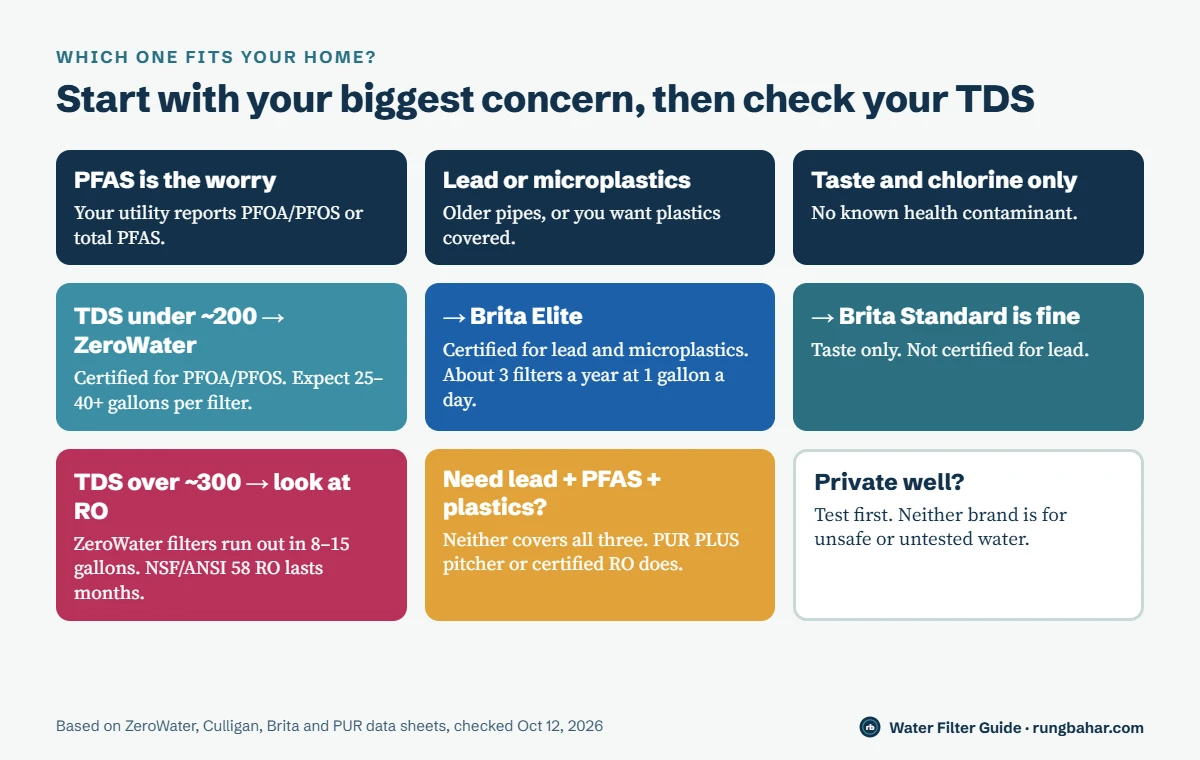
    Decision chart: PFAS concern and TDS under about 200 points to ZeroWater, lead or microplastics to Brita Elite, taste only to Brita Standard, TDS over 300 to reverse osmosis, private wells to testing first
    Pick by your main concern first, then check your tap water TDS.

    ZeroWater or Brita: which one to buy

    • Choose ZeroWater if PFAS (PFOA/PFOS) is your main concern, your tap water TDS is under about 200, and you like the very clean taste. Change filters at the rated life if you rely on it for lead.
    • Choose the Culligan ZeroWater pitcher if you are buying new and want total PFAS and a fluoride claim in a pitcher, after confirming the listing.
    • Choose the Brita Elite if you want lead and microplastics covered with about three filter changes a year, and PFAS is not a known issue in your water.
    • Skip both if your TDS is over 300 (ZeroWater filters will run out fast; consider RO), if you need a certified PFAS pitcher that lasts longer (look at PUR PLUS), or if you are on an untested private well.
    • Do not buy the Brita Standard for health reasons; it is a taste filter.

    Certified PFOA/PFOS

    ZeroWater 5-stage filter (ZR-001)

    • Certification: NSF/ANSI 42 and 53 (lead, PFOA/PFOS, chromium-6, mercury), IAPMO R&T
    • Best for: Low-TDS tap water, PFAS concerns, lowest-TDS taste
    • Skip if: your tap TDS is over 300 or you want few filter changes

    Read the ZeroWater data sheet

    Most listed claims

    Culligan with ZeroWater Technology (ZEROF01)

    • Certification: NSF/ANSI 42, 53 and 401 listed (lead, total PFAS, fluoride); IAPMO per product page
    • Best for: New pitcher buyers who want PFAS and fluoride in one pitcher
    • Skip if: you already own an older ZeroWater pitcher (not compatible)

    Read the Culligan ZeroWater data sheet

    Longest life

    Brita Elite filter (OB06)

    • Certification: NSF/ANSI 42, 53 (lead) and 401 (microplastics)
    • Best for: Lead and microplastics with about 3 changes a year
    • Skip if: PFAS is your main concern

    Read the Brita Elite data sheet

    How to check a ZeroWater or Brita claim before you buy

    1. Find the replacement filter’s model number: ZR-001 or ZF-201 for ZeroWater 5-stage, ZEROF01 for Culligan ZeroWater, OB03 or OB06 for Brita.
    2. Open that model’s performance data sheet (linked in the sources below) and find your contaminant.
    3. Note the rated life in gallons. A claim only applies within it.
    4. Confirm the listing with the certifier named on the sheet or product page, using the IAPMO R&T, WQA or NSF directories.
    5. For ZeroWater, measure your tap water with the included TDS meter on day one, so you can predict how long each filter will last.

    Still deciding what type of filter you need? Start with how to choose a water filter in 5 steps, answer three questions in the filter finder, or run the ZIP code tap-water check to see what your utility reports.

    ZeroWater vs Brita: 14 common questions, answered

    These are the questions people search most when choosing between ZeroWater and Brita, answered from the data sheets.

    Is ZeroWater better than Brita?

    It depends on what you need. ZeroWater’s 5-stage filter is certified for lead and PFOA/PFOS and removes nearly all dissolved minerals. The Brita Elite is certified for lead and microplastics and lasts 120 gallons, many times longer than a ZeroWater filter on typical tap water.

    Does ZeroWater remove more than Brita?

    On PFAS, chromium-6 and dissolved minerals, yes. On microplastics, the Brita Elite has a certified claim and ZeroWater does not. Both certified models pass the same lead test.

    Zero Water vs Brita Elite: which is better for lead?

    Both are certified under NSF/ANSI 53 to reduce lead from 150 ppb to 5 ppb or less: ZeroWater at 98.8 to 98.9 percent and the Elite at 99.5 to 99.6 percent. The Brita Standard is not certified for lead.

    Does ZeroWater remove fluoride?

    The ZeroWater 5-stage data sheet does not list fluoride. The newer Culligan with ZeroWater Technology filter lists fluoride at 99.7 percent average reduction. Brita filters do not list fluoride.

    Does ZeroWater remove microplastics?

    Neither ZeroWater data sheet lists a microplastics claim. The Brita Elite is certified under NSF/ANSI 401 at 99.6 percent.

    Does ZeroWater remove PFAS?

    The 5-stage filter is certified for PFOA and PFOS (99.8 percent). The Culligan ZeroWater filter lists total PFAS at 99.7 percent. Brita’s current pitcher data sheets list no PFAS.

    How long does a ZeroWater filter last compared with Brita?

    ZeroWater rates its 5-stage filter at 15 gallons and estimates 8 to 40+ gallons depending on tap water TDS. The Brita Standard is rated for 40 gallons and the Brita Elite for 120.

    Why does my ZeroWater filter run out so fast?

    Your tap water probably has a high TDS. The filter removes all dissolved minerals, and each filter holds about 18,000 mg. At a TDS of 300 or more, ZeroWater estimates only 8 to 15 gallons per filter.

    Why does my ZeroWater water taste fishy?

    ZeroWater and Culligan list a fishy or otherwise changed taste or smell as a sign the filter is exhausted. Replace it when the TDS meter reads 006 or the taste changes.

    Does ZeroWater remove minerals like calcium and magnesium?

    Yes. It removes nearly all dissolved minerals, including calcium and magnesium. Brita filters leave most minerals in place.

    Is ZeroWater water safe to drink every day?

    Low-mineral water is safe to drink; most of the minerals people need come from food. Some people find it tastes flat. It is not a purifier for unsafe well water.

    Can I use a Brita filter in a ZeroWater pitcher?

    No. The cartridges are different shapes, and a filter’s certified results only apply in the pitchers listed on its data sheet. Culligan ZeroWater filters also do not fit older ZeroWater pitchers.

    Zero Water vs PUR: which is better?

    The PUR PLUS pitcher filter is certified for lead, total PFAS and microplastics and is rated for 40 gallons. ZeroWater adds chromium-6 and near-zero TDS but needs more frequent changes on most tap water.

    Is ZeroWater as good as reverse osmosis?

    For TDS, ZeroWater gets lower. For overall coverage and running cost, a certified under-sink RO system usually wins, especially when tap water TDS is over 300.

    Sources and how we checked this page

    Every claim on this page comes from ZeroWater’s, Culligan’s and Brita’s performance data sheets and product pages, the US EPA, the World Health Organization and NSF, checked on October 12, 2026. We do not test filters in a lab, and we have no commercial relationship with ZeroWater, Culligan or Brita. Data sheets change, so check the one for the exact filter you buy.

  • Brita vs PUR: Which Filter Is Certified to Remove More?

    Brita vs PUR: Which Filter Is Certified to Remove More?

    Published October 11, 2026. Every claim is checked against the sources listed at the end of this page. How we research.

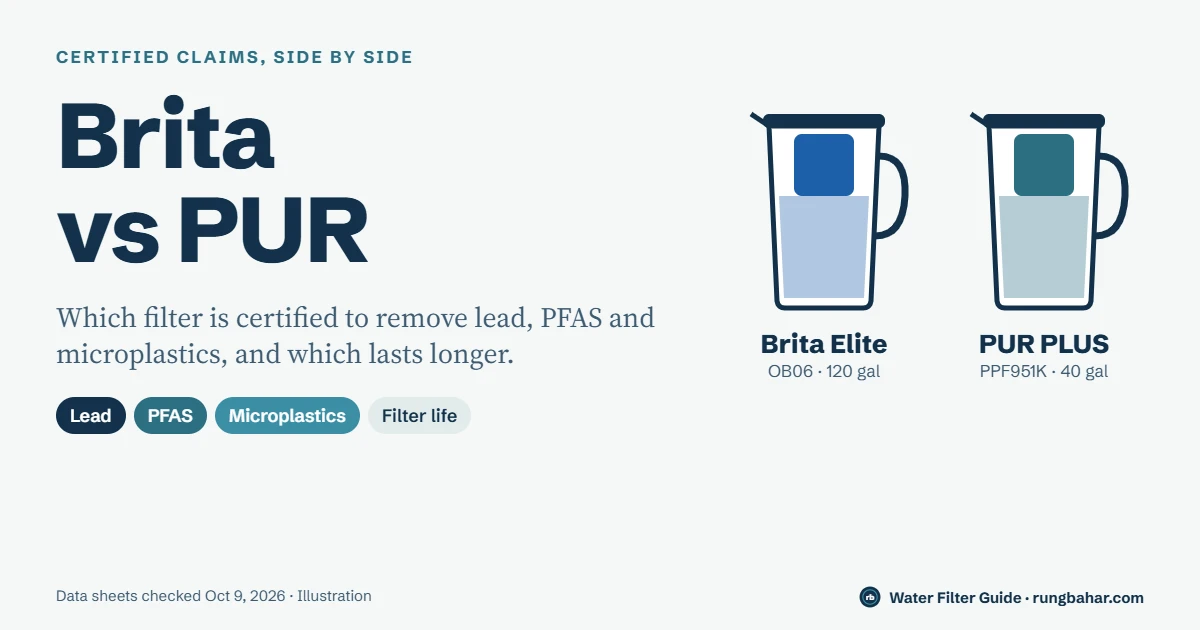
    The short answer: On paper, PUR now certifies more than Brita. The PUR PLUS pitcher filter (PPF951K) is certified to reduce lead, microplastics and total PFAS; the Brita Elite (OB06) is certified for lead and microplastics but has no PFAS claim on its current data sheet. The trade-off is filter life: a Brita Elite is rated for 120 gallons, a PUR PLUS pitcher filter for 40. On the faucet, PUR’s filters add a total PFAS claim that Brita’s FR-200 does not have. The cheap basic filters from both brands (Brita Standard, PUR PPF900Z) are not certified for lead at all.

    Quick check

    What matters most to you?

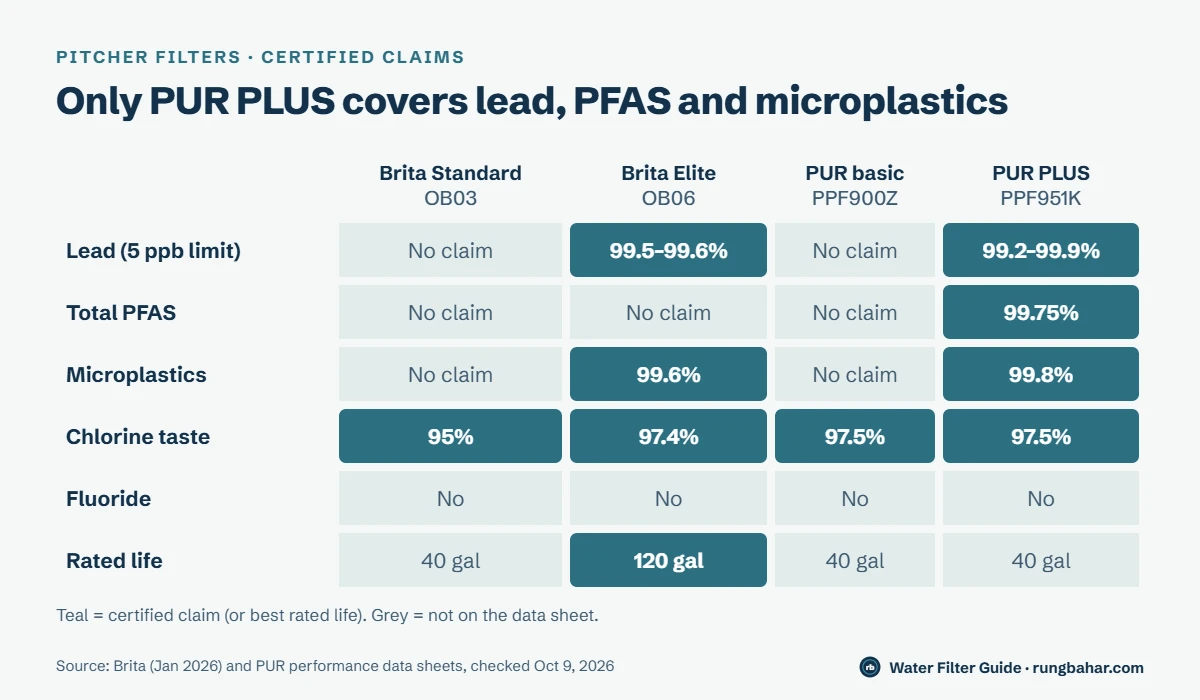
    Chart comparing Brita Standard, Brita Elite, PUR PPF900Z and PUR PLUS: only PUR PLUS is certified for lead, total PFAS and microplastics; Brita Elite covers lead and microplastics and lasts 120 gallons
    Only PUR PLUS carries certified lead, PFAS and microplastics claims; the Brita Elite lasts three times as long.

    Which Brita and which PUR are you comparing?

    Most “Brita vs PUR” comparisons go wrong in the first line, because both brands sell a cheap filter and a better one, and the cheap ones are very different products. If you compare the wrong pair, you get the wrong answer. The four pitcher filters that matter in the US are:

    • Brita Standard (model OB03): Brita’s basic pitcher filter, rated for 40 gallons. Certified for chlorine taste and odor and a few metals, but not for lead.
    • Brita Elite (model OB06, sold for years as Longlast+): rated for 120 gallons and no more than 2 gallons a day. Certified for lead, microplastics and a long list of chemicals.
    • PUR pitcher filter (model PPF900Z, the blue one): PUR’s basic filter. Certified for chlorine taste and odor and some metals and chemicals, but not for lead.
    • PUR PLUS pitcher filter (model PPF951K): rated for 40 gallons. Certified for lead, microplastics, total PFAS and a group of emerging compounds.

    So the fair comparisons are Standard vs PPF900Z (the budget filters) and Elite vs PUR PLUS (the filters most people should be looking at). On the faucet, it is Brita’s FR-200 cartridge against PUR’s RF-9999 (PUR PLUS) and RF3375 cartridges. Everything below comes from each filter’s performance data sheet, the document that lists what was tested, at what concentration and with what result. We checked each one on October 9, 2026. Packaging claims and review-site scores were not used as evidence.

    One thing has changed recently. On September 15, 2026, PUR announced that its PUR PLUS pitcher, dispenser and faucet filters had been certified by IAPMO R&T to reduce total PFAS, alongside lead and microplastics. Most Brita vs PUR articles were written before that and still say neither brand handles PFAS. For PUR PLUS, that is now out of date.

    Brita vs PUR pitcher filters, side by side

    This table compares the certified claims on the four pitcher data sheets. “No claim” means the contaminant does not appear on the sheet. It does not prove the filter removes nothing; it means nobody certified a result.

    ContaminantBrita StandardBrita ElitePUR (PPF900Z)PUR PLUS (PPF951K)
    Lead (NSF/ANSI 53, 5 ppb limit)No claim99.5–99.6%No claim99.2–99.9%
    Total PFAS (NSF/ANSI 53)No claimNo claimNo claim99.75%
    Microplastics (NSF/ANSI 401)No claim99.6%No claim99.8%
    Chlorine taste and odor (NSF/ANSI 42)95%97.4%97.5%97.5%
    Mercury82–86%95.5–95.9%88.8–96.5%>96.4%
    Copper73–89%No claim85.7–90.1%95.9–99.3%
    Cadmium91–94%96.9–99.2%86.7–90.2%98.9–>99.3%
    BenzeneNo claimYes86.4%>96.8%
    Bisphenol A (NSF/ANSI 401)No claimYesNo claim>99.0%
    Fluoride, nitrate, arsenicNoNoNoNo
    Bacteria and virusesNoNoNoNo
    Rated life40 gallons120 gallons40 gallons40 gallons
    Certified byWQAIAPMO R&T, NSF, WQAIAPMO R&TIAPMO R&T

    Read the table by rows, not by brand. On the health claims people search for most (lead, PFAS and microplastics), PUR PLUS covers all three and the Brita Elite covers two. On life per filter, the Elite wins easily. On the budget filters, both cover taste and a few metals, and neither is the right choice if lead is your concern.

    The certifier line is worth a note, because some readers expect to see “NSF” and do not. NSF International is one of several accredited certifiers that test to the NSF/ANSI standards. IAPMO R&T and the Water Quality Association (WQA) are accredited too, and a listing from any of them counts. Our guide to checking whether a filter is really certified shows how to look up a model on each certifier’s directory.

    Lead: a tie between the right models

    If lead is your reason for buying, both brands have a certified answer, and both have a filter that is not one. The Brita Elite data sheet shows lead cut from 150 parts per billion (ppb) to below the 5 ppb limit, with 99.5 percent average reduction at pH 6.5 and 99.6 percent at pH 8.5. The current PUR PLUS pitcher sheet shows 99.9 percent at pH 6.5 and 99.2 percent at pH 8.5, against the same 5 ppb limit.

    Those numbers are close enough that they should not decide your purchase. Both filters passed the same pass-or-fail test against the same 5 ppb limit, and a fraction of a percentage point between averages tells you little about real use. What matters more is that you buy the certified model. The Brita Standard and the blue PUR PPF900Z have no lead claim at all, and they are usually the cheapest filters on the shelf, which is why they end up in many pitchers by default.

    A detail for anyone who kept an old PUR leaflet: an earlier version of PUR’s pitcher data sheet showed the lead test against a 10 ppb limit, the rule before NSF tightened it in 2019. The current sheet shows 5 ppb. If you rely on a pitcher for lead, use the current sheet, and change the filter on time, because the claim only applies within the rated 40 or 120 gallons. Our guide to lead in tap water covers testing and what else to do while you wait for pipe replacement.

    PFAS: only PUR PLUS carries a certified claim

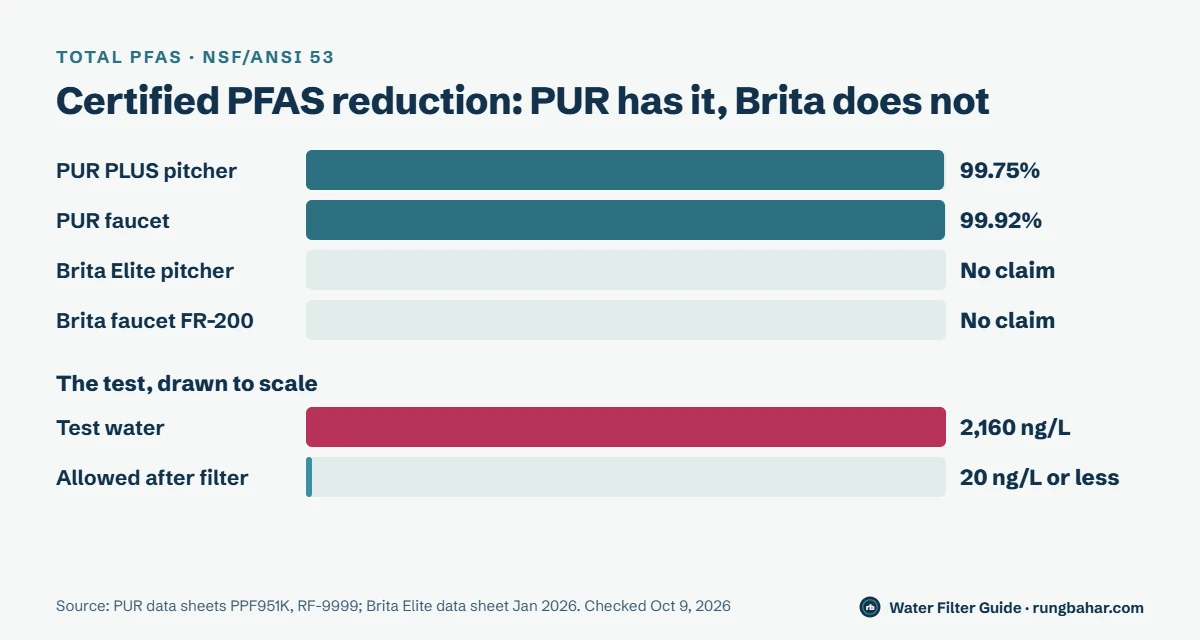
    This is the biggest difference between the two brands right now. The PUR PLUS pitcher data sheet lists “Total PFAS” under NSF/ANSI 53 with a 99.75 percent average reduction. The test water starts at about 2,160 nanograms per liter of a mix of seven PFAS compounds (PFOA, PFOS, PFHxS, PFNA, PFHpA, PFBS and PFDA), and the filter has to bring the total down to 20 nanograms per liter or less across its rated life. PUR’s faucet filter lists the same test at 99.92 percent.

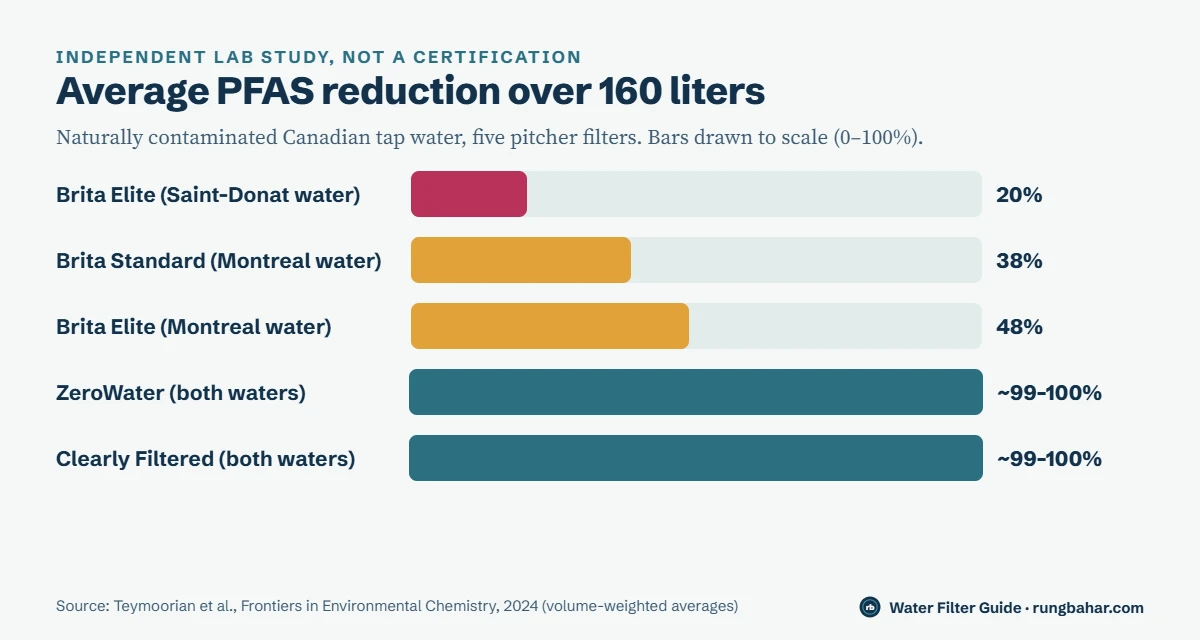
    The Brita Elite data sheet dated January 2026 lists no PFOA, PFOS or total PFAS. You may find an older Elite data sheet online, dated February 2023 and posted on Brita’s Canadian site, that lists PFOA and PFOS at 98.1 percent. The current sheet does not include that claim, so treat Brita’s pitcher filters as having no certified PFAS reduction unless the leaflet in your own box says otherwise. Independent testing points the same way: a 2024 Université de Montréal study measured only partial and variable PFAS reduction from both Brita pitcher filters. Our page on what Brita filters remove has the details.

    Bar chart: PUR PLUS pitcher reduces total PFAS 99.75 percent and PUR faucet 99.92 percent under NSF/ANSI 53, while Brita Elite and Brita FR-200 have no PFAS claim; the test cuts 2,160 ng/L to 20 ng/L or less
    PUR’s PFAS claim is certified under NSF/ANSI 53; Brita’s current data sheets list no PFAS.

    Two cautions keep this in proportion. First, the PUR PFAS certification was announced in September 2026, so filters made before then may come with an older leaflet that does not list it; check that the model number on your box matches the current data sheet and the IAPMO R&T listing. Second, a certified pitcher is one option, not the only one. The US EPA’s advice is to look for certification to NSF/ANSI 53 or 58 for PFAS reduction, and under-sink reverse osmosis systems certified under NSF/ANSI 58 remain the widest-coverage choice. Before you buy anything, it is worth finding out whether your water has PFAS at all; how to check for PFAS in your tap water walks through the free sources.

    Microplastics: both premium filters are certified

    Microplastics reduction is tested under NSF/ANSI 401, using particles between 0.5 and 1 micron, and a filter must reduce them by at least 85 percent. The Brita Elite averaged 99.6 percent and the PUR PLUS pitcher 99.8 percent. On the faucet, Brita’s FR-200 lists 99.9 percent and PUR’s faucet filter 99.65 percent.

    Any of those four is a reasonable choice if microplastics are your main concern. The basic filters from both brands make no microplastics claim. The PUR PPF900Z lists a much coarser particle class (50 to 80 microns), which is about sediment, not microplastics. For what the 401 test does and does not tell you, see our guide to water filters for microplastics.

    Filter life and cost per gallon

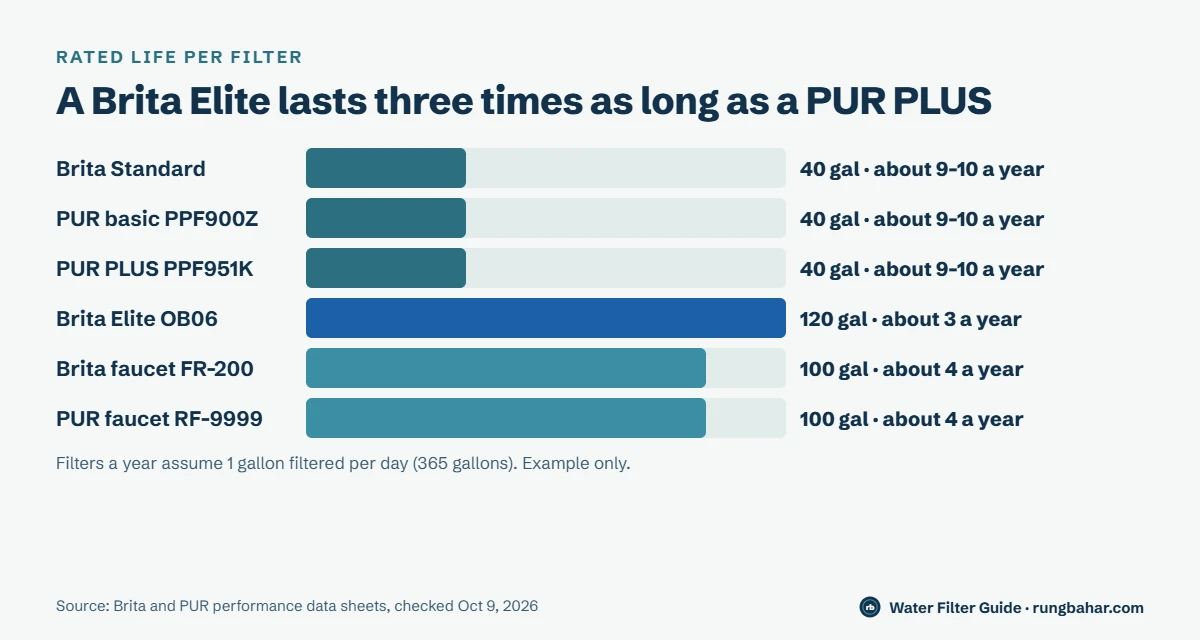
    Here Brita has the clear advantage. The Elite is rated for 120 gallons. The PUR PLUS, PUR basic and Brita Standard pitcher filters are each rated for 40. Both brands’ faucet filters are rated for 100 gallons.

    To-scale bars of rated filter life: Brita Standard, PUR basic and PUR PLUS 40 gallons, Brita Elite 120 gallons, Brita and PUR faucet filters 100 gallons, with about 9 to 10, 3 and 4 filters a year at 1 gallon a day
    At a gallon a day, a 40-gallon pitcher filter needs changing about 9 to 10 times a year, a Brita Elite about 3.

    Rated gallons turn into a yearly filter count you can plan around. As an example only, take a household that filters 1 gallon a day for drinking and cooking, or 365 gallons a year:

    • A 40-gallon pitcher filter (PUR PLUS, PUR basic or Brita Standard): about 9 to 10 filters a year.
    • A Brita Elite at 120 gallons: about 3 filters a year.
    • A 100-gallon faucet filter from either brand: about 4 filters a year.

    Multiply those counts by the price you actually see in your store or online, for the pack size you would buy. We do not quote prices here because they change weekly and vary by retailer. The point is the ratio: a PUR PLUS filter has to cost about a third of a Brita Elite filter to match it per gallon. If you filter more than 2 gallons a day, though, note that Brita says the Elite should process no more than 2 gallons daily for best results, and a faucet filter may suit you better than any pitcher.

    Filter life has a practical side too. A filter used past its rating does not just slow down; the certified claims no longer apply. If you know you are bad at remembering replacements, fewer changes a year is a real benefit, not just a cost one.

    Faucet filters: Brita vs PUR

    The faucet comparison follows the same pattern as the pitchers. Both brands rate their faucet cartridges for 100 gallons and certify them for lead, microplastics, chlorine and a long list of volatile organic chemicals and pesticides. The difference is PFAS.

    ClaimBrita faucet (FR-200)PUR faucet (RF-9999 / RF3375)
    Lead99.9%99.6–99.7%
    Total PFASNo claim99.92%
    Microplastics99.9%99.65%
    Chlorine taste and odor99.0%98.71%
    Asbestos99.9%No claim
    MercuryNo claim78.6–81.6%
    VOCs (chloroform surrogate)99.8%99.51%
    Rated life100 gallons100 gallons
    Rated flow0.58 gal/min0.52 gal/min
    Certified byWQAIAPMO R&T

    PUR’s current faucet data sheet covers both of its replacement cartridges, the RF-9999 (PUR PLUS, with its Mineral Core) and the RF3375, with one set of results, while PUR’s announcement names the RF-9999. If PFAS is your reason for choosing PUR’s faucet filter, check that the cartridge you buy appears on the IAPMO R&T listing with a PFAS claim. Brita’s faucet sheet covers its FF-100 and SAFF-100 systems with the FR-200 cartridge.

    Faucet filters suit people who go through more water than a pitcher can keep up with, and renters who cannot install anything under the sink. They generally do not fit pull-down or sprayer faucets, so check the brand’s compatibility notes against your tap first. For more renter-friendly options, see our guide to water filters for an apartment.

    What neither Brita nor PUR removes

    A pitcher or faucet filter from either brand is a carbon filter. That makes it good at taste, chlorine, many metals and many organic chemicals, and no use at all for some common concerns:

    • Fluoride: no data sheet from either brand lists it. Brita says outright that its filters are not designed to remove fluoride. See filters that actually remove fluoride.
    • Nitrate and arsenic: not listed by either brand. These usually need reverse osmosis or specialist media.
    • Bacteria and viruses: both brands say their filters do not remove microbes and must not be used on unsafe water without disinfection. They are not for boil-water notices or untested wells.
    • Chloramine: neither pitcher sheet has a specific chloramine claim, which matters if your utility disinfects with chloramine.
    • Hardness: neither softens water or stops scale in a meaningful way.

    If your concern is on that list, the brand question does not matter. The reverse osmosis guide covers the main alternative.

    Which one to buy

    There is no single winner, but there is a clear answer for each situation:

    • You want the most certified claims in a pitcher: PUR PLUS (PPF951K). It is the only one of the four with lead, microplastics and total PFAS all certified.
    • You want lead and microplastics with the fewest filter changes: Brita Elite (OB06). Three times the life per filter, and lead and microplastics certified.
    • You only want better-tasting city water: either brand’s basic filter is enough, but do not rely on it for lead.
    • You want a faucet filter and care about PFAS: PUR, after confirming the cartridge’s listing.
    • You need fluoride, nitrate or arsenic removed, or you are on a well: neither. Look at certified reverse osmosis, after testing.
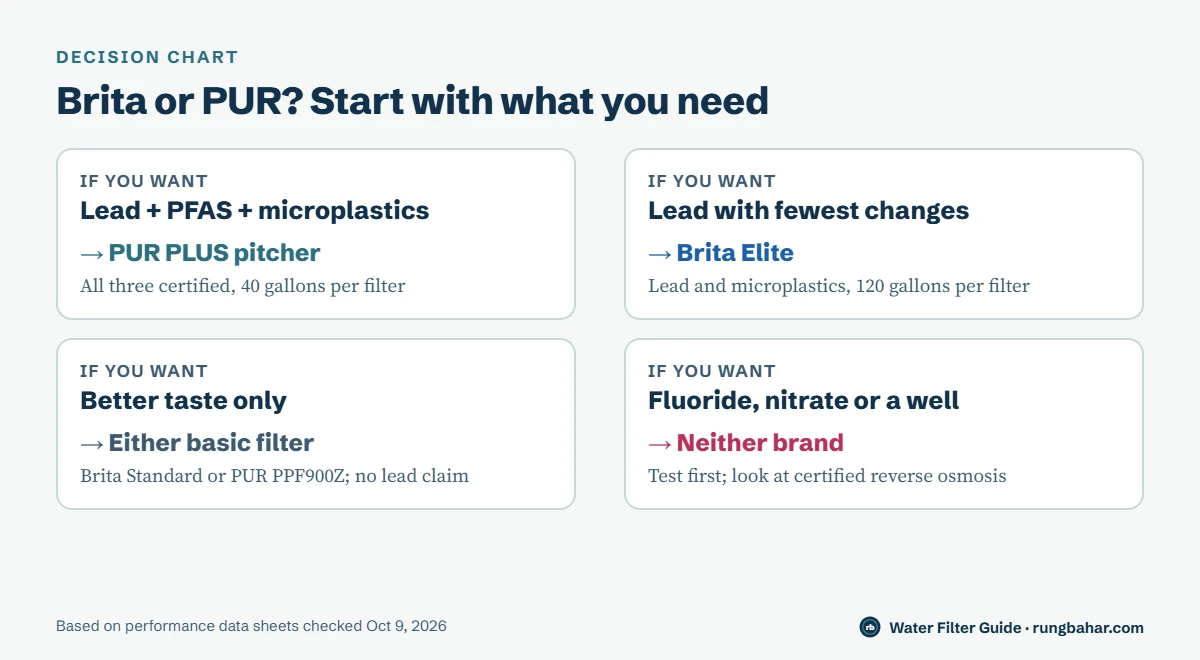
    Decision chart: for lead, PFAS and microplastics choose PUR PLUS; for lead with the fewest changes choose Brita Elite; for taste only either basic filter; for fluoride, nitrate or well water neither brand
    Pick the filter by the contaminant you care about, not by the brand.

    Most certified claims

    PUR PLUS pitcher filter (PPF951K)

    • Certification: NSF/ANSI 42, 53 (lead, total PFAS) and 401 (microplastics)
    • Best for: Lead, PFAS and microplastics in one pitcher
    • Skip if: you hate frequent filter changes (40 gallons each)

    Read the PUR PLUS data sheet

    Longest life

    Brita Elite pitcher filter (OB06)

    • Certification: NSF/ANSI 42, 53 (lead) and 401 (microplastics)
    • Best for: Lead and microplastics with about 3 changes a year at 1 gallon a day
    • Skip if: PFAS is your main concern

    Read the Brita Elite data sheet

    Faucet mount

    PUR faucet filter (RF-9999)

    • Certification: NSF/ANSI 42, 53 (lead, total PFAS) and 401
    • Best for: Higher daily use, renters, PFAS plus lead
    • Skip if: you have a pull-down or sprayer faucet

    Read the PUR faucet data sheet

    How to check a Brita or PUR claim before you buy

    Both brands sell several filters in similar boxes, and store listings mix them up. Five minutes of checking avoids buying the wrong one:

    1. Find the exact model number of the replacement filter: OB03 or OB06 for Brita pitchers, PPF900Z or PPF951K for PUR pitchers, FR-200 for Brita faucet, RF-9999 or RF3375 for PUR faucet.
    2. Open the performance data sheet for that model (links in the sources below) and find your contaminant in the table.
    3. Check the limit and the rated life. A lead claim with a 5 ppb limit is the current standard.
    4. Confirm the listing with the certifier named on the sheet: IAPMO R&T for PUR, and WQA, NSF or IAPMO R&T for Brita.
    5. If a contaminant is missing from the data sheet, treat it as not covered, whatever the packaging says.

    If you are still deciding which type of filter you need, start with how to choose a water filter in 5 steps, or answer three questions in the filter finder. And if you are on city water, the ZIP code tap-water check on our homepage shows what your utility reports.

    Brita vs PUR: 12 common questions, answered

    These are the questions people search most when choosing between Brita and PUR, answered from the data sheets.

    Is Brita or PUR better?

    It depends on the model. PUR PLUS has more certified claims (lead, microplastics and total PFAS). Brita Elite lasts three times as long per filter and covers lead and microplastics. Both brands’ basic filters cover taste only, not lead.

    Which is better for lead, Brita or PUR?

    Both brands have filters certified under NSF/ANSI 53 to reduce lead below 5 ppb: Brita Elite (99.5 to 99.6 percent) and PUR PLUS (99.2 to 99.9 percent), plus both faucet filters. The Brita Standard and PUR PPF900Z are not certified for lead.

    Does PUR remove PFAS?

    The PUR PLUS pitcher filter (PPF951K) is certified under NSF/ANSI 53 for 99.75 percent total PFAS reduction, and PUR’s faucet filter for 99.92 percent, according to PUR’s data sheets and a September 2026 announcement. The basic PUR PPF900Z has no PFAS claim.

    Does Brita remove PFAS?

    Not as a certified claim. Brita’s January 2026 Elite data sheet and its faucet filter sheet list no PFAS. An older 2023 Canadian Elite sheet listed PFOA and PFOS, but the current sheet does not.

    Brita vs PUR faucet filter: which is better?

    Both are rated for 100 gallons and certified for lead and microplastics. PUR’s faucet sheet adds total PFAS. Brita’s FR-200 adds asbestos and has a slightly higher rated flow (0.58 vs 0.52 gallons a minute).

    Which filter lasts longer, Brita or PUR?

    The Brita Elite, at 120 gallons. PUR PLUS, PUR basic and Brita Standard pitcher filters are rated for 40 gallons. Faucet filters from both brands are rated for 100 gallons.

    Can I use a Brita filter in a PUR pitcher?

    No. The two brands use different cartridge shapes, and each data sheet lists the specific pitchers its filter was certified in. Using a filter in a pitcher it was not tested with means the certified results may not apply.

    Do Brita or PUR filters remove fluoride?

    No. Neither brand lists fluoride on any data sheet. For fluoride you need reverse osmosis, activated alumina, bone char or distillation.

    Is PUR NSF certified?

    PUR’s current data sheets name IAPMO R&T as the certifier, testing to the NSF/ANSI 42, 53 and 401 standards. IAPMO R&T is an accredited certifier, so the claims count the same as an NSF International listing.

    Brita vs PUR vs ZeroWater: how do they differ?

    ZeroWater uses ion exchange as well as carbon and is built to remove dissolved solids, so it behaves differently from both. Compare the data sheets for the exact filters; our ZeroWater vs Brita comparison covers the ZeroWater data sheets.

    Brita vs PUR vs Culligan or Waterdrop: does the same method apply?

    Yes. For any brand, find the replacement filter’s model number, read its performance data sheet and confirm the listing with the certifier. Claims missing from the data sheet do not count.

    Are Brita or PUR filters safe for well water?

    Only if the well water is already microbiologically safe. Both brands say their filters do not remove microbes. Test a private well for bacteria, nitrate and arsenic before choosing any filter.

    Sources and how we checked this page

    Every claim on this page comes from Brita’s and PUR’s performance data sheets, PUR’s September 2026 announcement, the US EPA and a peer-reviewed study, checked on October 9, 2026. We do not test filters in a lab, and we have no commercial relationship with Brita or PUR. Data sheets change, so check the one for the exact filter you buy.

  • Does Brita Remove PFAS, Lead, Fluoride or Microplastics?

    Does Brita Remove PFAS, Lead, Fluoride or Microplastics?

    Published October 5, 2026. Every claim is checked against the sources listed at the end of this page. How we research.

    The short answer: It depends on which Brita filter you use. The Brita Standard pitcher filter is certified for chlorine taste and odor, copper, cadmium, mercury and zinc, but not for lead, PFAS, fluoride or microplastics. The Brita Elite filter is certified to reduce lead (by more than 99 percent in testing) and microplastics, plus chlorine and a long list of other chemicals, but it has no certified PFAS claim. No Brita filter is designed to remove fluoride.

    Quick check

    What do you want your Brita to remove?

    Chart comparing Brita Standard, Brita Elite and Brita faucet filters: all reduce chlorine, the Elite is certified for lead at 99.5 percent and microplastics at 99.6 percent, none has a PFAS claim and none removes fluoride or bacteria
    Only the Brita Elite carries certified lead and microplastics claims; no Brita filter is certified for PFAS.

    Which Brita filter do you have?

    “Brita” is a brand, not a single filter. The answer to almost every “does Brita remove…” question changes depending on which filter is inside the pitcher or on the faucet. In the US, the three you are most likely to have are:

    • Brita Standard filter (model OB03): the basic pitcher and dispenser filter. Brita rates it for 40 gallons, or about every 2 months for an average family.
    • Brita Elite filter (model OB06, sold for years as Longlast+): the longer-life pitcher filter. Brita rates it for 120 gallons, or about every 6 months, and no more than 2 gallons a day.
    • Brita faucet filters: the cartridges that clip onto a kitchen tap. Brita rates them for about 4 months of use.

    The easiest way to tell is to read the name printed on the filter or its box. If you cannot see it, look at your replacement order history. Everything below is based on each filter’s performance data sheet: the document that lists what the filter was tested and certified to reduce, at what concentration and by how much. That sheet is the only place a claim counts. Packaging slogans, review sites and “reduces 60 contaminants” headlines do not tell you which contaminants were tested.

    Brita claims at a glance

    This table summarizes the certified claims on the Standard and Elite data sheets and Brita’s published faucet claims, checked on October 4, 2026. “No claim” means the contaminant does not appear on the data sheet. It does not prove the filter removes zero percent; it means nobody certified that it does.

    ContaminantBrita StandardBrita EliteBrita faucet
    Chlorine taste and odorYes, 95% (NSF/ANSI 42)Yes, 97.4% (NSF/ANSI 42)Yes (Brita claim)
    LeadNo claimYes, 99.5–99.6% (NSF/ANSI 53)99% (Brita claim)
    PFAS (PFOA, PFOS)No claimNo claimNo claim found
    FluorideNoNoNo
    MicroplasticsNo claimYes, 99.6% (NSF/ANSI 401)99% (Brita claim)
    MercuryYes, 82–86%Yes, 95.5–95.9%See data sheet
    CadmiumYes, 91–94%Yes, 96.9–99.2%See data sheet
    CopperYes, 73–89%No claimSee data sheet
    Benzene and other VOCsNo claimYes (several, NSF/ANSI 53)Benzene (Brita claim)
    Bacteria and virusesNoNo (not a purifier)No
    Rated life40 gallons / about 2 months120 gallons / about 6 monthsAbout 4 months

    Two patterns stand out. First, the Elite is a much more capable filter than the Standard on paper: it adds lead, microplastics, asbestos, several pesticides and solvents, and a set of “emerging” compounds such as bisphenol A and some pharmaceuticals under NSF/ANSI 401. Second, neither pitcher filter has a PFAS claim, which is the question people search most. For a side-by-side with PUR’s listings, see Brita vs PUR.

    Does Brita remove PFAS?

    Not as a certified claim. We checked the current Brita Elite data sheet (dated December 2025) and the Brita Standard data sheet. Neither lists PFOA, PFOS or total PFAS. So Brita does not claim, and no certifier has confirmed, that either pitcher filter reduces PFAS to a stated level.

    That does not mean the filters do nothing. Activated carbon, the main ingredient in both, can adsorb some PFAS. The question is how much, for how long and for which types. A 2024 peer-reviewed study from the Université de Montréal, published in Frontiers in Environmental Chemistry, ran naturally contaminated Canadian tap water through five pitcher filters for up to 160 liters. Its results for Brita were modest and inconsistent:

    • Brita Elite: about 20 percent average PFAS reduction with one water source and 48 percent with another.
    • Brita Standard: about 38 percent average PFAS reduction with the one water source tested.
    • Two other pitchers in the same study, ZeroWater and Clearly Filtered, reduced PFAS by roughly 99 to 100 percent (see ZeroWater vs Brita for the certified claims).
    Bar chart from a 2024 Université de Montréal study: Brita Elite reduced PFAS by 20 and 48 percent in two waters, Brita Standard by 38 percent, while ZeroWater and Clearly Filtered reached about 99 to 100 percent
    In independent testing, Brita’s PFAS reduction was partial and depended on the water.

    One study is not a certification, and the results depended on the water chemistry and the length of the PFAS molecules. But it lines up with what the data sheets imply: Brita filters are not built for PFAS. The US EPA’s advice for home filters is simple. If PFAS is your concern, check the packaging or data sheet for certification to NSF/ANSI 53 or NSF/ANSI 58 that names PFAS reduction, from an accredited certifier. Our guide to NSF 53 vs 58 explains the difference, and reverse osmosis is one of the most effective home options for PFAS.

    What to do first: find out whether your water actually has PFAS. Your utility’s annual water quality report (Consumer Confidence Report) lists detected contaminants, and many utilities have started PFAS monitoring. If your levels are low or not detected, you may not need a PFAS filter at all.

    Does Brita remove lead?

    The Brita Elite does. The Brita Standard does not. This is the most important difference between the two pitcher filters.

    The Elite data sheet lists lead reduction under NSF/ANSI 53, tested at two pH levels. In both tests, water started at 150 parts per billion (ppb) of lead and had to come out at 5 ppb or less. The Elite averaged 99.5 percent reduction at pH 6.5 and 99.6 percent at pH 8.5. That 5 ppb limit is the stricter rule NSF introduced in 2019; before that, filters only had to reach 10 ppb.

    To-scale bars showing the NSF/ANSI 53 lead test: 150 ppb of lead in the test water, a 5 ppb maximum allowed after filtering, and the Brita Elite average result of about 0.75 ppb
    The Brita Elite cut lead from 150 ppb to well under the 5 ppb limit in certification testing.

    The Standard filter’s data sheet does not list lead at all. Its metal claims are copper, cadmium, mercury and zinc. If you bought a Brita pitcher years ago because of lead pipes, check which filter you are buying now, because the difference matters.

    Brita also advertises its faucet filters as removing 99 percent of lead. If you prefer a faucet mount, read the data sheet for the exact faucet cartridge before you rely on it, since Brita sells more than one faucet filter.

    Three practical points for lead. Use the filter for drinking and cooking water, not just occasionally. Replace it on time, because a lead claim only applies within the rated capacity. And if you are in a home with a lead service line, our guide to checking whether a filter is really certified shows how to confirm the exact model number on the certifier’s listing.

    Does Brita remove fluoride?

    No. Brita states in its own FAQ that its cartridges are not designed to remove fluoride, and neither the Standard nor the Elite data sheet lists fluoride. That is not a flaw in Brita specifically. Activated carbon, the medium most pitcher and faucet filters rely on, is not a fluoride treatment; the Water Quality Association’s fluoride fact sheet does not list it among the methods that work.

    If you want less fluoride, the methods that work are reverse osmosis, activated alumina, bone char, some anion exchange media and distillation. Reverse osmosis is the most common home choice, and many reverse osmosis systems carry a certified fluoride reduction claim under NSF/ANSI 58. In that test, water starting at 8.0 milligrams per liter must come out at 1.5 mg/L or less. See what reverse osmosis removes for the full list.

    Does Brita remove microplastics?

    The Brita Elite has a certified microplastics claim; the Standard does not. Microplastics reduction is tested under NSF/ANSI 401. The Elite data sheet lists “microplastics, particles 0.5–1 µm” with 99.6 percent average reduction, against a pass mark of 85 percent. That size range is tiny: a micron is a thousandth of a millimeter, so these particles are far smaller than anything you could see.

    Brita also says its faucet filters remove 99 percent of microplastics. The Standard pitcher filter makes no microplastics claim. For a deeper explanation of what the 401 standard covers, see our guide to water filter certifications.

    Chlorine, chloramine, nitrate and bacteria

    Chlorine: yes, every Brita filter

    Chlorine taste and odor reduction under NSF/ANSI 42 is what every Brita filter does well. The Standard averaged 95 percent and the Elite 97.4 percent in testing, starting from 2 parts per million. If your main complaint is that tap water tastes like a swimming pool, a Standard filter is usually enough.

    Chloramine: no certified claim

    Many US utilities disinfect with chloramine, a mix of chlorine and ammonia, instead of chlorine. Chloramine is harder for carbon to remove and needs its own NSF/ANSI 42 chloramine claim. Neither Brita pitcher data sheet lists it. Your utility’s water quality report usually says which disinfectant it uses.

    Nitrate, arsenic and minerals: no

    Neither data sheet lists nitrate, nitrite or arsenic. These are common concerns on private wells and are usually handled with reverse osmosis or specialized media. Brita filters also have no hardness claim in the US, so they will not fix scale on your kettle in a meaningful way, and they do not strip out the calcium and magnesium that are naturally in water.

    Bacteria and viruses: not a purifier

    The Elite data sheet says the filter is not intended to purify water and should not be used with water that is microbiologically unsafe or of unknown quality without disinfection before or after. The filter media contains a small amount of silver to support filter hygiene, and some silver may pass into the water. If you are under a boil-water notice or your well has tested positive for bacteria, a Brita is not the answer.

    Brita Standard vs Brita Elite: which should you use?

    For most people deciding between the two, the Elite is the more useful filter. It covers lead and microplastics, it lasts three times as long per filter, and you change it twice a year instead of about six times.

    To-scale bars showing rated filter life: Brita Standard 40 gallons, about every 2 months, versus Brita Elite 120 gallons, about every 6 months
    The Elite filter is rated for three times as many gallons as the Standard.

    The Standard filter still makes sense in a narrow case: your water is from a utility with no lead concerns, you mainly want better-tasting water, and you go through more than 2 gallons of filtered water a day, which is the Elite’s stated daily limit. Whichever you pick, the price per gallon depends on the store and the pack size, so compare the cost of a year’s worth of filters, not a single cartridge.

    If you need PFAS, fluoride, nitrate or arsenic reduced, the honest answer is that neither Brita pitcher filter is the right tool. Here are the three directions that usually fit:

    Lead and microplastics

    Brita Elite pitcher filter

    • Certification: NSF/ANSI 42, 53 and 401 (lead, microplastics)
    • Best for: Utility water, lead concerns, better taste
    • Skip if: you need PFAS or fluoride reduction

    Read the Elite data sheet

    PFAS in a pitcher

    A pitcher certified for PFOA/PFOS

    • Certification: NSF/ANSI 53 with a PFOA/PFOS or total PFAS claim
    • Best for: Renters who want PFAS reduction without plumbing
    • Skip if: you also need fluoride removed

    Search certified models

    Widest coverage

    Under-sink reverse osmosis

    • Certification: NSF/ANSI 58 with your contaminants listed
    • Best for: PFAS, fluoride, nitrate, arsenic, high TDS
    • Skip if: you cannot install under the sink

    Search certified RO models

    How to check a Brita claim yourself

    Brita filters are certified by more than one organization. The current Elite data sheet names IAPMO R&T, NSF International and the Water Quality Association (WQA). The Standard data sheet names WQA. That is normal, and all three are accredited certifiers. Here is how to check any claim in about five minutes:

    1. Find the exact filter name and model number on the box or cartridge.
    2. Open the performance data sheet. Brita links them from each product page, and a printed copy is in the box.
    3. Look for your contaminant in the table. Check the influent (starting) level, the maximum allowed in filtered water and the average reduction.
    4. Check the rated capacity. The claim only holds up to that number of gallons.
    5. Confirm the listing on the certifier’s website, such as the NSF certified product listings, using the model number.

    If a contaminant is missing from the data sheet, treat it as not covered, however the packaging is worded. Our step-by-step guide on how to check whether a filter is really NSF certified covers the common traps, like “tested to NSF standards” wording that does not mean certified.

    When Brita is enough, and when it is not

    A Brita filter is a reasonable choice when you are on city water, your annual water quality report shows no violations, and your main goal is better taste or a lead backstop. In that situation the Elite covers more ground than the Standard for not much extra effort.

    Brita is not enough when:

    • Your water report or a lab test shows PFAS you want reduced. Look for a certified PFAS claim under NSF/ANSI 53 or 58.
    • You want less fluoride. You will need reverse osmosis or another fluoride-specific method.
    • You are on a private well. Test first for bacteria, nitrate and arsenic, then choose treatment to match the results.
    • Your utility uses chloramine and the taste bothers you. Look for a specific chloramine claim.
    • You live in an older home with a known lead service line and want the strongest protection. A certified under-sink filter or reverse osmosis system can treat more water with less refilling.

    If you are not sure what your water needs, start with our guide to choosing a water filter in 5 steps, or answer three quick questions in the filter finder to get a filter type that matches your water.

    Brita: 14 common questions, answered

    These are the questions people search most about what Brita filters remove, answered from the data sheets.

    Does Brita remove PFAS?

    Not as a certified claim. Neither the Brita Standard nor the Brita Elite data sheet lists PFOA, PFOS or total PFAS. An independent 2024 lab study found only partial reduction (about 20 to 48 percent for the Elite). For PFAS, the EPA says to look for NSF/ANSI 53 or 58 certification for PFAS reduction.

    Does Brita remove lead?

    The Brita Elite filter is certified under NSF/ANSI 53 to reduce lead, averaging 99.5 to 99.6 percent in testing. The Brita Standard filter has no lead claim. Brita also advertises 99 percent lead removal for its faucet filters.

    Does Brita remove fluoride?

    No. Brita says its filters are not designed to remove fluoride, and fluoride does not appear on either pitcher data sheet. Reverse osmosis, activated alumina, bone char and distillation are the methods that reduce fluoride.

    Does Brita remove microplastics?

    The Brita Elite is certified under NSF/ANSI 401 to reduce microplastics (0.5 to 1 micron particles) by 99.6 percent on average. The Standard filter has no microplastics claim.

    Does Brita remove chlorine?

    Yes. Every Brita filter reduces chlorine taste and odor under NSF/ANSI 42. The Standard averaged 95 percent and the Elite 97.4 percent in certification testing.

    Does Brita remove nitrates?

    No. Neither Brita pitcher data sheet lists nitrate or nitrite. Reverse osmosis systems certified for nitrate under NSF/ANSI 58 are the usual choice.

    Does Brita remove minerals like calcium and magnesium?

    Not in any certified way. The US data sheets have no hardness claim, so most natural minerals pass through. A Brita is not a water softener.

    What is the difference between Brita Elite and Brita Standard?

    The Elite adds certified lead, microplastics, asbestos and many chemical claims, and lasts 120 gallons (about 6 months) versus 40 gallons (about 2 months) for the Standard. The Standard mainly covers chlorine taste, copper, cadmium, mercury and zinc.

    Is Brita NSF certified?

    Brita filters are certified by accredited bodies. The current Elite data sheet lists IAPMO R&T, NSF International and WQA; the Standard data sheet lists WQA. Always check the specific claim, not just the certification mark.

    Does Brita remove bacteria or make water safe to drink?

    No. Brita says the Elite is not intended to purify water. Do not use it on water that is microbiologically unsafe or of unknown quality without disinfection.

    Does Brita remove chloramine?

    Neither Brita pitcher data sheet lists chloramine. If your utility uses chloramine, look for a filter with a specific NSF/ANSI 42 chloramine claim.

    How often should I change a Brita filter?

    Brita rates the Standard filter for 40 gallons (about every 2 months) and the Elite for 120 gallons (about every 6 months). Faucet filters are rated for about 4 months. Claims only apply within that rated life.

    Is Brita better than nothing for PFAS?

    The Montreal study suggests Brita filters may reduce some PFAS, but the amount varied widely and is not certified. If you know your water has PFAS, a filter with a certified PFAS claim is the more reliable choice.

    Does boiling water and then using Brita remove more contaminants?

    Boiling does not remove lead, PFAS or fluoride and can concentrate them as water evaporates. Boiling is for killing germs, and filtering is for the specific contaminants on the data sheet.

    Sources and how we checked this page

    Every claim on this page comes from Brita’s own performance data sheets and FAQ, the US EPA, NSF and a peer-reviewed study, checked on October 4, 2026. We do not test filters in a lab, and we have no commercial relationship with Brita. Data sheets change, so check the one for the exact filter you buy.