Published October 4, 2026. Every claim is checked against the sources listed at the end of this page. How we research.
The short answer: A certified reverse osmosis (RO) system can reduce total dissolved solids, fluoride, arsenic, nitrate, lead, copper, radium, PFAS and many other contaminants, but only the ones named on its NSF/ANSI 58 listing. Its carbon stages handle chlorine taste, and microplastic claims fall under NSF/ANSI 401. RO does not remove dissolved gases such as hydrogen sulfide, and it should not be used alone on water that is microbiologically unsafe.
Quick check
What do you want reverse osmosis to remove?
How reverse osmosis works
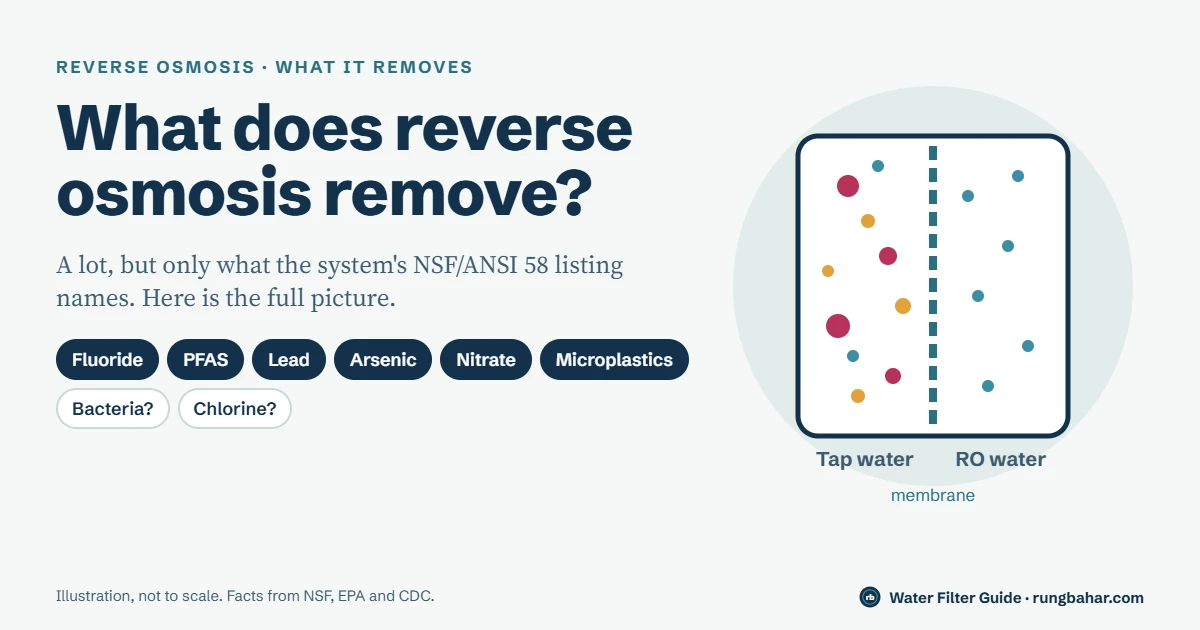
Reverse osmosis pushes water under pressure through a semi-permeable membrane. Water molecules pass through. Most dissolved salts, metals and many other substances do not, and they are flushed away in a stream of reject water that goes to the drain. That is why an RO system has a drain connection and why it reduces total dissolved solids (TDS), the measure of everything dissolved in water. Alberta’s agriculture department, in its guide to RO water treatment, puts the typical TDS reduction at 85 to 98 percent.
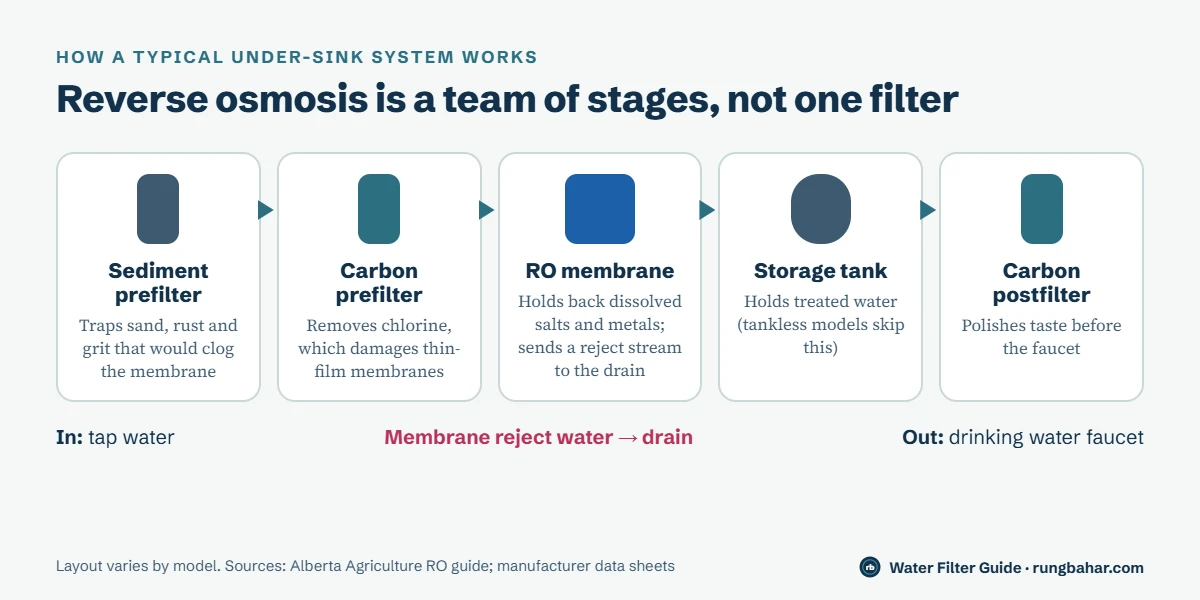
A home RO system is more than the membrane. A typical under-sink unit has a sediment prefilter to stop grit, a carbon prefilter to remove chlorine, the RO membrane itself, a storage tank and a carbon postfilter to polish taste. Tankless models skip the tank. The carbon prefilter matters more than it looks: the same Alberta guide notes that thin-film composite membranes, the common type, cannot tolerate chlorine.
So when people ask “what does reverse osmosis remove”, the honest answer has two parts. What the whole system removes, including its carbon stages. And what a specific model is certified to remove, which is the only part you can count on.
What reverse osmosis removes: the full table
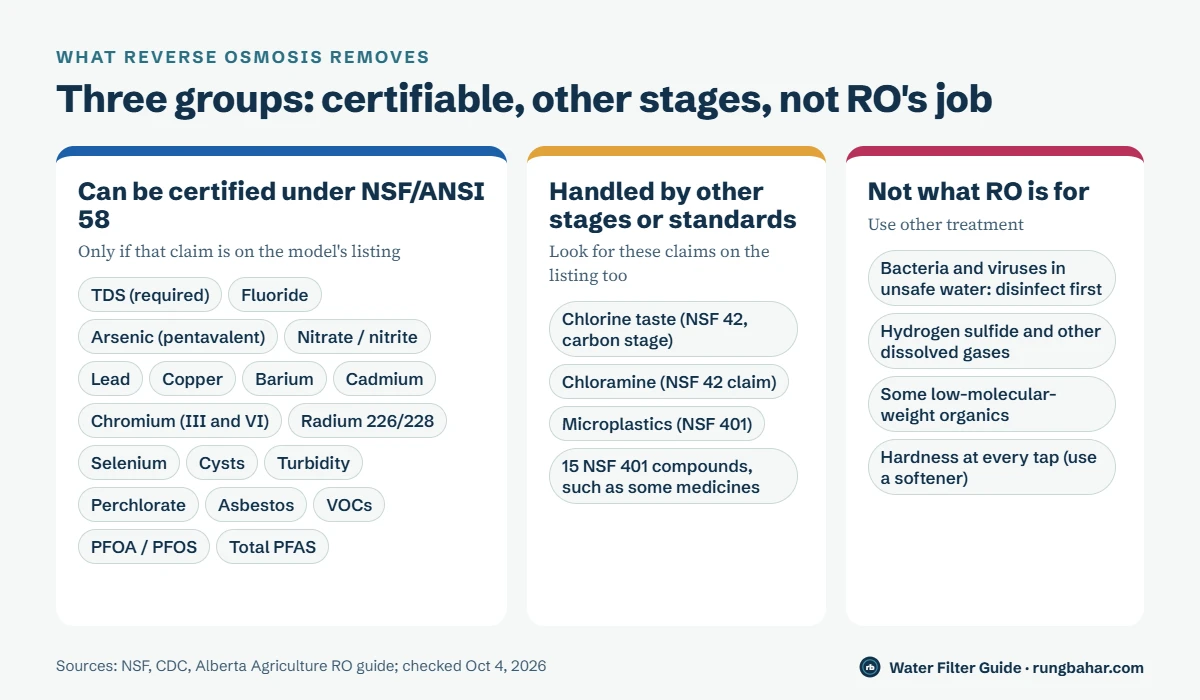
The table below combines the NSF/ANSI 58 claim list, EPA and CDC guidance and RO data sheets. “Certifiable” means a model can earn that claim; it does not mean every model has it.
| Contaminant | Can RO reduce it? | Certified claim to look for | Notes |
|---|---|---|---|
| Total dissolved solids (TDS) | Yes | NSF/ANSI 58, TDS (required) | Every certified RO system must pass this test |
| Fluoride | Yes | NSF/ANSI 58, fluoride | Optional claim; carbon filters are not designed for it |
| PFAS (PFOA, PFOS and others) | Yes | NSF/ANSI 58, PFOA/PFOS or total PFAS | EPA: membranes typically more than 90% effective |
| Lead | Yes | NSF/ANSI 58, lead | Must cut 150 ppb to 5 ppb or less since 2019 |
| Arsenic | Yes, pentavalent form | NSF/ANSI 58, arsenic (pentavalent) | Trivalent arsenic must be converted first |
| Nitrate and nitrite | Yes | NSF/ANSI 58, nitrate/nitrite | Common well water concern |
| Copper, barium, cadmium, chromium, selenium, radium | Yes | NSF/ANSI 58, each named | Check each one separately |
| Cysts (Cryptosporidium, Giardia) | Yes | NSF/ANSI 58, cysts | Not the same as bacteria or viruses |
| VOCs | Often, through the carbon stages | NSF/ANSI 58 or 53, VOC claim | Some light organics pass the membrane |
| Microplastics | Likely | NSF/ANSI 401, microplastics | Claim lives in 401, not 58 |
| Chlorine | Yes, by the carbon stages | NSF/ANSI 42, chlorine taste and odor | Chlorine damages common membranes |
| Chloramine | Depends on the carbon stage | NSF/ANSI 42, chloramine | Ask for the specific claim |
| Calcium, magnesium (minerals) | Yes | Covered by the TDS test | Some systems remineralize |
| Bacteria and viruses | Removed, but not a safety device | Not an NSF/ANSI 58 claim | Disinfect unsafe water first |
| Hydrogen sulfide and other gases | No | None | Gases pass through the membrane |
If you are still deciding whether you need RO at all, our guide on how to choose a water filter walks through the five steps, starting with what is actually in your water.
How certified RO claims are tested
RO systems are certified to NSF/ANSI 58 by NSF, WQA, IAPMO R&T, UL Solutions or CSA Group. Every certified system must pass one required test: TDS reduction. The challenge water is made up to 750 mg/L of TDS, and the system must achieve an average reduction of at least 75 percent. That test also checks that the membrane is intact.
Beyond TDS, NSF lists 16 optional claims: cysts, hexavalent and trivalent chromium, arsenic (including pentavalent arsenic), nitrate/nitrite, cadmium, lead, barium, turbidity, fluoride, copper, VOCs, asbestos, perchlorate, radium 226/228 and selenium. PFAS claims, for PFOA and PFOS or for a wider “total PFAS” group, can also be earned under NSF/ANSI 58. A model holds only the claims shown on its listing. Our explainer on water filter certifications covers each standard in more detail.
To see what a claim means in practice, look at the performance data sheet that comes with a certified system. One example is the data sheet for the Microline TFC-435, an NSF-certified RO system whose 2014 sheet is filed with California regulators. It shows the challenge level for each claim, the most the system may let through and the average reduction it achieved in testing.
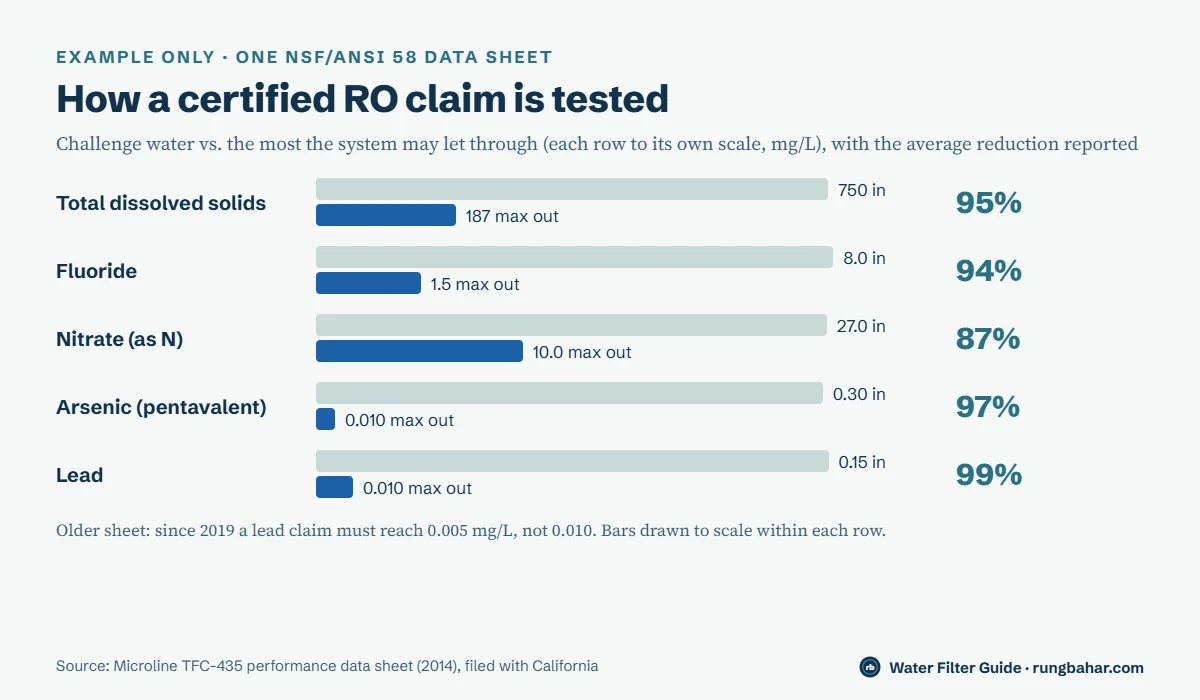
Two lessons stand out. First, the challenge water is far worse than most tap water, so a pass is meaningful. Second, data sheets age. This one shows a lead limit of 0.010 mg/L; since December 2019, NSF/ANSI 58 requires 0.005 mg/L (5 ppb). Always check the current listing, and use our guide on how to check if a water filter is really certified to do it.
Does reverse osmosis remove fluoride?
Yes. Fluoride is dissolved in water as an ion, which is exactly what an RO membrane is built to hold back, and fluoride reduction is one of the optional NSF/ANSI 58 claims. The CDC lists fluoride among the chemicals RO may reduce. In the example data sheet above, the fluoride test started at 8.0 mg/L and the system had to bring it down to 1.5 mg/L or less; it reported a 94 percent average reduction.
This is one of the clearest cases for RO over a carbon filter. Standard activated carbon filters are not designed for fluoride, and a pitcher or under-sink carbon filter certified to NSF/ANSI 53 will not normally list it. If fluoride is your reason for buying, confirm the exact model carries a fluoride claim. Our guide to water filters that remove fluoride compares RO with the other options.
Does reverse osmosis remove PFAS?
Yes, and it is one of the strongest home options. EPA research summarizing treatment technologies says RO membranes are “typically more than 90 percent effective” at removing a wide range of PFAS, including shorter-chain PFAS. EPA’s fact sheet on home filters names RO, activated carbon and ion exchange as the three filter types for PFAS, and tells buyers to look for NSF/ANSI 53 or 58 certification.
Two cautions. Certification claims are specific: “PFOA/PFOS reduction” and “total PFAS reduction” are different claims. And EPA notes that current certification standards do not yet guarantee reduction to its 2024 drinking water limits for PFAS. Read the exact claim on the listing, and replace the prefilters and membrane on schedule.
Does reverse osmosis remove lead, arsenic and nitrate?
Lead
Yes, when certified. Lead is an optional NSF/ANSI 58 claim, and the CDC lists lead among the chemicals RO removes. Since December 2019 a lead claim under NSF/ANSI 53 or 58 means the system cut challenge water containing 150 ppb of lead to 5 ppb or less. If lead is your only concern, a certified carbon filter can also do the job without wastewater; our NSF 53 vs 58 guide compares the two.
Arsenic
Partly, and the detail matters. Arsenic comes in two main forms. RO certification covers pentavalent arsenic (arsenic V). The example data sheet explains that trivalent arsenic (arsenic III) is generally harder to remove, that it can be converted to arsenic V by an effective oxidant such as free chlorine, and that chloramine is not enough to ensure complete conversion. Well water is often untreated, so ask your lab which form you have, or whether treatment before the RO system is needed.
Nitrate and nitrite
Yes, when certified. Nitrate/nitrite is an optional NSF/ANSI 58 claim. In the example data sheet, the nitrate test started at 27 mg/L (as nitrogen) and had to come down to 10 mg/L or less. EPA advises testing a private well for nitrates every year, so keep testing after you install treatment to confirm it is working.
Does reverse osmosis remove microplastics?
Physically, very likely. An RO membrane is designed to hold back dissolved substances, which are far smaller than plastic particles. But “likely” is not a certified claim. Microplastic reduction is certified under NSF/ANSI 401, not 58. The 401 test uses fine particles between 0.5 and 1 micron, and a certified product must reduce them by at least 85 percent.
If microplastics are your main concern, look for an NSF/ANSI 401 microplastics claim on the RO system’s listing. Many carbon block filters also carry that claim, so RO is not the only route.
Does reverse osmosis remove bacteria, viruses and E. coli?
This is where marketing and safety advice part ways. The CDC says RO systems remove parasites, bacteria and viruses, and EPA’s WaterSense program lists bacteria and viruses among the contaminants RO “can potentially remove”. But RO systems are not certified as disinfection devices. The data sheet example above carries the standard warning: do not use it with water that is microbiologically unsafe or of unknown quality without adequate disinfection before or after the system.
There are practical reasons. Alberta’s RO guide notes that bacteria can “grow through” membranes, leading to growth in the postfilter and storage tank. It also warns that neglected prefilters and postfilters can become “bacteria farms”. If your well tests positive for total coliform or E. coli, treat the cause and disinfect, for example with a UV system certified to NSF/ANSI 55 Class A, then use RO for chemical contaminants if you need it.
Does reverse osmosis remove chlorine, chloramine and minerals?
Chlorine: yes, but the carbon prefilter does the work, protecting the membrane. A system with an NSF/ANSI 42 chlorine taste and odor claim has proven it.
Chloramine: many US cities disinfect with chloramine instead of chlorine. A carbon stage certified for chlorine is not automatically certified for chloramine, so look for a specific NSF/ANSI 42 chloramine claim if your water quality report says your utility uses it.
Minerals: yes. RO reduces calcium, magnesium and other dissolved minerals along with contaminants; the CDC lists calcium, magnesium and potassium among the substances RO may reduce. That is why some systems add a remineralization stage. Whether low-mineral water matters for your health is covered in Is reverse osmosis water good for you? RO is not a substitute for a water softener, though: it treats one tap, while hard water scales every fixture in the house.
What reverse osmosis does not remove
- Dissolved gases. Alberta’s guide says volatile gases such as oxygen and hydrogen sulfide pass through RO membranes. A rotten-egg smell needs other treatment.
- Some light organic compounds. The same guide notes that some low-molecular-weight organic substances can pass the membrane. Carbon stages catch many of them; check for a VOC claim.
- Microbiological risk in unsafe water. RO is not a disinfection system. Disinfect first.
- Anything not on the listing. Even a contaminant RO usually handles is not certified for that model unless the claim is listed.
- Problems at other taps. An under-sink RO system treats one faucet. Showers, laundry and other taps get untreated water.
How much water does reverse osmosis waste?
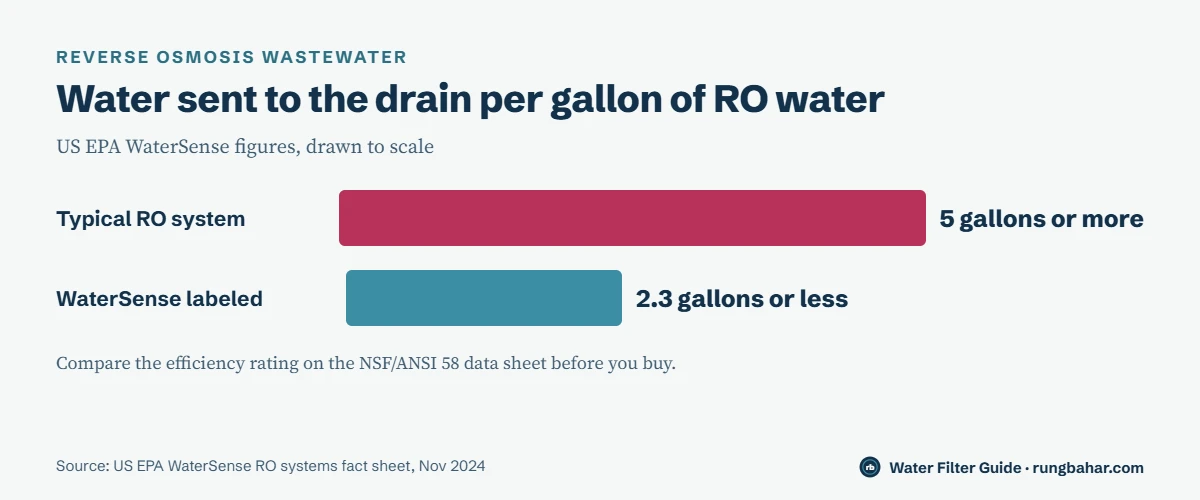
Every RO system sends some water to the drain to carry away what the membrane rejects. According to EPA’s WaterSense program, a typical RO system sends five gallons or more down the drain for every gallon of treated water. A WaterSense labeled system sends 2.3 gallons or less.
NSF/ANSI 58 data sheets report this as two numbers. The efficiency rating is the share of incoming water that ends up as treated water under conditions close to typical daily use. The recovery rating is the share of water reaching the membrane that comes out as treated water when the tank is bypassed. In the example data sheet, the efficiency rating was 14 percent and the recovery rating 30 percent. Higher is better for both. On a private well with a septic system, the reject water also goes into the septic tank, so efficiency matters even more.
Is reverse osmosis right for you?
RO is worth it when your water has something that simpler filters do not handle well: fluoride, nitrate, arsenic, high TDS, or PFAS where you want the broadest reduction. It is probably more than you need if your only issue is chlorine taste, or lead from older pipes, which a certified carbon filter can handle without wastewater.
- Good fit: fluoride, nitrate, arsenic or high TDS on your report; PFAS concerns; you own the home and have space under the sink.
- Think twice: you only want better taste; you rent and cannot install; your well has bacteria and no disinfection yet.
Still unsure? Our 15-second filter finder turns a few answers into a filter type and the certification to look for, and you can browse every topic on our water filter guides page.
The cards below link to certified listings so you can compare models by claim.
Widest coverage
Under-sink reverse osmosis
- Certification: NSF/ANSI 58 with your contaminants listed
- Best for: Fluoride, nitrate, arsenic, PFAS, high TDS
- Skip if: you cannot install under the sink
No plumbing
Countertop reverse osmosis
- Certification: NSF/ANSI 58 (check the claims on the listing)
- Best for: Renters who need RO-level reduction
- Skip if: you need a high daily volume
No wastewater
Under-sink carbon filter
- Certification: NSF/ANSI 53 for lead and PFOA/PFOS, plus 42
- Best for: Lead and PFAS without RO
- Skip if: you need fluoride, nitrate or arsenic reduced
Reverse osmosis: 16 common questions, answered
These are the questions people search most about what reverse osmosis removes, including the ones most guides skip.
What does reverse osmosis remove from water?
A certified RO system can reduce TDS, fluoride, arsenic (pentavalent), nitrate/nitrite, lead, copper, barium, cadmium, chromium, radium, selenium, cysts, turbidity, perchlorate, asbestos, VOCs and PFAS, but only the claims named on that model’s NSF/ANSI 58 listing. Its carbon stages remove chlorine.
Does reverse osmosis remove fluoride?
Yes. Fluoride reduction is an optional NSF/ANSI 58 claim, and standard carbon filters are not designed for fluoride. Confirm the exact model lists fluoride.
Does reverse osmosis remove PFAS?
Yes. EPA says RO membranes are typically more than 90 percent effective at removing a wide range of PFAS, including shorter-chain PFAS. Look for a PFOA/PFOS or total PFAS claim on the listing.
Does reverse osmosis remove microplastics?
Very likely, because the membrane holds back far smaller dissolved substances. The certified claim for microplastics is under NSF/ANSI 401, so look for that claim on the system’s listing.
Does reverse osmosis remove lead?
Yes, when the system is certified for lead. Since 2019, a lead claim means challenge water with 150 ppb of lead was reduced to 5 ppb or less.
Does reverse osmosis remove bacteria and E. coli?
The CDC says RO removes bacteria and viruses, but RO systems are not certified as disinfection devices, and data sheets warn against using them on microbiologically unsafe water. If your well has E. coli or coliform, disinfect first.
Does reverse osmosis remove chlorine?
Yes, through the carbon prefilter and postfilter rather than the membrane. Common thin-film membranes cannot tolerate chlorine, so the prefilter protects them.
Does reverse osmosis remove chloramine?
It depends on the carbon stage. A chlorine claim does not cover chloramine, so look for a specific NSF/ANSI 42 chloramine claim if your utility uses chloramine.
Does reverse osmosis remove nitrates?
Yes, when the system is certified for nitrate/nitrite. Keep testing a private well every year, as EPA advises, to confirm the system is working.
Does reverse osmosis remove arsenic?
RO certification covers pentavalent arsenic (arsenic V). Trivalent arsenic (arsenic III) is harder to remove and usually needs to be converted first, for example by free chlorine. Chloramine is not enough for full conversion.
Does reverse osmosis remove minerals?
Yes. RO reduces calcium, magnesium and other dissolved minerals, which is what the required TDS test measures. Some systems add a remineralization stage for taste.
Does reverse osmosis remove hydrogen sulfide or the rotten-egg smell?
No. Dissolved gases such as hydrogen sulfide pass through RO membranes. You need treatment designed for sulfur odor.
Does reverse osmosis remove pharmaceuticals?
Some may be reduced, but the certified claims for specific medicines are under NSF/ANSI 401, which covers 15 named compounds. Look for those claims rather than general “pharmaceutical” marketing.
Does reverse osmosis remove hardness?
At the RO tap, yes, because calcium and magnesium are reduced. But RO is not a substitute for a water softener, which treats hardness at every tap and protects pipes and appliances.
How much water does reverse osmosis waste?
EPA says a typical RO system sends five gallons or more to the drain for every gallon of treated water, while a WaterSense labeled system sends 2.3 gallons or less. Check the efficiency rating on the data sheet.
Is reverse osmosis better than a carbon filter?
It is broader, not always better. RO is the choice for fluoride, nitrate, arsenic and high TDS. For chlorine taste, or for lead and PFAS without wastewater, a certified carbon filter can be simpler and cheaper to run.
Sources and how we checked this page
Every fact on this page comes from the US EPA, the CDC, NSF, a provincial agriculture department and a certified RO system’s performance data sheet, checked on October 4, 2026. We do not test filters in a lab, and the data sheet shown is an example, not a recommendation.
- NSF: NSF/ANSI 58 reverse osmosis drinking water treatment systems
- NSF certified drinking water treatment unit listings
- US EPA: Reducing PFAS in drinking water with treatment technologies
- US EPA: Reducing PFAS in your drinking water with a home filter (fact sheet, PDF)
- US EPA WaterSense: Point-of-use reverse osmosis systems fact sheet (Nov 2024, PDF)
- US EPA: Protect your home’s water (private wells)
- CDC: About home water treatment systems
- Alberta Agriculture: Reverse osmosis water treatment
- Microline TFC-435 performance data sheet (2014, PDF, California State Water Resources Control Board)
- NSF: Stricter requirements for lead reduction certification (2019)
- NSF: NSF/ANSI 42, 53 and 401 filtration systems standards