Skip to content

Category: Reverse osmosis

What reverse osmosis removes, what it does not, and whether RO water is good to drink. Read what reverse osmosis removes and is reverse osmosis water good for you.

  • Is Reverse Osmosis Water Good for You? Minerals, Taste and Safety

    Is Reverse Osmosis Water Good for You? Minerals, Taste and Safety

    Published October 8, 2026. Every claim is checked against the sources listed at the end of this page. How we research.

    The short answer: Yes, for most people reverse osmosis (RO) water is safe and good to drink. It removes many contaminants, along with most of the calcium and magnesium in the water. Most people get far more of those minerals from food than from water, and Germany’s federal risk agency found no reason to advise healthy people with a balanced diet against very low-mineral water. A few groups should watch their mineral intake, and families who rely on fluoridated tap water for their children’s teeth should talk to a dentist.

    Quick check

    Which describes you best?
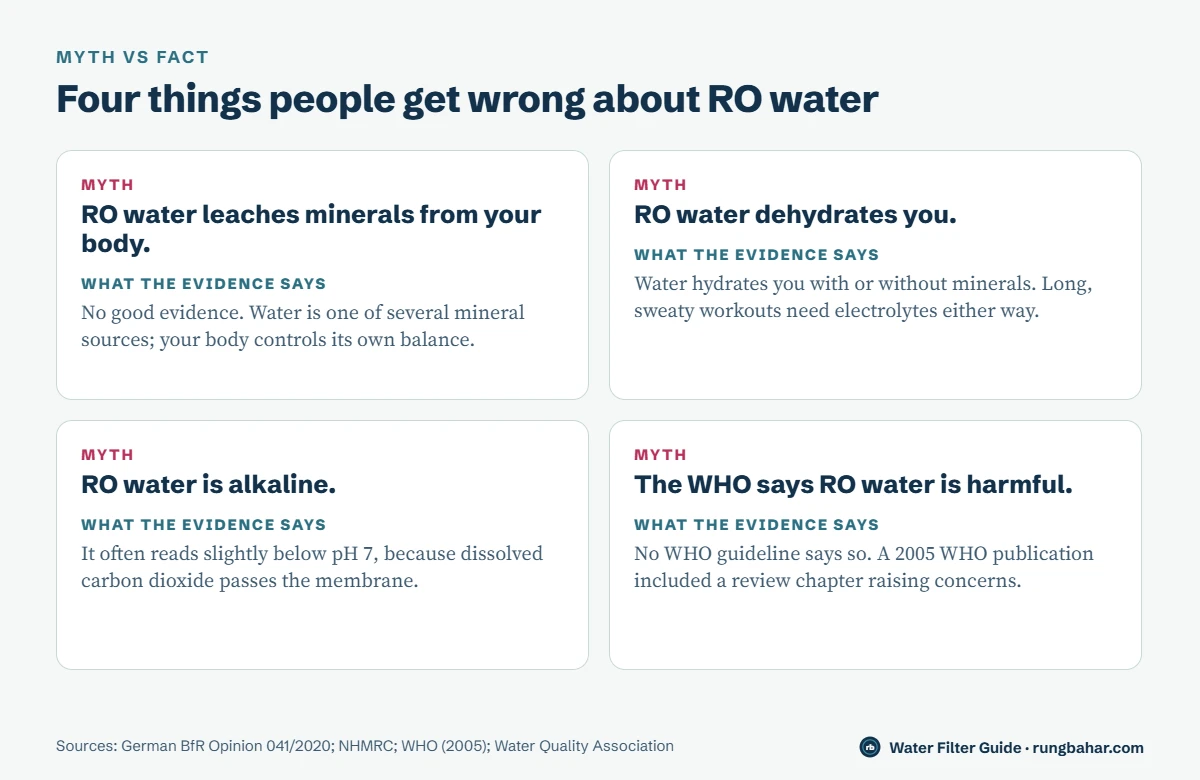
    Four myth and fact cards: RO water does not leach minerals from the body, it hydrates you, it is not alkaline and often reads slightly below pH 7, and no WHO guideline says it is harmful
    The common warnings about RO water do not hold up to the evidence.

    What reverse osmosis does to your water

    A home RO system pushes water through a very fine membrane under pressure. Water molecules pass through, while most dissolved substances do not. Those are flushed down the drain. A typical under-sink system adds a sediment filter and carbon filters before the membrane, and a carbon “polishing” filter after it.

    The result is water with far fewer dissolved solids. Certified systems can reduce a long list of contaminants, depending on the model: lead, arsenic, nitrate, fluoride, PFAS and more. Our guide to what reverse osmosis removes goes through them one by one, with what the certification has to show.

    That matters because the contaminants RO can remove are the ones with real health limits. The EPA sets enforceable limits for lead, arsenic, nitrate and fluoride, and in 2024 it set the first national limits for several PFAS in drinking water. A home RO system certified for those specific contaminants is one of the most thorough ways to reduce them at a single tap. If your water report or a lab test shows one of them near or above its limit, the case for RO is strong.

    RO is not picky, though. The same membrane that holds back lead also holds back calcium, magnesium, sodium and potassium. That is where the “is it bad for you” question comes from.

    The certification for home RO systems is NSF/ANSI 58. As with any filter, the standard number alone is not enough: check which contaminants the exact model is certified to reduce. Our NSF 53 vs 58 guide explains how the two main standards differ.

    The mineral question

    The main worry about RO water is that you lose the minerals in your tap water. That is true. The real question is how much those minerals mattered in the first place.

    Start with how much you need. The US National Institutes of Health sets the recommended daily calcium intake at 1,000 mg for adults aged 19 to 50, and 1,200 mg for women over 50 and everyone over 70. For magnesium it is 400 to 420 mg for men and 310 to 320 mg for women. The NIH names milk, yogurt and cheese as the main sources of calcium for most Americans, and legumes, nuts, seeds, whole grains and leafy greens for magnesium.

    Now compare that with water. Mineral content varies enormously from town to town, so here is a worked example rather than a rule. If your tap water has 40 mg of calcium per liter and you drink 2 liters a day, that is 80 mg of calcium, about 8% of a 1,000 mg daily target. Soft water may contain much less. Very hard water may contain more.
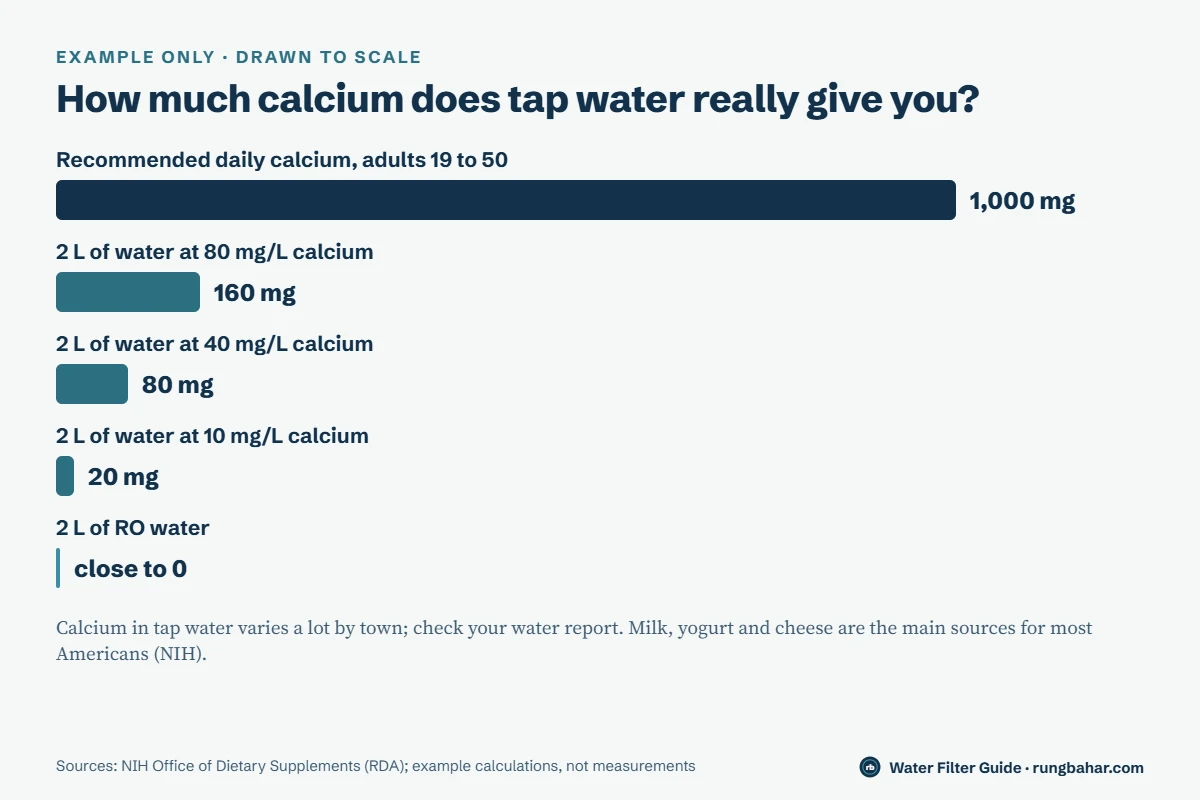
    Example bar chart drawn to scale: 1,000 mg daily calcium need for adults 19 to 50 versus 160, 80 and 20 mg from 2 liters of water at 80, 40 and 10 mg/L calcium, and close to zero from RO water
    Example only: even mineral-rich tap water supplies a small share of daily calcium.

    In 2020, the German Federal Institute for Risk Assessment (BfR) looked at exactly this question for bottled waters with very low mineral content. It concluded that “no adverse effects can be identified” that would justify advising against them, because water is “only one of several day-to-day sources of mineral intake.” The same reasoning applies to RO water at home.

    Why do some websites say the World Health Organization warns against RO water? In 2005 the WHO published a collection of papers on nutrients in drinking water. One chapter, by Czech scientist Frantisek Kozisek, raised concerns about drinking fully demineralized water over long periods, and that chapter is widely quoted. It is a review chapter, not a WHO rule. The WHO’s drinking water guidelines do not set a minimum mineral level, and the Water Quality Association argued at the time that the evidence was inconclusive. The honest summary: the question was studied and concerns were raised, but none of the health agencies we checked tells healthy people with a normal diet to avoid RO water.

    Who should pay attention

    The BfR named the groups who should keep an eye on their total calcium and magnesium intake if very low-mineral water is their main drink:

    • People with unbalanced diets
    • People who avoid certain foods, such as vegans or people who are lactose intolerant
    • Pregnant and breastfeeding women
    • Athletes during long exercise (more than about 1.5 hours)

    “Pay attention” does not mean “avoid.” It means making sure the rest of your diet covers calcium and magnesium, or choosing a remineralizing stage. If you have a medical condition that affects minerals or fluids, ask your doctor. This page is general information, not medical advice.

    Is RO water acidic or alkaline?

    RO water is not alkaline. It often reads slightly below 7 on a pH meter. Dissolved carbon dioxide passes through the membrane, while the minerals that would buffer it are removed, so a little carbonic acid forms. Low-mineral water is also hard to measure accurately, so home pH strips can mislead.

    Does that matter for your body? No. Your body keeps blood pH in a tight range on its own, and your stomach is far more acidic than any drinking water. Where it can matter is plumbing. Australia’s drinking water guidelines note that water with very low dissolved solids may be corrosive. That is one reason RO water is usually delivered through its own faucet and plastic tubing, and why makers of some appliances specify what water to use.

    If you want “alkaline” water, a remineralizing or alkaline post-filter will raise the pH by adding minerals back. There is no strong evidence that alkaline water has health benefits for healthy people, so treat it as a taste choice.

    Does RO water hydrate you?

    Yes. Water hydrates you whether or not it contains minerals. The idea that RO water “dehydrates” you or “leaches minerals from your body” is not supported by health agencies. Your food supplies the electrolytes your body needs for normal daily life.

    The exception is long, sweaty exercise. Then you lose sodium and other electrolytes in sweat, and any plain water, from the tap or from RO, will not replace them. That is what sports drinks and salty snacks are for, and it is why the BfR included athletes in its list.

    RO water and fluoride

    Many NSF/ANSI 58 systems are certified to reduce fluoride. For some people that is the reason they buy RO. For others it is a side effect to know about. If your city fluoridates its water and your children drink mostly RO water, they get less fluoride from water than their neighbors do. Mention it to your dentist, who can advise on toothpaste and other fluoride sources for your family.

    If you want fluoride out, our guide to water filters that remove fluoride explains which systems are certified for it and why most carbon filters are not.

    RO vs distilled vs tap vs mineral water

    WaterHow it is madeMineralsGood to know
    Reverse osmosisPressed through a membraneVery lowRemoves many contaminants; certified to NSF/ANSI 58
    DistilledBoiled, then the steam is condensedVery lowSimilar to RO in mineral content; home distillers are slow and use electricity
    Tap waterTreated by your utilityVaries by townMust meet EPA limits; quality report published yearly
    Mineral waterFrom a protected underground sourceVaries, often highMineral content is printed on many labels
    RO with remineralizing stageRO, then a mineral cartridgeSome added backMainly changes taste and pH; check what the cartridge adds

    Is RO water the same as distilled water? Not quite. Both are very low in minerals, but they are made differently. Distillation boils water and collects the steam, so it also leaves behind most contaminants. RO uses a membrane and pressure, and it relies on carbon stages for chlorine and many organic chemicals. For drinking, both are safe. For a CPAP machine, a steam iron or a lab, follow the maker’s instructions, which often specify distilled water.
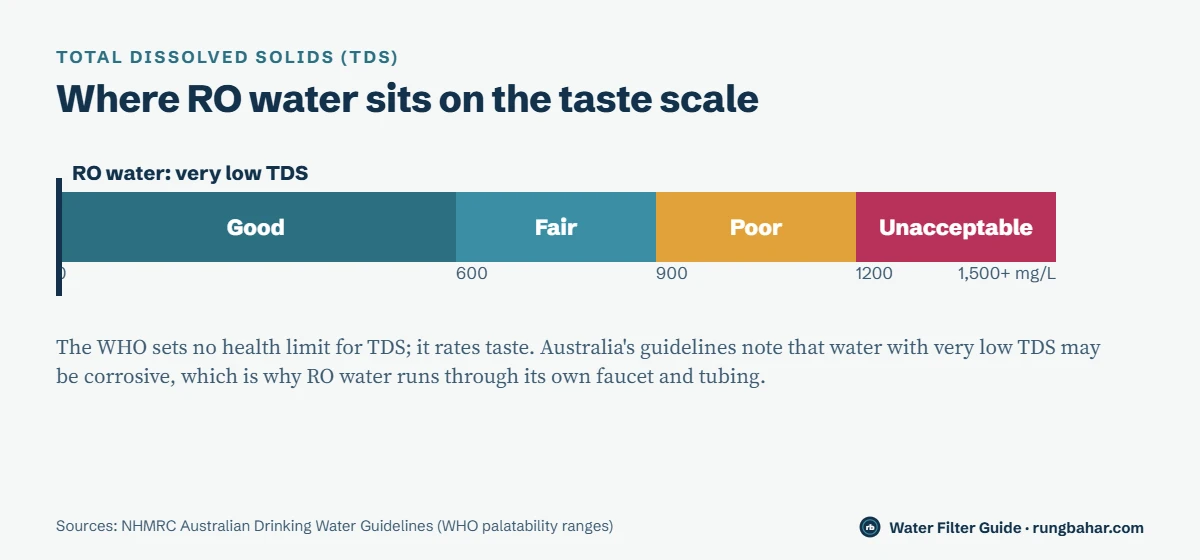
    TDS palatability scale based on WHO ranges: good 0 to 600 mg/L, fair 600 to 900, poor 900 to 1,200, unacceptable above 1,200, with RO water marked at the very low end
    There is no health limit for TDS; very low TDS water can be corrosive to plumbing.

    Should you add minerals back?

    For most people, adding minerals back is about taste. Very pure water can taste flat to people used to tap or mineral water. A remineralizing post-filter adds back small amounts of calcium and magnesium, which many people find tastes better and which raises the pH a little.

    Consider one if:

    • You or your family do not like the taste of plain RO water and drink less because of it. Drinking enough water matters more than its mineral content.
    • You are in one of the BfR’s groups and RO water is your main drink.
    • You want slightly higher pH for taste.

    Be realistic about what a cartridge does. It adds a modest amount of minerals, not a meaningful share of your daily calcium or magnesium. Food remains the main source. Mineral drops are another option, but follow the label and do not overdo it.
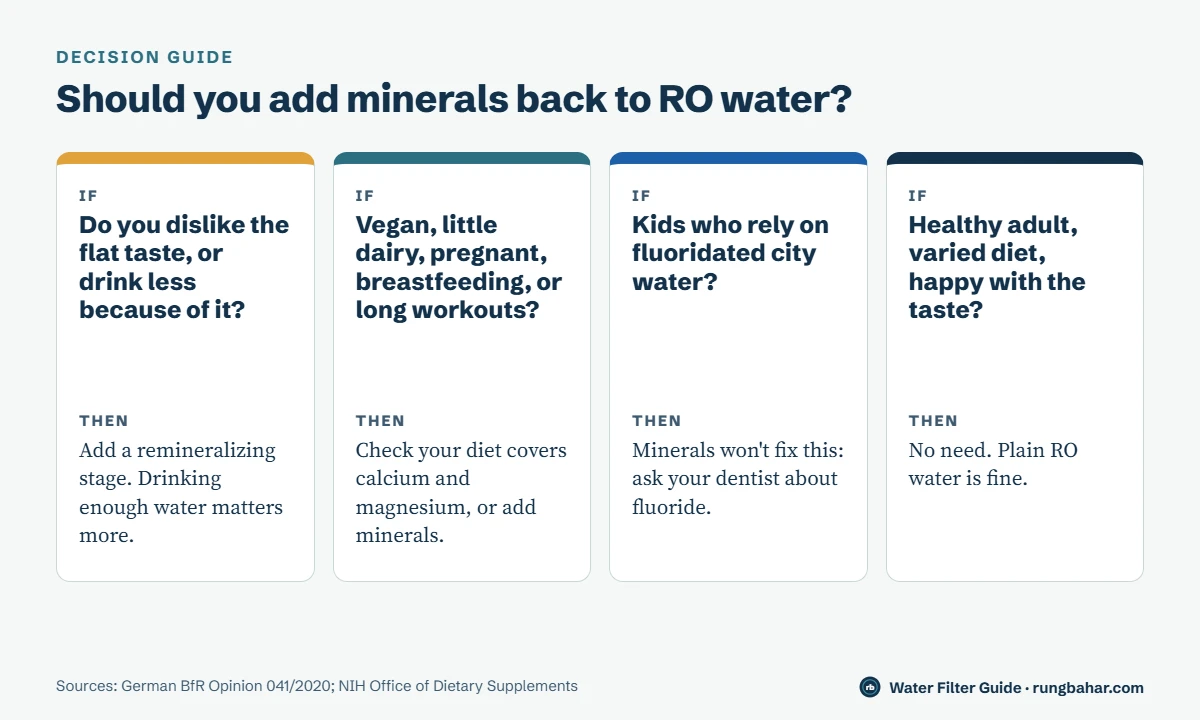
    Decision guide with four cases: dislike the taste then remineralize, vegan or pregnant or long workouts then check diet or add minerals, kids on fluoridated water then ask a dentist, healthy adult happy with taste then no need
    Remineralizing is mainly about taste, with a few groups who should watch minerals.

    Most households

    Under-sink RO, standard stages

    • Certification: NSF/ANSI 58, with the contaminants you need listed
    • Best for: Healthy adults who want PFAS, lead, nitrate or fluoride reduced
    • Skip if: your water test shows nothing RO is needed for

    See certified RO systems

    Taste first

    RO with a remineralizing stage

    • Certification: NSF/ANSI 58 for the RO system; check what the mineral stage adds
    • Best for: People who dislike flat-tasting water or want a slightly higher pH
    • Skip if: you are happy with the taste of plain RO water

    Use the filter finder

    Keep the minerals

    Certified carbon filter instead of RO

    • Certification: NSF/ANSI 42 and 53 for the contaminants in your water
    • Best for: Water that only needs chlorine, lead or PFOA/PFOS reduced
    • Skip if: you need nitrate, fluoride or dissolved solids reduced

    Search NSF listings

    Keeping RO water safe

    The biggest real-world risk with RO water is not missing minerals. It is a neglected system. Filters that are never changed stop doing their job, and storage tanks and lines can need cleaning. Follow the maker’s schedule for prefilters, the membrane and the post-filter, and sanitize the system as the manual describes.

    RO systems also send some water down the drain while they work. How much depends on the model, the water pressure and the water temperature, so compare the efficiency figure on the product’s performance data sheet if water use matters to you.

    Also remember what RO is not. It is not a substitute for disinfection on a well with bacteria problems; that is a job for a properly sized UV system or other treatment chosen after a water test. And if your utility uses chloramine, choose carbon prefilters rated for it. Our guide to filters that remove chloramine explains why.

    Before you buy, find out what is actually in your water. If you are on city water, the ZIP tap-water check on our homepage helps you find your utility’s report. If RO is more than your water needs, a certified carbon filter may be enough. Our water filter buying guide walks through the choice in five steps, and our guide to PFAS in tap water shows how to find out whether PFAS are in your water.

    The verdict

    Reverse osmosis water is good for you in the way that matters most: it can remove contaminants you do not want, and it is safe to drink. The loss of minerals is real but small for people who eat a varied diet, and a German government risk review found no reason to advise healthy people against low-mineral water. If you belong to one of the groups that should watch their mineral intake, if you dislike the taste, or if your children rely on fluoridated water, there are simple fixes: a remineralizing stage, attention to diet, and a quick word with your dentist or doctor.

    Still deciding whether RO is the right type for your home? The 15-second filter finder asks a few quick questions and suggests a type and certification.

    Is reverse osmosis water good for you? 14 common questions

    Short answers to what people search most. Each answer matches the sources listed at the bottom of the page.

    Is reverse osmosis water good for you?

    For most people, yes. It is safe to drink and removes many contaminants. It also removes most minerals, but food supplies most of the calcium and magnesium people need.

    Is reverse osmosis water bad for you?

    Not for healthy people with a varied diet. Germany’s federal risk agency found no adverse effects that would justify advising against very low-mineral water. Some groups, such as vegans, pregnant women and endurance athletes, should watch their total mineral intake.

    Is reverse osmosis water safe to drink?

    Yes, when the system is certified to NSF/ANSI 58 and maintained on schedule. A neglected system with old filters is the bigger risk.

    Is reverse osmosis water the same as distilled water?

    No. Both are very low in minerals, but distilled water is made by boiling and condensing steam, while RO water is pressed through a membrane. Both are safe to drink.

    Is reverse osmosis water alkaline?

    No. It often reads slightly below pH 7 because dissolved carbon dioxide passes through the membrane. A remineralizing filter raises the pH a little.

    Does reverse osmosis water have minerals?

    Very few. The membrane removes most calcium, magnesium, sodium and potassium. A remineralizing stage adds some back.

    Does reverse osmosis water hydrate you?

    Yes. Water hydrates you with or without minerals. During long, sweaty exercise, add electrolytes, whatever water you drink.

    Does reverse osmosis water leach minerals from your body?

    There is no good evidence for this. Health agencies treat water as only one of several sources of minerals, and your body controls its own mineral balance.

    Does reverse osmosis remove fluoride?

    Many NSF/ANSI 58 systems are certified to reduce fluoride. If your children rely on fluoridated tap water, ask your dentist about other fluoride sources.

    Can I use reverse osmosis water for baby formula?

    New York State’s health department lists reverse osmosis filtered water among the low-fluoride options for mixing formula. Follow your pediatrician’s advice and the formula instructions.

    Should I add minerals back to RO water?

    It is optional for most people and mainly improves taste. Consider it if you dislike the flat taste or belong to a group that should watch its mineral intake.

    Does the WHO say reverse osmosis water is harmful?

    No WHO guideline bans or warns against RO water. A 2005 WHO publication included a chapter raising concerns about long-term use of fully demineralized water, and that chapter is often quoted as if it were a rule.

    Is reverse osmosis water good for plants?

    Yes, many gardeners use it, especially for plants sensitive to dissolved salts or hard water. Very pure water carries no nutrients, so normal feeding still matters.

    Does reverse osmosis water taste different?

    Yes. Many people find it tastes clean but flat, because minerals that give water its taste are removed. A remineralizing filter changes that.

    Sources and how we checked this page

    Every fact on this page comes from the US National Institutes of Health, the German Federal Institute for Risk Assessment, the US Geological Survey, Australia’s National Health and Medical Research Council, the Water Quality Association, the World Health Organization’s published work, and NSF, checked on October 6, 2026. The calcium figure is a worked example, not a measurement of any water supply. We do not test water or filters in a lab. This page is general information, not medical advice.

  • What Does Reverse Osmosis Remove? Fluoride, PFAS, Lead, Microplastics and More

    What Does Reverse Osmosis Remove? Fluoride, PFAS, Lead, Microplastics and More

    Published October 4, 2026. Every claim is checked against the sources listed at the end of this page. How we research.

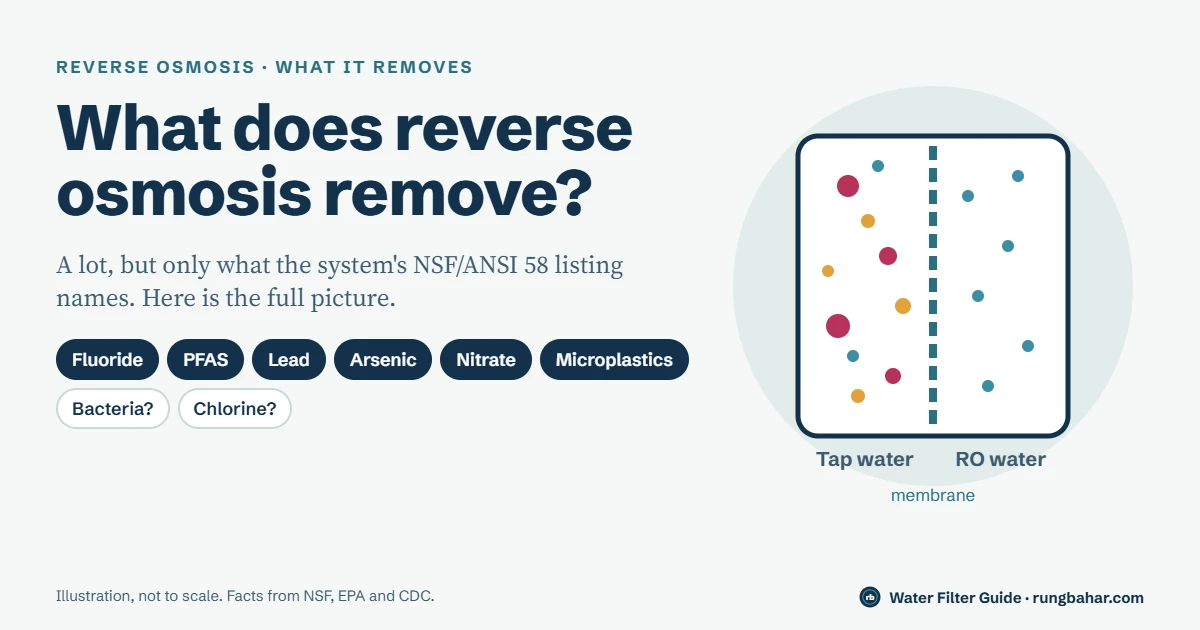
    The short answer: A certified reverse osmosis (RO) system can reduce total dissolved solids, fluoride, arsenic, nitrate, lead, copper, radium, PFAS and many other contaminants, but only the ones named on its NSF/ANSI 58 listing. Its carbon stages handle chlorine taste, and microplastic claims fall under NSF/ANSI 401. RO does not remove dissolved gases such as hydrogen sulfide, and it should not be used alone on water that is microbiologically unsafe.

    Quick check

    What do you want reverse osmosis to remove?

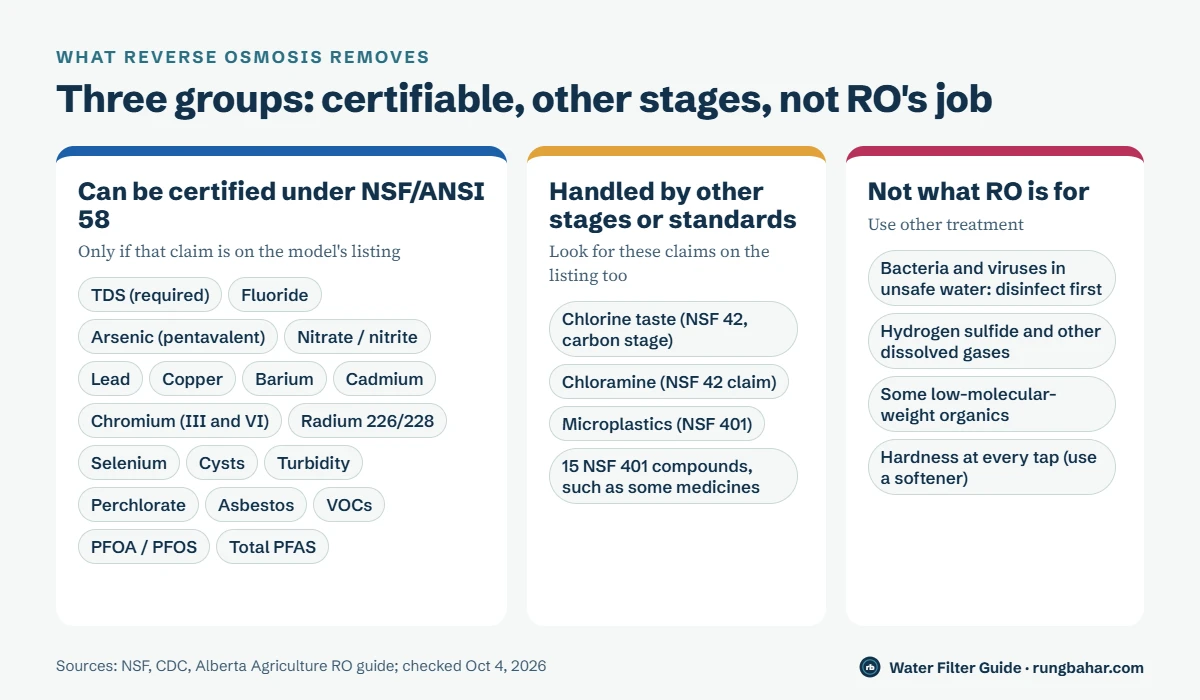
    Three columns: contaminants that can be certified under NSF/ANSI 58 such as fluoride, arsenic, nitrate, lead and PFAS; items handled by other stages or standards such as chlorine, chloramine and microplastics; and things RO is not for, such as bacteria in unsafe water and hydrogen sulfide
    Check which group your contaminant falls in, then look for that exact claim on the listing.

    How reverse osmosis works

    Reverse osmosis pushes water under pressure through a semi-permeable membrane. Water molecules pass through. Most dissolved salts, metals and many other substances do not, and they are flushed away in a stream of reject water that goes to the drain. That is why an RO system has a drain connection and why it reduces total dissolved solids (TDS), the measure of everything dissolved in water. Alberta’s agriculture department, in its guide to RO water treatment, puts the typical TDS reduction at 85 to 98 percent.

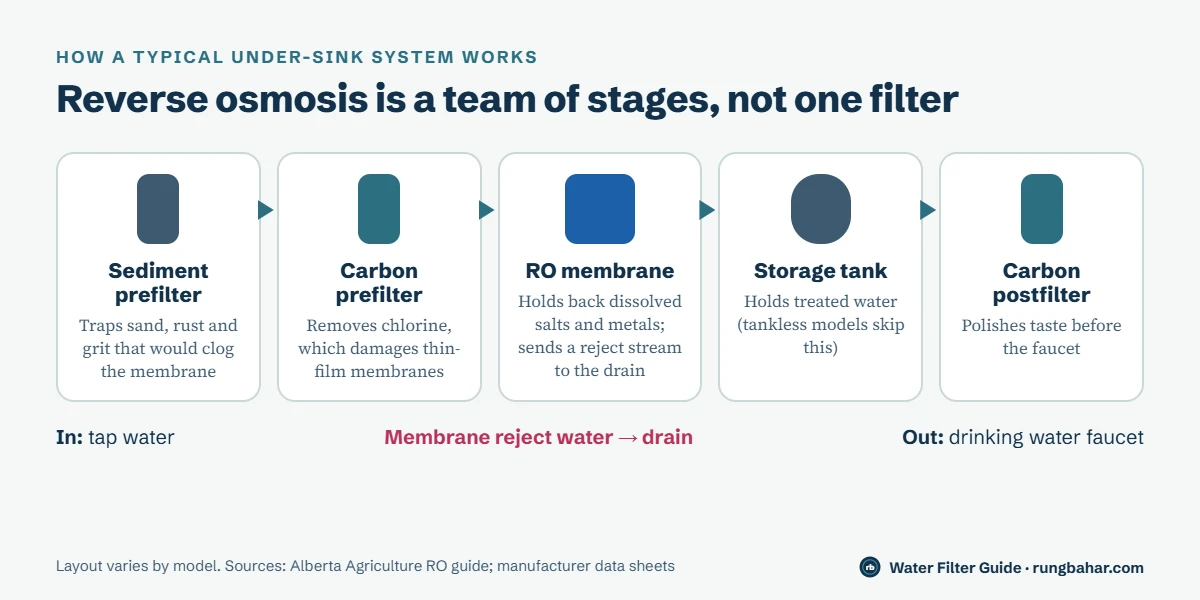
    A home RO system is more than the membrane. A typical under-sink unit has a sediment prefilter to stop grit, a carbon prefilter to remove chlorine, the RO membrane itself, a storage tank and a carbon postfilter to polish taste. Tankless models skip the tank. The carbon prefilter matters more than it looks: the same Alberta guide notes that thin-film composite membranes, the common type, cannot tolerate chlorine.

    Diagram of a typical under-sink reverse osmosis system: sediment prefilter, carbon prefilter, RO membrane with a reject line to the drain, storage tank and carbon postfilter
    Most of the contaminant removal happens at the membrane; the carbon stages handle chlorine and taste.

    So when people ask “what does reverse osmosis remove”, the honest answer has two parts. What the whole system removes, including its carbon stages. And what a specific model is certified to remove, which is the only part you can count on.

    What reverse osmosis removes: the full table

    The table below combines the NSF/ANSI 58 claim list, EPA and CDC guidance and RO data sheets. “Certifiable” means a model can earn that claim; it does not mean every model has it.

    ContaminantCan RO reduce it?Certified claim to look forNotes
    Total dissolved solids (TDS)YesNSF/ANSI 58, TDS (required)Every certified RO system must pass this test
    FluorideYesNSF/ANSI 58, fluorideOptional claim; carbon filters are not designed for it
    PFAS (PFOA, PFOS and others)YesNSF/ANSI 58, PFOA/PFOS or total PFASEPA: membranes typically more than 90% effective
    LeadYesNSF/ANSI 58, leadMust cut 150 ppb to 5 ppb or less since 2019
    ArsenicYes, pentavalent formNSF/ANSI 58, arsenic (pentavalent)Trivalent arsenic must be converted first
    Nitrate and nitriteYesNSF/ANSI 58, nitrate/nitriteCommon well water concern
    Copper, barium, cadmium, chromium, selenium, radiumYesNSF/ANSI 58, each namedCheck each one separately
    Cysts (Cryptosporidium, Giardia)YesNSF/ANSI 58, cystsNot the same as bacteria or viruses
    VOCsOften, through the carbon stagesNSF/ANSI 58 or 53, VOC claimSome light organics pass the membrane
    MicroplasticsLikelyNSF/ANSI 401, microplasticsClaim lives in 401, not 58
    ChlorineYes, by the carbon stagesNSF/ANSI 42, chlorine taste and odorChlorine damages common membranes
    ChloramineDepends on the carbon stageNSF/ANSI 42, chloramineAsk for the specific claim
    Calcium, magnesium (minerals)YesCovered by the TDS testSome systems remineralize
    Bacteria and virusesRemoved, but not a safety deviceNot an NSF/ANSI 58 claimDisinfect unsafe water first
    Hydrogen sulfide and other gasesNoNoneGases pass through the membrane

    If you are still deciding whether you need RO at all, our guide on how to choose a water filter walks through the five steps, starting with what is actually in your water.

    How certified RO claims are tested

    RO systems are certified to NSF/ANSI 58 by NSF, WQA, IAPMO R&T, UL Solutions or CSA Group. Every certified system must pass one required test: TDS reduction. The challenge water is made up to 750 mg/L of TDS, and the system must achieve an average reduction of at least 75 percent. That test also checks that the membrane is intact.

    Beyond TDS, NSF lists 16 optional claims: cysts, hexavalent and trivalent chromium, arsenic (including pentavalent arsenic), nitrate/nitrite, cadmium, lead, barium, turbidity, fluoride, copper, VOCs, asbestos, perchlorate, radium 226/228 and selenium. PFAS claims, for PFOA and PFOS or for a wider “total PFAS” group, can also be earned under NSF/ANSI 58. A model holds only the claims shown on its listing. Our explainer on water filter certifications covers each standard in more detail.

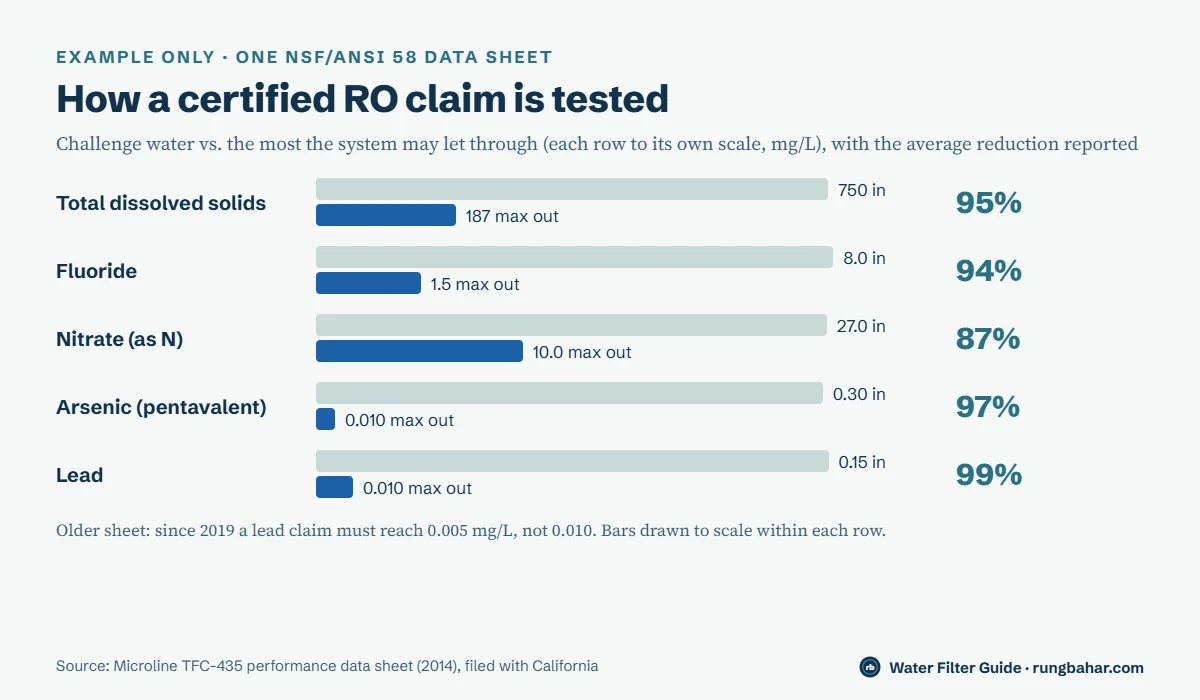
    To see what a claim means in practice, look at the performance data sheet that comes with a certified system. One example is the data sheet for the Microline TFC-435, an NSF-certified RO system whose 2014 sheet is filed with California regulators. It shows the challenge level for each claim, the most the system may let through and the average reduction it achieved in testing.

    Example from one NSF/ANSI 58 data sheet: TDS 750 to 187 mg/L maximum (95% average reduction), fluoride 8.0 to 1.5 (94%), nitrate 27 to 10 (87%), arsenic 0.30 to 0.010 (97%), lead 0.15 to 0.010 (99%)
    Example only: certified RO claims are tested against challenge water far worse than most taps.

    Two lessons stand out. First, the challenge water is far worse than most tap water, so a pass is meaningful. Second, data sheets age. This one shows a lead limit of 0.010 mg/L; since December 2019, NSF/ANSI 58 requires 0.005 mg/L (5 ppb). Always check the current listing, and use our guide on how to check if a water filter is really certified to do it.

    Does reverse osmosis remove fluoride?

    Yes. Fluoride is dissolved in water as an ion, which is exactly what an RO membrane is built to hold back, and fluoride reduction is one of the optional NSF/ANSI 58 claims. The CDC lists fluoride among the chemicals RO may reduce. In the example data sheet above, the fluoride test started at 8.0 mg/L and the system had to bring it down to 1.5 mg/L or less; it reported a 94 percent average reduction.

    This is one of the clearest cases for RO over a carbon filter. Standard activated carbon filters are not designed for fluoride, and a pitcher or under-sink carbon filter certified to NSF/ANSI 53 will not normally list it. If fluoride is your reason for buying, confirm the exact model carries a fluoride claim. Our guide to water filters that remove fluoride compares RO with the other options.

    Does reverse osmosis remove PFAS?

    Yes, and it is one of the strongest home options. EPA research summarizing treatment technologies says RO membranes are “typically more than 90 percent effective” at removing a wide range of PFAS, including shorter-chain PFAS. EPA’s fact sheet on home filters names RO, activated carbon and ion exchange as the three filter types for PFAS, and tells buyers to look for NSF/ANSI 53 or 58 certification.

    Two cautions. Certification claims are specific: “PFOA/PFOS reduction” and “total PFAS reduction” are different claims. And EPA notes that current certification standards do not yet guarantee reduction to its 2024 drinking water limits for PFAS. Read the exact claim on the listing, and replace the prefilters and membrane on schedule.

    Does reverse osmosis remove lead, arsenic and nitrate?

    Lead

    Yes, when certified. Lead is an optional NSF/ANSI 58 claim, and the CDC lists lead among the chemicals RO removes. Since December 2019 a lead claim under NSF/ANSI 53 or 58 means the system cut challenge water containing 150 ppb of lead to 5 ppb or less. If lead is your only concern, a certified carbon filter can also do the job without wastewater; our NSF 53 vs 58 guide compares the two.

    Arsenic

    Partly, and the detail matters. Arsenic comes in two main forms. RO certification covers pentavalent arsenic (arsenic V). The example data sheet explains that trivalent arsenic (arsenic III) is generally harder to remove, that it can be converted to arsenic V by an effective oxidant such as free chlorine, and that chloramine is not enough to ensure complete conversion. Well water is often untreated, so ask your lab which form you have, or whether treatment before the RO system is needed.

    Nitrate and nitrite

    Yes, when certified. Nitrate/nitrite is an optional NSF/ANSI 58 claim. In the example data sheet, the nitrate test started at 27 mg/L (as nitrogen) and had to come down to 10 mg/L or less. EPA advises testing a private well for nitrates every year, so keep testing after you install treatment to confirm it is working.

    Does reverse osmosis remove microplastics?

    Physically, very likely. An RO membrane is designed to hold back dissolved substances, which are far smaller than plastic particles. But “likely” is not a certified claim. Microplastic reduction is certified under NSF/ANSI 401, not 58. The 401 test uses fine particles between 0.5 and 1 micron, and a certified product must reduce them by at least 85 percent.

    If microplastics are your main concern, look for an NSF/ANSI 401 microplastics claim on the RO system’s listing. Many carbon block filters also carry that claim, so RO is not the only route.

    Does reverse osmosis remove bacteria, viruses and E. coli?

    This is where marketing and safety advice part ways. The CDC says RO systems remove parasites, bacteria and viruses, and EPA’s WaterSense program lists bacteria and viruses among the contaminants RO “can potentially remove”. But RO systems are not certified as disinfection devices. The data sheet example above carries the standard warning: do not use it with water that is microbiologically unsafe or of unknown quality without adequate disinfection before or after the system.

    There are practical reasons. Alberta’s RO guide notes that bacteria can “grow through” membranes, leading to growth in the postfilter and storage tank. It also warns that neglected prefilters and postfilters can become “bacteria farms”. If your well tests positive for total coliform or E. coli, treat the cause and disinfect, for example with a UV system certified to NSF/ANSI 55 Class A, then use RO for chemical contaminants if you need it.

    Does reverse osmosis remove chlorine, chloramine and minerals?

    Chlorine: yes, but the carbon prefilter does the work, protecting the membrane. A system with an NSF/ANSI 42 chlorine taste and odor claim has proven it.

    Chloramine: many US cities disinfect with chloramine instead of chlorine. A carbon stage certified for chlorine is not automatically certified for chloramine, so look for a specific NSF/ANSI 42 chloramine claim if your water quality report says your utility uses it.

    Minerals: yes. RO reduces calcium, magnesium and other dissolved minerals along with contaminants; the CDC lists calcium, magnesium and potassium among the substances RO may reduce. That is why some systems add a remineralization stage. Whether low-mineral water matters for your health is covered in Is reverse osmosis water good for you? RO is not a substitute for a water softener, though: it treats one tap, while hard water scales every fixture in the house.

    What reverse osmosis does not remove

    • Dissolved gases. Alberta’s guide says volatile gases such as oxygen and hydrogen sulfide pass through RO membranes. A rotten-egg smell needs other treatment.
    • Some light organic compounds. The same guide notes that some low-molecular-weight organic substances can pass the membrane. Carbon stages catch many of them; check for a VOC claim.
    • Microbiological risk in unsafe water. RO is not a disinfection system. Disinfect first.
    • Anything not on the listing. Even a contaminant RO usually handles is not certified for that model unless the claim is listed.
    • Problems at other taps. An under-sink RO system treats one faucet. Showers, laundry and other taps get untreated water.

    How much water does reverse osmosis waste?

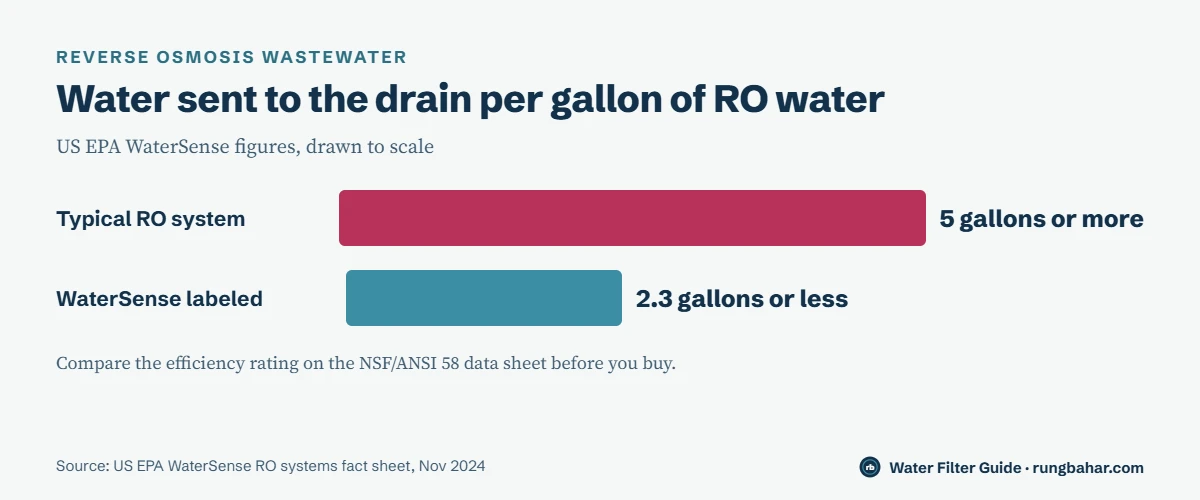
    Every RO system sends some water to the drain to carry away what the membrane rejects. According to EPA’s WaterSense program, a typical RO system sends five gallons or more down the drain for every gallon of treated water. A WaterSense labeled system sends 2.3 gallons or less.

    Bar chart from US EPA WaterSense: a typical RO system sends 5 gallons or more to the drain per gallon of treated water, a WaterSense labeled system 2.3 gallons or less
    A WaterSense labeled RO system wastes less than half the water of a typical one.

    NSF/ANSI 58 data sheets report this as two numbers. The efficiency rating is the share of incoming water that ends up as treated water under conditions close to typical daily use. The recovery rating is the share of water reaching the membrane that comes out as treated water when the tank is bypassed. In the example data sheet, the efficiency rating was 14 percent and the recovery rating 30 percent. Higher is better for both. On a private well with a septic system, the reject water also goes into the septic tank, so efficiency matters even more.

    Is reverse osmosis right for you?

    RO is worth it when your water has something that simpler filters do not handle well: fluoride, nitrate, arsenic, high TDS, or PFAS where you want the broadest reduction. It is probably more than you need if your only issue is chlorine taste, or lead from older pipes, which a certified carbon filter can handle without wastewater.

    • Good fit: fluoride, nitrate, arsenic or high TDS on your report; PFAS concerns; you own the home and have space under the sink.
    • Think twice: you only want better taste; you rent and cannot install; your well has bacteria and no disinfection yet.

    Still unsure? Our 15-second filter finder turns a few answers into a filter type and the certification to look for, and you can browse every topic on our water filter guides page.

    The cards below link to certified listings so you can compare models by claim.

    Widest coverage

    Under-sink reverse osmosis

    • Certification: NSF/ANSI 58 with your contaminants listed
    • Best for: Fluoride, nitrate, arsenic, PFAS, high TDS
    • Skip if: you cannot install under the sink

    Search certified RO models

    No plumbing

    Countertop reverse osmosis

    • Certification: NSF/ANSI 58 (check the claims on the listing)
    • Best for: Renters who need RO-level reduction
    • Skip if: you need a high daily volume

    Search certified models

    No wastewater

    Under-sink carbon filter

    • Certification: NSF/ANSI 53 for lead and PFOA/PFOS, plus 42
    • Best for: Lead and PFAS without RO
    • Skip if: you need fluoride, nitrate or arsenic reduced

    Search certified models

    Reverse osmosis: 16 common questions, answered

    These are the questions people search most about what reverse osmosis removes, including the ones most guides skip.

    What does reverse osmosis remove from water?

    A certified RO system can reduce TDS, fluoride, arsenic (pentavalent), nitrate/nitrite, lead, copper, barium, cadmium, chromium, radium, selenium, cysts, turbidity, perchlorate, asbestos, VOCs and PFAS, but only the claims named on that model’s NSF/ANSI 58 listing. Its carbon stages remove chlorine.

    Does reverse osmosis remove fluoride?

    Yes. Fluoride reduction is an optional NSF/ANSI 58 claim, and standard carbon filters are not designed for fluoride. Confirm the exact model lists fluoride.

    Does reverse osmosis remove PFAS?

    Yes. EPA says RO membranes are typically more than 90 percent effective at removing a wide range of PFAS, including shorter-chain PFAS. Look for a PFOA/PFOS or total PFAS claim on the listing.

    Does reverse osmosis remove microplastics?

    Very likely, because the membrane holds back far smaller dissolved substances. The certified claim for microplastics is under NSF/ANSI 401, so look for that claim on the system’s listing.

    Does reverse osmosis remove lead?

    Yes, when the system is certified for lead. Since 2019, a lead claim means challenge water with 150 ppb of lead was reduced to 5 ppb or less.

    Does reverse osmosis remove bacteria and E. coli?

    The CDC says RO removes bacteria and viruses, but RO systems are not certified as disinfection devices, and data sheets warn against using them on microbiologically unsafe water. If your well has E. coli or coliform, disinfect first.

    Does reverse osmosis remove chlorine?

    Yes, through the carbon prefilter and postfilter rather than the membrane. Common thin-film membranes cannot tolerate chlorine, so the prefilter protects them.

    Does reverse osmosis remove chloramine?

    It depends on the carbon stage. A chlorine claim does not cover chloramine, so look for a specific NSF/ANSI 42 chloramine claim if your utility uses chloramine.

    Does reverse osmosis remove nitrates?

    Yes, when the system is certified for nitrate/nitrite. Keep testing a private well every year, as EPA advises, to confirm the system is working.

    Does reverse osmosis remove arsenic?

    RO certification covers pentavalent arsenic (arsenic V). Trivalent arsenic (arsenic III) is harder to remove and usually needs to be converted first, for example by free chlorine. Chloramine is not enough for full conversion.

    Does reverse osmosis remove minerals?

    Yes. RO reduces calcium, magnesium and other dissolved minerals, which is what the required TDS test measures. Some systems add a remineralization stage for taste.

    Does reverse osmosis remove hydrogen sulfide or the rotten-egg smell?

    No. Dissolved gases such as hydrogen sulfide pass through RO membranes. You need treatment designed for sulfur odor.

    Does reverse osmosis remove pharmaceuticals?

    Some may be reduced, but the certified claims for specific medicines are under NSF/ANSI 401, which covers 15 named compounds. Look for those claims rather than general “pharmaceutical” marketing.

    Does reverse osmosis remove hardness?

    At the RO tap, yes, because calcium and magnesium are reduced. But RO is not a substitute for a water softener, which treats hardness at every tap and protects pipes and appliances.

    How much water does reverse osmosis waste?

    EPA says a typical RO system sends five gallons or more to the drain for every gallon of treated water, while a WaterSense labeled system sends 2.3 gallons or less. Check the efficiency rating on the data sheet.

    Is reverse osmosis better than a carbon filter?

    It is broader, not always better. RO is the choice for fluoride, nitrate, arsenic and high TDS. For chlorine taste, or for lead and PFAS without wastewater, a certified carbon filter can be simpler and cheaper to run.

    Sources and how we checked this page

    Every fact on this page comes from the US EPA, the CDC, NSF, a provincial agriculture department and a certified RO system’s performance data sheet, checked on October 4, 2026. We do not test filters in a lab, and the data sheet shown is an example, not a recommendation.