Updated October 20, 2026, by the RB Water Desk. How we research.
The short answer: It depends on which LifeStraw you mean. The LifeStraw Home pitcher is the only LifeStraw with a chemical filter and a third-party certification: WQA certifies it under NSF/ANSI 53 for lead (98.9 percent), mercury, cadmium and copper, and under NSF/ANSI 401 for microplastics. Its PFAS result (PFOA and PFOS) is lab-tested but not certified. The Personal straw and Go bottles remove bacteria, parasites and microplastics, not PFAS or lead. No LifeStraw removes fluoride or nitrate, and only LifeStraw’s separate purifier models are claimed to remove viruses.
First: which LifeStraw do you have?
LifeStraw is a brand of several very different products, made by Vestergaard Frandsen. Some were designed for hikers and emergency kits, where the danger is germs in stream water. Others were designed for kitchen tap water, where the concerns are lead, chlorine taste and chemicals. Asking “does LifeStraw remove PFAS?” only has an answer once you know which one you have.
- LifeStraw Personal (the original straw). A hollow-fiber membrane with 0.2-micron pores. It removes bacteria, parasites and microplastics. It has no carbon, so it does nothing for chemicals, metals or taste.
- LifeStraw Go Series bottles. The same type of membrane plus a small activated carbon capsule. LifeStraw says the carbon reduces chlorine, odors and organic chemicals, but does not remove heavy metals like lead.
- LifeStraw Home pitchers and dispensers. A membrane microfilter plus an activated carbon and ion exchange filter. This is the only LifeStraw line built for tap water chemicals, and the only one with a certification listing.
- LifeStraw purifiers (for example Mission, Family and Community). Larger gravity units for camps, households without safe water and emergencies. LifeStraw says these, unlike its filters, remove viruses.
If you bought a LifeStraw for the kitchen because of a news story about PFAS or lead, check that it is a Home pitcher or dispenser. A straw or Go bottle is a germ filter, not a tap water chemical filter.
What LifeStraw removes: the full table
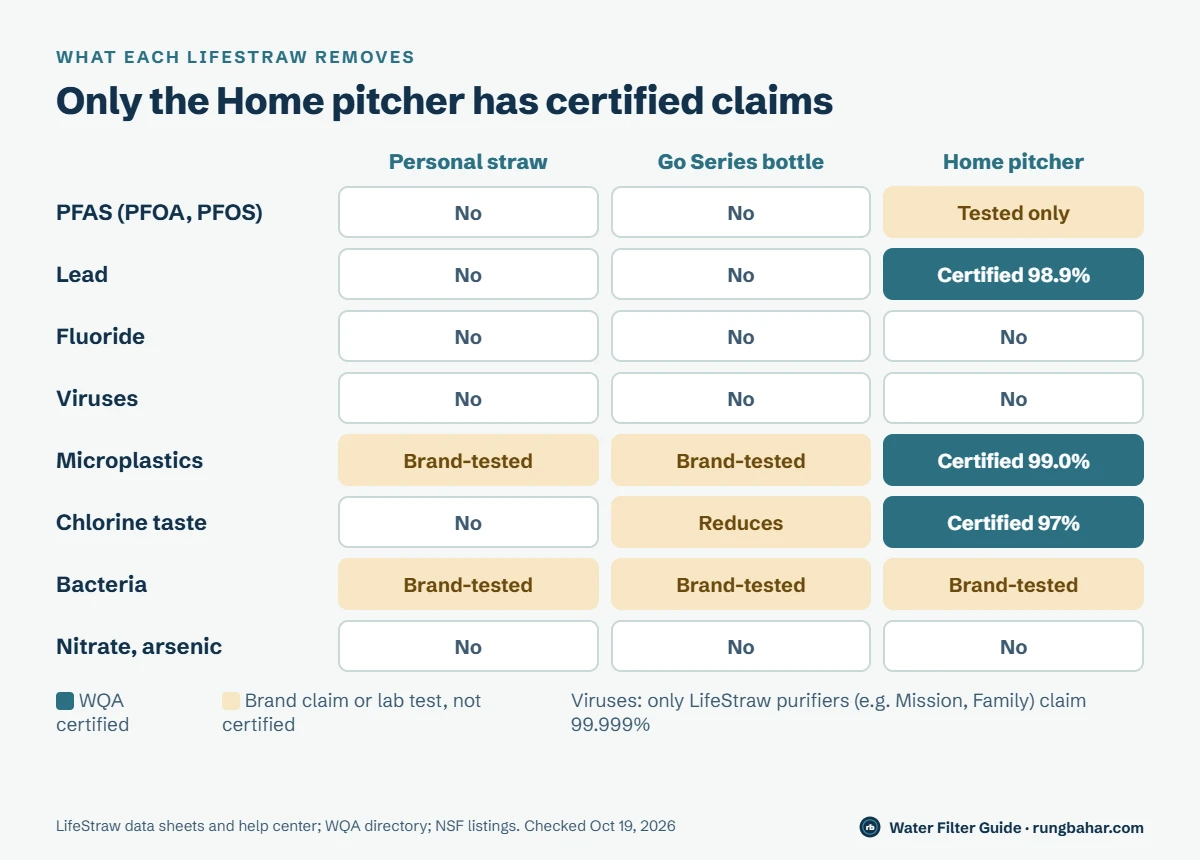
This table combines LifeStraw’s performance data sheets, its product pages and help center, and the Water Quality Association (WQA) certification directory, all checked October 19, 2026. “Certified” means a third-party certifier lists the claim. “Brand-tested” means LifeStraw reports a lab result but no certifier lists it.
| Contaminant | Personal straw | Go Series bottle | Home pitcher / dispenser |
|---|---|---|---|
| PFAS (PFOA, PFOS) | No claim | No (brand says no) | Brand-tested, not certified |
| Fluoride | No | No | No |
| Lead | No | No (brand says no) | Certified, 98.9% |
| Mercury, cadmium, copper | No | No | Certified, 82.9–98.9% |
| Microplastics | Brand-tested, 99.999% | Brand-tested | Certified, 99.0% |
| Chlorine taste and odor | No | Reduces (brand claim) | Certified, 97% |
| Chloramine | No | No | No (brand says no) |
| Bacteria | Brand-tested, 99.999999% | Brand-tested, 99.999999% | Brand-tested, 99.999999% |
| Parasites / cysts | Brand-tested, 99.999% | Brand-tested, 99.999% | Certified cyst reduction |
| Viruses | No | No | No |
| Nitrate, arsenic | No | No | No |
| Minerals, hardness, TDS | Kept | Kept | Kept |
Two things stand out. First, every certified claim belongs to the Home pitcher; the straw and bottles rely on LifeStraw’s own testing. Second, the PFAS line is the one most people care about, and it is the one claim on the Home pitcher that is tested but not certified.
PFAS
LifeStraw Personal and Go: no. Neither makes a PFAS claim. LifeStraw’s product pages point anyone worried about PFAS or lead to the Home pitchers instead.
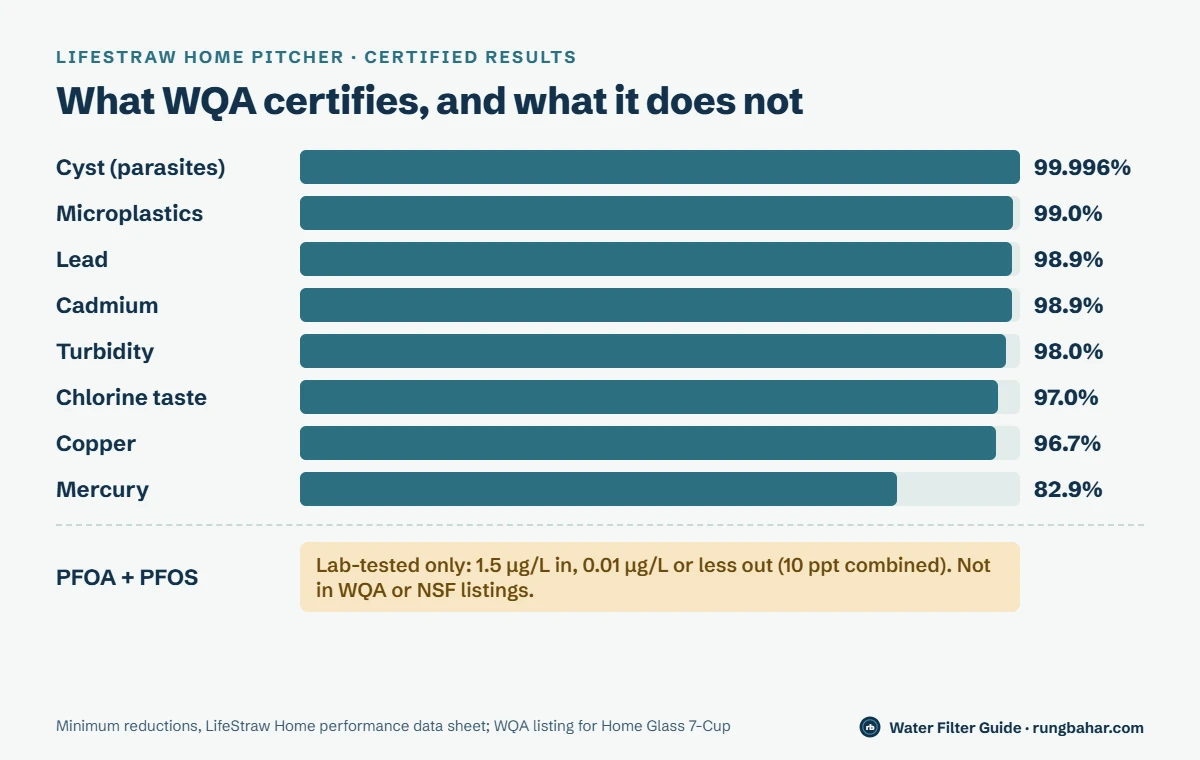
LifeStraw Home: lab-tested, not certified. LifeStraw’s Home performance data sheet lists PFOA plus PFOS tested at a challenge of 1.5 micrograms per liter (1,500 parts per trillion). The required maximum in product water is shown as 0.02 micrograms per liter, and LifeStraw’s result is 0.01 micrograms per liter, which is 10 parts per trillion combined. The row is marked “independently tested”, not “WQA certified”. LifeStraw’s help center says the pitcher was third-party tested to the NSF P473 protocol for PFOA and PFOS and is “not currently marketed as certified” to the 2022 PFAS updates to NSF/ANSI 53 and 58.
We checked both certifiers. WQA’s directory lists the LifeStraw Home Glass 7-Cup pitcher under NSF/ANSI 53 for cadmium, copper, cyst, lead, mercury and turbidity, with no PFOA or PFOS claim. NSF’s drinking water treatment listings returned no LifeStraw or Vestergaard products. So the PFAS result may well be real, but no certifier has confirmed it.
There is a second gap. The EPA’s drinking water limits for PFOA and PFOS are 4 parts per trillion each. LifeStraw’s data sheet reports only a combined maximum of 10 parts per trillion, so it does not show whether each compound would stay under 4. If PFAS is your main reason for buying a filter, our guide to filters certified for PFAS lists options with certified claims, and how to find out if your tap water has PFAS shows how to look up your utility’s results first.
Fluoride
No LifeStraw removes fluoride. LifeStraw’s help center says so directly, its FAQs repeat it for the Home pitchers, and fluoride appears on no LifeStraw data sheet. That is normal for carbon and membrane filters: fluoride is a small dissolved ion that passes through a 0.2-micron membrane and is not held by ordinary carbon.
If you want fluoride out, the usual options are reverse osmosis systems certified under NSF/ANSI 58 for fluoride, or specialty media such as bone char and activated alumina. Our guide to water filters that remove fluoride compares them. If you want to keep fluoride, any LifeStraw will leave it in.
Lead and heavy metals
LifeStraw Home: yes, and this one is certified. WQA lists the Home Glass 7-Cup under NSF/ANSI 53 for lead. LifeStraw’s data sheet gives the numbers: water spiked with 150 parts per billion of lead came out at 1.7 parts per billion at worst, against a required maximum of 5, a 98.9 percent reduction. Mercury (82.9 percent), cadmium (98.9 percent) and copper (96.7 percent) are certified too. The certified capacity is 40 gallons for the carbon and ion exchange filter, so the lead claim only holds if you change it on time.
One detail: the WQA listing names the glass 7-cup model. LifeStraw’s data sheet says all Home products use the same filters, which would cover the plastic pitchers and dispensers too, but if you want to match a listing exactly, the glass 7-cup is the one named.
Personal and Go: no. LifeStraw states that the Go bottle’s carbon “does not remove heavy metals”, and the straw has no chemical stage at all. For other certified lead pitchers, see water filter pitchers certified for lead, and for where lead comes from, lead in tap water.
Viruses: filter vs purifier
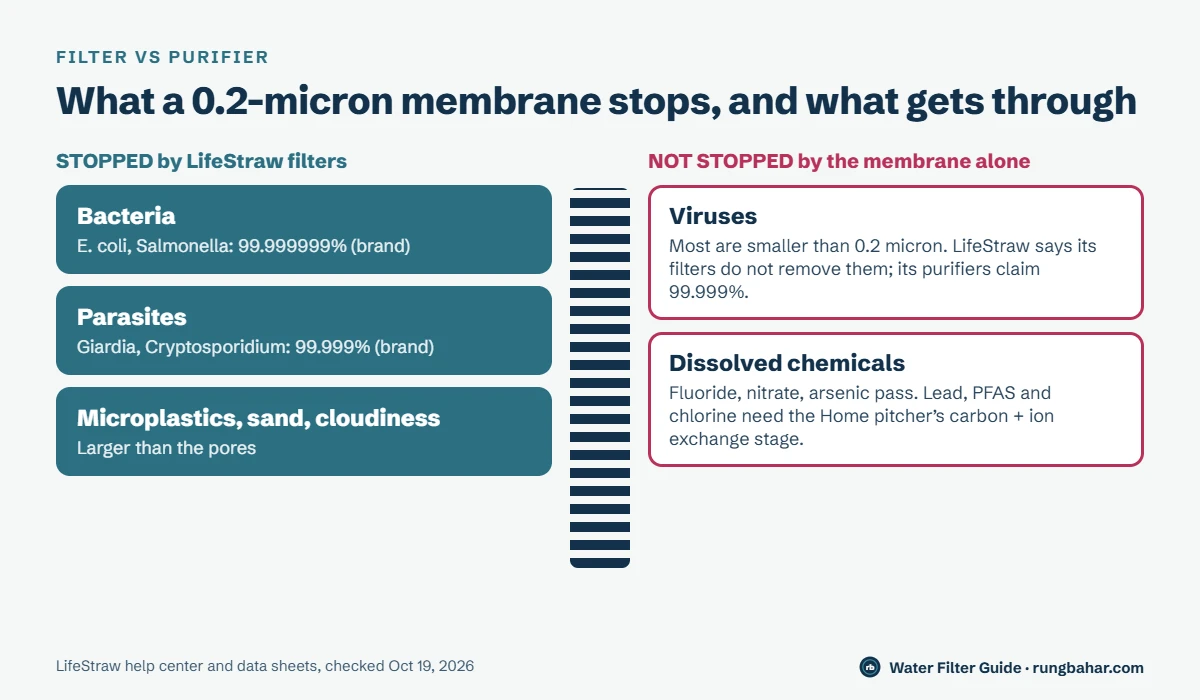
This is where the LifeStraw name causes the most confusion. LifeStraw sells two kinds of products, and it uses the words carefully. Its filters, including the Personal straw, Go bottles, Home pitchers and Peak filters, remove bacteria and parasites but, in LifeStraw’s own words, “do not remove viruses.” Its purifiers, such as LifeStraw Mission, Family, Community and the Peak gravity purifier with virus removal, are claimed to remove 99.999 percent of viruses as well.
The reason is size. A 0.2-micron membrane stops bacteria and protozoa such as Giardia and Cryptosporidium, but most viruses are smaller than that. For US tap water this rarely matters, because city water is disinfected. It matters on trips abroad, after floods, or with untreated surface water, where viruses such as norovirus and hepatitis A are a risk. In those cases, use a purifier, boil the water, or disinfect it as health authorities advise. Our page on what boiling does and does not remove explains the trade-offs.
Microplastics
Yes, all LifeStraw filters claim it. The Personal straw and Go bottles claim 99.999 percent removal of microplastics from LifeStraw’s testing. The Home pitcher is certified by WQA under NSF/ANSI 401 for microplastics.
Read the Home data sheet closely and you will see two different numbers. The headline claim says 99.999 percent, but the NSF/ANSI 401 table, the certified one, reports a minimum of 99.0 percent. Both may be true for different tests, but the certified figure is 99.0 percent, and that is the one we would quote. Our guide to filters that remove microplastics explains what the 401 test measures.
Chlorine and chloramine
Home pitcher: certified by WQA under NSF/ANSI 42 for chlorine taste and odor, with 97 percent reduction in testing. Go bottles: the carbon capsule reduces chlorine, but there is no certification, and the capsule is rated for only about 26 gallons. Personal straw: no chlorine reduction.
Chloramine is different. Many US cities disinfect with chloramine instead of chlorine, and LifeStraw lists chloramine among the things its products do not remove. If your utility uses chloramine, see which filters remove chloramine.
Nitrates, arsenic and minerals
LifeStraw’s help center lists the things its filters do not remove: arsenic, chloramine, fluoride, nitrates, petroleum, total dissolved solids, hardness minerals, salt and the disinfection byproducts known as THMs and HAAs. That list matters most for well owners. A LifeStraw can deal with bacteria from a well, but it will not touch nitrate or arsenic, the two well contaminants with the clearest health limits.
Keeping minerals is a design choice. LifeStraw says the Home filters keep calcium, magnesium and potassium, so a TDS meter will read about the same before and after. If a low TDS reading is what you want, ZeroWater works the opposite way; see does ZeroWater remove fluoride, PFAS, lead or microplastics? For nitrate or arsenic, reverse osmosis certified for the specific contaminant is the usual answer.
Filter life: when the claims stop
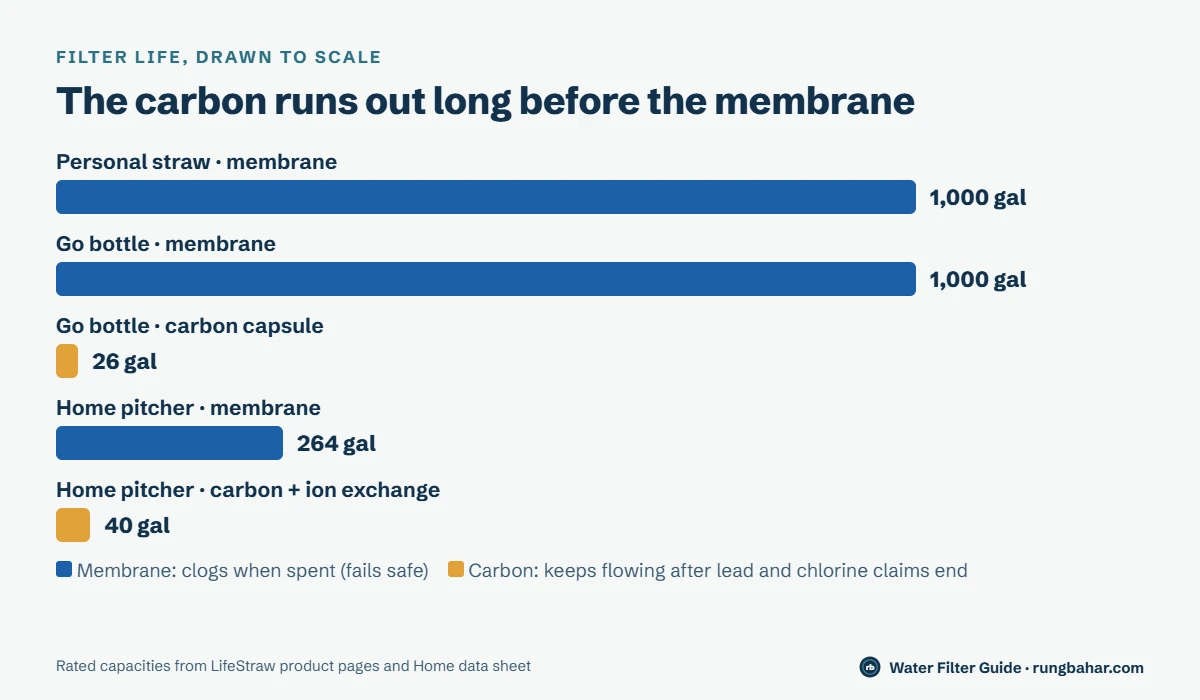
Each LifeStraw has two lifespans, and the shorter one decides how long the chemical claims last.
| Product | Membrane microfilter | Carbon filter | What runs out first |
|---|---|---|---|
| Personal straw | Up to 1,000 gallons | None | The membrane (it clogs and stops flowing) |
| Go Series bottle | Up to 1,000 gallons | About 26 gallons (about 2 months) | Carbon: chlorine and taste claims end |
| Home pitcher / dispenser | 264 gallons (about 1 year) | 40 gallons (about 2 months) | Carbon: lead, metals and chlorine claims end |
The membrane fails safe: when it is used up it clogs, so water stops coming through. Carbon does not. A spent carbon filter still pours water freely while it no longer removes lead or chlorine. For the Home pitcher, 40 gallons over 2 months works out to about 10 to 11 cups of filtered water a day for the whole household; if you use more, change it sooner. Our guide on how often to change a water filter covers how to track it.
“Tested” vs “certified”
LifeStraw’s pages use the words “tested”, “meets” and “certified” close together, and its Home product page lists “WQA, NSF 53, NSF 401, NSF P473, NSF 42, US EPA & NSF P231” under certifications. The data sheet is more precise: each row says either “WQA certified” or “independently tested.” Only the first kind has been checked by a certifier that also audits the factory.
That distinction is not a criticism of LifeStraw. Independent lab reports are useful, and LifeStraw publishes more of them than many brands. But a certification listing is the only claim you can verify yourself in a public directory. Our guide on how to check if a water filter is really certified walks through NSF, WQA and IAPMO searches, and does Brita remove PFAS, lead, fluoride or microplastics? applies the same test to Brita.
Is LifeStraw the right filter for you?
- Hiking, travel or an emergency kit in the US: the Personal straw or a Go bottle is built for this. Add a purifier, boiling or disinfection if viruses are a risk.
- Lead from old pipes: the LifeStraw Home pitcher is certified for lead, as are several other pitchers. Change the carbon filter every 40 gallons.
- PFAS: LifeStraw Home has a lab result but no certification. If you want a certified PFAS claim, compare options in our PFAS filter guide.
- Fluoride, nitrate or arsenic: LifeStraw is the wrong tool. Look at reverse osmosis certified for that contaminant.
- Not sure what is in your water: start with your utility’s report or our ZIP code tap water check, then try the 15-second filter finder.
Tap water: lead, chlorine
LifeStraw Home pitcher
- Certification: WQA, NSF/ANSI 42, 53 (lead, mercury, cadmium, copper, cyst) and 401
- Best for: lead from plumbing, chlorine taste, microplastics
- Skip if: you need certified PFAS, fluoride or nitrate removal
Outdoors and emergencies
LifeStraw Personal or Go
- Certification: none listed; brand-tested to EPA guide standard and NSF P231
- Best for: bacteria and parasites in stream or lake water
- Skip if: you want lead, PFAS or virus removal
PFAS is the priority
A filter certified for PFAS
- Certification: NSF/ANSI 53 or 58 with PFOA/PFOS or total PFAS named
- Best for: utilities reporting PFAS above EPA limits
- Skip if: your water report shows no PFAS detected
Does LifeStraw remove…? 15 common questions, answered
Short answers to what people search most, based on LifeStraw’s data sheets and help center and the WQA and NSF directories, checked October 19, 2026.
Does LifeStraw remove PFAS?
Only the LifeStraw Home pitcher and dispenser make a PFAS claim. LifeStraw reports PFOA plus PFOS reduced to 0.01 µg/L or less in independent testing, but WQA and NSF list no PFAS certification for it. The Personal straw and Go bottles do not remove PFAS.
Does LifeStraw remove fluoride?
No. LifeStraw says none of its products remove fluoride. Use reverse osmosis certified for fluoride, bone char or activated alumina if you want it out.
Does LifeStraw remove lead?
The LifeStraw Home pitcher does: WQA certifies it under NSF/ANSI 53 for lead, with 98.9 percent reduction in testing. The Personal straw and Go bottles do not remove lead.
Does LifeStraw remove viruses?
Not the filters. LifeStraw says its filters, including the Personal straw, Go bottles and Home pitchers, do not remove viruses. Its purifier models, such as Mission, Family and Community, are claimed to remove 99.999 percent of viruses.
Does LifeStraw remove microplastics?
Yes. The Home pitcher is WQA certified under NSF/ANSI 401 for microplastics (99.0 percent minimum), and the Personal straw and Go bottles claim 99.999 percent from LifeStraw’s testing.
Does LifeStraw remove chlorine?
The Home pitcher is certified for chlorine taste and odor (97 percent). The Go bottle’s carbon reduces chlorine but is not certified. The Personal straw does not reduce chlorine, and no LifeStraw removes chloramine.
Does LifeStraw remove bacteria?
Yes. LifeStraw reports 99.999999 percent bacteria removal for its filters, tested to the EPA guide standard and NSF P231. This is brand testing rather than a certification listing.
Does LifeStraw remove nitrates?
No. LifeStraw lists nitrates and nitrites among the contaminants its products do not remove. Boiling does not help either; it concentrates nitrate.
Does LifeStraw remove minerals?
No. LifeStraw says its filters keep minerals such as calcium and magnesium, and lists hardness and TDS as not removed.
Does LifeStraw remove arsenic?
No. Arsenic is on LifeStraw’s list of contaminants its products do not remove. Reverse osmosis certified for arsenic is the usual home option.
Is LifeStraw NSF certified?
We found no LifeStraw product in NSF’s drinking water listings on October 19, 2026. The LifeStraw Home Glass 7-Cup pitcher is certified by WQA, another accredited certifier, to NSF/ANSI 42, 53 and 401.
Is LifeStraw safe to drink tap water with?
Yes, it is designed for that. Just know which claims each model has: the Home pitcher covers lead and chlorine, while a straw or bottle only covers germs and microplastics, which disinfected city water rarely needs.
Is LifeStraw better than Brita?
Both the LifeStraw Home pitcher and the Brita Elite filter are certified for lead and microplastics, and neither has a certified PFAS claim. LifeStraw Home adds a membrane for bacteria and parasites; Brita Elite lasts longer per filter. Compare certifications for your contaminant, not brands.
Is LifeStraw legit or a scam?
LifeStraw is a real brand with published data sheets and a WQA listing for its Home pitcher. The caution is with wording: some claims are brand-tested rather than certified, so check which kind each claim is.
How long does a LifeStraw last?
The Personal straw membrane lasts up to 1,000 gallons. The Home pitcher membrane lasts 264 gallons (about a year) and its carbon filter 40 gallons (about 2 months). The Go bottle’s carbon lasts about 26 gallons.
Sources and how we checked this page
Every claim on this page comes from LifeStraw’s performance data sheets, product pages and help center, the Water Quality Association and NSF certification directories, and the US EPA, checked on October 19, 2026. We do not test filters in a lab, and we have no commercial relationship with LifeStraw or Vestergaard. Data sheets and listings change, so check the one for the exact product you buy.
- LifeStraw: Home Glass 7-Cup pitcher (product page and FAQs)
- LifeStraw: Home performance data sheet (PDF)
- LifeStraw: Home Essential 7-Cup pitcher (filter life, standards)
- LifeStraw: Personal Water Filter Straw (product page and FAQs)
- LifeStraw: Personal filtration performance sheet (PDF)
- LifeStraw: Go Series 1L bottle (product page and FAQs)
- LifeStraw help center: Do you have products that remove PFAS?
- LifeStraw help center: What LifeStraw removes (and does not)
- LifeStraw help center: Do LifeStraw products remove fluoride?
- LifeStraw help center: Water filter vs water purifier
- Water Quality Association: Certified product search, LifeStraw
- NSF: Drinking water treatment unit listings (searched LifeStraw and Vestergaard)
- US EPA: PFAS national primary drinking water regulation
- US EPA: Reducing PFAS in your drinking water with a home filter (PDF)