Updated October 19, 2026, by the RB Water Desk. How we research.
The short answer: A water filter removes PFAS only if its listing names a PFAS claim. Look for “PFOA/PFOS reduction” or the broader “total PFAS reduction” under NSF/ANSI 53, or the same claims under NSF/ANSI 58 for reverse osmosis. Certified options exist in every format: the PUR PLUS pitcher and faucet filters and the Culligan ZeroWater pitcher (total PFAS), the ZeroWater 5-stage pitcher and GE’s RPWFE fridge filter (PFOA/PFOS), under-sink carbon systems from Pentair and Aquasana, and reverse osmosis systems that list PFOA and PFOS. Pick the format by how much water you drink and what else is in it, not by the brand.
Quick pick
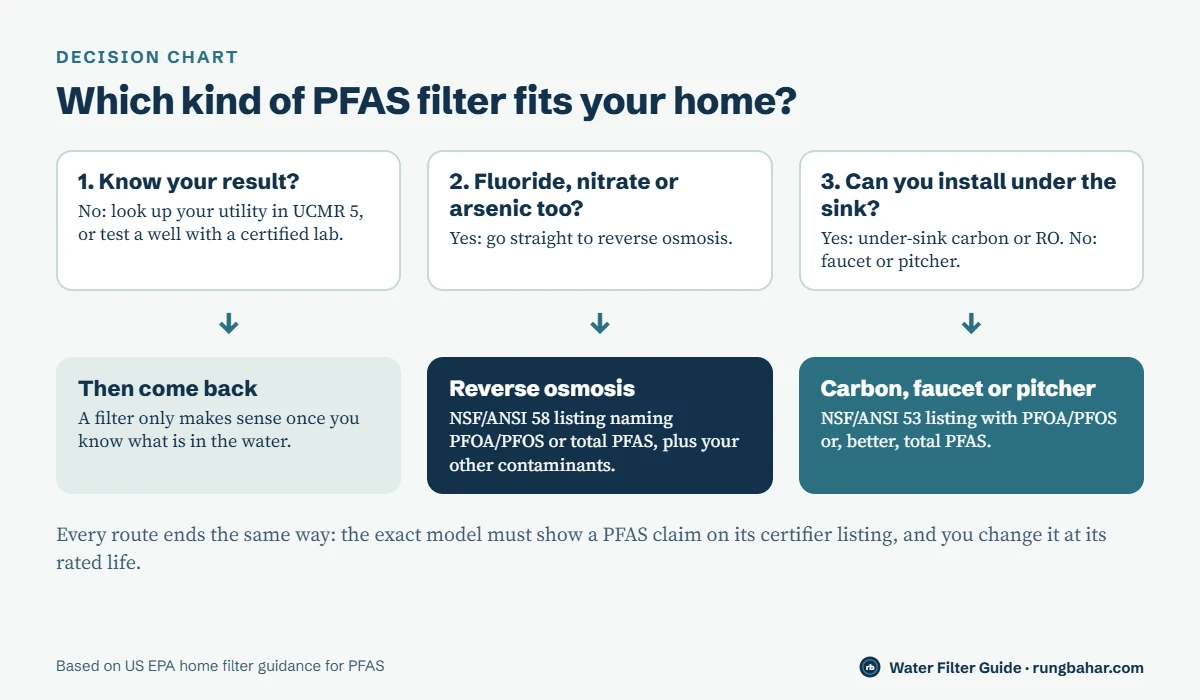
What best describes your situation?
Certified PFAS filters by type, at a glance
PFAS (per- and polyfluoroalkyl substances) are man-made chemicals that break down very slowly. The US EPA’s advice for home filters is short: look for certification to NSF/ANSI 53 or NSF/ANSI 58 for PFAS reduction, from an accredited certifier (NSF, IAPMO R&T, WQA, CSA Group or UL), and replace cartridges on the maker’s schedule. That is the test we used for every filter below.
We read each filter’s current performance data sheet or product page between October 6 and October 19, 2026. We have not lab-tested any of these filters, and we have no commercial relationship with any brand named here. This is a list of filters with a checkable PFAS claim, sorted by format, not a ranking of every filter on sale.
| Filter (model) | Type | PFAS claim | Rated life | Certifier |
|---|---|---|---|---|
| PUR PLUS pitcher filter (PPF951K) | Pitcher | Total PFAS, 99.75% | 40 gallons | IAPMO R&T |
| Culligan with ZeroWater Technology (ZEROF01) | Pitcher | Total PFAS, 99.7% | 20 gallons | Per Culligan data sheet |
| ZeroWater 5-stage (ZR-001) | Pitcher | PFOA/PFOS, 99.8% | 15 gallons | IAPMO R&T |
| PUR PLUS faucet filter (RF-9999) | Faucet | Total PFAS, 99.92% | 100 gallons | IAPMO R&T |
| GE RPWFE | Fridge | PFOA/PFOS, 99% (GE page) | About 6 months | IAPMO (per GE) |
| Pentair FreshPoint Easy Flow (4005450) | Under-sink carbon | PFOA/PFOS, up to 98% | 3,000 gallons or 1 year | IAPMO R&T |
| Pentair Everpure H-1200 (EV928200) | Under-sink carbon | PFOA/PFOS | 1,000 gallons | IAPMO R&T |
| Aquasana Claryum 2-Stage (AQ-5200 / AQ-6200) | Under-sink carbon | PFOA/PFOS (96–99.7% on Aquasana pages) | 500 gallons or 6 months | WQA |
| Waterdrop G3P800 (WD-G3P800) | Reverse osmosis | PFOA and PFOS listed | See data sheet | IAPMO R&T |
Read the table by the PFAS column first, then by rated life. Every filter here passed a PFAS test, but the tests differ (see the next section), and the rated life decides how often you must change it to keep the claim. The percentages are averages from the certification test water, not a promise about your tap.
PFOA/PFOS vs total PFAS: what the two claims mean
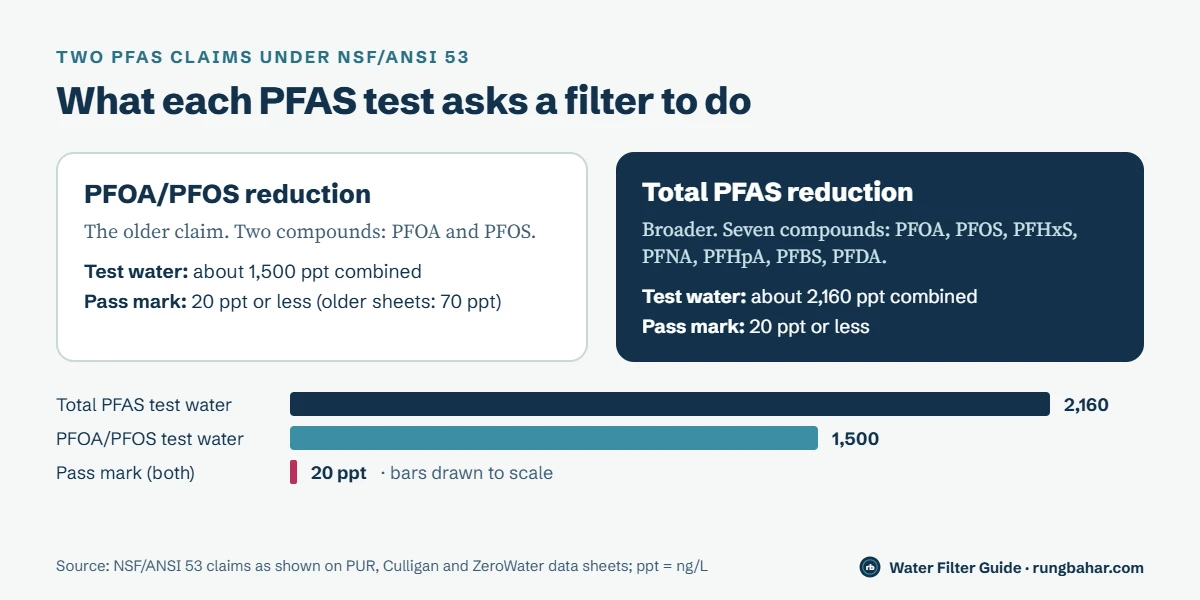
NSF/ANSI 53 has two PFAS claims, and a filter can hold one, both or neither. Knowing the difference is the fastest way to compare filters.
PFOA/PFOS reduction is the older claim. The test water contains PFOA and PFOS, the two best-known PFAS, at about 1.5 micrograms per liter combined (1,500 parts per trillion). Since a 2022 update, the filter must bring them down to 20 parts per trillion combined across its rated life. Some older data sheets still show the earlier pass mark of 70 parts per trillion (0.07 ppb), so read the limit printed on the sheet.
Total PFAS reduction is broader. The test water carries a mix of seven compounds (PFOA, PFOS, PFHxS, PFNA, PFHpA, PFBS and PFDA) at about 2,160 nanograms per liter combined, and the filter must keep the total at 20 nanograms per liter or less. PFHxS and PFNA are two of the PFAS the EPA set limits for in 2024. If you are choosing between two otherwise similar filters, the total PFAS claim tells you more.
Reverse osmosis systems can earn the same PFOA/PFOS or total PFAS claims under NSF/ANSI 58. Our explainer on NSF 53 vs 58 covers the two standards in detail.
One caution from the EPA itself: current certification standards do not guarantee that filtered water will meet its 2024 drinking water limits of 4 parts per trillion each for PFOA and PFOS. The certification proves a large, repeatable reduction from a high starting level. A filter that takes 1,500 parts per trillion down to 20 or less is removing more than 98 percent in the test; how low your own water ends up depends on where it starts, which is one reason to look up your result first.
Pitcher filters certified for PFAS
Best for: renters, small households and anyone who drinks about a gallon a day or less. Three pitcher filters on US shelves carry a certified PFAS claim.
PUR PLUS (PPF951K). On September 15, 2026, PUR announced that IAPMO R&T had certified its PUR PLUS pitcher and dispenser filter for total PFAS, alongside lead and microplastics. The data sheet lists total PFAS at 99.75 percent, lead at 99.2 to 99.9 percent and microplastics at 99.8 percent, with a rated life of 40 gallons. It is the one pitcher filter we found that covers the three most-searched contaminants. Make sure you buy the PLUS: the blue PUR filter (PPF900Z) has no PFAS, lead or microplastics claim. Our page on what PUR filters remove has the full list.
Culligan with ZeroWater Technology (ZEROF01). This newer filter lists total PFAS at 99.7 percent, fluoride at 99.7 percent and lead at 98.8 to 98.9 percent, with a rated life of 20 gallons. It is the pick if you want PFAS and fluoride from a pitcher. Like all ZeroWater-style filters, it strips nearly all minerals, so on hard water it runs out sooner.
ZeroWater 5-stage (ZR-001). The original ZeroWater filter lists PFOA/PFOS at 99.8 percent under NSF/ANSI 53, plus lead, with a rated life of 15 gallons. It is the narrowest PFAS claim of the three and the shortest life. If you already own a ZeroWater pitcher it is a valid PFAS filter; if you are buying new, the Culligan version covers more. See what ZeroWater removes for both data sheets.
A note on rated life: the PFAS claim holds only up to the gallons on the data sheet. ZeroWater’s own replace signal is a meter reading of 006, which on soft water can come long after the rated 15 or 20 gallons. If PFAS is why you bought it, change the filter at the rated gallons.
Faucet and refrigerator filters
PUR PLUS faucet filter (RF-9999). PUR’s current faucet data sheet covers the RF-9999 and RF3375 cartridges and lists total PFAS at 99.92 percent, lead at 99.6 to 99.7 percent and microplastics at 99.65 percent, with a rated life of 100 gallons. A faucet filter gives you filtered water for cooking as well as drinking, lasts two and a half times as long as the PUR PLUS pitcher filter and attaches to the faucet with no under-sink plumbing. PUR’s older faucet data sheet from September 2025 had no PFAS claim, so check the leaflet in your box. Brita’s faucet filter (FR-200) lists lead and microplastics but no PFAS; our Brita vs PUR comparison puts the two side by side.
Refrigerator filters. The fridge brand does not decide this; the exact cartridge does. GE’s product page says the RPWFE is certified to reduce 99 percent of PFOA/PFOS, tested by IAPMO to NSF/ANSI 42, 53, 401 and P473. The Whirlpool EveryDrop Filter 1 and LG LT1000P pages we read list lead but no PFAS claim. Cheaper “compatible” cartridges need their own listing; quoting the brand-name filter’s certificate is not proof. Do fridge filters remove PFAS? walks through how to check yours.
Under-sink carbon systems
Best for: homeowners and long-term renters who want filtered water at the kitchen tap with few cartridge changes and no wastewater. These systems hold far more carbon than a pitcher, which is why their rated lives run to hundreds or thousands of gallons.
Pentair FreshPoint Easy Flow (item 4005450). Pentair’s page says the system reduces up to 98 percent of PFOA/PFOS, certified by IAPMO R&T against NSF/ANSI 53, with lead reduction of 97.7 percent at pH 6.5 and 99.5 percent at pH 8.5. Pentair recommends replacing the filter every 3,000 gallons or one year, whichever comes first. That makes it the longest-lived PFAS-certified option we found.
Pentair Everpure H-1200 (EV928200). Pentair says the H-1200 is certified by IAPMO R&T against NSF/ANSI 53 for PFOA and PFOS, rated for 1,000 gallons at 0.5 gallons per minute. The page also says it is “certified to reduce up to 99.6% of total PFAS” without naming the standard for that figure, so treat the PFOA/PFOS claim as the confirmed one until the data sheet shows a total PFAS line. It needs a separate drinking water faucet.
Aquasana Claryum 2-Stage (AQ-5200, now sold as AQ-6200). Aquasana lists the Claryum 2-Stage as WQA tested and certified to NSF/ANSI 42, 53 and 401, including PFOA/PFOS. Its own pages give different figures, 96 percent on the certified products page and 99.7 percent on the current product page, so check the data sheet for the number. It is rated for 500 gallons or six months.
No plumbing
PUR PLUS faucet filter (RF-9999)
- Certification: NSF/ANSI 53 total PFAS and lead, 401 microplastics (IAPMO R&T)
- Best for: renters who cook with filtered water
- Skip if: your faucet has a pull-down sprayer
Fewest changes
Pentair FreshPoint Easy Flow
- Certification: NSF/ANSI 53 PFOA/PFOS (IAPMO R&T) and lead
- Best for: one cartridge a year at the kitchen tap
- Skip if: you also need fluoride or nitrate removed
Widest coverage
Reverse osmosis with a PFAS claim
- Certification: NSF/ANSI 58 listing that names PFOA/PFOS or total PFAS
- Best for: high PFAS results, or PFAS plus fluoride, nitrate or arsenic
- Skip if: you have no space under the sink
Reverse osmosis: the broadest option
Reverse osmosis (RO) pushes water through a membrane fine enough to hold back most dissolved substances, then polishes it with carbon. EPA research summarizing treatment technologies says RO membranes are “typically more than 90 percent effective” across a wide range of PFAS, including shorter-chain ones that carbon handles less well. A 2020 Duke University and NC State study of home filters found under-sink RO and two-stage filters removed 94 percent or more of the PFAS measured, while carbon-only filters averaged 73 percent with results that “varied greatly.”
The catch is that not every RO system carries a PFAS claim. The only claim every NSF/ANSI 58 system must pass is total dissolved solids. For example, A. O. Smith’s data sheet for its 800-gallon-a-day tankless RO (AOS-DFRO800) lists TDS and chlorine only, with no PFAS line. By contrast, the data sheet for the Waterdrop G3P800 lists PFOA and PFOS among its NSF/ANSI 53 and 58 health claims, alongside lead, arsenic, fluoride and nitrate, certified by IAPMO R&T. Both are RO systems; only one gives you a checkable PFAS result.
RO also brings trade-offs. Systems send some water down the drain (A. O. Smith rates its unit at 64 percent efficiency), most need space under the sink, and the water comes out low in minerals. If fluoride, nitrate, arsenic or high TDS is also on your water report, those trade-offs are usually worth it. If PFAS is your only concern, a certified carbon system does the job without wastewater. Our guide to what reverse osmosis removes covers the rest.
How many filters a year each one needs
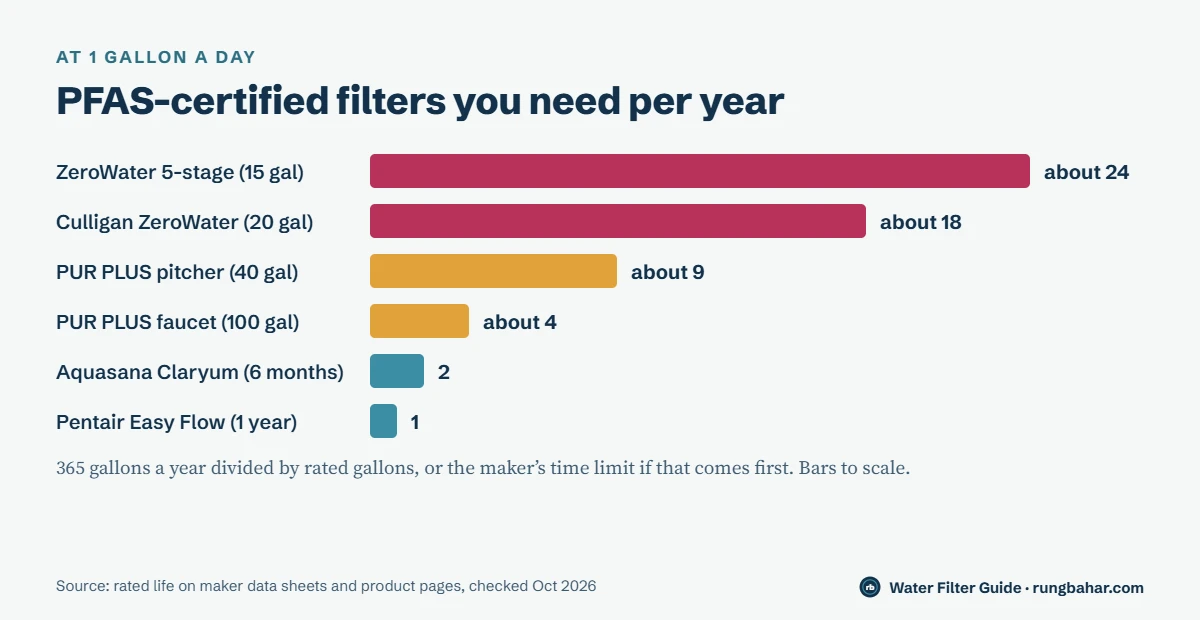
Cartridge count is the hidden cost of a PFAS filter, and it is easy to work out from the rated life. The table assumes one gallon of drinking and cooking water a day, about right for one or two people, and the maker’s time limit where one is given. Double the pitcher and faucet numbers for a family that uses two gallons a day.
| Filter | Rated life | Filters a year at 1 gallon/day | Limit that applies |
|---|---|---|---|
| ZeroWater 5-stage | 15 gallons | About 24 | Gallons |
| Culligan ZeroWater | 20 gallons | About 18 | Gallons |
| PUR PLUS pitcher | 40 gallons | About 9 | Gallons |
| PUR PLUS faucet | 100 gallons | About 4 | Gallons |
| Aquasana Claryum 2-Stage | 500 gallons or 6 months | 2 | Months |
| Pentair Everpure H-1200 | 1,000 gallons | Under 1 (1,000 gallons lasts about 2.7 years) | Gallons; check the maker’s time limit |
| Pentair FreshPoint Easy Flow | 3,000 gallons or 1 year | 1 | Months |
Two patterns stand out. First, pitchers are cheap to start but need the most cartridges; a ZeroWater user drinking a gallon a day buys about two filters a month. Second, under-sink systems usually hit their time limit before their gallon limit in a small household, so the months matter more than the gallons. Our guide to how often to change a water filter covers every filter type.
Popular filters with no PFAS claim
Several of the best-selling filters in the US have no certified PFAS claim on their current data sheets. That does not prove they remove nothing; carbon adsorbs some PFAS. It means no one has certified a result you can check.
- Brita Standard and Brita Elite pitcher filters. The current Elite data sheet (January 2026) lists lead and microplastics but no PFOA, PFOS or total PFAS. An older 2023 Canadian Elite sheet did list PFOA/PFOS; the current US sheet does not. A 2024 Université de Montréal study measured only partial, variable PFAS reduction from both Brita pitcher filters. Details in what Brita removes.
- The basic blue PUR pitcher filter (PPF900Z). Certified for chlorine taste and some metals only.
- Brita faucet filter (FR-200). Lead and microplastics, no PFAS.
- Many refrigerator cartridges, including the two brand-name ones we checked besides GE’s.
- RO systems that list only TDS, such as the A. O. Smith example above. RO usually reduces PFAS well, but without a listed claim you are relying on the general research, not a test of that model.
How to check a PFAS claim in five minutes
Marketing pages use phrases like “reduces forever chemicals” or “tested to NSF standards.” Neither is a certification. This check settles it for any filter:
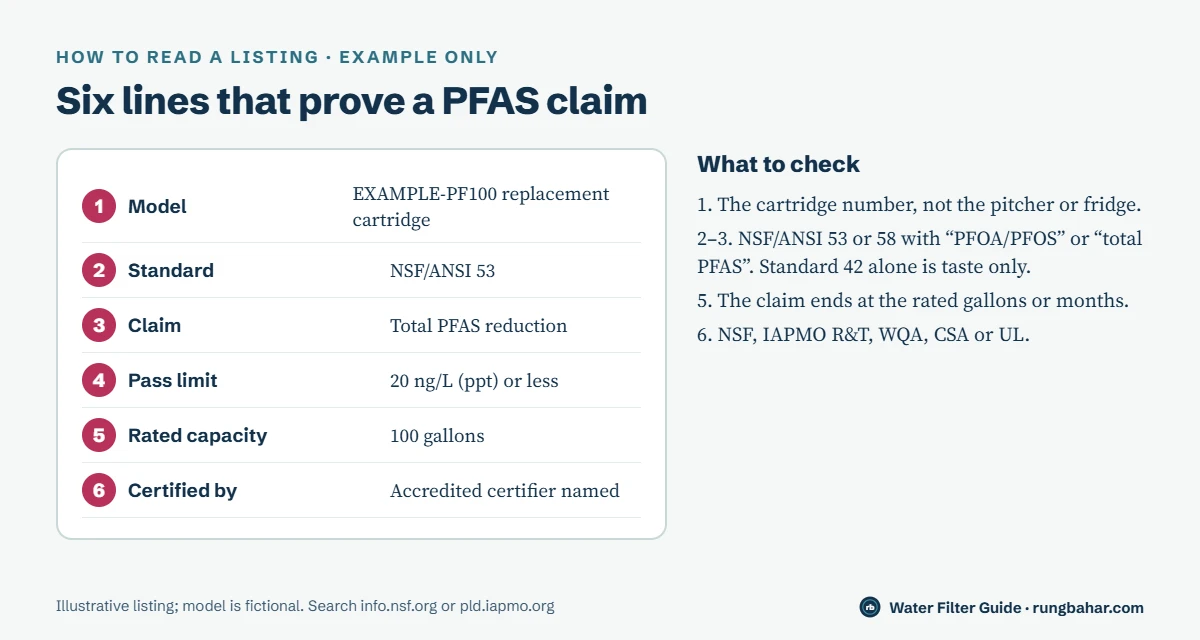
- Find the exact model number of the cartridge, not the pitcher or the fridge.
- Search the certifier’s listing. Start with NSF’s drinking water listings, then IAPMO R&T and WQA. The box or data sheet usually names the certifier.
- Read the claims under NSF/ANSI 53 or 58. You want the words “PFOA/PFOS reduction” or “total PFAS reduction.” A listing for NSF/ANSI 42 only (taste and odor) is not a PFAS claim.
- Note the rated life in gallons and months. The claim stops there.
- Match the data sheet in your box to the model. New claims, like PUR’s September 2026 total PFAS certification, may not be on older stock.
Our step-by-step guide on how to check if a water filter is really NSF certified shows each certifier’s search page with screenshots of what to look for.
Getting the PFAS reduction you paid for
A certified filter is tested new, used correctly, up to its rated life. Real-world results drop when any of those slips. Four habits keep you close to the test result:
- Change on schedule. The EPA’s PFAS fact sheet warns that not replacing a filter on the maker’s schedule can increase your exposure. A full carbon cartridge can stop adsorbing, and the water looks the same.
- Write the install date on the cartridge. Many fridge and faucet indicator lights run on a timer, not on actual use.
- Use cold water only. Filters are certified with cold water, and makers such as A. O. Smith state on the data sheet that the system is for cold water only.
- Flush new cartridges as the instructions say, to clear carbon fines and air.
Boiling is not a substitute. Boiling does not destroy PFAS, and as water evaporates the PFAS left behind become slightly more concentrated. See does boiling water remove PFAS for the details.
Do you need a PFAS filter at all?
Find out before you buy. Every US water system serving more than 3,300 people sampled for 29 PFAS between 2023 and 2025, and the results are public in the EPA’s UCMR 5 Data Finder. In its final release in August 2026, the EPA said 7.8 percent of systems would have a running annual average above 4 parts per trillion for PFOA or PFOS. Most people are below the limits; a meaningful minority are not.
Our guide to PFAS in tap water shows how to look up your system’s results, and the ZIP code water check on our homepage tells you which system serves you. On a private well, nobody tests for you: use a state-certified lab and ask for EPA Method 533 or 537.1.
The federal yardstick has not moved. The EPA’s 2024 limits of 4 parts per trillion each for PFOA and PFOS remain in force. In May 2026 the EPA proposed letting some systems take until 2031 to comply and rescinding the limits for PFHxS, PFNA, GenX and PFAS mixtures; as of its October 8, 2026 page update, those proposals were not final. Either way, a utility above the limit may take years to install treatment, and a certified home filter is the practical step in the meantime. Not sure which type suits your kitchen? The 15-second filter finder narrows it down, and our renter-friendly filter guide covers options that need no plumbing.
PFAS water filters: 14 common questions, answered
Short answers to what people search most, based on certifier listings, maker data sheets and EPA guidance checked October 19, 2026.
What water filter removes PFAS?
One certified for it. Look for “PFOA/PFOS reduction” or “total PFAS reduction” under NSF/ANSI 53, or under NSF/ANSI 58 for reverse osmosis. Certified examples include PUR PLUS pitcher and faucet filters, both ZeroWater filters, GE’s RPWFE fridge filter, and under-sink systems from Pentair and Aquasana.
Which type of water filter is best for PFAS?
Reverse osmosis has the widest coverage: EPA research puts RO membranes at typically more than 90 percent effective across many PFAS. Certified carbon filters also work and waste no water. The certification on the exact model matters more than the type.
Is there a water filter that removes PFAS and microplastics?
Yes. The PUR PLUS pitcher and faucet filters list total PFAS under NSF/ANSI 53 and microplastics under NSF/ANSI 401 on their data sheets. Neither ZeroWater filter has a microplastics claim.
Is there a water filter that removes fluoride and PFAS?
Reverse osmosis systems certified for both under NSF/ANSI 58 do. In a pitcher, the Culligan with ZeroWater Technology filter lists fluoride and total PFAS at 99.7 percent each. Carbon-only filters are not designed for fluoride.
Can a filter remove PFAS but not fluoride?
Yes, most carbon filters do exactly that. PUR PLUS, Pentair and Aquasana carbon systems list PFAS claims and no fluoride claim, so fluoride stays in the water.
Do water filters that remove PFAS also remove lead?
Usually, but check. All the filters in our table also list lead reduction on their data sheets or product pages. The two claims must be on the same model’s listing.
Does a Brita filter remove PFAS?
Not as a certified claim. The current Brita Standard and Elite data sheets list no PFOA, PFOS or total PFAS, and a 2024 study found only partial, variable reduction.
Which water filter pitcher removes PFAS?
PUR PLUS (total PFAS, 99.75 percent, 40 gallons), Culligan ZeroWater (total PFAS, 99.7 percent, 20 gallons) and ZeroWater 5-stage (PFOA/PFOS, 99.8 percent, 15 gallons), according to their data sheets.
Does reverse osmosis remove PFAS?
Yes. EPA research says RO membranes are typically more than 90 percent effective at removing a wide range of PFAS. For proof on a specific system, its NSF/ANSI 58 listing should name PFOA/PFOS or total PFAS.
Do refrigerator filters remove PFAS?
Some do. GE says its RPWFE is certified for 99 percent PFOA/PFOS reduction. Many fridge cartridges have no PFAS claim, so check the cartridge part number on a certifier listing.
Will a filter get PFAS below the EPA limit of 4 ppt?
Often, but no certification promises it. The EPA notes current standards do not guarantee reduction to its 2024 limits. Certified filters cut test water at 1,500 to 2,160 parts per trillion down to 20 or less.
How often should I change a PFAS filter?
At the rated life on the data sheet: from 15 gallons for a ZeroWater pitcher to 3,000 gallons or one year for Pentair’s Easy Flow. The PFAS claim stops at that point.
Does boiling water remove PFAS?
No. Boiling does not break PFAS down, and evaporation slightly concentrates what is left.
Do I need a whole-house PFAS filter?
Usually not. The main exposure route is drinking and cooking water, which point-of-use filters cover. Whole-house carbon systems with PFOA/PFOS claims exist, such as Aquasana’s OptimH2O (IAPMO, NSF/ANSI 53), but they typically cost more to buy and maintain.
Sources and how we checked this page
Every product claim on this page comes from the makers’ performance data sheets, product pages and certifier listings, checked between October 6 and October 19, 2026. Agency guidance comes from the US EPA. We do not test filters in a lab, and we have no commercial relationship with any brand named here. Data sheets change, so check the one for the model you buy.
- US EPA: Reducing PFAS in your drinking water with a home filter (PDF)
- US EPA: Reducing PFAS in drinking water with treatment technologies
- US EPA: PFAS national primary drinking water regulation
- US EPA: Proposed PFAS rescission rule (updated Oct 8, 2026)
- PUR: Performance data sheet, PUR PLUS pitcher filter PPF951K (PDF)
- PUR: Performance data sheet, PUR PLUS faucet filter RF-9999 (PDF)
- PUR via GlobeNewswire: PUR PLUS certified to reduce total PFAS (Sept 15, 2026)
- ZeroWater: Performance data sheet, 5-stage filter family (April 2026, PDF)
- Culligan: Performance data sheet, Culligan with ZeroWater Technology (PDF)
- Brita: Performance data sheet, Brita Elite filter (January 2026, PDF)
- Pentair: FreshPoint Easy Flow under-sink system
- Pentair: Everpure H-1200 drinking water system
- Aquasana: Certified products
- Aquasana: Claryum 2-Stage product page
- Waterdrop G3P800 performance data sheet (PDF, hosted by Lowe’s)
- A. O. Smith: AOS-DFRO800 performance data sheet (PDF)
- Teymoorian et al. (2024), Frontiers in Environmental Chemistry: PFAS removal by pitcher filters
- NSF certified drinking water treatment unit listings
- IAPMO R&T product listing directory