Skip to content

Category: PFAS

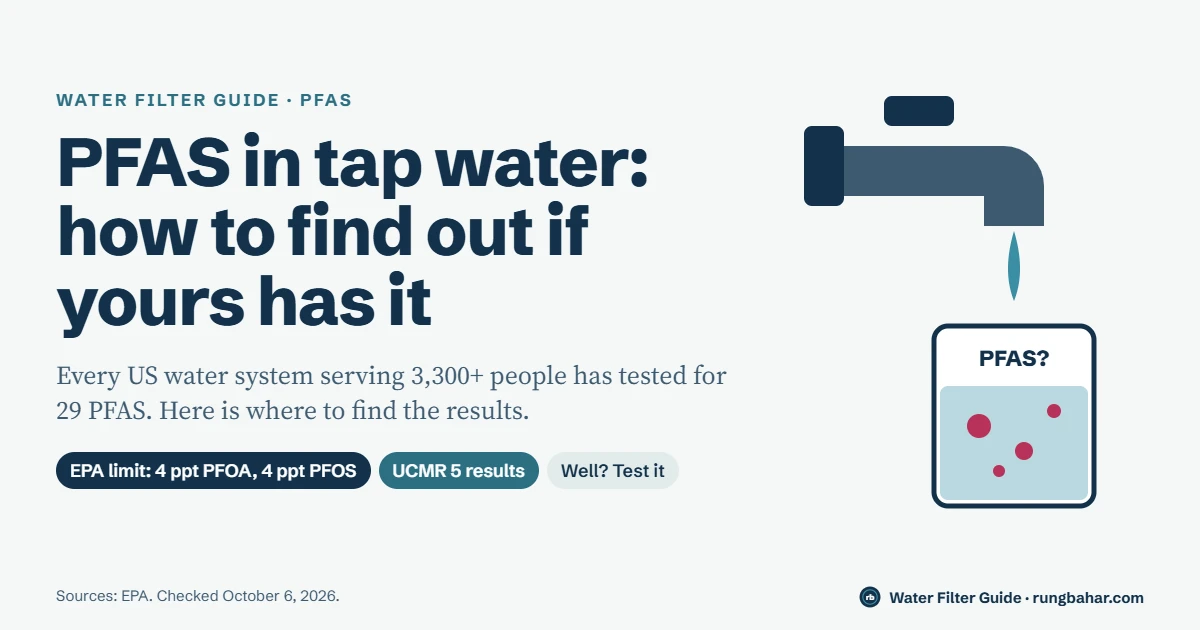
PFAS (“forever chemicals”) are now regulated in US drinking water. Find out whether your tap has PFAS, and whether refrigerator filters remove PFAS. Filters certified for PFOA/PFOS reduction are listed by NSF, IAPMO and WQA.

  • PFAS in Tap Water: How to Find Out If Yours Has It

    PFAS in Tap Water: How to Find Out If Yours Has It

    Published October 7, 2026. Every claim is checked against the sources listed at the end of this page. How we research.

    The short answer: If you are on city water, your utility has very likely already tested for PFAS. Every US water system serving more than 3,300 people sampled for 29 PFAS between 2023 and 2025, and the results are public in the EPA’s UCMR 5 Data Finder. Compare the PFOA and PFOS numbers with the EPA limit of 4 parts per trillion (ppt) each. On a private well, nobody tests for you: use a state-certified lab.

    Quick check

    Where are you with PFAS in your water?
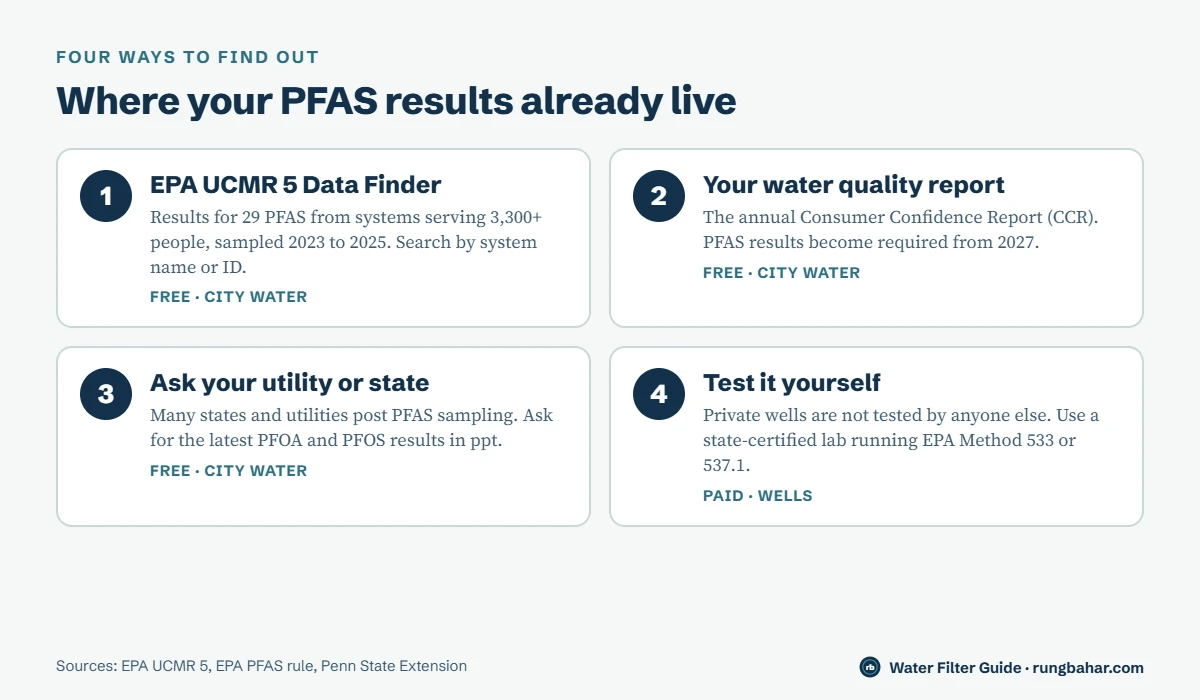
    Four ways to find PFAS results: the EPA UCMR 5 Data Finder, your annual water quality report, your utility or state, and testing a private well at a state-certified lab using EPA Method 533 or 537.1
    City water results are free to look up; private wells need their own test.

    How common is PFAS in US tap water?

    PFAS (per- and polyfluoroalkyl substances) are thousands of man-made chemicals used in nonstick coatings, stain-resistant fabrics, food packaging and some firefighting foams. They break down very slowly, which is why they are called “forever chemicals,” and they can reach drinking water sources from factories, airports, military bases, landfills and wastewater.

    Two large federal efforts give a sense of scale. In 2023 the US Geological Survey (USGS) tested tap water from 716 locations for 32 PFAS and estimated that at least 45% of the nation’s tap water has one or more types. It found PFAS at similar levels in public supplies and private wells, with most detections in urban areas around the Great Plains, Great Lakes, Eastern Seaboard and central and southern California.

    The second effort is the EPA’s fifth Unregulated Contaminant Monitoring Rule, known as UCMR 5. It required every community water system serving 3,300 or more people, plus a representative sample of smaller ones, to test for 29 PFAS and lithium during one 12-month period between 2023 and 2025. The EPA released the final data on August 27, 2026: just under 2 million results from more than 10,000 public water systems.
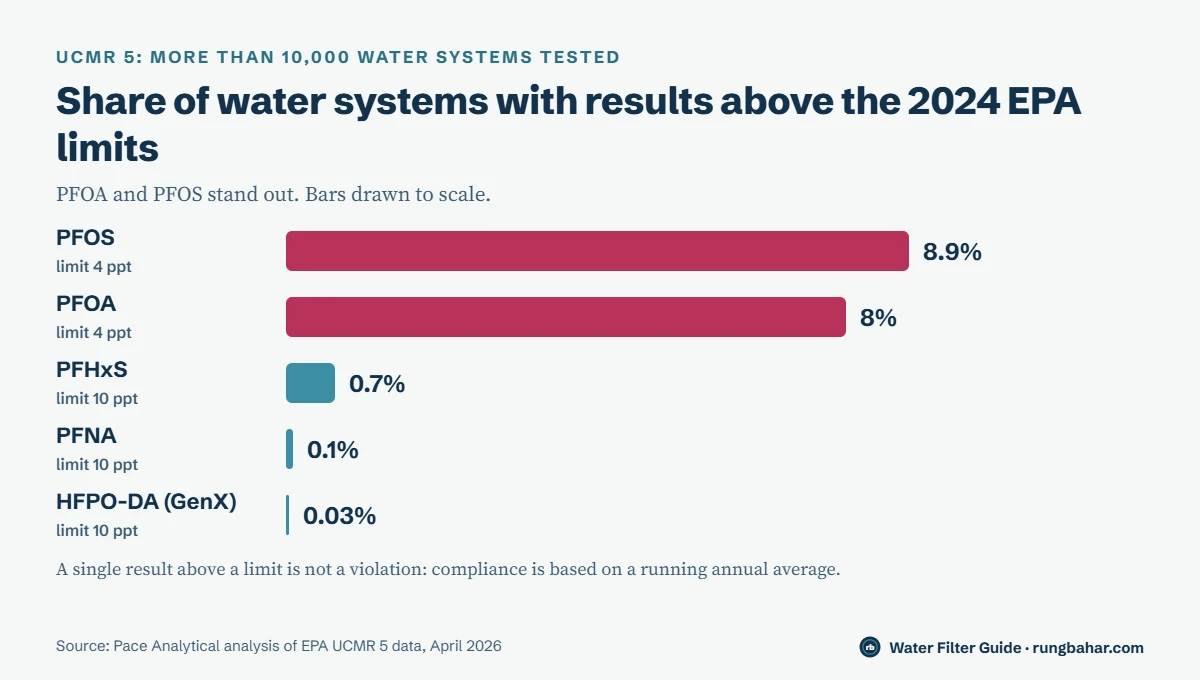
    Bar chart of UCMR 5 results: 8.9 percent of water systems above 4 ppt for PFOS, about 8 percent for PFOA, 0.7 percent above 10 ppt for PFHxS, 0.1 percent for PFNA and 0.03 percent for GenX
    PFOA and PFOS are the PFAS most often found above the EPA limits.

    An April 2026 analysis of the UCMR 5 data by Pace Analytical found that about 8% of participating systems reported PFOA above 4 ppt and 8.9% reported PFOS above 4 ppt. Other regulated PFAS were rarely above their limits: about 0.7% of systems for PFHxS and about 0.1% for PFNA. In its final release, the EPA said 7.8% of water systems would have a running annual average above the limit for PFOA or PFOS. Put simply, most systems are below the limits, but a meaningful minority are not, and you cannot tell which group yours is in without looking.

    Step 1: Search the EPA’s UCMR 5 Data Finder

    This is the fastest free check for most people on city water. The UCMR 5 Data Finder lets you filter results by water system name or ID, state, system size, contaminant and source water type.

    1. Find your water system’s name. It is on your water bill. If you are not sure, our ZIP code water check shows the system that serves your ZIP, its water source and its latest lead results from EPA records.
    2. Open the Data Finder and choose your state. Then type the system name, or its ID (the PWSID, which starts with your state’s two letters).
    3. Filter to PFOA and PFOS first. These are the two with federal limits that the EPA has proposed to keep. Then look at PFHxS, PFNA, HFPO-DA (GenX) and PFBS.
    4. Look at every sample, not just one. Larger systems often have several wells or treatment plants, and each entry point was sampled separately. Your home may get water from one or a blend.
    5. Write down the highest and the typical numbers in ppt, and the sample dates.

    The EPA notes that UCMR 5 reporting levels are based on what labs can reliably measure, not on health effects. A result of “ND” or “<MRL” means below that reporting level, not zero. For PFOA and PFOS the level was 4 ppt (0.004 micrograms per liter).

    For people comfortable with spreadsheets, the EPA’s downloadable UCMR 5 data files also include the ZIP codes each system reported serving. That is how many “PFAS by ZIP code” maps are built. Third-party maps, such as the Environmental Working Group’s tap water database, can be handy, but they may compare results with their own health guidelines rather than the EPA limits, so read the fine print.

    Step 2: Read your water quality report

    Every community water system must send customers an annual water quality report, also called a Consumer Confidence Report (CCR), usually by July 1. Many utilities already list their PFAS sampling in it, sometimes in a separate “unregulated contaminants” table.

    Under the EPA’s 2024 PFAS rule, systems must finish initial PFAS monitoring by 2027 and start giving customers information on PFAS levels beginning in 2027. So reports issued from 2027 onward should include PFAS more consistently. Our guide to choosing a water filter explains how to turn a report into a filter decision.

    When you read the table, look for the contaminant name, the unit (ppt or ng/L are the same thing), the average and the range. If PFAS is not mentioned at all, it does not mean there is none. Move on to Step 3.

    Step 3: Ask your utility or state

    Utilities answer this question often. Call or email customer service and ask three things: the most recent PFOA and PFOS results in ppt, which source or treatment plant serves your address, and whether any treatment for PFAS is planned. Many larger utilities also post a PFAS page with sample results.

    State environment and health agencies are another source. Several states sampled for PFAS before the federal rule and publish the data, and some set their own PFAS standards. Search for your state’s name plus “PFAS drinking water” to find the official page.

    Private well? Test it yourself

    The EPA does not regulate private wells, and no utility tests them. The USGS study found PFAS levels in private wells similar to public supplies, so if you live near a known source, such as an airport, military base, fire training site, landfill or factory that used PFAS, a test is worth considering.

    • Use a state-certified or accredited lab. Your state health or environment department can name labs that test drinking water for PFAS.
    • Ask for EPA Method 533 or 537.1. These are the EPA’s drinking water methods. Penn State Extension notes that Method 537.1 measures 18 PFAS and Method 533 measures 25.
    • Follow the lab’s sampling kit exactly. PFAS are in many everyday products, so labs give specific instructions to avoid contaminating the sample.
    • Expect a real cost. Penn State Extension put PFAS testing at around $250 to $500 per sample in its July 2024 update. Ask your state whether free or subsidized testing is offered near known sites.

    Store-bought “PFAS test strips” or general water test kits are not a substitute for a certified lab result at the parts-per-trillion level the EPA limits use.

    How to read a PFAS result

    PFAS are measured in tiny amounts. One part per trillion is one nanogram per liter. Results may be shown as ppt, ng/L or micrograms per liter (µg/L), where 0.004 µg/L equals 4 ppt.

    PFASEPA limit set in 2024Status as of October 6, 2026
    PFOA4.0 pptProposed to keep; compliance deadline proposed to move from 2029 to 2031 for eligible systems
    PFOS4.0 pptProposed to keep; same deadline proposal
    PFHxS10 pptProposed to rescind (May 2026)
    PFNA10 pptProposed to rescind (May 2026)
    HFPO-DA (GenX)10 pptProposed to rescind (May 2026)
    Mixture of PFHxS, PFNA, GenX and PFBSHazard Index of 1Proposed to rescind (May 2026)

    Three points make results easier to read. First, utility compliance is based on a running annual average, so one high sample is a warning sign, not a violation. Second, the limit is per chemical for PFOA and PFOS, so a result of 3 ppt PFOA and 3 ppt PFOS is below both limits. Third, “ND” means below the reporting level, which is not the same as zero. If you want PFAS as low as practical, a certified filter can take you below what the utility is required to reach.

    What the EPA rule says now
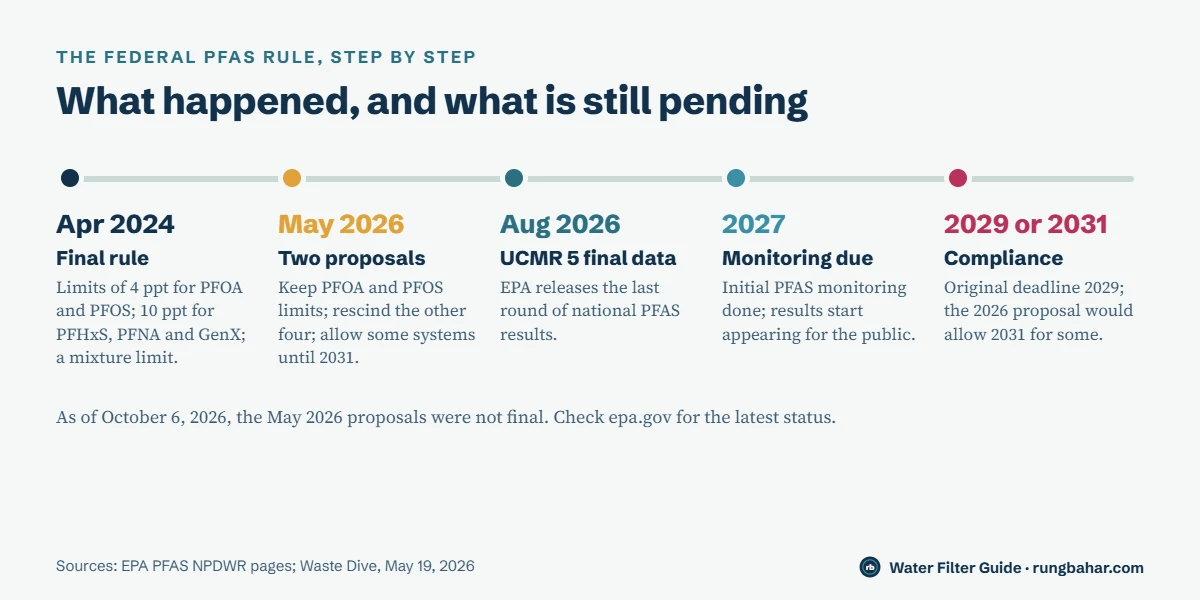
    Timeline of the EPA PFAS rule: final rule April 2024, two proposals in May 2026, final UCMR 5 data August 2026, initial monitoring due 2027, compliance 2029 or 2031
    The 2024 limits for PFOA and PFOS stand; the May 2026 changes were still proposals in October 2026.

    The EPA finalized the first national PFAS drinking water rule on April 10, 2024. It set limits of 4 ppt each for PFOA and PFOS, 10 ppt each for PFHxS, PFNA and HFPO-DA, and a combined Hazard Index for mixtures. Systems were given until 2027 to finish initial monitoring and until 2029 to meet the limits.

    On May 18, 2026, the EPA proposed two changes. One would keep the PFOA and PFOS limits but let eligible systems take until April 2031 to comply, with a duty to tell customers about any extension. The other would rescind the limits for PFHxS, PFNA, HFPO-DA and the mixture. The comment period closed on July 20, 2026. As of October 6, 2026, these were proposals, not final rules, so check the EPA’s PFAS page for the current status.

    For your household, the practical message has not changed: PFOA and PFOS at 4 ppt remain the federal yardstick, and you can compare your utility’s numbers with them today.

    What PFAS exposure is linked to

    The CDC’s Agency for Toxic Substances and Disease Registry (ATSDR) lists health effects that studies have linked to certain PFAS, including higher cholesterol levels, a lower antibody response to some vaccines, changes in liver enzymes, small decreases in birth weight, pregnancy-induced high blood pressure and preeclampsia, and kidney and testicular cancer (for PFOA). Scientists are still learning about the effects of mixtures of PFAS.

    There is no set of symptoms that tells you PFAS are in your water. The only way to know is a test result. If you have questions about your own health or about PFAS blood testing, talk to your doctor; ATSDR also publishes guidance on PFAS blood tests for clinicians and the public. This page is not medical advice.

    If your water has PFAS: what to do

    If your results are above 4 ppt for PFOA or PFOS, or you simply want lower levels, a home filter is the practical step while utilities work on treatment. The EPA’s advice is to look for a filter certified to NSF/ANSI 53 or NSF/ANSI 58 for PFAS reduction, and to replace cartridges and membranes on the maker’s schedule. Certification can come from NSF, CSA Group, IAPMO R&T, UL or WQA.

    On the listing, look for “PFOA/PFOS reduction” or “total PFAS reduction.” The total PFAS claim also covers PFHpA, PFHxS, PFNA and PFBS. Our guide to NSF 53 vs 58 explains both claims, and how to check if a filter is really NSF certified shows how to confirm a model in a few minutes.

    Lowest cost to start

    Pitcher or faucet filter with a PFAS claim

    • Certification: NSF/ANSI 53 naming PFOA/PFOS or total PFAS
    • Best for: Renters and small households with modest results
    • Skip if: your results are well above 4 ppt or you need lots of water

    Search certified models

    No wastewater

    Under-sink carbon filter

    • Certification: NSF/ANSI 53 for PFOA/PFOS or total PFAS, ideally lead too
    • Best for: Drinking and cooking water at the kitchen tap
    • Skip if: you also need fluoride or nitrate removed

    See certified listings

    Strongest home option

    Reverse osmosis system

    • Certification: NSF/ANSI 58 with PFOA/PFOS or total PFAS named
    • Best for: High results, or PFAS plus fluoride, nitrate or arsenic
    • Skip if: you cannot install under the sink

    What RO removes

    Independent research supports the order of those cards. A 2020 Duke University and NC State study found that under-sink reverse osmosis and two-stage filters removed 94% or more of the PFAS measured, while activated carbon filters removed 73% on average with wide variation. The EPA says reverse osmosis membranes are typically more than 90% effective across a wide range of PFAS. See what reverse osmosis removes for the full picture.

    Already own a filter? Check it before buying anything. Many popular pitchers and refrigerator cartridges have no PFAS claim. Our guides to what Brita removes and whether fridge filters remove PFAS cover the common cases. Boiling is not a fix: see does boiling water remove PFAS. Not sure where to start? The 15-second filter finder suggests a filter type for your situation.

    PFAS in tap water: 14 common questions

    Short answers to what people search most, based on EPA, USGS and ATSDR sources checked October 6, 2026.

    How do I find out if my tap water has PFAS?

    On city water, search your water system in the EPA’s UCMR 5 Data Finder, read your annual water quality report, or ask your utility. On a private well, test it with a state-certified lab.

    How can I check PFAS in water by ZIP code?

    The EPA tool searches by water system, not ZIP. Find your system first (your bill or our ZIP check names it), then search it in the UCMR 5 Data Finder.

    Is there a map of PFAS in tap water?

    Several. The EPA publishes UCMR 5 data, and third parties such as the Environmental Working Group map it. Check whether a map uses EPA limits or its own guidelines.

    What is the safe level of PFAS in drinking water?

    The EPA’s 2024 limits are 4 ppt each for PFOA and PFOS. The EPA has proposed keeping those two limits.

    What does PFAS in water mean?

    It means per- and polyfluoroalkyl substances, long-lasting man-made chemicals, were measured in the water, usually in parts per trillion.

    What are the symptoms of PFAS in water?

    There are no symptoms that reveal PFAS in your water. ATSDR links certain PFAS to effects such as higher cholesterol and some cancers. Ask your doctor about personal health questions.

    How common is PFAS in US tap water?

    The USGS estimated at least 45% of US tap water has one or more PFAS. In UCMR 5, about 8% of systems had PFOA results and 8.9% had PFOS results above 4 ppt.

    What does “ND” mean on a PFAS result?

    Not detected above the reporting level. In UCMR 5 that level was 4 ppt for PFOA and PFOS, so ND is not the same as zero.

    How do I test my well water for PFAS?

    Use a state-certified lab that runs EPA Method 533 or 537.1 and follow its sampling kit. Penn State Extension cited about $250 to $500 per sample in 2024.

    Does boiling water remove PFAS?

    No. PFAS do not leave with the steam, so boiling does not reduce them.

    Does a Brita filter remove PFAS?

    Neither Brita filter has a certified PFAS claim. Look for a filter whose listing names PFOA/PFOS or total PFAS under NSF/ANSI 53.

    What filter removes PFAS from tap water?

    Filters certified to NSF/ANSI 53 or 58 for PFAS reduction. Reverse osmosis and under-sink carbon systems are the strongest home options.

    How do water utilities remove PFAS?

    The EPA lists granular activated carbon, ion exchange and high-pressure membranes such as reverse osmosis as effective treatment.

    When do utilities have to meet the PFAS limits?

    The 2024 rule says 2029. A May 2026 proposal would let eligible systems take until 2031 for PFOA and PFOS; it was not final as of October 6, 2026.

    Sources and how we checked this page

    Facts on this page come from the EPA, the USGS, ATSDR (CDC), Penn State Extension, trade reporting on EPA data and peer-reviewed research, checked on October 6, 2026. We do not test water or filters in a lab.

  • Do Refrigerator Water Filters Remove PFAS and Lead?

    Do Refrigerator Water Filters Remove PFAS and Lead?

    Published October 7, 2026. Every claim is checked against the sources listed at the end of this page. How we research.

    The short answer: Some refrigerator water filters are certified to reduce lead, and a smaller number are also certified to reduce PFAS (PFOA and PFOS). Many are certified only for chlorine taste and odor. The fridge brand does not decide this; the exact replacement cartridge does. Look up its part number on the NSF, IAPMO or WQA listing and check for “lead reduction” and “PFOA/PFOS” or “total PFAS” under NSF/ANSI 53.

    Quick check

    What best describes your fridge filter question?

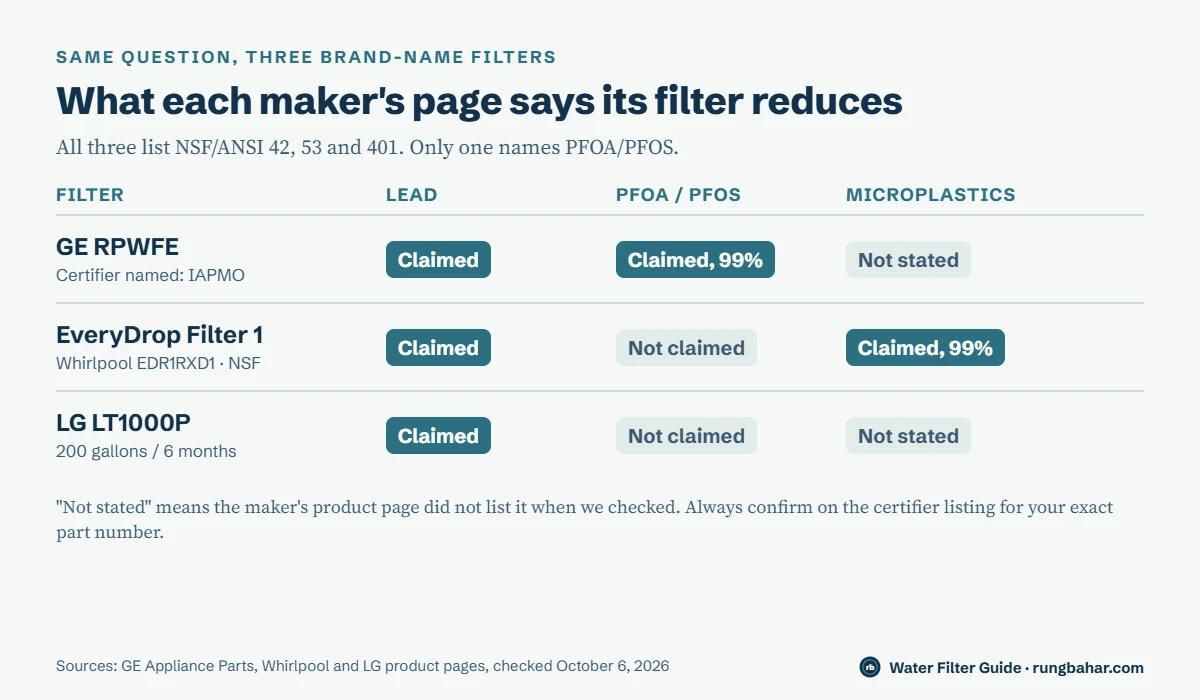
    Table comparing three refrigerator filters: GE RPWFE claims lead and 99% PFOA/PFOS; EveryDrop Filter 1 claims lead and 99% microplastics but not PFOA/PFOS; LG LT1000P claims lead but not PFOA/PFOS
    All three brand-name filters claim lead reduction; only the GE RPWFE page names PFOA/PFOS.

    Do refrigerator water filters remove PFAS?

    Some do, and you can prove it for a specific cartridge. Many do not carry a PFAS claim at all. That gap is the reason this question is so confusing: two filters that fit the same fridge, look the same and cost about the same can be certified for very different things.

    PFAS (per- and polyfluoroalkyl substances) are a large family of man-made chemicals. In April 2024 the EPA set drinking water limits of 4 parts per trillion each for the two best known, PFOA and PFOS. Home filters handle them in one of two ways: activated carbon, which grabs the molecules as water passes through, or reverse osmosis, which pushes water through a very tight membrane. A refrigerator filter is a small carbon cartridge, so it can reduce PFAS if the carbon and the design are right, but it is not a given.

    The proof is a certified claim. NSF/ANSI 53 includes a “PFOA/PFOS reduction” claim, and since a 2022 update the test requires a filter to bring PFOA and PFOS down to 20 parts per trillion combined. The same standard also has a “total PFAS” claim that adds PFHpA, PFHxS, PFNA and PFBS. We explain both in NSF 53 vs 58. If the listing for your cartridge shows neither claim, the maker has not proven a PFAS result for it.

    Independent testing points the same way. A 2020 Duke University and NC State study of home filters found that under-sink reverse osmosis and two-stage filters removed 94% or more of the PFAS measured, while activated carbon filters, the group that includes fridge, pitcher and faucet filters, removed 73% on average, with results that “varied greatly.” In other words, carbon can help, but you need the claim to know whether your cartridge is one of the good ones.

    Do refrigerator water filters remove lead?

    Many brand-name refrigerator filters are certified for lead. Of the three popular cartridges we checked, all three list lead reduction on the maker’s page. That is a better picture than PFAS, but it still is not universal, and it depends on the exact part number.

    The lead claim also lives in NSF/ANSI 53. Since December 2019, a filter must take challenge water containing 150 parts per billion (ppb) of lead and bring it to 5 ppb or less, tested at two pH levels, over the filter’s rated life. If your cartridge’s listing says “lead reduction” under NSF/ANSI 53 (or the same claim under NSF/ANSI 58 for reverse osmosis), it has passed that test.

    Two practical points matter for lead. First, use only cold water for drinking and cooking, because hot water pulls more lead from pipes and fixtures. Fridge water is cold by design, which helps. Second, a filter only works while it is within its rated capacity. Once it passes its gallon rating or its months, the lead claim no longer applies. If you are not sure whether your home has lead pipes, our ZIP code water check shows your water system’s latest lead results from EPA records.

    What three brand-name fridge filters claim

    To show how much claims vary, we read the product pages for three widely sold brand-name cartridges on October 6, 2026. All three list NSF/ANSI 42, 53 and 401. Their contaminant claims are not the same.

    FilterLeadPFOA/PFOSMicroplasticsOther notes
    GE RPWFEClaimedClaimed: “99% of PFOA/PFOS”Not stated on the page we read“Tested/Verified by independent laboratory (IAPMO)”; GE recommends replacing every 6 months
    Whirlpool EveryDrop Filter 1 (EDR1RXD1)ClaimedNot claimedClaimed: 99%Certified by NSF; “70 potentially harmful contaminants”; replace every 6 months
    LG LT1000PClaimedNot claimedNot stated on the page we readNSF 42, 53, 401; rated 200 gallons or 6 months

    This is not a ranking. It is an example of the pattern you will see across fridge filters: lead claims are common, PFAS claims are not, and a cartridge that is excellent for one thing may say nothing about another. If PFAS is the reason you are reading this, the cartridge’s listing has to name PFOA/PFOS or total PFAS. For the same fridge, a newer or different cartridge model may have a claim that an older one lacks, so check the part number you would actually buy.

    Makers also update cartridges. A filter sold under the same name a few years ago may have been certified for fewer contaminants. When a page and a listing disagree, trust the certifier’s listing, and note the date you checked.

    Which certifications matter for a fridge filter

    Fridge filters use the same standards as other drinking water filters. The number alone does not tell you what was tested, so read the claim listed under it. Our guide to water filter certifications covers every standard in detail.

    StandardWhat it coversWhat it means for a fridge filter
    NSF/ANSI 42Taste, odor, chlorine, particulatesBetter-tasting water and ice. No health claim, so no proof for lead or PFAS
    NSF/ANSI 53Health contaminants: lead, cysts, VOCs, PFOA/PFOS, total PFAS and moreThe one to read for lead and PFAS. Check which claims are listed
    NSF/ANSI 401Emerging contaminants such as some pharmaceuticals, plus microplasticsUseful extras. Not a lead or PFAS claim
    NSF/ANSI 372Low lead content in the product’s own partsAbout the plastic and metal parts, not what the filter removes
    NSF/ANSI 58Reverse osmosis systemsNot used for fridge cartridges, but relevant if you add an RO system

    Certification can come from NSF, IAPMO R&T, WQA, CSA Group or UL. The EPA lists all five as accredited certifiers for drinking water filters. A filter certified by IAPMO or WQA instead of NSF is just as valid; you simply search that certifier’s database. Our step-by-step guide on how to check if a water filter is really NSF certified shows where to look.

    Generic, “compatible” and counterfeit cartridges

    Brand-name fridge filters are not cheap, so many people buy cartridges sold as “compatible with” or “replacement for” a brand-name model. Some of these are certified in their own right and list real claims. Others carry no certification at all, and some are counterfeits that copy the brand’s packaging.

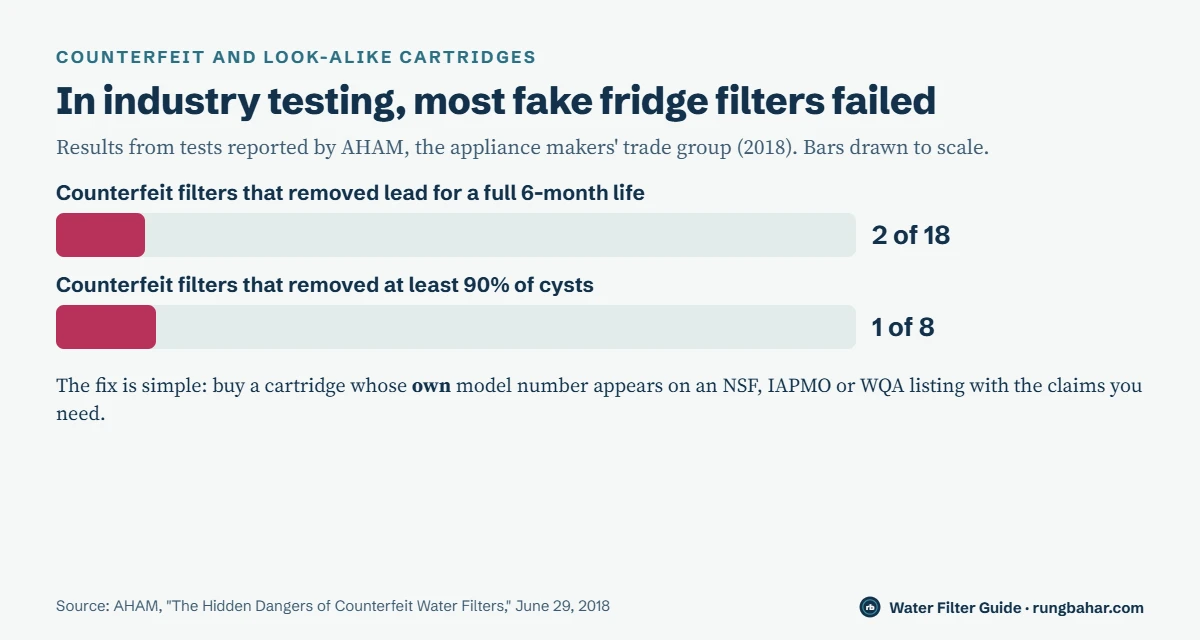
    Bar chart: only 2 of 18 counterfeit refrigerator filters removed lead for a full six-month life, and only 1 of 8 removed at least 90 percent of cysts, per AHAM testing
    In AHAM-reported testing, most counterfeit fridge filters failed lead and cyst tests.

    The risk is not theoretical. The Association of Home Appliance Manufacturers (AHAM) reported in 2018 that in lead testing, only 2 of 18 counterfeit filters removed lead for the full six-month refrigerator life, and that 7 of 8 failed to remove 90% of cysts. A separate extraction test on counterfeit filters found compounds leaching into the water above allowable levels. AHAM represents appliance makers, so it has a commercial interest here, but the tests were run with independent labs, and the lesson is the same either way.

    A “compatible” cartridge can still be a sound choice. The rule is that its own model number must appear on a certifier’s listing with the claims you need. Matching the brand-name filter’s shape, or quoting the brand-name filter’s certificate, is not proof. If you cannot find the cartridge’s own listing on NSF, IAPMO or WQA, assume it has no certified lead or PFAS claim.

    Warning signs on a listing page or box include a certification logo with no certifier name, wording like “meets NSF standards” or “tested to NSF standards” without a listing, and a price that looks too good for a cartridge sold as the brand-name part.

    What refrigerator filters do not remove

    People search for many contaminants alongside fridge filters. Here is what a typical carbon fridge cartridge does and does not do, based on how carbon filtration works and the claims these filters carry.

    • Chlorine: yes. Chlorine taste and odor reduction under NSF/ANSI 42 is the most common claim of all. Some cartridges also claim chloramine; check for that word if your utility uses it.
    • Fluoride: no. Carbon is not designed for fluoride. See water filters that remove fluoride for what does work.
    • Microplastics: some do. Look for a microplastics claim under NSF/ANSI 401, as on the EveryDrop Filter 1. Our microplastics filter guide explains the test.
    • Bacteria and viruses: no. Some cartridges are certified for cysts such as Giardia and Cryptosporidium, but that is not a bacteria or virus claim. A fridge filter is not a disinfection system.
    • Nitrate, sodium and minerals such as calcium: no. These are dissolved ions that carbon does not hold. Reverse osmosis or, for hardness, a softener is the usual answer.
    • Hardness and scale: no. A fridge filter will not soften water.

    If any of these is your main concern, start with your water rather than your fridge. What reverse osmosis removes covers fluoride, nitrate and minerals in one place.

    How often to change a refrigerator water filter

    Most brand-name makers say about every six months. GE and Whirlpool both recommend replacing their filters every six months with regular use, and LG rates the LT1000P at 200 gallons or six months. A household that uses a lot of fridge water can hit the gallon rating sooner.

    Timing matters more than many people think, because every certified claim is tied to the filter’s rated capacity. The EPA’s PFAS filter fact sheet warns that not replacing a filter on the maker’s schedule can increase your risk of exposure. A carbon cartridge that is full can stop removing contaminants, and the water still comes out of the door looking the same.

    A few habits help. Note the install date on the cartridge with a marker. Trust the fridge’s filter light, but know that many lights run on a timer, not on actual use. After installing a new cartridge, run and discard a few gallons, or follow the maker’s flushing instructions, to clear trapped air and loose carbon fines.

    How to check what your fridge filter removes

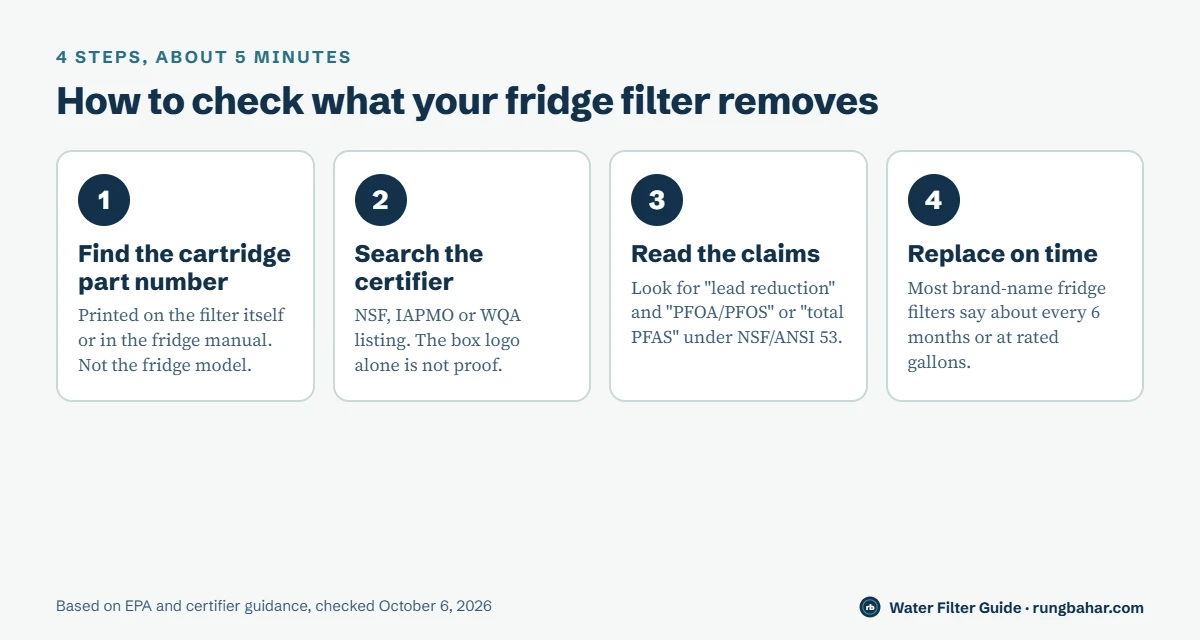
    Four steps to check a refrigerator filter: find the cartridge part number, search NSF, IAPMO or WQA, read the lead and PFOA/PFOS claims, replace about every six months
    Five minutes with the certifier listing tells you more than the box does.
    1. Find the cartridge part number. It is printed on the filter and in your fridge manual. Use the cartridge number, not the fridge model number.
    2. Search the certifier. Try NSF’s drinking water treatment listings first, then IAPMO and WQA. The box or product page often names which one certified it.
    3. Read the claims under NSF/ANSI 53. For lead, look for “lead reduction.” For PFAS, look for “PFOA/PFOS reduction” or “total PFAS reduction.” Write down the rated capacity.
    4. Compare with your water. Your annual water quality report and our ZIP code check tell you what your utility has found.

    This takes about five minutes and settles the question for your fridge better than any brand claim on a box.

    When a fridge filter is not enough

    A fridge filter is convenient, and for chlorine taste plus certified lead reduction it can be all many households need. It has limits. It treats only the water from the door and the ice maker, the flow is slow for filling pots, and the small cartridge has less carbon than an under-sink system.

    Consider a stronger option if your water report shows PFAS well above the EPA’s 4 parts per trillion limits, if you need fluoride, nitrate or arsenic removed, or if you want filtered water at the kitchen tap for cooking. The cards below sum up the usual next steps.

    Keep the fridge

    Certified replacement cartridge

    • Certification: NSF/ANSI 53 with lead and PFOA/PFOS or total PFAS on the cartridge’s own listing
    • Best for: Drinking water and ice for small households
    • Skip if: you need fluoride or nitrate removed

    Search certified cartridges

    More carbon, faster flow

    Under-sink carbon filter

    • Certification: NSF/ANSI 53 for lead and PFOA/PFOS or total PFAS
    • Best for: Filtered water at the kitchen tap for drinking and cooking
    • Skip if: you rent and cannot change plumbing

    See certified listings

    Widest coverage

    Reverse osmosis system

    • Certification: NSF/ANSI 58 with PFAS, lead and fluoride named
    • Best for: High PFAS results, fluoride, nitrate or arsenic
    • Skip if: you have no space under the sink or mind some wastewater

    What RO removes

    Some RO systems can also feed the fridge line, so you get the same water at the tap and in the door. If you are not sure which type fits your home, our water filter buying guide walks through it in five steps, or use the 15-second filter finder.

    Fridge filters: 14 common questions

    Short answers to what people search most, based on certifier listings, maker pages and EPA guidance checked October 6, 2026.

    Does a refrigerator water filter remove PFAS?

    Only if the cartridge is certified for it. Look for “PFOA/PFOS reduction” or “total PFAS reduction” under NSF/ANSI 53 on its listing. Many fridge filters have no PFAS claim.

    Does a refrigerator water filter remove lead?

    Many brand-name cartridges are certified for lead under NSF/ANSI 53, which requires cutting 150 ppb to 5 ppb or less. Check your exact part number.

    Does the GE RPWFE filter remove PFAS?

    GE’s product page says the RPWFE is certified to reduce 99% of PFOA/PFOS, tested by IAPMO to NSF/ANSI 42, 53, 401 and P473 (checked October 6, 2026).

    Does the EveryDrop Filter 1 remove PFAS?

    Whirlpool’s page lists lead, mercury, VOCs and 99% of microplastics, but not PFOA/PFOS (checked October 6, 2026).

    Does a refrigerator water filter remove microplastics?

    Some do. Look for a microplastics claim under NSF/ANSI 401. EveryDrop Filter 1 lists 99% microplastics reduction.

    Does a refrigerator water filter remove fluoride?

    No. Fridge filters are carbon based and are not designed for fluoride. Reverse osmosis certified for fluoride reduction is the usual option.

    Does a refrigerator water filter remove bacteria?

    No. Some are certified for cysts such as Giardia, but not for bacteria or viruses. Follow any boil notice from your utility.

    Does a fridge filter remove chlorine?

    Yes, almost all do. Chlorine taste and odor reduction under NSF/ANSI 42 is the most common fridge filter claim.

    Does a refrigerator filter remove nitrates, sodium or minerals?

    No. Those are dissolved ions that carbon does not capture. Reverse osmosis can reduce them; a softener handles hardness.

    How often should I change my fridge water filter?

    Most makers say about every six months, or sooner if you reach the rated gallons. LG rates the LT1000P at 200 gallons or six months.

    Are generic fridge filters safe?

    Some are certified and fine. The cartridge’s own model number must appear on an NSF, IAPMO or WQA listing with the claims you need.

    Is fridge filter water safer than tap water?

    It can be, for the contaminants its cartridge is certified to reduce. It does nothing for contaminants outside its claims.

    What happens if I use the bypass plug?

    The water and ice are not filtered at all. They come straight from your pipes, just chilled.

    Is a fridge filter enough for PFAS?

    If its listing has a PFAS claim and your levels are modest, it can help. For high results, an under-sink RO system is a stronger option.

    Sources and how we checked this page

    Facts on this page come from manufacturer product pages, EPA guidance, the Association of Home Appliance Manufacturers and peer-reviewed research, checked on October 6, 2026. We do not test filters in a lab. Product examples are not a ranking or an endorsement.