Updated October 20, 2026, by the RB Water Desk. How we research.
The short answer: City water is treated, tested and regulated under the Safe Drinking Water Act, and your utility has to publish the results every year. Well water is often excellent, but nobody regulates or tests it except you: about 43 million Americans rely on private wells, and USGS sampling found more than 1 in 5 wells had at least one contaminant above a health benchmark. Neither is automatically safer. With city water, the usual issues are chlorine taste, lead from old pipes and PFAS. With a well, test every year for bacteria, nitrate, pH and dissolved solids, then treat what the results show.
Well water vs city water: the main differences
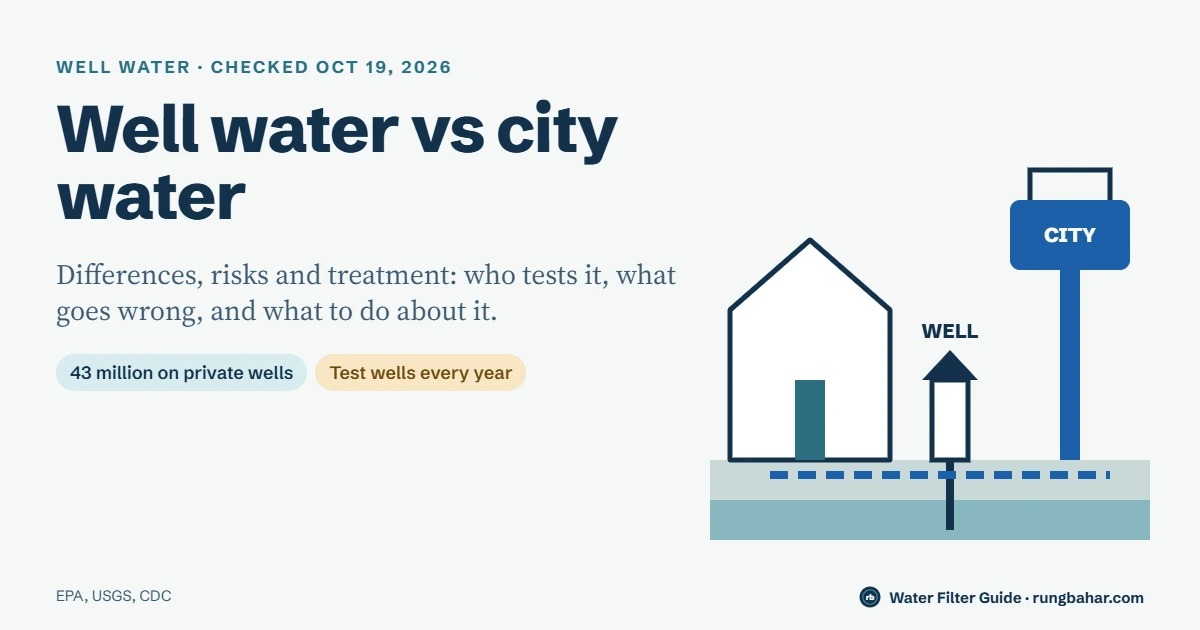
About 15 percent of people in the US, more than 43 million, get their drinking water from a private well, according to the EPA and USGS. Almost everyone else is served by one of more than 148,000 public water systems, which the EPA says provide drinking water to about 90 percent of Americans. The water can come from the same aquifer. What differs is who treats it, who tests it and who answers for it.
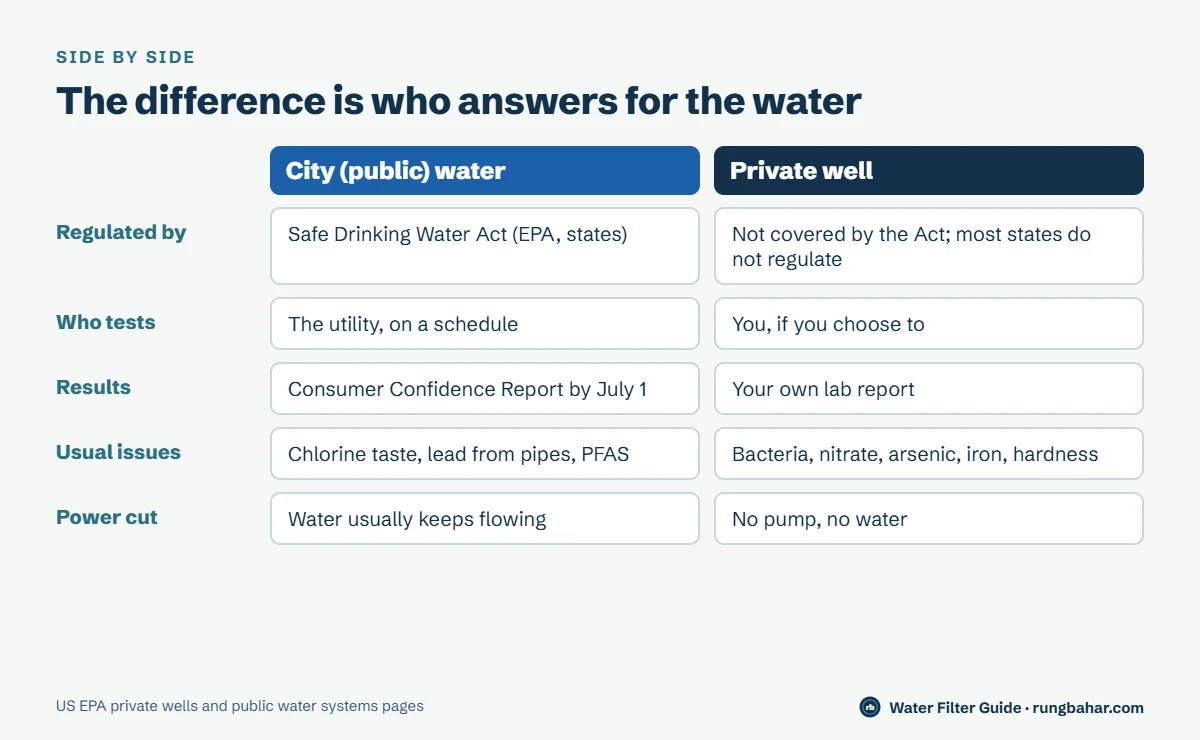
| City (public) water | Private well | |
|---|---|---|
| Regulated by | EPA rules under the Safe Drinking Water Act, enforced mostly by states | Not covered by the Safe Drinking Water Act; most states do not regulate it either |
| Who tests it | The utility, on a set schedule, for more than 90 regulated contaminants | You, when you choose to |
| Treatment | Disinfection (chlorine or chloramine) plus whatever the source needs | None unless you install it |
| Results you can read | Annual Consumer Confidence Report by July 1 | Your own lab report |
| Typical issues | Chlorine taste, disinfection byproducts, lead from old pipes, PFAS | Bacteria, nitrate, arsenic, radon, uranium, iron, manganese, hardness |
| What you pay | A water bill (EPA: the average family spends more than $1,000 a year) | Electricity for the pump, testing, maintenance and any treatment |
| If the power goes out | Water usually keeps flowing | No pump, no water, unless you have a backup |
Read the table by row. The big difference is not purity, it is accountability. A utility that breaks a limit has to tell customers and fix it. A well that develops a problem can go unnoticed for years, because nothing about most contaminants shows in the glass.
Who is responsible for your water
The EPA regulates public water systems: any system with at least 15 connections or that regularly serves at least 25 people. Those systems must meet limits for more than 90 contaminants, monitor on a schedule and send every customer an annual water quality report, the Consumer Confidence Report, each year by July 1. If your home is on city water, that report is the first thing to read, and our water filter buying guide shows how to turn it into a decision.
Private wells are different. The EPA’s private well page is blunt: private wells are not regulated under the Safe Drinking Water Act, most states do not regulate them either, and “private well owners are responsible for delivering safe drinking water to their households.” Some states and counties add their own rules for new wells, such as minimum distances from septic systems. North Carolina, for example, requires at least 100 feet between a well and a septic system, with exceptions down to 50 feet on restricted lots. Rules vary, so check with your county or state health department.
That responsibility is not as heavy as it sounds. It comes down to an annual test, a quick spring inspection of the wellhead, and acting on what the test shows.
What can go wrong with well water
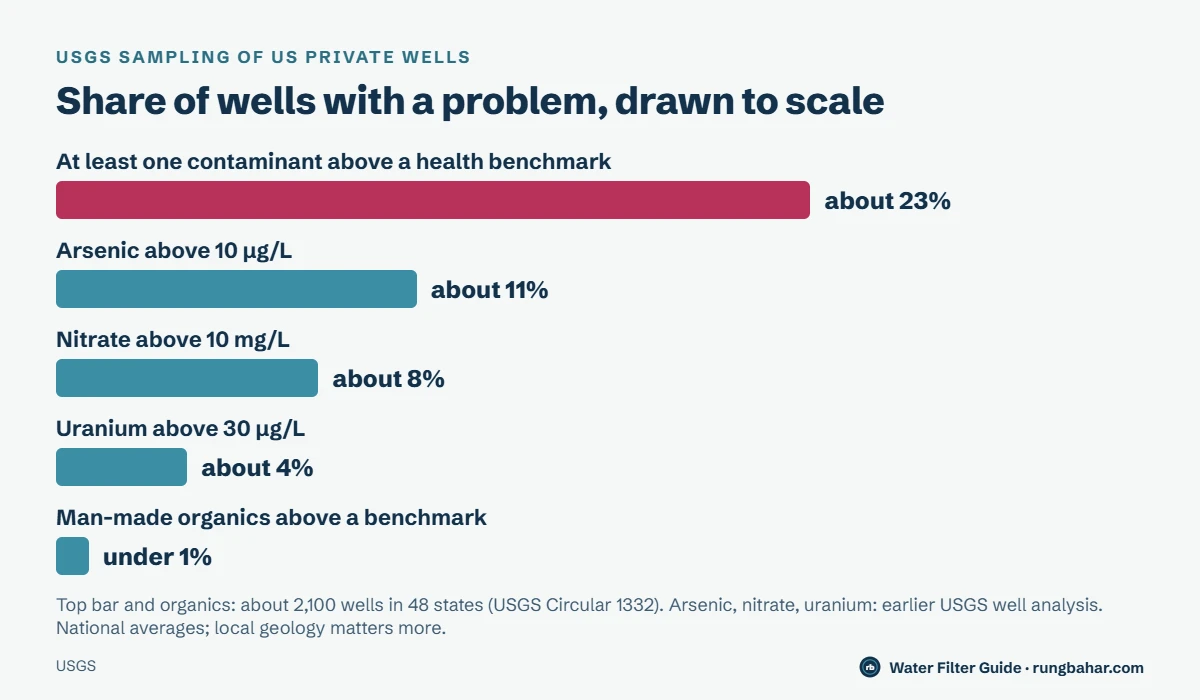
Most well problems come from the ground itself, not from pollution. The USGS sampled about 2,100 domestic wells in 48 states and found that about 23 percent had at least one contaminant above a human-health benchmark, mostly naturally occurring inorganic chemicals. Man-made organic compounds were detected in 60 percent of wells but were above benchmarks in fewer than 1 percent. Microbial contaminants were found in up to a third of the roughly 400 wells tested for them.
An earlier USGS analysis of well data broke down a few of the big ones: arsenic above 10 micrograms per liter (the EPA limit) in about 11 percent of wells, nitrate above 10 milligrams per liter in about 8 percent, and uranium above 30 micrograms per liter in about 4 percent. These are national figures from older sampling; your local geology matters far more than the average.
| Contaminant | EPA limit or guideline | Common source | What you notice |
|---|---|---|---|
| Coliform bacteria / E. coli | None allowed (E. coli) | Septic systems, animal waste, a cracked well cap | Usually nothing |
| Nitrate | 10 mg/L (as nitrogen) | Fertilizer, septic, manure | Nothing |
| Arsenic | 0.010 mg/L (10 ppb) | Natural rock | Nothing |
| Uranium / radium | 30 µg/L / 5 pCi/L | Natural rock | Nothing |
| Lead | Action level 0.015 mg/L (0.010 from Nov 2027) | Plumbing, especially with acidic water | Nothing; sometimes blue-green stains from copper |
| Iron | 0.3 mg/L (aesthetic) | Natural | Orange stains, metallic taste |
| Manganese | 0.05 mg/L aesthetic; 0.3 mg/L health advisory | Natural | Black or brown stains |
| Hardness | No federal limit | Limestone and similar rock | Scale, spotty dishes |
The pattern is worth noticing: the contaminants with health limits are mostly invisible, while the ones you can see and taste (iron, manganese, hardness, sulfur smell) are mostly nuisance issues. A well that tastes perfect can still fail a nitrate or arsenic test. Our guide to well water test results explains each line on a lab report.
What can go wrong with city water
City water is held to legal limits, but meeting the limits at the treatment plant does not guarantee perfect water at your tap. Three issues come up most:
- Lead from pipes. Treatment plants do not add lead; it leaches from lead service lines, old solder and some fixtures between the main and your faucet. The EPA’s Lead and Copper Rule Improvements, finalized in October 2024, require utilities to replace lead and certain galvanized service lines within 10 years of the November 2027 compliance date and lower the lead action level to 10 parts per billion. Until your line is replaced, a filter certified to NSF/ANSI 53 for lead is the practical step; see lead in tap water and filters for lead pipes.
- Disinfectant and byproducts. Utilities keep chlorine or chloramine in the pipes to stop germs regrowing, up to a maximum of 4 milligrams per liter. Disinfection also forms byproducts, which are regulated (80 micrograms per liter for total trihalomethanes and 60 for five haloacetic acids). A carbon filter handles the taste; chloramine needs a filter certified for chloramine.
- PFAS. The EPA set limits of 4 parts per trillion each for PFOA and PFOS in April 2024, and those limits remain in force. In May 2026 the EPA proposed giving some systems until 2031 to comply and rescinding the limits for four other PFAS; as of the EPA’s October 8, 2026 page update, those proposals were not final. Your system’s 2023–2025 PFAS results are public, and PFAS in tap water shows how to look them up.
The difference from a well is that each of these is tracked, reported and has a deadline attached. On city water you can usually find your numbers in ten minutes with our ZIP code water check.
Is well water safe to drink?
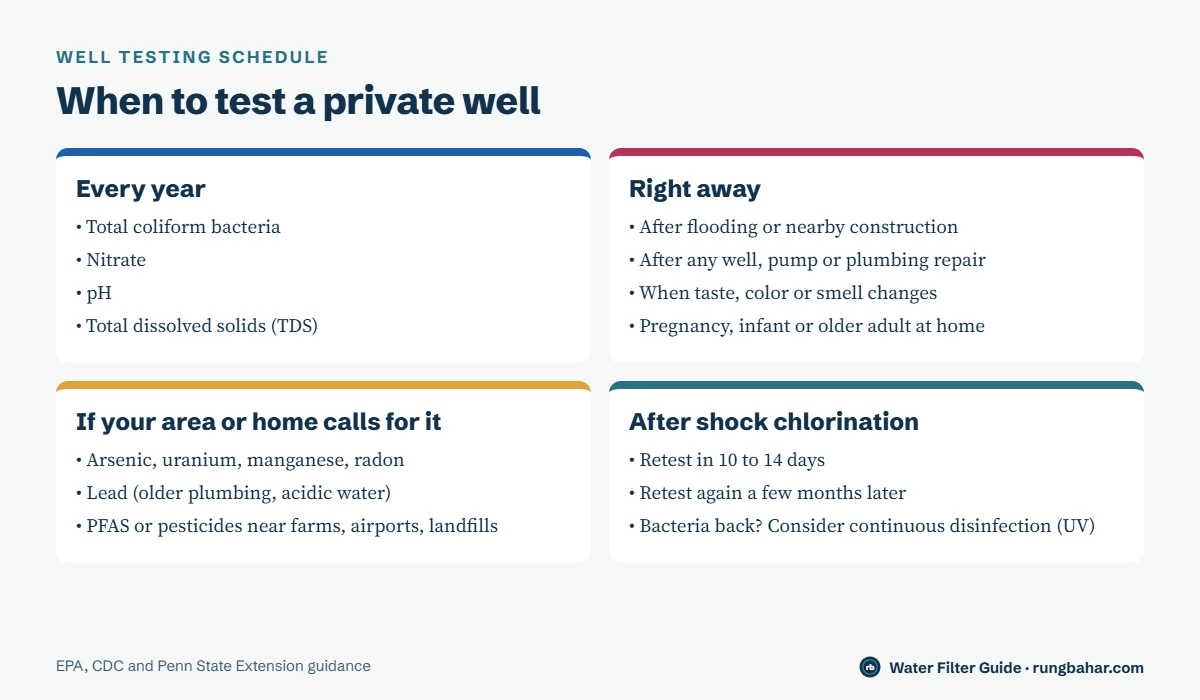
Usually, if you test it and act on the results. Many wells produce water that meets every drinking water limit with no treatment at all. The problem is that you cannot tell which kind of well you have by looking at it, smelling it or tasting it. The EPA and CDC both advise testing a private well at least once a year for total coliform bacteria, nitrates, total dissolved solids and pH.
Test sooner, and more often, in these situations, which both agencies list:
- After flooding, or after nearby construction or land disturbance.
- After any repair to the well, pump or plumbing.
- When the water’s taste, color or smell changes.
- When someone in the home is pregnant or nursing, or an infant, child or older adult lives there.
- When there are known problems nearby, such as septic failures, farms or waste sites.
Babies need extra care. CDC’s toxic substances agency says infants under 4 months are most at risk from nitrate, especially those fed formula diluted with water from untested rural wells. Boiling does not help: it removes no nitrate and, as water evaporates, leaves it more concentrated. Bacteria are the one problem boiling does fix, which is why health departments issue boil notices; it is a short-term measure, not treatment. Our page on what boiling does and does not remove covers the details.
How to test well water, and what it costs
Use a state-certified laboratory. Your state or county health department can name one, and some offer free or subsidized testing. Penn State Extension warns against relying on results from uncertified labs or from companies selling treatment equipment. The EPA’s Safe Drinking Water Hotline (800-426-4791) can also point you to certified labs.
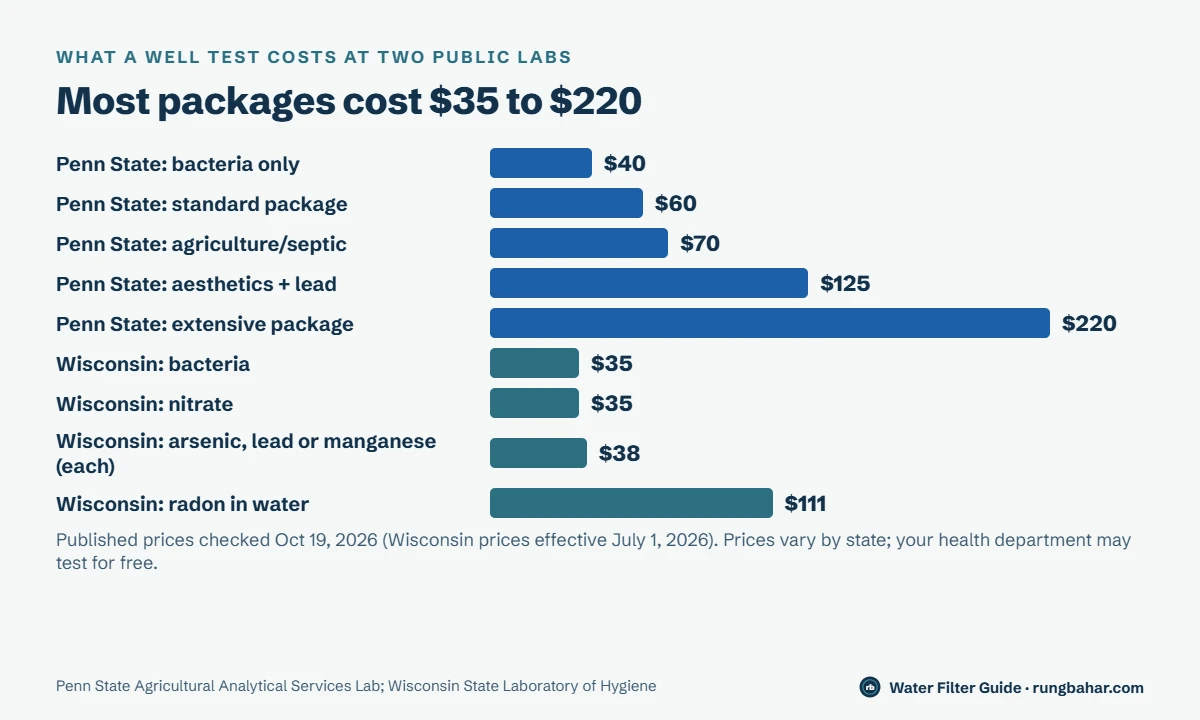
Prices from two public labs show the range. Penn State’s Agricultural Analytical Services Lab lists a bacteria-only test at $40, a standard package at $60, an agriculture or septic package at $70, an aesthetics and corrosivity package with lead at $125 and an extensive package at $220. The Wisconsin State Laboratory of Hygiene charges $35 each for bacteria and nitrate, $38 each for arsenic, lead or manganese and $111 for radon in water (prices effective July 1, 2026). Prices change and vary by state, so treat these as a guide.
What to order depends on where you live. Start with bacteria, nitrate, pH and TDS every year. Add arsenic, uranium, manganese or radon if your state or county flags them, a lead test if your home has older plumbing or acidic water, and pesticides or PFAS if you are near farms, airports, landfills or industrial sites. Penn State suggests coliform bacteria every year and pH and TDS every three years once you have a stable baseline; the EPA and CDC recommend all four yearly. Follow the lab’s sampling instructions exactly, especially for bacteria, which need a sterile bottle and delivery within a set time.
Treatment: matching the fix to the problem
Buy treatment for what your test found, not for what a salesperson suspects. Each problem has a usual fix and a certification to look for.
| Problem | Usual fix | Certification to look for |
|---|---|---|
| Bacteria (well) | Shock chlorination first; UV or continuous chlorination if it returns | NSF/ANSI 55 Class A for UV |
| Nitrate | Reverse osmosis, ion exchange or distillation | NSF/ANSI 58 nitrate claim (RO) |
| Arsenic | Reverse osmosis (often over 95 percent at the tap), activated alumina | NSF/ANSI 58 arsenic claim |
| Iron and manganese | Softener for low levels; greensand or oxidation and filtration for higher ones | NSF/ANSI 44 (softeners) |
| Hardness | Water softener | NSF/ANSI 44 |
| Sediment | Cartridge or multimedia filter | Check rated micron size |
| Low pH, lead from plumbing | Acid-neutralizing filter or soda ash feed; replace lead plumbing | NSF/ANSI 53 lead claim for a drinking water filter |
| Chlorine taste (city) | Activated carbon | NSF/ANSI 42 |
| Lead or PFAS (city or well) | Certified carbon filter or reverse osmosis | NSF/ANSI 53 or 58 with the claim named |
Two details trip people up. First, shock chlorination does not always solve a bacteria problem: Penn State found it fixed only about 15 percent of coliform-positive wells when combined with a sanitary cap, because the source of contamination often remains. Retest 10 to 14 days later and again a few months on. If bacteria return, continuous disinfection is the answer; our guide do I need a UV system for my well? covers when UV works and when it does not. Second, UV needs clear water. Penn State advises against it above 1,000 total coliform or 100 fecal coliform per 100 milliliters, and it needs a sediment prefilter and a new lamp every year.
For hardness, our guide to hard water vs soft water explains the numbers, and water softener vs water filter shows why one rarely replaces the other. For nitrate, arsenic or high dissolved solids, see what reverse osmosis removes.
Step 1 on any well
State-certified lab test
- Certification: Lab certified by your state for drinking water
- Best for: every well, every year: bacteria, nitrate, pH, TDS
- Skip if: never; a home test strip is not a substitute
Bacteria that keeps coming back
UV disinfection system
- Certification: NSF/ANSI 55 Class A
- Best for: wells with recurring coliform after shock chlorination
- Skip if: water is cloudy, high in iron or very high in bacteria
Nitrate, arsenic, PFAS
Under-sink reverse osmosis
- Certification: NSF/ANSI 58 with your contaminants named
- Best for: drinking and cooking water with several dissolved problems
- Skip if: the only issue is bacteria (RO is not a disinfection system)
Running costs compared
City water arrives with a bill. The EPA’s WaterSense program says the average family spends more than $1,000 a year on water costs, and each American uses about 82 gallons a day at home. Some of that bill is sewer service, which a home on a well usually handles with a septic system instead.
A well has no water bill, but it has costs that are easy to overlook: electricity for the pump, an annual lab test (roughly $35 to $220 depending on what you order, from the public-lab prices above), occasional repairs, and any treatment equipment with its filters, salt or UV lamps. The septic system also needs pumping on the schedule your local health department recommends, which protects the well as well as the drain field. Because treatment depends entirely on what is in the water, a well with clean water can be very cheap to run, and one with arsenic or bacteria can cost more than a water bill.
People sometimes ask whether to connect to city water when a main reaches their road. There is no national price to quote, because tap fees and the cost of running a line to the house vary widely by town. For serious, expensive-to-treat problems, Penn State Extension notes that connecting to public water may be the economically better choice. Ask your utility for the connection cost and compare it with several years of treatment and testing.
Taste, skin and hair
Much of what people notice when they move between well and city water is not safety at all. City water often tastes or smells of chlorine, which a carbon filter certified to NSF/ANSI 42 removes. Well water often tastes of its minerals: some people love it, others find it metallic (iron) or notice a rotten-egg smell (hydrogen sulfide).
Dry skin, dull hair and soap that will not lather are usually blamed on hardness, and hardness is about the rock the water passed through, not whether it came from a well or a utility. Many city supplies are hard too. Test your hardness (many labs include it, and inexpensive test strips are fine for this nuisance measure) before buying a softener. There is no federal health limit for hardness; it is mainly a plumbing and comfort issue.
Which is better for you?
Neither, by default. City water is the lower-effort option: someone else treats, tests and reports, and you only need to read the annual report and deal with what happens inside your own pipes. Well water can be just as good or better, with no chlorine and no bill, if you commit to yearly testing and treat what you find.
- On a well: test this year with a certified lab, keep the wellhead capped and clear, retest yearly and after floods or repairs, and choose treatment from the results.
- On city water: read your Consumer Confidence Report, check whether you have a lead service line, look up your PFAS results, and filter for the specific issues you find.
- Either way: buy filters by certification for your contaminant, not by brand. The 15-second filter finder suggests a filter type for your situation.
Well water vs city water: 15 common questions, answered
Short answers to what people search most, based on EPA, CDC, USGS and state extension sources checked October 19, 2026.
Is well water better than city water?
Not automatically. Well water can be excellent and has no chlorine or bill, but it is untested unless you test it. City water is treated and monitored for more than 90 contaminants. The better choice is the one whose test results you know.
What are the pros and cons of well water vs city water?
Well pros: no water bill, no added chlorine, independence. Well cons: you handle testing, treatment and pump repairs, and no water in a power cut. City pros: treatment and monitoring done for you. City cons: a monthly bill, chlorine taste, and possible lead from old pipes.
Is well water safe to drink?
Often, but only a test can tell you. USGS sampling found about 1 in 5 private wells had at least one contaminant above a health benchmark. EPA and CDC advise testing every year for bacteria, nitrate, pH and dissolved solids.
Is well water safe to drink after boiling?
Boiling kills bacteria and viruses, but it does not remove nitrate, arsenic, lead or PFAS, and it concentrates nitrate as water evaporates. Use it for a short-term bacteria problem, not as treatment.
Is well water safe during pregnancy or for babies?
Test it first. CDC says infants under 4 months fed formula made with untested well water are most at risk from nitrate. EPA and CDC advise more frequent testing when someone is pregnant or an infant lives in the home.
How often should you test well water?
At least once a year for total coliform bacteria, nitrates, total dissolved solids and pH, according to EPA and CDC, and right away after flooding, repairs or a change in taste, color or smell.
How much does well water testing cost?
Public labs charge roughly $35 to $220 depending on the package. Penn State’s lab lists $40 for bacteria only and $220 for its extensive package; Wisconsin’s state lab charges $35 each for bacteria and nitrate.
Where can I get my well water tested?
At a state-certified laboratory. Your state or county health department lists them, and some offer free testing. The EPA Safe Drinking Water Hotline, 800-426-4791, can also help.
Do I need a filtration system for well water?
Only for what your test finds. Bacteria call for disinfection, nitrate and arsenic for reverse osmosis, iron and hardness for a softener or iron filter. Many wells need nothing.
Is a UV light enough for well water?
UV certified to NSF/ANSI 55 Class A kills bacteria, viruses and cysts, but it does nothing for nitrate, arsenic or metals, needs clear water and a sediment prefilter, and its lamp must be replaced yearly.
Does city water have chemicals in it?
Yes, by design: chlorine or chloramine is kept in the pipes to stop germs, up to 4 mg/L. Disinfection byproducts and PFAS are regulated. Your annual water quality report lists what was found.
Is city water or well water better for skin and hair?
The difference people notice is usually hardness, which depends on local rock, not the water source. Both well and city water can be hard. A softener addresses hardness; a carbon filter addresses chlorine.
Which tastes better, well water or city water?
It is personal. City water can taste of chlorine; well water tastes of its minerals and sometimes of iron or sulfur. Carbon filters fix chlorine taste; iron and sulfur need specific well treatment.
Is well water safe for dogs and other pets?
There is no separate pet standard. If a test shows your water is unsafe for people, for example from bacteria or nitrate, do not give it to pets either, and ask your vet about specific concerns.
Can I switch from well water to city water?
Sometimes, if a public main runs near your property. Ask your utility about connection fees and your health department about decommissioning the well properly.
Sources and how we checked this page
Every fact on this page comes from US government agencies, state extension services and public laboratories, checked on October 19, 2026. Lab prices are the labs’ published prices and change over time. We do not test water ourselves, and this page is not medical advice.
- US EPA: Private drinking water wells
- US EPA: Protect your home’s water (private wells)
- USGS: Domestic (private) supply wells
- USGS Circular 1332: Quality of water from domestic wells (2009)
- USGS: Chemical quality of self-supplied domestic well water in the United States
- US EPA: National primary drinking water regulations
- US EPA: Consumer Confidence Report information for consumers
- US EPA: PFAS national primary drinking water regulation
- US EPA: Proposed PFAS rescission rule
- Federal Register: Lead and Copper Rule Improvements (Oct 30, 2024)
- CDC: Testing private well water
- CDC/ATSDR: Nitrate/nitrite toxicity, who is at risk
- Penn State Extension: Testing your drinking water
- Penn State Extension: Coliform bacteria in drinking water
- Penn State Extension: Nitrates in drinking water
- Penn State Extension: Iron and manganese in private water systems
- Penn State Extension: Removal of arsenic from wells
- Penn State Extension: Common drinking water problems and solutions
- Penn State Agricultural Analytical Services Lab: Drinking water testing prices
- Wisconsin State Laboratory of Hygiene: Water testing prices
- US EPA WaterSense: Statistics and facts
- NC DHHS: Private wells frequently asked questions (PDF)
- NSF: Standards for water treatment systems