Updated October 17, 2026, by the RB Water Desk. How we research.
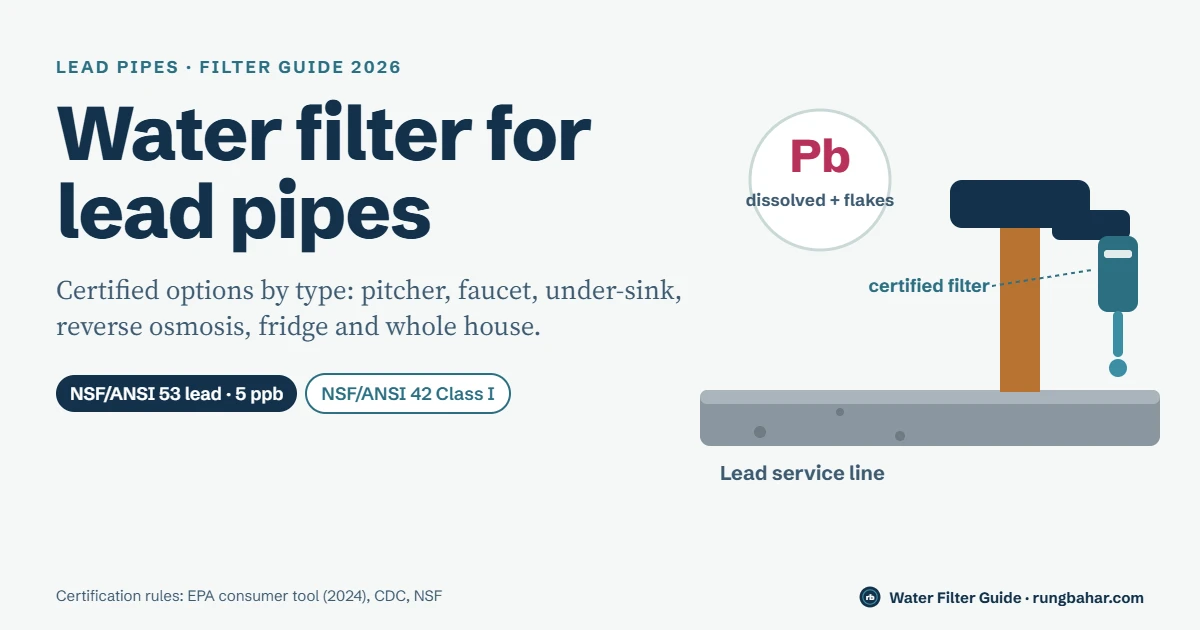
The short answer: A water filter for lead pipes has to be certified to NSF/ANSI 53 for lead (tested at 150 parts per billion in, 5 ppb or less out) and, as EPA and CDC advise, to NSF/ANSI 42 for Class I particulate, because lead pipes shed both dissolved lead and tiny lead flakes. A certified pitcher or faucet filter covers drinking and cooking water for the least money and effort. An under-sink filter suits a family that uses a lot of kitchen water, and a reverse osmosis system makes sense only if its data sheet lists a lead claim (and a copper claim if you have copper pipes). Whole-house lead filters exist but are rare and are not a substitute for a filtered kitchen tap.
Quick pick
Where do you need lead-safe water most?
What makes a filter a lead filter
Lead does not come from the water treatment plant. It dissolves or breaks off from the pipes between the water main and your glass: a lead service line, lead solder on copper pipes, or older brass faucets and fittings. That is why one home on a street can have lead and the next one does not, and why the level can jump after the water sits in the pipes overnight. Our guide to lead in tap water, from signs to testing covers where it comes from and how to test; this page is about choosing the filter.
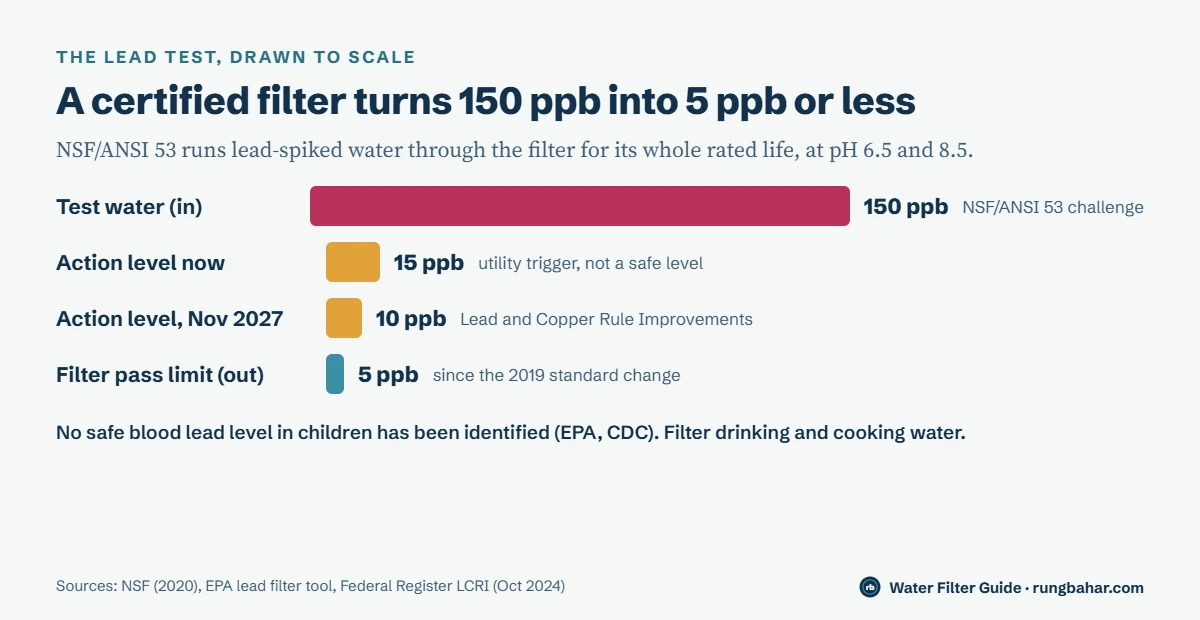
Lead pipes shed lead in two forms. Some is dissolved. Some is particulate: small flakes and grains of lead scale that break loose, especially when pipes are disturbed by street work or plumbing repairs. A good lead filter has to stop both. The EPA and CDC therefore ask for two certifications on the same product:
- NSF/ANSI 53, lead reduction. The test runs water spiked with 150 ppb of lead through the filter for its whole rated life. Since a 2019 change to the standard, the filtered water must stay at 5 ppb or less (it used to be 10 ppb). The test is run at two pH levels; at pH 8.5, about 30 percent of the lead in the test water is particulate.
- NSF/ANSI 42, Class I particulate reduction. This shows the filter traps very fine particles, the size range that can carry lead flakes.
- An accredited certifier. NSF, WQA, IAPMO R&T, UL or CSA. EPA’s consumer tool lists the directories where you can look the product up.
Reverse osmosis systems are tested under a different standard, NSF/ANSI 58, and the lead claim is optional there. A system can carry an “NSF 58” badge for reducing total dissolved solids without ever being tested for lead. More on that trap below, and on the standards themselves in NSF 53 vs 58 explained.
Certified options by type
Every option below can be a lead filter if the specific model is certified. The table compares the types and gives one example for each that we checked against the maker’s performance data sheet or product page on October 17, 2026. We have not tested any of these products ourselves, and we have no commercial relationship with any brand on this page. The types are listed roughly from the smallest up-front cost and effort to the largest; we do not quote prices because they change too often to stay accurate.
| Type | Example checked | Lead certification | Filter life | Good fit |
|---|---|---|---|---|
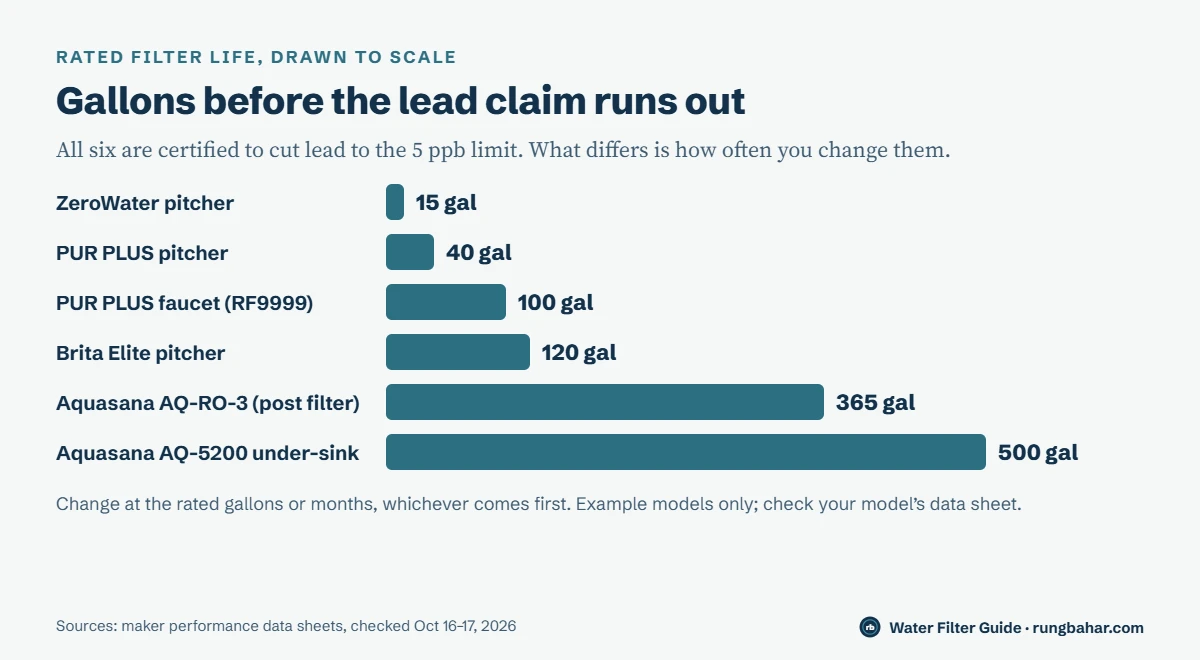
| Pitcher | Brita Elite, PUR PLUS, ZeroWater | NSF/ANSI 53 lead, 5 ppb limit | 15 to 120 gallons | 1 to 2 people, renters |
| Faucet-mount | PUR PLUS faucet filter (RF9999) | IAPMO R&T: NSF/ANSI 42, 53, 401; lead 99.70% / 99.60% | 100 gallons | Renters, steady daily use |
| Under-sink filter | Aquasana AQ-5200 | WQA: NSF/ANSI 42, 53, 401; lead to 5 ppb | 500 gallons | Families, heavy cooking |
| Reverse osmosis | Aquasana AQ-RO-3 | WQA: NSF/ANSI 42, 53, 58, 401; lead >99.4% / >99.3%, copper 96.6% | 365 gallons (post filter) | Lead plus copper, PFAS, nitrate |
| Fridge filter | Whirlpool EveryDrop Filter 1 (EDR1RXD1) | NSF: NSF/ANSI 42, 53, 401; lead listed | 6 months | Homes that drink from the fridge |
| Whole house | Pentair LR-BB50 | NSF: NSF/ANSI 53 lead; 98.8% / 99.9% | 4 to 5 months | Rare cases; still filter the kitchen |
The two lead percentages in the table are the results at pH 6.5 and pH 8.5. Every certified product has to meet the same 5 ppb limit, so a filter with 99.7 percent is not meaningfully “safer” than one with 98.8 percent; both passed. What separates them is how much water they handle before you change them, what else they remove and how they fit your kitchen.
Pitchers and faucet filters: the simplest start
For most households with lead pipes, a certified pitcher or faucet filter is the right first step. Lead matters in the water you drink and cook with, which is a few gallons a day at most. Neither option needs a plumber, and both go with you if you move.
Pitchers. Three pitcher filter families on US shelves carry an NSF/ANSI 53 lead claim to the 5 ppb limit: the Brita Elite (120 gallons, about 6 months), the PUR PLUS (40 gallons) and ZeroWater (15 or 20 gallons). The basic Brita Standard and blue PUR filters are not certified for lead, which catches many buyers. Our comparison of pitchers certified for lead has the data-sheet details and filter counts per year.
Faucet-mount filters. A faucet filter screws onto the end of your kitchen faucet and has a lever to switch between filtered and unfiltered water. The PUR PLUS replacement filter (RF9999 or RF3375) is certified by IAPMO R&T to NSF/ANSI 42, 53 and 401. Its data sheet lists 99.70 percent lead reduction at pH 6.5 and 99.60 percent at pH 8.5, against 0.15 mg/L (150 ppb) in and 0.005 mg/L (5 ppb) allowed out. It also carries total PFAS (99.92 percent) and microplastics (99.65 percent) claims. It is rated for 100 gallons, flows at about half a gallon per minute and must not be used with water above 82°F, so keep the lever on unfiltered for hot water. The sheet lists the compatible PUR faucet units, such as the PFM400H and FM2000B.
Faucet filters do not fit pull-down or pull-out sprayer faucets, and some do not fit faucets with unusual threads. If yours will not take one, a pitcher is the fallback. People who ask whether PUR filters remove lead often miss that PUR sells several filter lines, and only the certified ones carry the lead claim.
Under-sink filters: filtered water at a separate tap
An under-sink filter connects to the cold water line inside the cabinet and feeds a small dedicated faucet on the sink. It handles far more water than a pitcher, delivers it at a normal faucet pace and only needs a cartridge change once or twice a year in a typical home. It is the step up for families who cook a lot, fill pots and kettles from the tap or mix baby formula daily.
The Aquasana AQ-5200 is a common example. Its performance data sheet says it is tested and certified by WQA to NSF/ANSI 42, 53 and 401, with lead reduction passing the 5 µg/L (5 ppb) limit at both pH levels, PFOA/PFOS reduction of 95.2 percent and a rated capacity of 500 gallons. Brands often sell several similar models with different certifications, which is why you read the data sheet for the precise model you are buying rather than the brand’s general claims.
Before you buy, check three things: there is room in the cabinet for the housing, there is a spare hole in the sink or countertop for the extra faucet (or you are willing to drill one), and you can reach the shut-off valve. Most under-sink filters are a do-it-yourself job with basic tools; renters should ask the landlord first.
Reverse osmosis: for lead and copper together
Homes with lead service lines often also have copper indoor plumbing, and corrosive water can carry both metals. The federal action level for copper is 1.3 mg/L. A carbon filter certified under NSF/ANSI 53 is not tested for copper; copper reduction is a claim made under NSF/ANSI 58, the reverse osmosis standard. If copper is a concern (for example, blue-green stains on fixtures or a copper result above the action level), a reverse osmosis system with both claims is the tool that matches the problem.
The Aquasana AQ-RO-3 is an example with both claims on one sheet. It is certified by WQA to NSF/ANSI 42, 53, 58 and 401. The data sheet lists lead reduction above 99.4 percent at pH 6.5 and above 99.3 percent at pH 8.5 against the 5 ppb limit, copper reduction of 96.6 percent, PFOA and PFOS reduction of 96 percent and total dissolved solids reduction of 95 percent. It produces about 13 gallons a day, and its post filter is rated for 365 gallons.
Reverse osmosis also removes much of the fluoride, nitrate and arsenic in water, along with most minerals. It wastes some water down the drain and needs more cabinet space than a simple filter. Our guide to what reverse osmosis removes covers those trade-offs. If lead is your only concern, an NSF/ANSI 53 filter is simpler.
Fridge filters and whole-house filters
Refrigerator filters
Many households drink most of their water from the fridge dispenser, so its filter matters. Many fridge filters are certified only for chlorine taste and odor under NSF/ANSI 42. Some are certified for lead. Whirlpool’s product page for the EveryDrop Filter 1 (EDR1RXD1) lists lead among its reductions under NSF/ANSI 42, 53 and 401, certified by NSF, with a replacement interval of 6 months. Look up the exact cartridge your fridge takes; our page on what refrigerator filters remove explains how.
Whole-house filters
A whole-house filter treats water where it enters the home, so every tap gets filtered water. It sounds like the complete answer for lead pipes, but there are two catches. First, very few whole-house filters are certified for lead. The NSF claims guide does not list a whole-house category for lead at all, though a few newer systems now claim NSF/ANSI 53 lead certification: Pentair’s LR-BB50 (certified by NSF, 98.8 percent at pH 6.5 and 99.9 percent at pH 8.5, cartridge replaced every 4 to 5 months) and Aquasana’s OptimH2O whole-house system (certified by IAPMO). Second, a whole-house filter does nothing about lead that comes from the plumbing after it, such as lead solder or brass faucets inside the house. EPA’s own page on home treatment for lead discusses point-of-use filters only.
For most homes, a certified point-of-use filter at the kitchen tap is the better buy. A whole-house system is worth discussing with a plumber if you also have other whole-house problems, and only if the model you choose is listed for lead.
Simplest upgrade
PUR PLUS faucet filter (RF9999)
- Certification: IAPMO R&T: NSF/ANSI 42, 53 (lead), 401
- Best for: renters, standard kitchen faucets
- Skip if: you have a pull-down sprayer faucet
Family kitchen
Aquasana AQ-5200 under-sink filter
- Certification: WQA: NSF/ANSI 42, 53 (lead, 5 ppb), 401
- Best for: high daily use, fewer filter changes
- Skip if: you cannot add a faucet to the sink
Lead + copper
Aquasana AQ-RO-3 reverse osmosis
- Certification: WQA: NSF/ANSI 42, 53, 58 (copper), 401
- Best for: lead plus copper, PFAS or nitrate
- Skip if: you only need lead removal
Four label traps that fool buyers
Most bad lead filter purchases come from reading the front of the box instead of the data sheet. Four traps come up again and again.
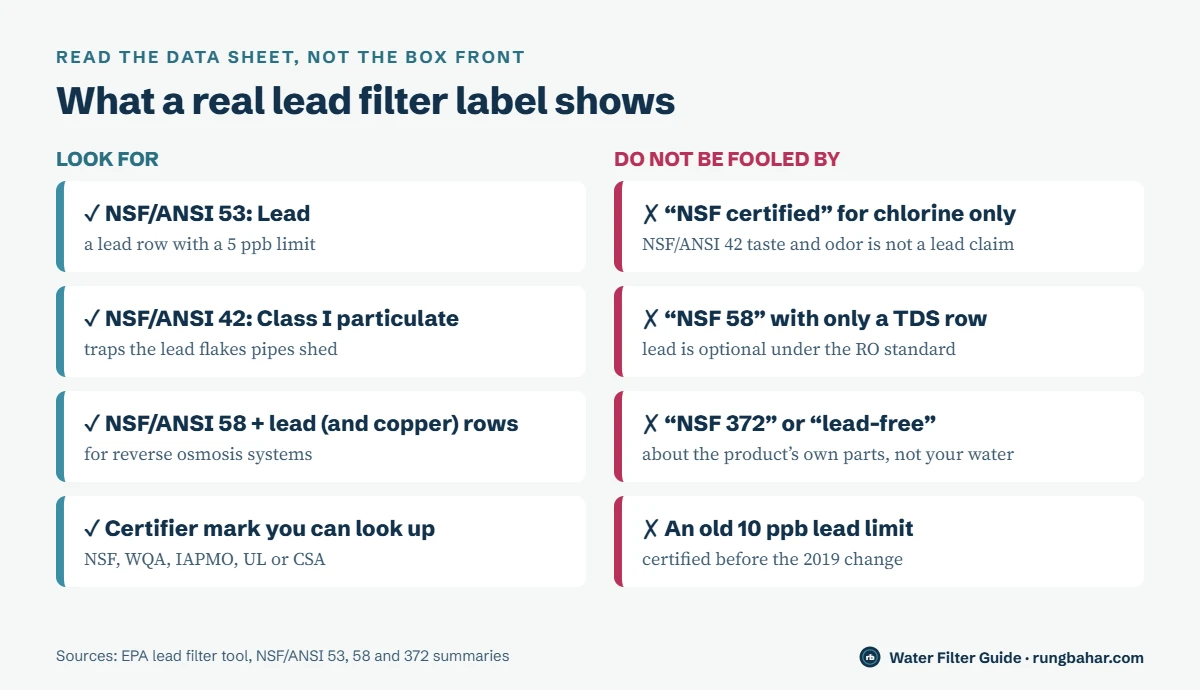
- “NSF certified” for something else. A filter certified only to NSF/ANSI 42 for chlorine taste is “NSF certified” but does nothing proven for lead. The lead claim has to be listed by name under NSF/ANSI 53 (or 58).
- “NSF 58” without a lead claim. Reverse osmosis systems only have to prove total dissolved solids reduction. Lead and copper are optional claims. Some popular RO systems list only TDS on their data sheets.
- “NSF 372” or “lead-free.” NSF/ANSI 372 is about the lead content of the product’s own parts, not about removing lead from your water. A “lead-free” faucet can still deliver lead from the pipes upstream.
- Old 10 ppb certifications. The 2019 change to 5 ppb did not cancel older certifications, so some listings still show a 10 ppb limit. Prefer products tested to 5 ppb, the level EPA’s tool uses.
Checking takes about three minutes: find the model number, open the performance data sheet, look for the lead row and its limit, then confirm the product in the certifier’s directory. Our step-by-step guide on how to check whether a filter is really certified walks through it with screenshots.
Using a lead filter correctly
A certified filter only protects you if it is used the way it was tested. EPA and CDC guidance comes down to a short list:
- Cold water only. Use only cold water for drinking, cooking and making baby formula. Hot water dissolves more lead from pipes, and most filters are not rated for hot water.
- Change the cartridge on time. An expired cartridge is less effective. The certification covers only the rated gallons or months, whichever comes first. Our guide on how often to change a water filter has the intervals by type.
- Flush when water has sat. If water has not been used for several hours, run the tap before filling. How long depends on whether you have a lead service line, so ask your utility.
- Do not boil to remove lead. Boiling does not remove lead. See what boiling does and does not remove.
- Filter during and after pipe work. Street work, meter changes and service line replacement can knock lead particles loose. Keep using the filter, and change it early if flow drops.
- Test again. A filter is a stopgap. Ask your utility for a lead test, or use a certified lab, and keep the result.
No safe blood lead level in children has been identified, so homes with babies, young children or someone pregnant should start using a certified filter for all drinking and cooking water as soon as lead pipes are suspected, not after the test comes back.
Lead pipes, utilities and the new federal rule
A filter protects you today; replacing the lead service line removes the source. Under the federal Lead and Copper Rule Revisions, every water system had to publish an inventory of service line materials by October 16, 2024, so your utility may already be able to tell you whether your address has a lead, galvanized or unknown line. Our ZIP code tap water check is a quick way to start looking up your water system.
The newer Lead and Copper Rule Improvements (LCRI), published in October 2024, require most water systems to replace lead and certain galvanized service lines within 10 years of the rule’s compliance date of November 1, 2027. From that date the lead action level drops from 15 ppb to 10 ppb, and systems must give customers certified pitcher or point-of-use filters, with six months of replacement cartridges, after a full or partial lead line replacement. Systems with repeated action level exceedances must also make certified filters available. Water utilities have challenged the rule in court; oral argument took place on September 30, 2026, and a decision is pending, so details could change.
Until your line is replaced, the practical plan is simple: confirm whether you have a lead line, use a certified filter for drinking and cooking water, change it on time and test after any work on your pipes. If you are not sure which filter type fits your home, the 15-second filter finder narrows it down.
Water filters for lead: 15 common questions, answered
These are the questions people search most about filtering lead, answered from certifier listings, manufacturer data sheets and EPA and CDC guidance.
What water filter removes lead?
Filters certified to NSF/ANSI 53 for lead, or reverse osmosis systems certified under NSF/ANSI 58 with a lead claim. Certified options exist as pitchers, faucet filters, under-sink filters, fridge filters and a few whole-house systems. Check the lead row on the product’s performance data sheet.
Do water filters work for lead pipes?
Yes, if they are certified for lead. The NSF/ANSI 53 test runs 150 ppb of lead through the filter for its whole rated life, and the output must stay at 5 ppb or less. EPA and CDC also recommend NSF/ANSI 42 Class I particulate reduction for the lead flakes that pipes can shed.
Is a pitcher filter enough if I have lead pipes?
For drinking and cooking water in a small household, a pitcher certified for lead is enough, as long as you use cold water and change the filter on time. Larger households often prefer a faucet or under-sink filter because a pitcher empties quickly.
What is the best water filter for lead removal?
There is no single best one, because every certified filter passes the same 5 ppb limit. Choose by how much water you use, what else you need removed and what fits your kitchen: a pitcher or faucet filter for simplicity, an under-sink filter for volume, reverse osmosis for lead plus copper.
Which water filter removes lead and copper?
Look for a reverse osmosis system whose data sheet lists both a lead claim and a copper claim under NSF/ANSI 58. The Aquasana AQ-RO-3, for example, lists lead (5 ppb limit) and copper reduction of 96.6 percent. Carbon filters certified under NSF/ANSI 53 are not tested for copper.
Does a Brita filter remove lead?
Among Brita pitcher filters, only the Brita Elite carries a lead claim. The basic Brita Standard pitcher filter is not certified for lead. Our page on what Brita filters remove has the details by filter.
Does a ZeroWater filter remove lead?
Yes. ZeroWater’s 5-stage pitcher filter and the Culligan filter with ZeroWater technology are certified to NSF/ANSI 53 for lead to the 5 ppb limit, but they last only 15 to 20 gallons and wear out faster on hard water.
Do under-sink water filters remove lead?
Certified ones do. The Aquasana AQ-5200, for example, is certified by WQA to NSF/ANSI 53 for lead to 5 ppb. Many under-sink filters are certified only for chlorine taste, so check the data sheet for a lead row.
Do whole-house water filters remove lead?
Most do not have a lead certification. A few, such as the Pentair LR-BB50 and the Aquasana OptimH2O whole-house system, claim NSF/ANSI 53 lead certification. Even then, lead from solder or brass fixtures inside the house can enter after the filter, so a certified kitchen filter is still the safer first step.
Does reverse osmosis remove lead?
Reverse osmosis can remove lead very well, but lead is an optional claim under NSF/ANSI 58. Only trust a system whose data sheet lists a lead result. Some RO systems are certified only for total dissolved solids.
Does a filter that removes lead also remove microplastics and chlorine?
Some do. The PUR PLUS faucet filter, for example, is also certified for microplastics and chlorine taste and odor, and the Aquasana AQ-5200 for microplastics. Each claim must be listed separately on the data sheet.
Can I use filtered water for baby formula if I have lead pipes?
Use cold water through a filter certified for lead, change the cartridge on time and follow your pediatrician’s advice. Never use hot tap water for formula, and do not rely on boiling, which does not remove lead.
How often should I change a lead filter?
At the rated gallons or months, whichever comes first: 15 to 120 gallons for certified pitchers, 100 gallons for the PUR PLUS faucet filter, around 500 gallons for some under-sink filters. Change early if the flow slows after pipe work.
Will my utility give me a free water filter?
Ask your utility what it offers now. Under the new federal rule, from November 1, 2027 systems must provide certified filters and six months of cartridges after a lead line replacement, and systems with repeated lead exceedances must make filters available.
How do I know if I have lead pipes?
Check your utility’s service line inventory, then look at the pipe where water enters your home: lead is dull gray, soft, and a scratch with a key shows shiny silver, and a magnet does not stick. Our lead in tap water guide shows the 2-minute check.
Sources and how we checked this page
Every product claim on this page comes from the maker’s performance data sheet or product page, and every health and rule statement from EPA, CDC, NSF or the Federal Register, checked on October 17, 2026. We do not test filters in a lab and have no commercial relationship with any brand named here. Data sheets change, so check the one for the exact model you buy.
- EPA: Consumer tool for identifying point-of-use and pitcher filters certified to reduce lead
- EPA: How to identify filters certified to reduce lead (June 2024, PDF)
- EPA: Reduce your risk of lead in drinking water (PDF)
- EPA: Actions you can take to reduce lead exposure
- EPA: What home treatment devices are used to control lead
- CDC: Lead in drinking water
- NSF: Stricter requirements for lead reduction certification
- Water Conditioning & Purification: Adjustment to the NSF/ANSI 53 lead requirement
- NSF: NSF/ANSI 58 reverse osmosis systems
- NSF: Contaminant reduction claims guide
- Federal Register: Lead and Copper Rule Improvements (Oct 30, 2024)
- EPA: LCRI frequently asked questions (PDF)
- NRDC: AWWA v. EPA case page
- PUR: RF9999 faucet filter performance data sheet (PDF)
- Aquasana: AQ-5200 / AQ-5300 / AQ-5300+ performance data (PDF)
- Aquasana: AQ-RO-3 performance data (PDF)
- Whirlpool: EveryDrop Filter 1 (EDR1RXD1) product page
- Pentair: Whole house heavy duty lead system (LR-BB50)
- Aquasana: OptimH2O whole house filter certified for lead (news release)
- NSF certified drinking water treatment units listing