Published October 10, 2026. Every claim is checked against the sources listed at the end of this page. How we research.
The short answer: A well water report has two kinds of row on it. Health-based limits, such as nitrate at 10 mg/L and arsenic at 0.010 mg/L, are the ones that call for action when you go over. Aesthetic guidance, such as iron at 0.3 mg/L or pH between 6.5 and 8.5, is about staining, taste and your plumbing rather than your health. Coliform bacteria should be absent, full stop. Everything else is a matter of reading the unit on each row, comparing it with the right limit, and treating only what the lab actually found.
Quick check
Which line on your report are you worried about?
Nobody checks your well but you
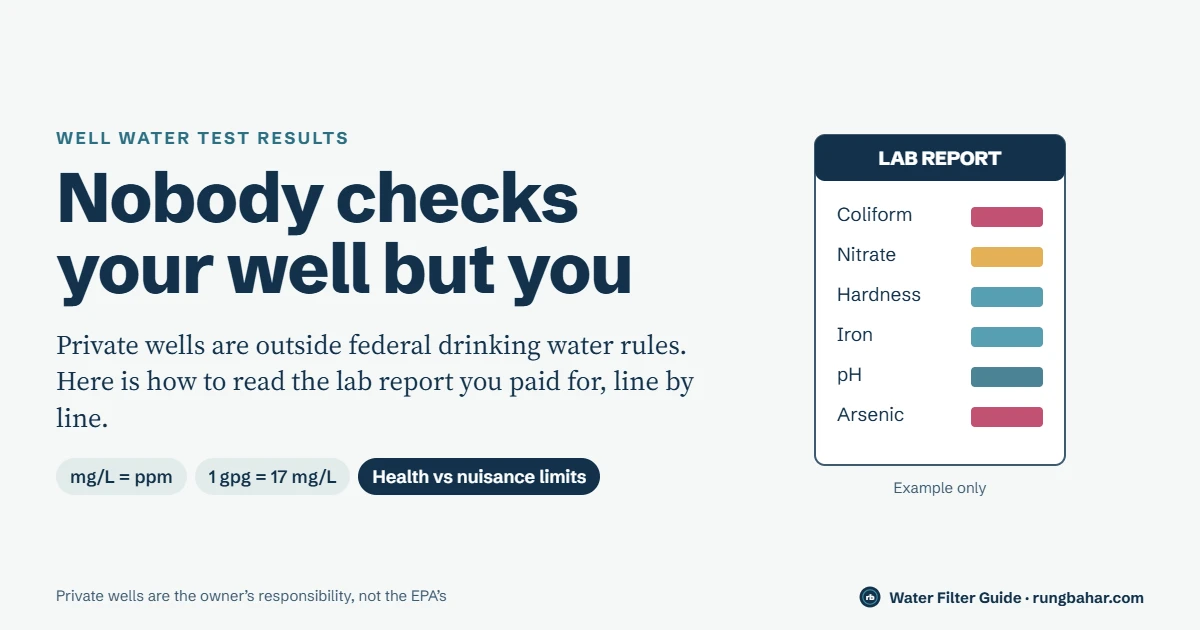
A public water system has to test to a federal schedule and tell you what it found. A private well has none of that. The Safe Drinking Water Act sets standards for public systems, and the EPA recommends that private well owners test their own water every year for total coliform bacteria, nitrates, total dissolved solids and pH. That recommendation is the whole safety net, and acting on it is voluntary.
The EPA also says to test more often if small children or older adults live in the house, or if anyone in the household is pregnant or nursing, and to test straight away when conditions near the well change: flooding, nearby construction, industrial activity, a repair to the well system, or any noticeable change in odor, color or taste.
So the lab report in your hand is the only picture of your water that exists. It is worth reading properly, which takes about ten minutes once you know what the columns mean.
The units, before the numbers
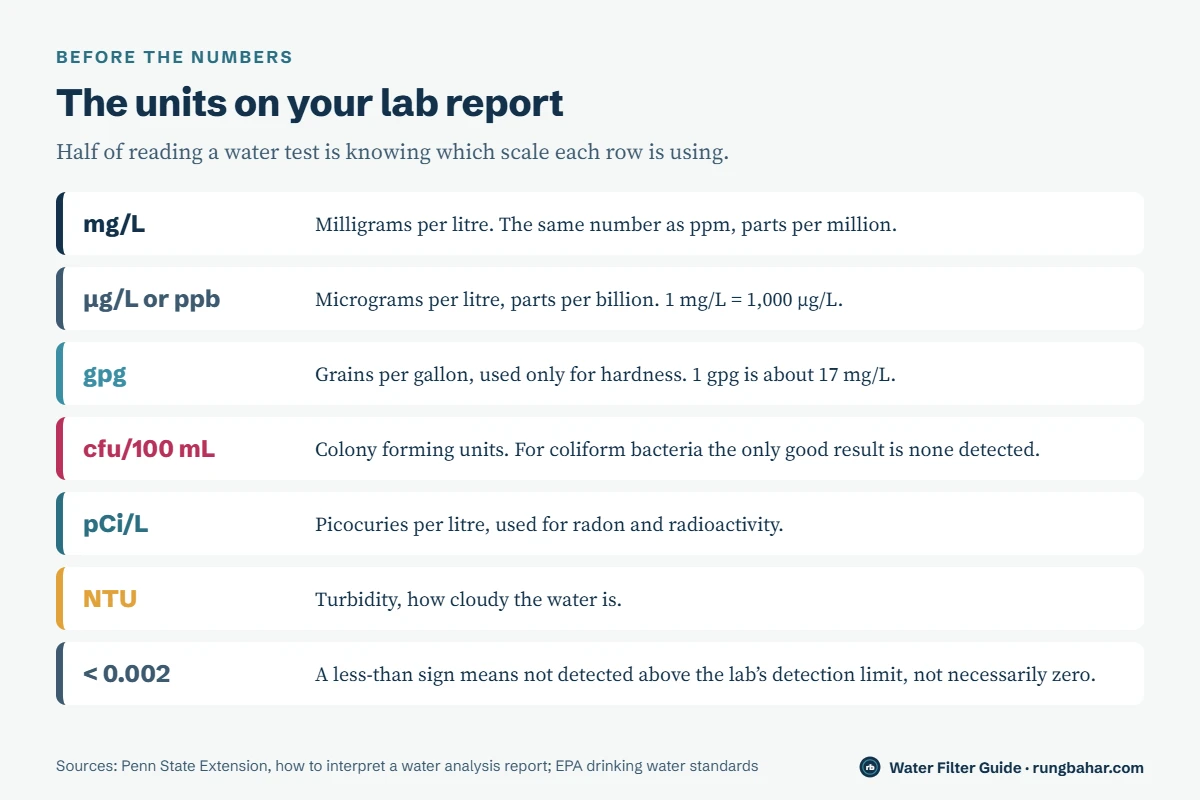
Most confusion with a water test is a unit problem rather than a chemistry problem. Five units cover almost every line.
- mg/L is milligrams per litre, and it is the same number as ppm, parts per million. Metals, nitrate and most minerals are reported this way.
- µg/L is micrograms per litre, the same as ppb, parts per billion. There are 1,000 µg/L in 1 mg/L. Arsenic and lead often appear in these units, which is why 0.010 mg/L and 10 ppb are the same result.
- gpg, grains per gallon, is used only for hardness. One grain per gallon is about 17 mg/L.
- cfu/100 mL, colony forming units, is used for bacteria. For coliform in drinking water the only acceptable result is none detected.
- pCi/L, picocuries per litre, is used for radon and other radioactivity. NTU measures turbidity, how cloudy the water is.
Then there is the row people misread most: a result written as “<0.002”. The less-than sign means the lab did not detect the substance above its detection limit for that method. It is a good result. It is not a certificate that the number is zero, and a different lab with a more sensitive method might report a small number instead.
Two kinds of limit on one page
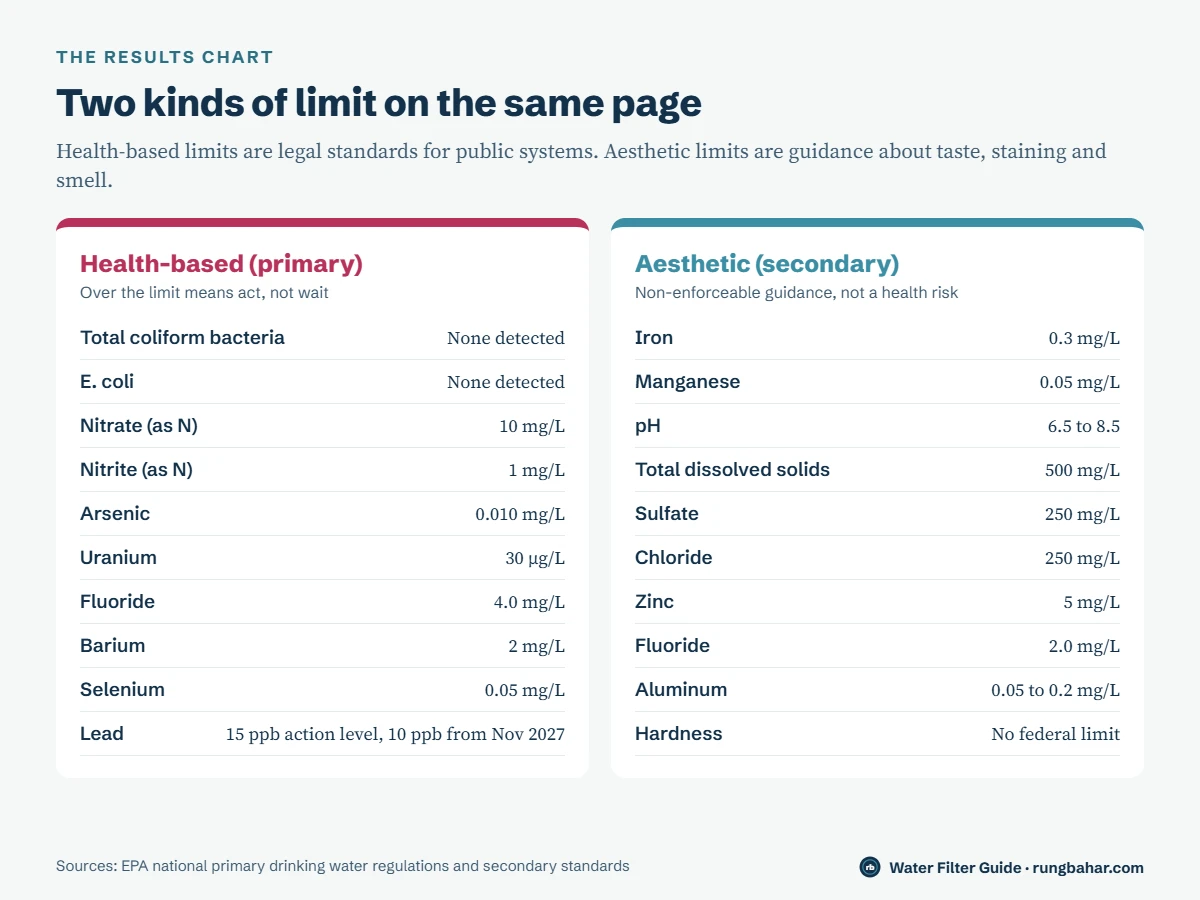
Lab reports usually flag anything over a limit, but they rarely explain that the limits come from two different places.
Primary standards are health-based and legally enforceable for public water systems. Nitrate at 10 mg/L measured as nitrogen, nitrite at 1 mg/L, arsenic at 0.010 mg/L, uranium at 30 µg/L, fluoride at 4.0 mg/L, barium at 2 mg/L, selenium at 0.05 mg/L. Lead is handled differently, through a treatment technique with an action level of 15 ppb that drops to 10 ppb on the compliance date of November 1, 2027. If one of these is exceeded on your well, treat it as a reason to stop drinking the water until you have a fix.
Secondary standards are non-enforceable guidance the EPA publishes for aesthetic effects, such as taste, color and staining. Iron at 0.3 mg/L, manganese at 0.05 mg/L, pH between 6.5 and 8.5, total dissolved solids at 500 mg/L, sulfate and chloride at 250 mg/L, zinc at 5 mg/L, fluoride at 2.0 mg/L. Going over these does not mean the water is unsafe. It usually means laundry, fixtures and taste are about to annoy you.
Hardness sits outside both lists. There is no federal limit for it at all, which is covered further down.
Coliform and E. coli
Total coliform bacteria are an indicator rather than a danger in themselves. They are common in soil and surface water, so finding them in a well means the well is connected to something it should not be: a cracked casing, a bad seal, surface water running down the annulus, or contamination introduced during a repair. E. coli is the narrower and more serious result, because it points to fecal contamination.
A positive result is not a reason to buy a filter. It is a reason to find the opening. The sequence that actually works is: stop drinking the water, shock chlorinate the well, flush it, retest after the chlorine has cleared, and inspect the wellhead, cap and casing while you wait. If the result comes back positive again after a proper shock treatment, the problem is structural, and continuous disinfection, usually an ultraviolet system certified to NSF/ANSI 55 Class A, becomes the long-term answer.
Boiling is the correct emergency measure for bacteria, which is the opposite of its uselessness against metals and nitrate. A rolling boil kills the organisms. It does nothing for anything dissolved, as we covered in what boiling water actually removes.
Nitrate and nitrite
Nitrate is the single most common health-based exceedance on rural wells, and it is invisible, tasteless and odorless. It comes from fertilizer, manure, septic systems and naturally decaying organic matter, which is why shallow wells in farmed areas see it most.
The limit is 10 mg/L measured as nitrogen, and the number on your report should say whether it is “as N” or “as nitrate”, because the two scales differ by a factor of about 4.4. If the report says nitrate-nitrogen or “as N”, compare it with 10. The group at risk is infants under six months, where high nitrate interferes with the blood’s ability to carry oxygen.
Two practical points. Never boil water to deal with nitrate: boiling removes water and leaves the nitrate behind, so the concentration goes up. And do not assume a carbon filter helps, because it does not. Reverse osmosis certified to NSF/ANSI 58, or anion exchange, is the treatment that works. Our guide to what reverse osmosis removes covers how it handles dissolved ions.
Arsenic, lead, uranium and the rest
Arsenic is the one that catches people out, because it is geological rather than agricultural. It dissolves out of rock into groundwater in many parts of the country, has no taste or smell, and sits at a health limit of 0.010 mg/L. Treatment is reverse osmosis or adsorptive media, and the right media depends on whether the arsenic is present as arsenic III or arsenic V, which is why the lab result matters more than a product brochure.
Lead on a well report almost always comes from your plumbing rather than the aquifer, since lead does not usually occur in groundwater at meaningful levels. A first-draw sample from the kitchen tap tells you what your own pipes and brass fittings contribute, and a filter certified to NSF/ANSI 53 for lead is the interim answer. The lead guide covers the testing and the certified options in detail.
Uranium has a limit of 30 µg/L and shows up in some granite regions. Barium, selenium and fluoride have their own primary limits. Radon, reported in pCi/L, is a separate test that most standard packages do not include, and it matters mostly because of what the gas does when it comes out of the water into the air of a bathroom.
Hardness, iron, manganese and smell
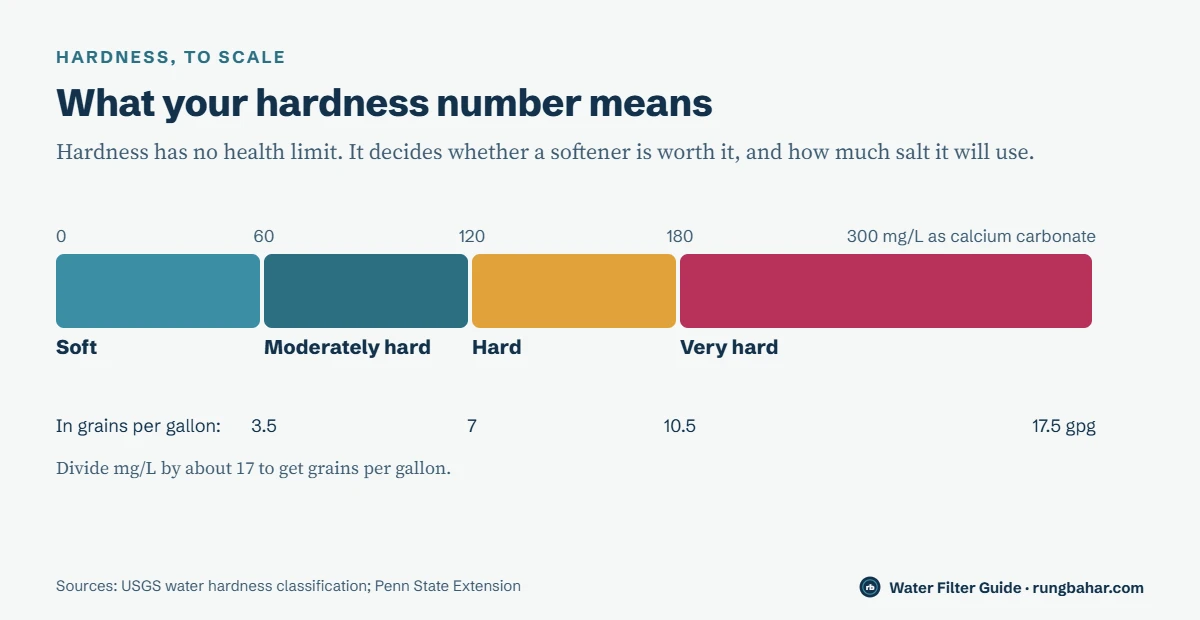
These rows cause the most complaints and the least danger. Hardness is dissolved calcium and magnesium. The USGS classes water up to 60 mg/L as calcium carbonate as soft, 61 to 120 as moderately hard, 121 to 180 as hard and anything above 180 as very hard. Divide by about 17 to get grains per gallon, which is the number a softener is sized on. If your water is over about 7 gpg and you are tired of scale, our softener sizing calculator turns the number into a capacity. If you are weighing a no-salt option, salt-free conditioners vs salt softeners explains what each one actually does.
Iron above the 0.3 mg/L guidance shows up as orange or rust staining in sinks, laundry and the dishwasher, and a metallic taste. Manganese above 0.05 mg/L gives black specks and black staining. Dissolved iron is clear when the water is drawn and turns orange as it oxidises in the glass, which is the usual giveaway. A softener removes only modest amounts of dissolved iron, and oxidised iron fouls the resin, so an oxidising filter ahead of the softener is the normal arrangement.
Sulfur smell, the rotten egg one, is not on the standard chemistry list at all. The first diagnostic is free: if the smell is only on the hot side, it is the water heater and its anode rod, not the well.
pH, TDS and corrosive water
The pH guidance range is 6.5 to 8.5. Low pH does not hurt you directly, but acidic water pulls metals out of whatever it runs through. That is how blue-green staining from copper, pinhole leaks in copper pipe, and elevated lead and copper in a first-draw sample all appear on the same report as a pH of 6.1. A neutralising filter is the standard fix, and if your pH is low it is worth testing the tap for lead and copper rather than assuming the aquifer is clean.
Total dissolved solids, with guidance at 500 mg/L, is the sum of everything dissolved. A high number is not a contaminant finding; it is a prompt to look at which specific rows are carrying it, usually hardness, sulfate, chloride or iron. A TDS meter on the kitchen counter measures the same idea crudely and tells you nothing about which substances are present.
Matching a result to a treatment
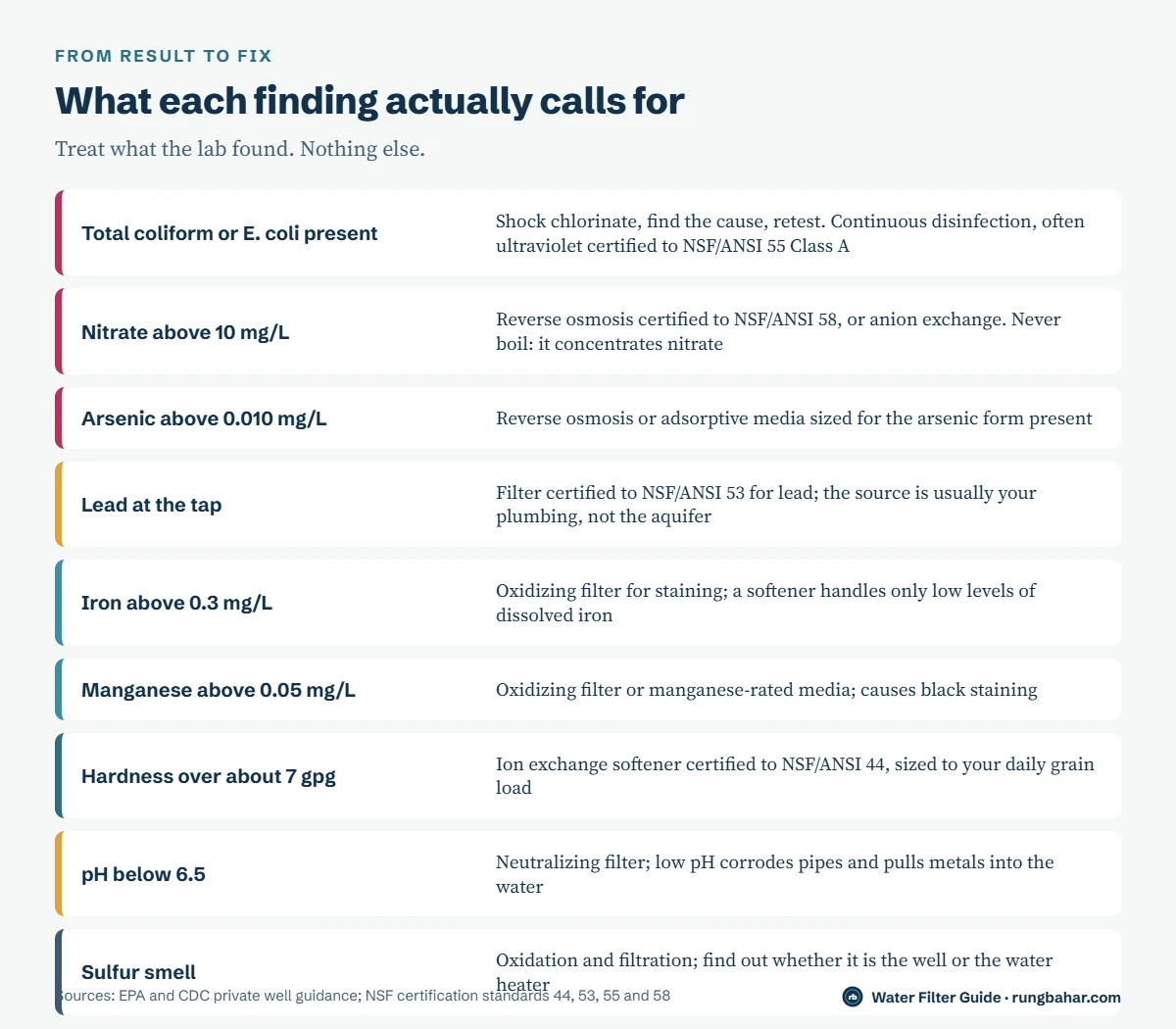
One rule prevents most wasted money on well water: treat what the lab found, in the order the risk justifies, and buy equipment whose certification names that contaminant.
| Finding | What it means | Treatment that matches it |
|---|---|---|
| Coliform or E. coli present | The well is open to contamination | Shock chlorination and repair first; UV certified to NSF/ANSI 55 Class A for ongoing protection |
| Nitrate over 10 mg/L as N | Health limit exceeded; infants at risk | Reverse osmosis certified to NSF/ANSI 58, or anion exchange. Not carbon, not boiling |
| Arsenic over 0.010 mg/L | Health limit exceeded | Reverse osmosis, or adsorptive media matched to the arsenic form |
| Lead detected at the tap | Usually your plumbing, not the well | Filter certified to NSF/ANSI 53 for lead, plus a look at the fittings |
| Iron over 0.3 mg/L | Staining and taste | Oxidising filter; a softener alone handles only low dissolved iron |
| Hardness over about 7 gpg | Scale, soap curd, appliance wear | Ion exchange softener certified to NSF/ANSI 44, sized to your daily grain load |
| pH under 6.5 | Corrosive to plumbing | Neutralising filter, then retest for lead and copper |
Certification matters more here than in a city house, because well treatment is sold by local dealers with a strong incentive to bundle. Check the exact system on the certifier’s listing before you sign anything, the way we set out in how to check whether a filter is really certified, and read what each certification covers so you can tell a tested claim from a sales claim.
Bacteria keeps coming back
Ultraviolet disinfection
- Certification: NSF/ANSI 55 Class A for disinfection
- Best for: Wells that test positive again after shock chlorination
- Skip if: you have not yet found and fixed the way in
Nitrate, arsenic or uranium
Reverse osmosis at the kitchen tap
- Certification: NSF/ANSI 58 listing that names your contaminant
- Best for: Health-based exceedances in drinking and cooking water
- Skip if: the problem is bacteria, which RO is not the answer for
Scale and staining
Softener, with iron handled first
- Certification: NSF/ANSI 44 for the softener
- Best for: Hard water over about 7 gpg with low dissolved iron
- Skip if: iron is high, until an oxidising filter goes in ahead of it
What to test, and how often
The baseline schedule is the EPA’s: once a year for total coliform bacteria, nitrate, total dissolved solids and pH. Build the rest around your own circumstances.
- Add local concerns. Your county health department knows what the aquifer in your area does: arsenic, uranium, radon, fluoride, or a plume from a known site. Ask them what to add to the annual panel.
- Test immediately after flooding, after any work on the well, pump or pressure tank, or if the water changes in taste, smell or appearance.
- Test before a baby arrives. Nitrate is the specific reason, and the result should be in hand before formula gets mixed with the water.
- Test the tap, not just the well, for lead and copper, because those come from the plumbing between the well and your glass.
- Keep the reports. A row of years tells you whether a number is drifting, which a single test never can.
Use a laboratory certified by your state drinking water program, and follow its sampling instructions exactly. Which bottle, which tap, whether to run the water first, how fast to get it back: all of that changes the result more than most people expect. If you are starting from scratch on treatment after the results come in, the five-step buying guide and the filter finder narrow the choice quickly, and the homepage ZIP tap-water check is worth a look if you also use city water anywhere.
Well water test results: 14 common questions
Short answers to what well owners actually search. Each one matches the sources listed at the bottom of this page.
How do I read my well water test results?
Work row by row. Check the unit first (mg/L is the same as ppm, µg/L is the same as ppb), then compare the number with the right limit: health-based limits such as nitrate at 10 mg/L and arsenic at 0.010 mg/L, or aesthetic guidance such as iron at 0.3 mg/L. Coliform bacteria should read as absent.
What is a normal well water test result?
There is no single normal. A good result is: coliform absent, nitrate well under 10 mg/L, pH between 6.5 and 8.5, TDS under 500 mg/L, iron under 0.3 mg/L and manganese under 0.05 mg/L. Hardness has no federal limit and varies hugely by region.
Who regulates private well water?
Nobody tests it for you. Federal drinking water standards apply to public water systems; a private well is the owner’s responsibility, with state and county health departments providing guidance and lists of certified labs.
What does “less than” mean on a water test?
It means the lab did not detect the substance above its detection limit for that method. It is a good result, but it is a statement about the sensitivity of the test rather than proof of zero.
What does total coliform mean on a well test?
It means the well is open to surface water or soil somewhere. Coliform bacteria are an indicator of a pathway in, not usually a direct hazard. E. coli is the more serious result, because it indicates fecal contamination.
Is nitrate at 8 mg/L safe?
It is below the 10 mg/L health limit, but on a well it is worth watching, because nitrate tends to move with the seasons and with fertilizer use. Retest more often, and look at the trend rather than the single number.
Does boiling well water make it safe?
For bacteria, yes: boiling kills them. For nitrate, arsenic, lead and other dissolved substances, no. Boiling removes water and leaves them behind, so the concentration rises.
How do I convert hardness to grains per gallon?
Divide mg/L as calcium carbonate by about 17. So 120 mg/L is roughly 7 gpg and 180 mg/L is roughly 10.5 gpg. Softeners are sized in grains, which is why the conversion matters.
Is hard water in a well bad for you?
No. Hardness has no federal health limit and is classed as an aesthetic issue. It causes scale, soap curd and appliance wear, which is a cost argument for a softener rather than a health one.
What causes orange or black staining from well water?
Orange and rust staining is usually iron above the 0.3 mg/L guidance. Black specks and black staining point at manganese above 0.05 mg/L. Both are aesthetic standards rather than health limits.
My pH is 6.1. Does that matter?
Not directly to your health, but acidic water corrodes plumbing and dissolves metals into the water. Low pH is a common reason for copper staining and for lead and copper showing up in a first-draw tap sample. A neutralising filter raises it.
How often should I test my well?
The EPA recommends yearly testing for total coliform bacteria, nitrate, total dissolved solids and pH, with extra tests after flooding, repairs, or any change in taste, smell or appearance, and more frequent testing when infants, older adults or anyone pregnant lives in the house.
Do home test strips work for well water?
They are a rough screen. For hardness, iron or pH they give you a usable ballpark. For health-based results measured in parts per billion, such as arsenic and lead, or for bacteria, use a laboratory certified by your state drinking water program.
Should I test for arsenic and radon if they are not on the standard panel?
Ask your county health department what is common in your aquifer. Arsenic and radon are both geological, both invisible, and both missing from many standard packages, so they often have to be requested separately.
Sources and how we checked this page
Every limit on this page was checked against the issuing agency on October 7, 2026: the EPA for primary and secondary drinking water standards and private well guidance, the USGS for the hardness classification, and Penn State Extension for units and interpretation. We do not test products ourselves and we do not quote prices we have not verified.
- EPA: protect your home’s water, private well testing recommendations
- EPA: national primary drinking water regulations and MCLs
- EPA: secondary drinking water standards for nuisance chemicals
- EPA: Lead and Copper Rule Improvements and the 2027 compliance date
- USGS: hardness of water classification
- Penn State Extension: how to interpret a water analysis report
- Penn State Extension: water softening, hardness units and sizing
- NSF: certified drinking water treatment unit listings
- NSF: what standards 42, 53 and 401 cover