Published October 12, 2026. Every claim is checked against the sources listed at the end of this page. How we research.
The short answer: ZeroWater and the Brita Elite are both certified to reduce lead, but they win on different things. ZeroWater’s 5-stage filter is also certified for PFOA and PFOS (99.8 percent on its data sheet) and strips out nearly all dissolved minerals, so a TDS meter reads close to zero. The Brita Elite has no PFAS claim but is certified for microplastics and is rated for 120 gallons, against ZeroWater’s rated 15 gallons (8 to 40+ in practice, depending on your tap water’s TDS). Choose ZeroWater for PFAS and the lowest-TDS water; choose the Brita Elite for fewer filter changes. The basic Brita Standard filter is not certified for lead.
Quick check: filters per year
1. What is your tap water’s TDS?
2. How much filtered water do you use a day?
Which ZeroWater and which Brita are you comparing?
“ZeroWater vs Brita” sounds like a two-product question, but there are four filters that matter, and two of them changed recently. If you compare the wrong pair, the answer flips.
- ZeroWater 5-stage filter (replacement ZR-001 / ZF-201): the filter most ZeroWater pitchers and dispensers on store shelves use. Its April 2026 data sheet names IAPMO R&T as the certifier and a rated life of 15 gallons.
- Culligan with ZeroWater Technology filter (ZEROF01): a newer filter sold under the Culligan name. Its data sheet lists more claims, including total PFAS and fluoride, and a rated life of 20 gallons. It does not fit older ZeroWater pitchers, and older filters do not fit the new pitchers.
- Brita Standard (OB03): Brita’s basic white filter, rated for 40 gallons. Certified for chlorine taste and a few metals, not for lead.
- Brita Elite (OB06, formerly Longlast+): rated for 120 gallons. Certified for lead, microplastics and a long list of chemicals, but no PFAS on its current data sheet.
So the useful comparisons are ZeroWater 5-stage vs Brita Elite (the two filters most people are choosing between) and, if you are buying a new pitcher anyway, Culligan ZeroWater vs Brita Elite. Everything below comes from each filter’s performance data sheet, the document that lists what was tested, at what concentration and with what result. We checked them on October 12, 2026. We did not test any filter ourselves, and packaging slogans and review-site scores were not used as evidence.
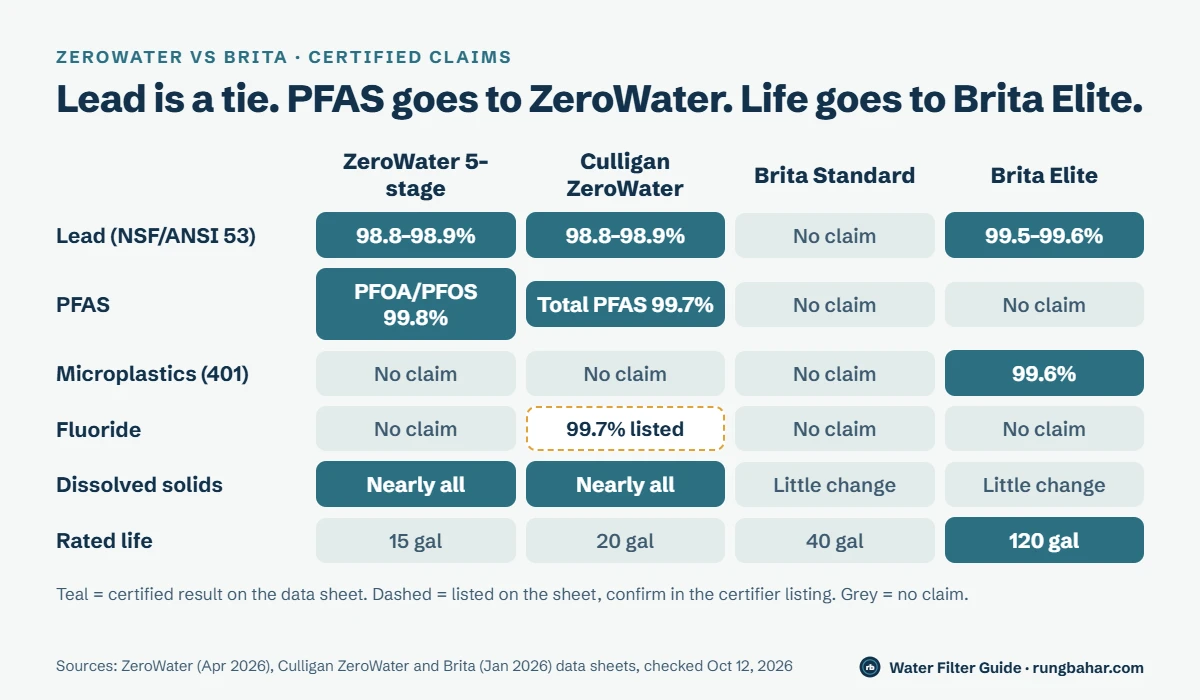
ZeroWater vs Brita: certified claims side by side
“No claim” means the contaminant is not on that filter’s data sheet. It does not prove the filter removes none of it; it means nobody certified a result you can rely on.
| Contaminant | ZeroWater 5-stage | Culligan ZeroWater | Brita Standard | Brita Elite |
|---|---|---|---|---|
| Lead (NSF/ANSI 53, 5 ppb limit) | 98.8–98.9% | 98.8–98.9% | No claim | 99.5–99.6% |
| PFOA / PFOS (NSF/ANSI 53) | 99.8% | Total PFAS 99.7% | No claim | No claim |
| Microplastics (NSF/ANSI 401) | No claim | No claim | No claim | 99.6% |
| Chromium-6 | 99.4–99.5% | 99.4–99.5% | No claim | No claim |
| Mercury | 94.2–96.6% | 94.2–96.6% | 82–86% | 95.5–95.9% |
| Fluoride | No claim | 99.7% (listed) | No | No |
| Nitrate | No claim | 99.1% (listed) | No | No |
| Chlorine taste and odor (NSF/ANSI 42) | 99.4% | 99.4% | 95% | 97.4% |
| Dissolved solids (TDS) | Nearly all (brand claim) | Nearly all (brand claim) | Not listed | Not listed |
| Bacteria and viruses | No | No | No | No |
| Rated life | 15 gallons | 20 gallons | 40 gallons | 120 gallons |
| Certifier named | IAPMO R&T | IAPMO (product page) | WQA | IAPMO R&T, NSF, WQA |
Read the table by row. On lead, it is a tie between the certified models. On PFAS, ZeroWater has a certified claim and Brita does not. On microplastics, Brita Elite has a certified claim and ZeroWater does not. On filter life, Brita wins by a wide margin. Our guide to checking whether a filter is really certified explains why an IAPMO R&T or WQA listing counts the same as one from NSF International.
How each filter works, in plain terms
Both brands use activated carbon, which grabs chlorine and many organic chemicals by sticking them to its huge internal surface. Both also use ion exchange resin, tiny beads that swap one dissolved ion for another. The difference is how much resin, and what it is designed to do.
Brita’s filters are built mainly for taste and a targeted list of contaminants. They leave most of the natural minerals (calcium, magnesium, bicarbonate) in the water, so the water tastes like your tap water without the chlorine.
ZeroWater calls its design a “5-stage ion exchange” filter, and the key stage is a large bed of mixed resin that pulls out almost every charged particle in the water: the harmful ones like lead, and the harmless ones like calcium and sodium. That is why ZeroWater ships a TDS meter with its pitchers and promises a reading of 000. It is also why the filter wears out faster: the resin has a fixed capacity, and every milligram of ordinary minerals uses some of it up.
Lead: both certified models pass the same test
If lead is why you are buying a filter, either brand works, as long as you buy the right model. Under NSF/ANSI 53, the test water starts at 150 parts per billion (ppb) of lead and the filter must keep the output at or below 5 ppb for its whole rated life. ZeroWater’s data sheet shows 98.9 percent average reduction at pH 6.5 and 98.8 percent at pH 8.5. The Brita Elite sheet shows 99.5 and 99.6 percent.
Do not read much into the gap. Both filters passed the same pass-or-fail limit, and a fraction of a percent between averages in a lab run tells you little about your kitchen. The real risk is buying the Brita Standard by mistake: it is usually the cheaper filter on the shelf and has no lead claim. If you have lead pipes or an older home, see lead in tap water: testing and filters that work for what to do besides filtering.
One more point for ZeroWater users: the lead claim applies within the rated life on the data sheet, which is 15 gallons for the 5-stage filter. ZeroWater’s own advice is to change the filter when the TDS meter reads 006, which on low-TDS water can be well past 15 gallons. If lead is your main concern, the conservative choice is to follow the rated gallons, not the meter.
PFAS: ZeroWater has a certified claim, Brita does not
This is the clearest difference between the brands. The ZeroWater 5-stage data sheet lists PFOA and PFOS together under NSF/ANSI 53, with 99.8 percent average reduction from a challenge of about 1.5 micrograms per liter (1,500 nanograms per liter). The newer Culligan ZeroWater sheet goes further and lists “total PFAS” at 99.7 percent, the newer test that covers a mix of seven PFAS compounds, not just PFOA and PFOS.
The Brita Elite data sheet dated January 2026 lists no PFOA, PFOS or total PFAS, and the Brita Standard sheet does not either. Some older articles cite a 2023 Canadian Elite sheet with a PFOA/PFOS claim; the current sheet does not carry it, so we treat Brita pitcher filters as having no certified PFAS reduction. Our page on what Brita filters remove covers the history.
Before you buy for PFAS, check whether your water has it. Many utilities have now tested for PFAS, and results are free to look up; how to find out if your tap water has PFAS shows where. If it does, a certified pitcher is one option. An under-sink reverse osmosis system certified under NSF/ANSI 58 is the other, with wider coverage and lower cost per gallon over time.
TDS: why ZeroWater reads 000 and Brita does not
Total dissolved solids (TDS) is the combined weight of everything dissolved in water, mostly harmless minerals and salts, measured in milligrams per liter (about the same as parts per million). Most US tap water sits somewhere between 50 and a few hundred. The US EPA’s non-enforceable guideline for TDS is 500 mg/L, set for taste, scaling and staining, not for health. Our guide to what a TDS reading means explains the scale in more detail.
ZeroWater’s 0 reading is real: the resin removes nearly all of those minerals. A Brita filter barely changes TDS, because it was never designed to remove calcium and magnesium. That is why “zero water vs brita TDS” videos always look like a knockout for ZeroWater.
But a low TDS number does not mean safer water, and a high one does not mean dangerous water. Lead at a worrying level is a few parts per billion, thousands of times too small to move a TDS meter. PFAS are measured in parts per trillion. A TDS meter tells you how many minerals are in the water and whether a ZeroWater filter is exhausted. It cannot tell you whether a Brita filter is working. The World Health Organization notes that water with very low TDS can taste flat; some people love ZeroWater’s clean taste for exactly that reason, and others find it bland. Our guide to whether low-mineral RO water is good for you covers the mineral question in more depth, and it applies equally to ZeroWater water.
Filter life: the biggest practical difference
Brita filters are rated by volume: 40 gallons for the Standard and 120 for the Elite, whatever your water is like. ZeroWater’s rated life is 15 gallons on its data sheet, but in practice the filter lasts until its resin is full of minerals, so the life depends on your tap water’s TDS. ZeroWater says each filter removes about 18,000 milligrams of dissolved solids and publishes this estimate:
| Tap water TDS | ZeroWater’s estimate per filter | Filters a year at 1 gallon a day |
|---|---|---|
| 2–50 (low) | 40 gallons or more | About 9 or fewer |
| 51–200 (typical, per ZeroWater) | 25–40 gallons | About 9 to 15 |
| 201–300 (high) | 15–25 gallons | About 15 to 24 |
| 301–400 (very high) | 8–15 gallons | About 24 to 46 |
| Over 400 | 8 gallons or less | 46 or more |
| Brita Elite (any TDS) | 120 gallons (rated) | About 3 |
| Brita Standard (any TDS) | 40 gallons (rated) | About 9 to 10 |
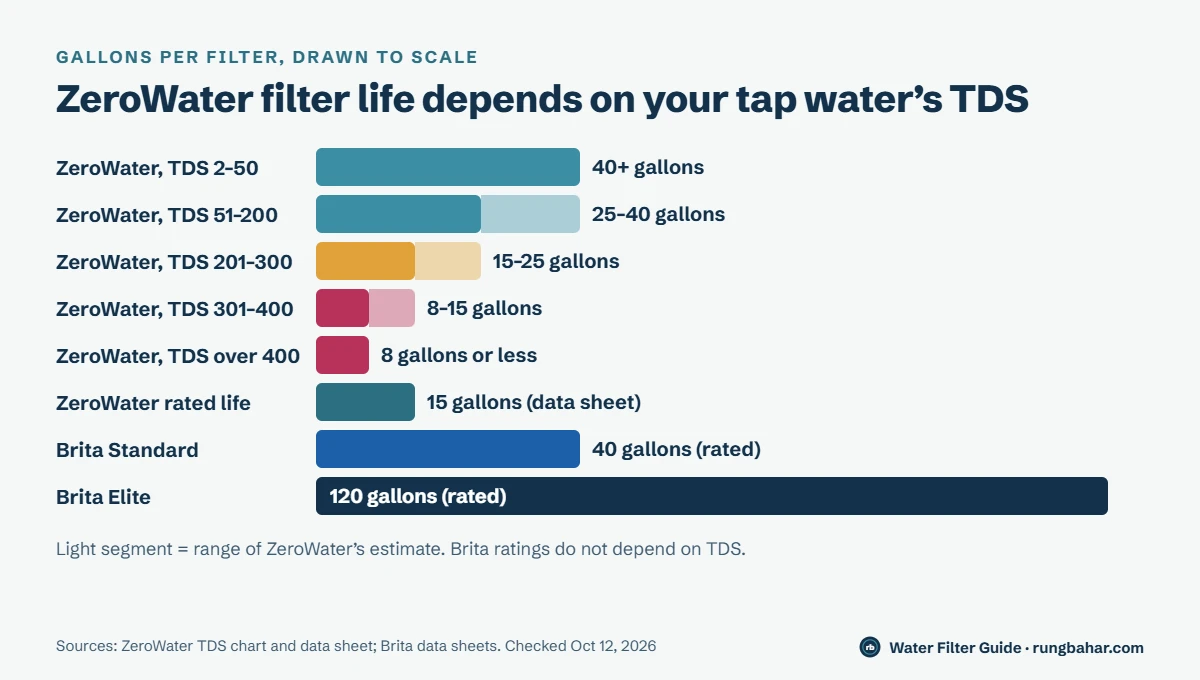
The worked example uses 365 gallons a year, a household that filters 1 gallon a day for drinking and cooking. That is an example only; use the quick check at the top of this page with your own numbers. For a typical tap water around 150 to 200 mg/L, a ZeroWater user changes filters roughly every 3 to 6 weeks, while a Brita Elite user changes about 3 times a year.
This is why cost-per-gallon claims vary so much between review sites: the answer depends on your water. We do not quote prices here, because filter prices change weekly and differ by pack size. Take the number of filters a year from the table, multiply by today’s price per filter, and you have a fair yearly cost for your home. If your TDS is above about 300, the math usually favors an under-sink reverse osmosis system, whose membrane and filters last months rather than weeks.
Fluoride, microplastics, nitrate and bacteria
Fluoride
Neither Brita filter lists fluoride. The ZeroWater 5-stage data sheet does not list fluoride either, although ion exchange resin can remove some fluoride; without a certified result, you cannot know how much or for how long. The newer Culligan ZeroWater sheet lists fluoride at 99.7 percent average reduction. If fluoride is your reason to filter, check that the claim appears in the certifier’s listing for the exact model, or look at the proven options in water filters that remove fluoride.
Microplastics
The Brita Elite is certified under NSF/ANSI 401 for microplastics, with 99.6 percent reduction of particles in the 0.5 to 1 micron range. Neither ZeroWater data sheet lists microplastics. That does not mean ZeroWater lets them through, only that there is no certified number. If microplastics are your priority, the Elite is the documented choice; see what the microplastics certification says.
Nitrate
Nitrate matters mostly for private wells near farmland and for formula-fed infants. The Culligan ZeroWater sheet lists nitrate at 99.1 percent, but it sits outside the NSF/ANSI 42, 53 and 401 sections on the sheet, so treat it as a manufacturer result until you see it in a certifier listing. No Brita filter lists nitrate. For a well with nitrate, start with our well water results guide.
Bacteria and viruses
Neither brand is a purifier. Both data sheets say the filters are for water that is already microbiologically safe and should not be used on water of unknown quality without disinfection.
ZeroWater vs PUR, and ZeroWater vs reverse osmosis
ZeroWater vs PUR: the PUR PLUS pitcher filter is certified for lead, total PFAS and microplastics and is rated for 40 gallons, so it covers the three headline contaminants in one filter and lasts longer than ZeroWater on most tap water. ZeroWater’s advantages are chromium-6 and the near-zero TDS. Our Brita vs PUR comparison has the PUR data sheet numbers.
ZeroWater vs reverse osmosis: both lower TDS sharply. An under-sink RO system certified under NSF/ANSI 58 must cut TDS from a 750 mg/L test water to 187 mg/L or less, and many systems do much better; ZeroWater gets closer to zero. The difference is in running cost and coverage. RO membranes last months or years, RO systems are often certified for fluoride, arsenic and nitrate as well, and they work on high-TDS water where ZeroWater filters run out in days. ZeroWater needs no installation, which matters for renters. See what reverse osmosis removes for the full list.
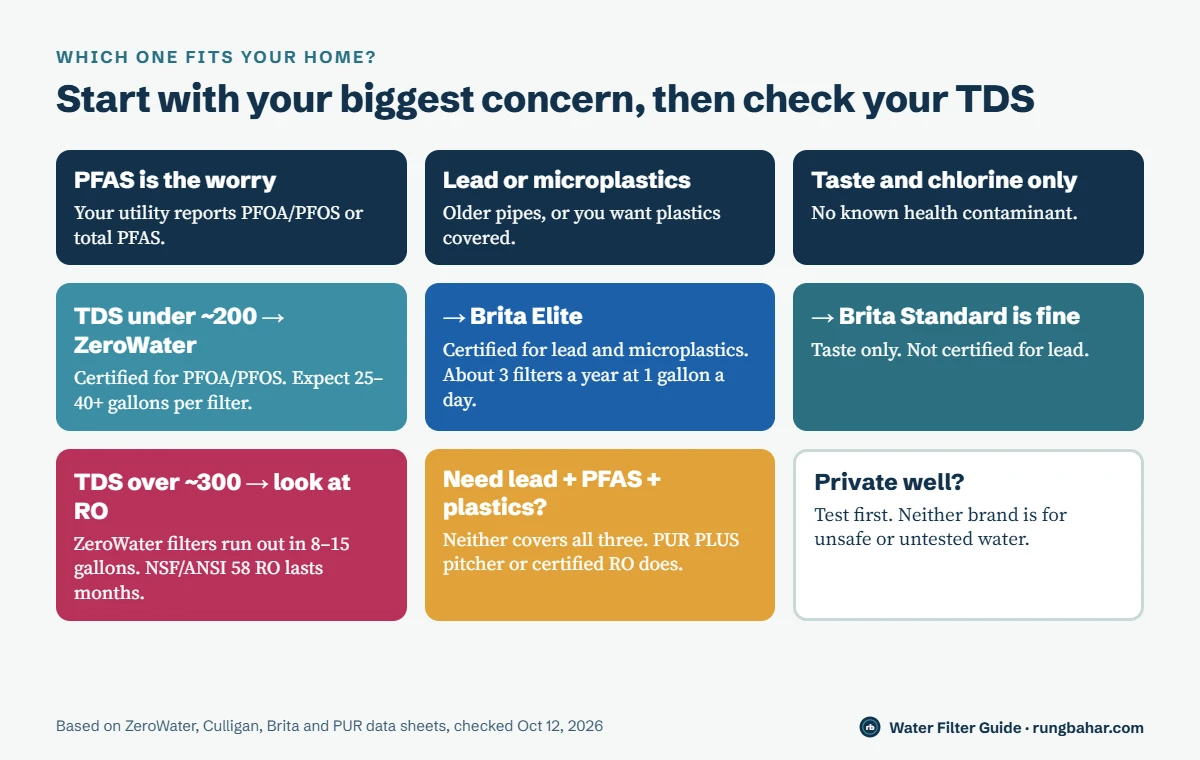
ZeroWater or Brita: which one to buy
- Choose ZeroWater if PFAS (PFOA/PFOS) is your main concern, your tap water TDS is under about 200, and you like the very clean taste. Change filters at the rated life if you rely on it for lead.
- Choose the Culligan ZeroWater pitcher if you are buying new and want total PFAS and a fluoride claim in a pitcher, after confirming the listing.
- Choose the Brita Elite if you want lead and microplastics covered with about three filter changes a year, and PFAS is not a known issue in your water.
- Skip both if your TDS is over 300 (ZeroWater filters will run out fast; consider RO), if you need a certified PFAS pitcher that lasts longer (look at PUR PLUS), or if you are on an untested private well.
- Do not buy the Brita Standard for health reasons; it is a taste filter.
Certified PFOA/PFOS
ZeroWater 5-stage filter (ZR-001)
- Certification: NSF/ANSI 42 and 53 (lead, PFOA/PFOS, chromium-6, mercury), IAPMO R&T
- Best for: Low-TDS tap water, PFAS concerns, lowest-TDS taste
- Skip if: your tap TDS is over 300 or you want few filter changes
Most listed claims
Culligan with ZeroWater Technology (ZEROF01)
- Certification: NSF/ANSI 42, 53 and 401 listed (lead, total PFAS, fluoride); IAPMO per product page
- Best for: New pitcher buyers who want PFAS and fluoride in one pitcher
- Skip if: you already own an older ZeroWater pitcher (not compatible)
Longest life
Brita Elite filter (OB06)
- Certification: NSF/ANSI 42, 53 (lead) and 401 (microplastics)
- Best for: Lead and microplastics with about 3 changes a year
- Skip if: PFAS is your main concern
How to check a ZeroWater or Brita claim before you buy
- Find the replacement filter’s model number: ZR-001 or ZF-201 for ZeroWater 5-stage, ZEROF01 for Culligan ZeroWater, OB03 or OB06 for Brita.
- Open that model’s performance data sheet (linked in the sources below) and find your contaminant.
- Note the rated life in gallons. A claim only applies within it.
- Confirm the listing with the certifier named on the sheet or product page, using the IAPMO R&T, WQA or NSF directories.
- For ZeroWater, measure your tap water with the included TDS meter on day one, so you can predict how long each filter will last.
Still deciding what type of filter you need? Start with how to choose a water filter in 5 steps, answer three questions in the filter finder, or run the ZIP code tap-water check to see what your utility reports.
ZeroWater vs Brita: 14 common questions, answered
These are the questions people search most when choosing between ZeroWater and Brita, answered from the data sheets.
Is ZeroWater better than Brita?
It depends on what you need. ZeroWater’s 5-stage filter is certified for lead and PFOA/PFOS and removes nearly all dissolved minerals. The Brita Elite is certified for lead and microplastics and lasts 120 gallons, many times longer than a ZeroWater filter on typical tap water.
Does ZeroWater remove more than Brita?
On PFAS, chromium-6 and dissolved minerals, yes. On microplastics, the Brita Elite has a certified claim and ZeroWater does not. Both certified models pass the same lead test.
Zero Water vs Brita Elite: which is better for lead?
Both are certified under NSF/ANSI 53 to reduce lead from 150 ppb to 5 ppb or less: ZeroWater at 98.8 to 98.9 percent and the Elite at 99.5 to 99.6 percent. The Brita Standard is not certified for lead.
Does ZeroWater remove fluoride?
The ZeroWater 5-stage data sheet does not list fluoride. The newer Culligan with ZeroWater Technology filter lists fluoride at 99.7 percent average reduction. Brita filters do not list fluoride.
Does ZeroWater remove microplastics?
Neither ZeroWater data sheet lists a microplastics claim. The Brita Elite is certified under NSF/ANSI 401 at 99.6 percent.
Does ZeroWater remove PFAS?
The 5-stage filter is certified for PFOA and PFOS (99.8 percent). The Culligan ZeroWater filter lists total PFAS at 99.7 percent. Brita’s current pitcher data sheets list no PFAS.
How long does a ZeroWater filter last compared with Brita?
ZeroWater rates its 5-stage filter at 15 gallons and estimates 8 to 40+ gallons depending on tap water TDS. The Brita Standard is rated for 40 gallons and the Brita Elite for 120.
Why does my ZeroWater filter run out so fast?
Your tap water probably has a high TDS. The filter removes all dissolved minerals, and each filter holds about 18,000 mg. At a TDS of 300 or more, ZeroWater estimates only 8 to 15 gallons per filter.
Why does my ZeroWater water taste fishy?
ZeroWater and Culligan list a fishy or otherwise changed taste or smell as a sign the filter is exhausted. Replace it when the TDS meter reads 006 or the taste changes.
Does ZeroWater remove minerals like calcium and magnesium?
Yes. It removes nearly all dissolved minerals, including calcium and magnesium. Brita filters leave most minerals in place.
Is ZeroWater water safe to drink every day?
Low-mineral water is safe to drink; most of the minerals people need come from food. Some people find it tastes flat. It is not a purifier for unsafe well water.
Can I use a Brita filter in a ZeroWater pitcher?
No. The cartridges are different shapes, and a filter’s certified results only apply in the pitchers listed on its data sheet. Culligan ZeroWater filters also do not fit older ZeroWater pitchers.
Zero Water vs PUR: which is better?
The PUR PLUS pitcher filter is certified for lead, total PFAS and microplastics and is rated for 40 gallons. ZeroWater adds chromium-6 and near-zero TDS but needs more frequent changes on most tap water.
Is ZeroWater as good as reverse osmosis?
For TDS, ZeroWater gets lower. For overall coverage and running cost, a certified under-sink RO system usually wins, especially when tap water TDS is over 300.
Sources and how we checked this page
Every claim on this page comes from ZeroWater’s, Culligan’s and Brita’s performance data sheets and product pages, the US EPA, the World Health Organization and NSF, checked on October 12, 2026. We do not test filters in a lab, and we have no commercial relationship with ZeroWater, Culligan or Brita. Data sheets change, so check the one for the exact filter you buy.
- ZeroWater: performance data sheet, 5-stage filter family (April 2026, PDF)
- ZeroWater: performance results page
- ZeroWater: How long will my ZeroWater filter last? (TDS chart)
- Culligan: performance data sheet, Culligan with ZeroWater Technology (PDF)
- Culligan: ZeroWater replacement filter ZEROF01 (compatibility and certifier)
- Brita: performance data sheet, Brita Elite filter (January 2026, PDF)
- Brita: performance data sheet, Brita Standard filter OB03 (PDF)
- US EPA: secondary drinking water standards (TDS 500 mg/L)
- World Health Organization: total dissolved solids in drinking-water (PDF)
- A. O. Smith: example NSF/ANSI 58 data sheet showing the 750 mg/L TDS test (PDF)
- NSF: stricter requirements for lead reduction certification
- IAPMO R&T product listing directory
- NSF certified drinking water treatment unit listings