Published October 11, 2026. Every claim is checked against the sources listed at the end of this page. How we research.
The short answer: On paper, PUR now certifies more than Brita. The PUR PLUS pitcher filter (PPF951K) is certified to reduce lead, microplastics and total PFAS; the Brita Elite (OB06) is certified for lead and microplastics but has no PFAS claim on its current data sheet. The trade-off is filter life: a Brita Elite is rated for 120 gallons, a PUR PLUS pitcher filter for 40. On the faucet, PUR’s filters add a total PFAS claim that Brita’s FR-200 does not have. The cheap basic filters from both brands (Brita Standard, PUR PPF900Z) are not certified for lead at all.
Which Brita and which PUR are you comparing?
Most “Brita vs PUR” comparisons go wrong in the first line, because both brands sell a cheap filter and a better one, and the cheap ones are very different products. If you compare the wrong pair, you get the wrong answer. The four pitcher filters that matter in the US are:
- Brita Standard (model OB03): Brita’s basic pitcher filter, rated for 40 gallons. Certified for chlorine taste and odor and a few metals, but not for lead.
- Brita Elite (model OB06, sold for years as Longlast+): rated for 120 gallons and no more than 2 gallons a day. Certified for lead, microplastics and a long list of chemicals.
- PUR pitcher filter (model PPF900Z, the blue one): PUR’s basic filter. Certified for chlorine taste and odor and some metals and chemicals, but not for lead.
- PUR PLUS pitcher filter (model PPF951K): rated for 40 gallons. Certified for lead, microplastics, total PFAS and a group of emerging compounds.
So the fair comparisons are Standard vs PPF900Z (the budget filters) and Elite vs PUR PLUS (the filters most people should be looking at). On the faucet, it is Brita’s FR-200 cartridge against PUR’s RF-9999 (PUR PLUS) and RF3375 cartridges. Everything below comes from each filter’s performance data sheet, the document that lists what was tested, at what concentration and with what result. We checked each one on October 9, 2026. Packaging claims and review-site scores were not used as evidence.
One thing has changed recently. On September 15, 2026, PUR announced that its PUR PLUS pitcher, dispenser and faucet filters had been certified by IAPMO R&T to reduce total PFAS, alongside lead and microplastics. Most Brita vs PUR articles were written before that and still say neither brand handles PFAS. For PUR PLUS, that is now out of date.
Brita vs PUR pitcher filters, side by side
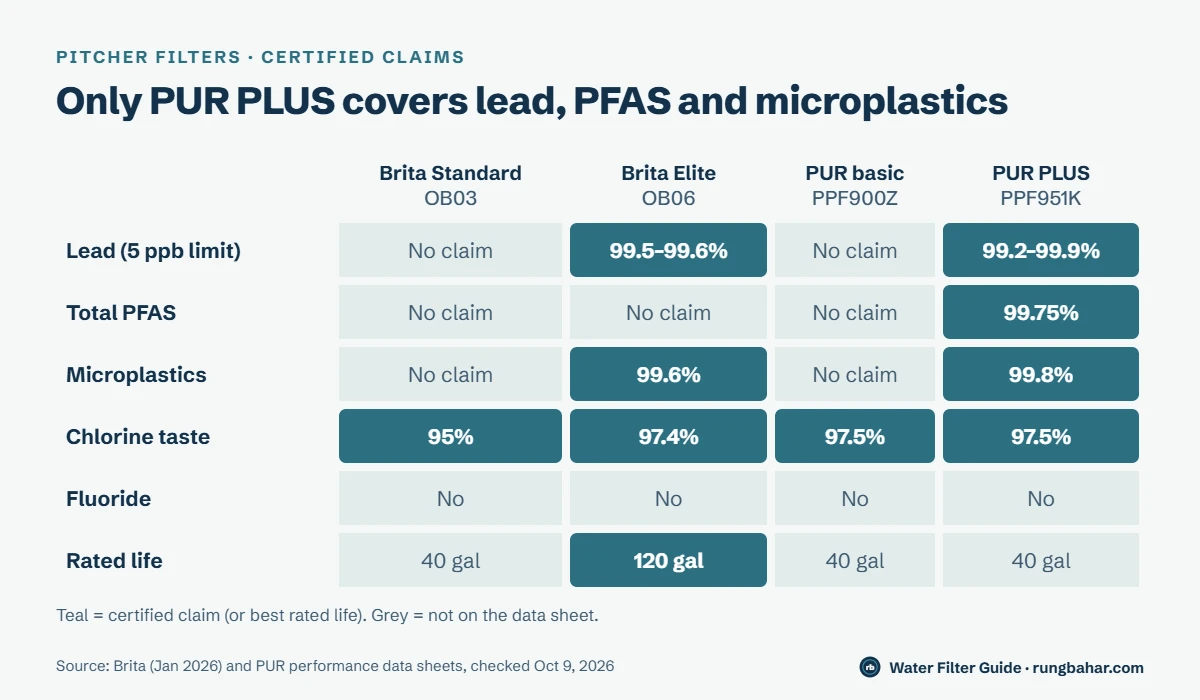
This table compares the certified claims on the four pitcher data sheets. “No claim” means the contaminant does not appear on the sheet. It does not prove the filter removes nothing; it means nobody certified a result.
| Contaminant | Brita Standard | Brita Elite | PUR (PPF900Z) | PUR PLUS (PPF951K) |
|---|---|---|---|---|
| Lead (NSF/ANSI 53, 5 ppb limit) | No claim | 99.5–99.6% | No claim | 99.2–99.9% |
| Total PFAS (NSF/ANSI 53) | No claim | No claim | No claim | 99.75% |
| Microplastics (NSF/ANSI 401) | No claim | 99.6% | No claim | 99.8% |
| Chlorine taste and odor (NSF/ANSI 42) | 95% | 97.4% | 97.5% | 97.5% |
| Mercury | 82–86% | 95.5–95.9% | 88.8–96.5% | >96.4% |
| Copper | 73–89% | No claim | 85.7–90.1% | 95.9–99.3% |
| Cadmium | 91–94% | 96.9–99.2% | 86.7–90.2% | 98.9–>99.3% |
| Benzene | No claim | Yes | 86.4% | >96.8% |
| Bisphenol A (NSF/ANSI 401) | No claim | Yes | No claim | >99.0% |
| Fluoride, nitrate, arsenic | No | No | No | No |
| Bacteria and viruses | No | No | No | No |
| Rated life | 40 gallons | 120 gallons | 40 gallons | 40 gallons |
| Certified by | WQA | IAPMO R&T, NSF, WQA | IAPMO R&T | IAPMO R&T |
Read the table by rows, not by brand. On the health claims people search for most (lead, PFAS and microplastics), PUR PLUS covers all three and the Brita Elite covers two. On life per filter, the Elite wins easily. On the budget filters, both cover taste and a few metals, and neither is the right choice if lead is your concern.
The certifier line is worth a note, because some readers expect to see “NSF” and do not. NSF International is one of several accredited certifiers that test to the NSF/ANSI standards. IAPMO R&T and the Water Quality Association (WQA) are accredited too, and a listing from any of them counts. Our guide to checking whether a filter is really certified shows how to look up a model on each certifier’s directory.
Lead: a tie between the right models
If lead is your reason for buying, both brands have a certified answer, and both have a filter that is not one. The Brita Elite data sheet shows lead cut from 150 parts per billion (ppb) to below the 5 ppb limit, with 99.5 percent average reduction at pH 6.5 and 99.6 percent at pH 8.5. The current PUR PLUS pitcher sheet shows 99.9 percent at pH 6.5 and 99.2 percent at pH 8.5, against the same 5 ppb limit.
Those numbers are close enough that they should not decide your purchase. Both filters passed the same pass-or-fail test against the same 5 ppb limit, and a fraction of a percentage point between averages tells you little about real use. What matters more is that you buy the certified model. The Brita Standard and the blue PUR PPF900Z have no lead claim at all, and they are usually the cheapest filters on the shelf, which is why they end up in many pitchers by default.
A detail for anyone who kept an old PUR leaflet: an earlier version of PUR’s pitcher data sheet showed the lead test against a 10 ppb limit, the rule before NSF tightened it in 2019. The current sheet shows 5 ppb. If you rely on a pitcher for lead, use the current sheet, and change the filter on time, because the claim only applies within the rated 40 or 120 gallons. Our guide to lead in tap water covers testing and what else to do while you wait for pipe replacement.
PFAS: only PUR PLUS carries a certified claim
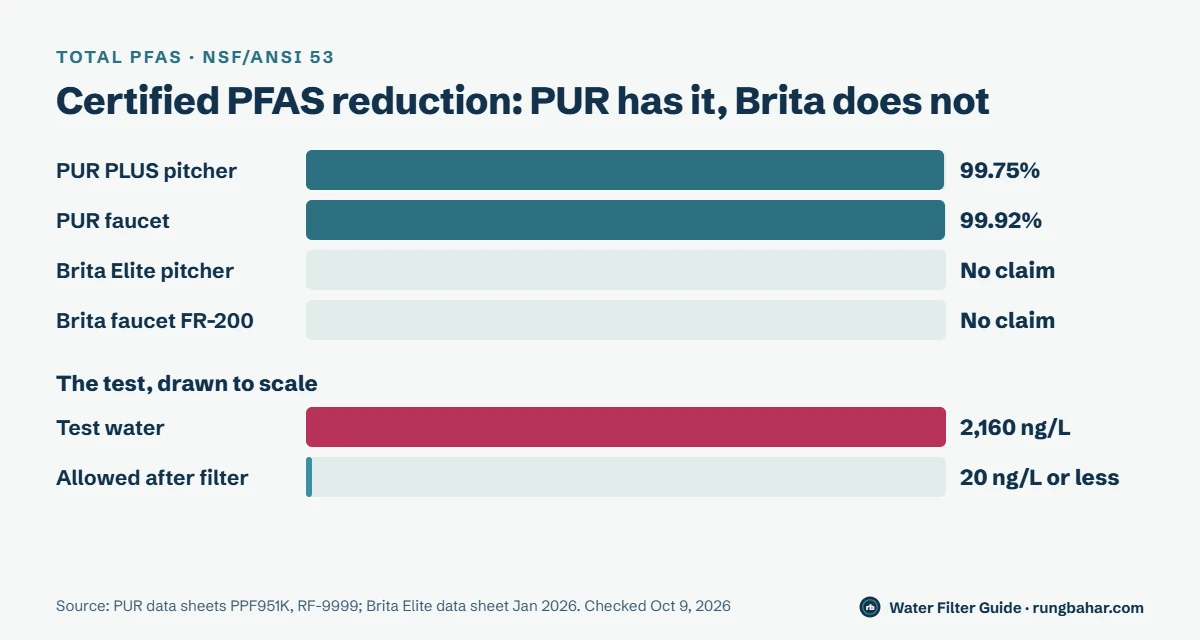
This is the biggest difference between the two brands right now. The PUR PLUS pitcher data sheet lists “Total PFAS” under NSF/ANSI 53 with a 99.75 percent average reduction. The test water starts at about 2,160 nanograms per liter of a mix of seven PFAS compounds (PFOA, PFOS, PFHxS, PFNA, PFHpA, PFBS and PFDA), and the filter has to bring the total down to 20 nanograms per liter or less across its rated life. PUR’s faucet filter lists the same test at 99.92 percent.
The Brita Elite data sheet dated January 2026 lists no PFOA, PFOS or total PFAS. You may find an older Elite data sheet online, dated February 2023 and posted on Brita’s Canadian site, that lists PFOA and PFOS at 98.1 percent. The current sheet does not include that claim, so treat Brita’s pitcher filters as having no certified PFAS reduction unless the leaflet in your own box says otherwise. Independent testing points the same way: a 2024 Université de Montréal study measured only partial and variable PFAS reduction from both Brita pitcher filters. Our page on what Brita filters remove has the details.
Two cautions keep this in proportion. First, the PUR PFAS certification was announced in September 2026, so filters made before then may come with an older leaflet that does not list it; check that the model number on your box matches the current data sheet and the IAPMO R&T listing. Second, a certified pitcher is one option, not the only one. The US EPA’s advice is to look for certification to NSF/ANSI 53 or 58 for PFAS reduction, and under-sink reverse osmosis systems certified under NSF/ANSI 58 remain the widest-coverage choice. Before you buy anything, it is worth finding out whether your water has PFAS at all; how to check for PFAS in your tap water walks through the free sources.
Microplastics: both premium filters are certified
Microplastics reduction is tested under NSF/ANSI 401, using particles between 0.5 and 1 micron, and a filter must reduce them by at least 85 percent. The Brita Elite averaged 99.6 percent and the PUR PLUS pitcher 99.8 percent. On the faucet, Brita’s FR-200 lists 99.9 percent and PUR’s faucet filter 99.65 percent.
Any of those four is a reasonable choice if microplastics are your main concern. The basic filters from both brands make no microplastics claim. The PUR PPF900Z lists a much coarser particle class (50 to 80 microns), which is about sediment, not microplastics. For what the 401 test does and does not tell you, see our guide to water filters for microplastics.
Filter life and cost per gallon
Here Brita has the clear advantage. The Elite is rated for 120 gallons. The PUR PLUS, PUR basic and Brita Standard pitcher filters are each rated for 40. Both brands’ faucet filters are rated for 100 gallons.
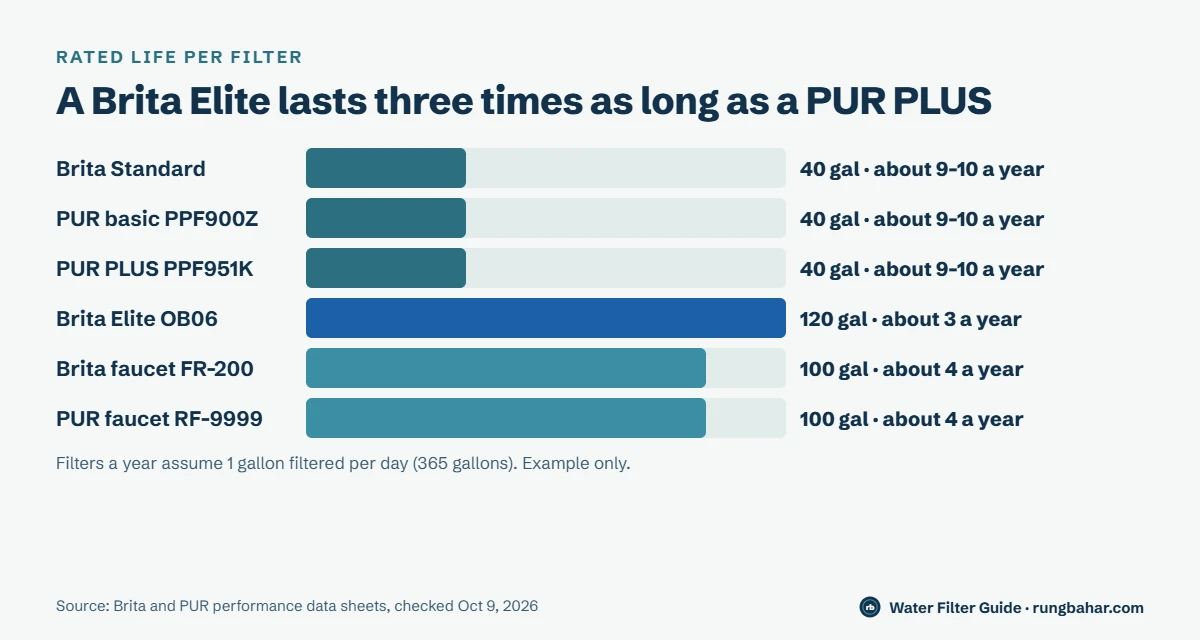
Rated gallons turn into a yearly filter count you can plan around. As an example only, take a household that filters 1 gallon a day for drinking and cooking, or 365 gallons a year:
- A 40-gallon pitcher filter (PUR PLUS, PUR basic or Brita Standard): about 9 to 10 filters a year.
- A Brita Elite at 120 gallons: about 3 filters a year.
- A 100-gallon faucet filter from either brand: about 4 filters a year.
Multiply those counts by the price you actually see in your store or online, for the pack size you would buy. We do not quote prices here because they change weekly and vary by retailer. The point is the ratio: a PUR PLUS filter has to cost about a third of a Brita Elite filter to match it per gallon. If you filter more than 2 gallons a day, though, note that Brita says the Elite should process no more than 2 gallons daily for best results, and a faucet filter may suit you better than any pitcher.
Filter life has a practical side too. A filter used past its rating does not just slow down; the certified claims no longer apply. If you know you are bad at remembering replacements, fewer changes a year is a real benefit, not just a cost one.
Faucet filters: Brita vs PUR
The faucet comparison follows the same pattern as the pitchers. Both brands rate their faucet cartridges for 100 gallons and certify them for lead, microplastics, chlorine and a long list of volatile organic chemicals and pesticides. The difference is PFAS.
| Claim | Brita faucet (FR-200) | PUR faucet (RF-9999 / RF3375) |
|---|---|---|
| Lead | 99.9% | 99.6–99.7% |
| Total PFAS | No claim | 99.92% |
| Microplastics | 99.9% | 99.65% |
| Chlorine taste and odor | 99.0% | 98.71% |
| Asbestos | 99.9% | No claim |
| Mercury | No claim | 78.6–81.6% |
| VOCs (chloroform surrogate) | 99.8% | 99.51% |
| Rated life | 100 gallons | 100 gallons |
| Rated flow | 0.58 gal/min | 0.52 gal/min |
| Certified by | WQA | IAPMO R&T |
PUR’s current faucet data sheet covers both of its replacement cartridges, the RF-9999 (PUR PLUS, with its Mineral Core) and the RF3375, with one set of results, while PUR’s announcement names the RF-9999. If PFAS is your reason for choosing PUR’s faucet filter, check that the cartridge you buy appears on the IAPMO R&T listing with a PFAS claim. Brita’s faucet sheet covers its FF-100 and SAFF-100 systems with the FR-200 cartridge.
Faucet filters suit people who go through more water than a pitcher can keep up with, and renters who cannot install anything under the sink. They generally do not fit pull-down or sprayer faucets, so check the brand’s compatibility notes against your tap first. For more renter-friendly options, see our guide to water filters for an apartment.
What neither Brita nor PUR removes
A pitcher or faucet filter from either brand is a carbon filter. That makes it good at taste, chlorine, many metals and many organic chemicals, and no use at all for some common concerns:
- Fluoride: no data sheet from either brand lists it. Brita says outright that its filters are not designed to remove fluoride. See filters that actually remove fluoride.
- Nitrate and arsenic: not listed by either brand. These usually need reverse osmosis or specialist media.
- Bacteria and viruses: both brands say their filters do not remove microbes and must not be used on unsafe water without disinfection. They are not for boil-water notices or untested wells.
- Chloramine: neither pitcher sheet has a specific chloramine claim, which matters if your utility disinfects with chloramine.
- Hardness: neither softens water or stops scale in a meaningful way.
If your concern is on that list, the brand question does not matter. The reverse osmosis guide covers the main alternative.
Which one to buy
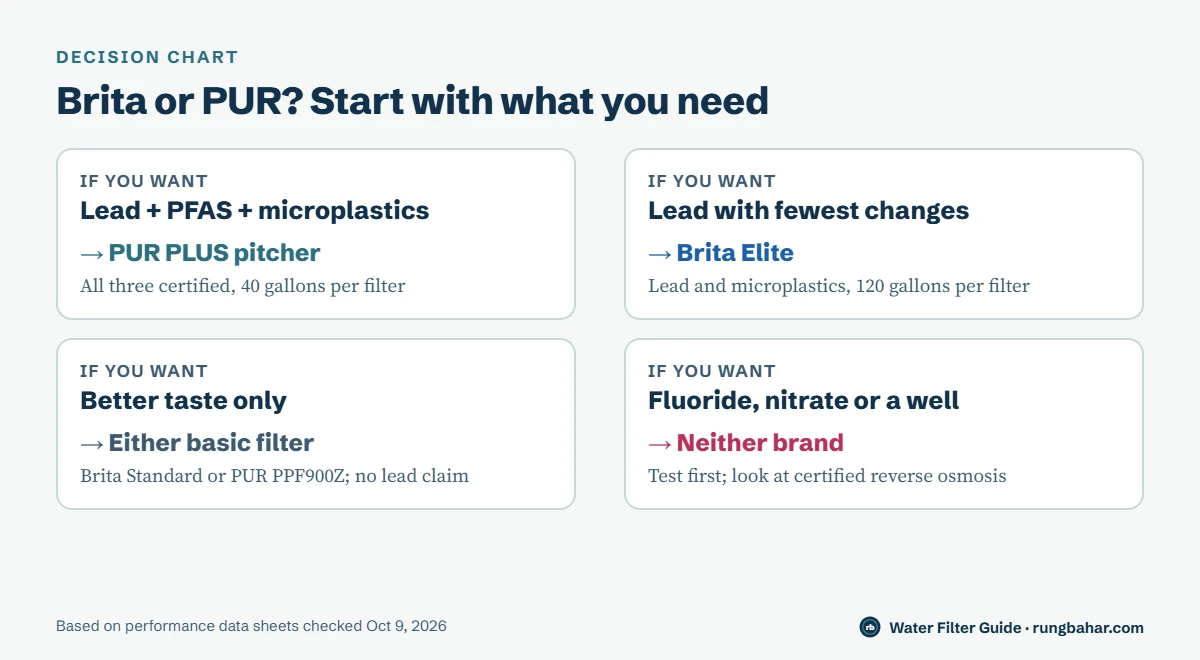
There is no single winner, but there is a clear answer for each situation:
- You want the most certified claims in a pitcher: PUR PLUS (PPF951K). It is the only one of the four with lead, microplastics and total PFAS all certified.
- You want lead and microplastics with the fewest filter changes: Brita Elite (OB06). Three times the life per filter, and lead and microplastics certified.
- You only want better-tasting city water: either brand’s basic filter is enough, but do not rely on it for lead.
- You want a faucet filter and care about PFAS: PUR, after confirming the cartridge’s listing.
- You need fluoride, nitrate or arsenic removed, or you are on a well: neither. Look at certified reverse osmosis, after testing.
Most certified claims
PUR PLUS pitcher filter (PPF951K)
- Certification: NSF/ANSI 42, 53 (lead, total PFAS) and 401 (microplastics)
- Best for: Lead, PFAS and microplastics in one pitcher
- Skip if: you hate frequent filter changes (40 gallons each)
Longest life
Brita Elite pitcher filter (OB06)
- Certification: NSF/ANSI 42, 53 (lead) and 401 (microplastics)
- Best for: Lead and microplastics with about 3 changes a year at 1 gallon a day
- Skip if: PFAS is your main concern
Faucet mount
PUR faucet filter (RF-9999)
- Certification: NSF/ANSI 42, 53 (lead, total PFAS) and 401
- Best for: Higher daily use, renters, PFAS plus lead
- Skip if: you have a pull-down or sprayer faucet
How to check a Brita or PUR claim before you buy
Both brands sell several filters in similar boxes, and store listings mix them up. Five minutes of checking avoids buying the wrong one:
- Find the exact model number of the replacement filter: OB03 or OB06 for Brita pitchers, PPF900Z or PPF951K for PUR pitchers, FR-200 for Brita faucet, RF-9999 or RF3375 for PUR faucet.
- Open the performance data sheet for that model (links in the sources below) and find your contaminant in the table.
- Check the limit and the rated life. A lead claim with a 5 ppb limit is the current standard.
- Confirm the listing with the certifier named on the sheet: IAPMO R&T for PUR, and WQA, NSF or IAPMO R&T for Brita.
- If a contaminant is missing from the data sheet, treat it as not covered, whatever the packaging says.
If you are still deciding which type of filter you need, start with how to choose a water filter in 5 steps, or answer three questions in the filter finder. And if you are on city water, the ZIP code tap-water check on our homepage shows what your utility reports.
Brita vs PUR: 12 common questions, answered
These are the questions people search most when choosing between Brita and PUR, answered from the data sheets.
Is Brita or PUR better?
It depends on the model. PUR PLUS has more certified claims (lead, microplastics and total PFAS). Brita Elite lasts three times as long per filter and covers lead and microplastics. Both brands’ basic filters cover taste only, not lead.
Which is better for lead, Brita or PUR?
Both brands have filters certified under NSF/ANSI 53 to reduce lead below 5 ppb: Brita Elite (99.5 to 99.6 percent) and PUR PLUS (99.2 to 99.9 percent), plus both faucet filters. The Brita Standard and PUR PPF900Z are not certified for lead.
Does PUR remove PFAS?
The PUR PLUS pitcher filter (PPF951K) is certified under NSF/ANSI 53 for 99.75 percent total PFAS reduction, and PUR’s faucet filter for 99.92 percent, according to PUR’s data sheets and a September 2026 announcement. The basic PUR PPF900Z has no PFAS claim.
Does Brita remove PFAS?
Not as a certified claim. Brita’s January 2026 Elite data sheet and its faucet filter sheet list no PFAS. An older 2023 Canadian Elite sheet listed PFOA and PFOS, but the current sheet does not.
Brita vs PUR faucet filter: which is better?
Both are rated for 100 gallons and certified for lead and microplastics. PUR’s faucet sheet adds total PFAS. Brita’s FR-200 adds asbestos and has a slightly higher rated flow (0.58 vs 0.52 gallons a minute).
Which filter lasts longer, Brita or PUR?
The Brita Elite, at 120 gallons. PUR PLUS, PUR basic and Brita Standard pitcher filters are rated for 40 gallons. Faucet filters from both brands are rated for 100 gallons.
Can I use a Brita filter in a PUR pitcher?
No. The two brands use different cartridge shapes, and each data sheet lists the specific pitchers its filter was certified in. Using a filter in a pitcher it was not tested with means the certified results may not apply.
Do Brita or PUR filters remove fluoride?
No. Neither brand lists fluoride on any data sheet. For fluoride you need reverse osmosis, activated alumina, bone char or distillation.
Is PUR NSF certified?
PUR’s current data sheets name IAPMO R&T as the certifier, testing to the NSF/ANSI 42, 53 and 401 standards. IAPMO R&T is an accredited certifier, so the claims count the same as an NSF International listing.
Brita vs PUR vs ZeroWater: how do they differ?
ZeroWater uses ion exchange as well as carbon and is built to remove dissolved solids, so it behaves differently from both. Compare the data sheets for the exact filters; our ZeroWater vs Brita comparison covers the ZeroWater data sheets.
Brita vs PUR vs Culligan or Waterdrop: does the same method apply?
Yes. For any brand, find the replacement filter’s model number, read its performance data sheet and confirm the listing with the certifier. Claims missing from the data sheet do not count.
Are Brita or PUR filters safe for well water?
Only if the well water is already microbiologically safe. Both brands say their filters do not remove microbes. Test a private well for bacteria, nitrate and arsenic before choosing any filter.
Sources and how we checked this page
Every claim on this page comes from Brita’s and PUR’s performance data sheets, PUR’s September 2026 announcement, the US EPA and a peer-reviewed study, checked on October 9, 2026. We do not test filters in a lab, and we have no commercial relationship with Brita or PUR. Data sheets change, so check the one for the exact filter you buy.
- PUR: Performance data sheets (all current models)
- PUR: Performance data sheet, PUR PLUS pitcher filter PPF951K (PDF)
- PUR: Performance data sheet, PUR pitcher filter PPF900Z (PDF)
- PUR: Performance data sheet, PUR PLUS faucet filter RF-9999 (PDF)
- PUR: Performance data sheet, PUR faucet filter RF3375 (PDF)
- PUR via GlobeNewswire: PUR PLUS certified to reduce lead, microplastics and total PFAS (Sept 15, 2026)
- Brita: Performance data sheet, Brita Elite filter (January 2026, PDF)
- Brita Canada: Elite data sheet with PFOA/PFOS claim (February 2023, PDF)
- Brita: Performance data sheet, Brita Standard filter OB03 (PDF)
- Brita: Performance data sheet, faucet systems FF-100 and SAFF-100 with FR-200 filter (PDF)
- Teymoorian et al. (2024), Frontiers in Environmental Chemistry: PFAS removal by pitcher filters
- US EPA: Reducing PFAS in your drinking water with a home filter (PDF)
- NSF: Stricter requirements for lead reduction certification (2019)
- IAPMO R&T product listing directory
- NSF certified drinking water treatment unit listings