Updated October 14, 2026, by the RB Water Desk. How we research.
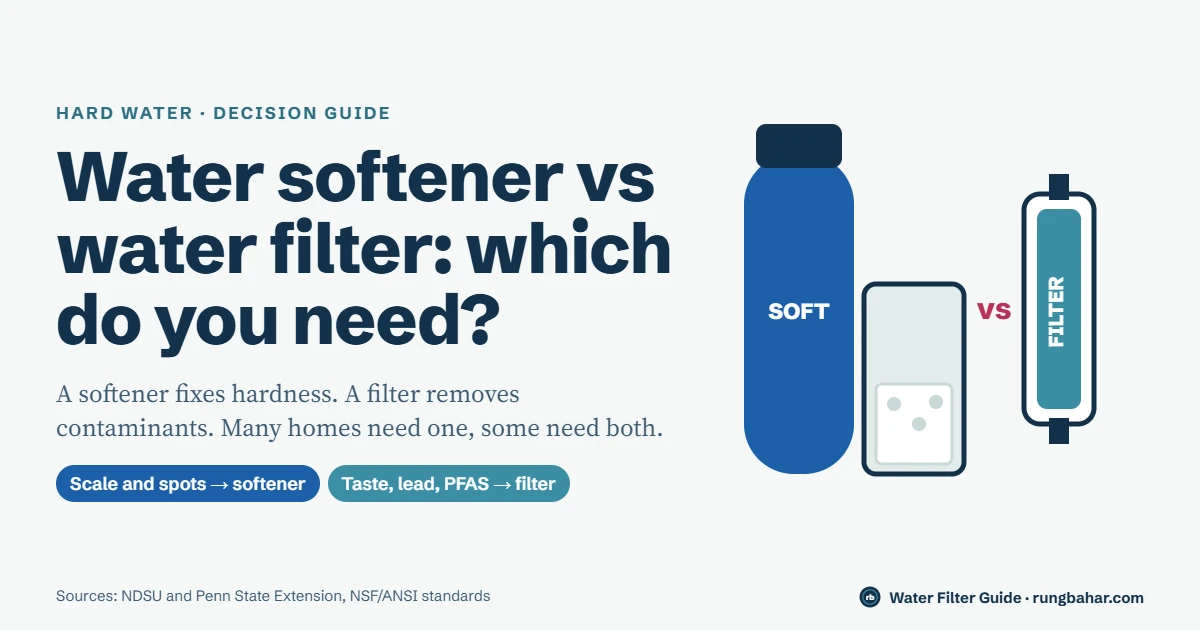
The short answer: A water softener removes hardness, the calcium and magnesium that cause scale, spots and poor lather. It does not make water safer to drink. A water filter removes contaminants such as chlorine, lead, PFAS or sediment, depending on what it is certified for, and it does not stop scale. If your problem is scale, you need a softener. If it is taste or a test result, you need a filter. Many homes with hard water and a drinking-water concern end up with both: a softener for the house and a certified filter at the kitchen tap.
Two different jobs
The confusion comes from the word “treatment”. Softeners and filters both sit on your plumbing, both need upkeep, and both are sold by the same dealers. But they solve different problems, and buying one when you needed the other is a costly mix-up.
Hardness is the amount of dissolved calcium and magnesium in your water. It is not a health risk. The US Geological Survey classes water as soft up to 60 mg/L (as calcium carbonate), moderately hard from 61 to 120, hard from 121 to 180 and very hard above 180. Softener sellers use grains per gallon (gpg); one grain per gallon is 17.1 mg/L, so 120 mg/L is about 7 gpg and 180 mg/L about 10.5 gpg. Hardness causes practical problems: scale in water heaters, kettles and shower heads, spots on dishes, and soap that will not lather. Our guide to hard water vs soft water explains the signs and how to test.
Contaminants are things you may not want to drink: chlorine and its taste, lead from old pipes, PFAS, nitrate, arsenic, sediment, or germs in a well. Some are health risks, some are only taste. Each one needs a treatment that is tested for it.
So the first question is not “softener or filter?” It is “what is actually in my water, and what bothers me about it?” A hardness test strip answers half of that in a minute. A utility water quality report or a lab test answers the rest.
What a water softener does
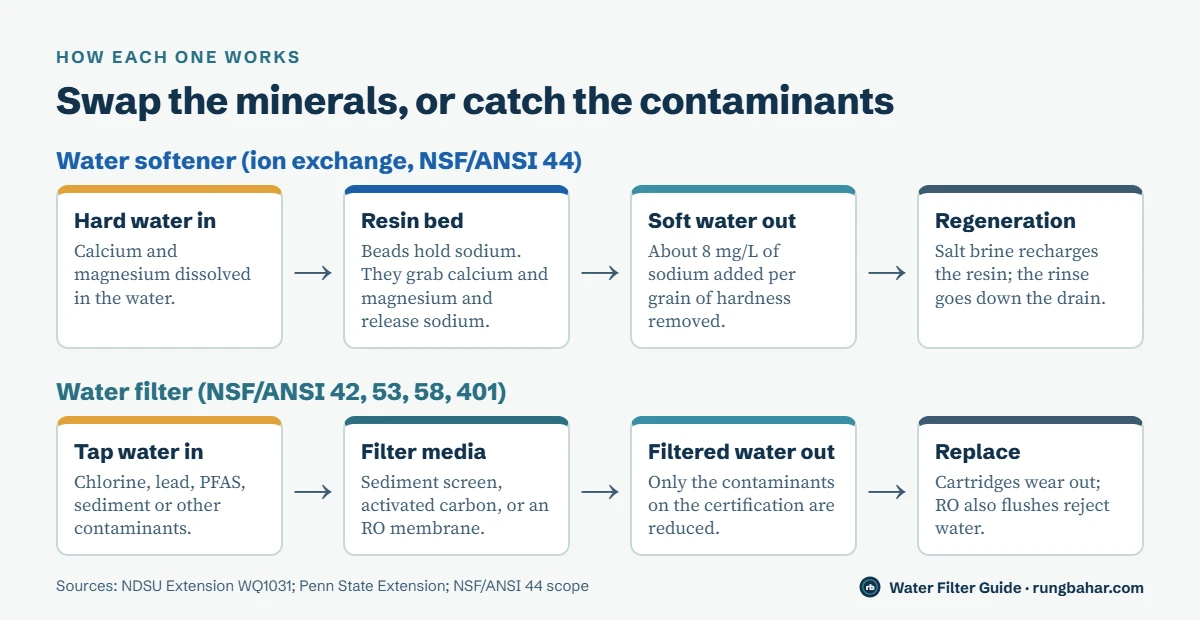
A standard water softener is an ion exchange unit. Water flows through a tank of resin beads that carry sodium. The beads grab calcium and magnesium out of the water and release sodium in their place. When the beads are full of hardness, the softener regenerates: it flushes them with salt brine from a second tank, which pushes the hardness off the beads and sends it down the drain. Penn State Extension estimates about 50 gallons of water per regeneration, which matters if you are on a septic system.
Residential softeners are certified under NSF/ANSI 44. The standard covers hardness reduction, the softener’s materials and its efficiency. It also allows two optional health claims, barium and radium, which a manufacturer can choose to have tested. Nothing in it covers lead, PFAS, chlorine, nitrate or germs.
Softeners do handle one common well-water problem. North Dakota State University Extension says a standard softener removes dissolved iron and manganese up to about 10 ppm. Above that, or when the iron is already rusty (oxidized), it clogs the resin and needs its own filter first. Penn State Extension also warns that bacteria can grow in the resin bed, so water that is not microbiologically safe should be disinfected before it reaches a softener.
What a softener adds is sodium. NDSU puts it at about 8 mg/L of sodium for every grain per gallon of hardness removed. We come back to what that means for drinking water below.
What a water filter does
“Water filter” covers several technologies that remove different things. The certification standard tells you which job a particular filter has been tested for.
- Sediment filters catch sand, rust flakes and silt. They protect plumbing and other equipment but do little for dissolved contaminants.
- Activated carbon filters (pitchers, faucet mounts, under-sink and whole-house cartridges) remove chlorine taste and odor under NSF/ANSI 42, and some are certified under NSF/ANSI 53 for health contaminants such as lead, PFAS or volatile organic chemicals. Chloramine needs carbon certified specifically for it, usually catalytic carbon.
- Reverse osmosis (RO) pushes water through a membrane that holds back most dissolved substances, certified under NSF/ANSI 58. It is the main home option for nitrate, arsenic, fluoride and total dissolved solids, and it also lowers sodium.
- NSF/ANSI 401 covers emerging contaminants such as microplastics and some pharmaceuticals. NSF/ANSI 55 covers UV disinfection, which is not a filter at all but is the usual answer for bacteria in a well.
Filters wear out on a schedule, not on a salt delivery. A carbon cartridge loses its certified performance after its rated gallons, and an RO membrane and its pre-filters on the schedule in the maker’s manual. None of them removes hardness in a useful way except RO, which does it at one tap and pays for it in membrane life.
Water softener vs water filter, side by side
| Water softener | Water filter | |
|---|---|---|
| Main job | Removes hardness (calcium, magnesium) | Removes the contaminants it is certified for |
| Fixes scale, spots, poor lather | Yes | No (RO only at one tap) |
| Improves chlorine taste | No | Yes, carbon (NSF/ANSI 42) |
| Lead, PFAS, VOCs | No claim | If certified (NSF/ANSI 53 or 58) |
| Nitrate, arsenic, fluoride | No | RO if certified (NSF/ANSI 58) |
| Iron and manganese | Dissolved, up to about 10 ppm | Needs a dedicated iron filter |
| Bacteria and viruses | No; can grow in the resin | No; use disinfection (UV, NSF/ANSI 55) |
| Changes sodium | Adds about 8 mg/L per gpg removed | No change (carbon) or lowers it (RO) |
| Usual location | Point of entry: whole house | Point of use (one tap) or point of entry |
| Upkeep | Salt refills; regeneration water to drain | Cartridge or membrane changes |
| Certification | NSF/ANSI 44 | NSF/ANSI 42, 53, 58, 401 |
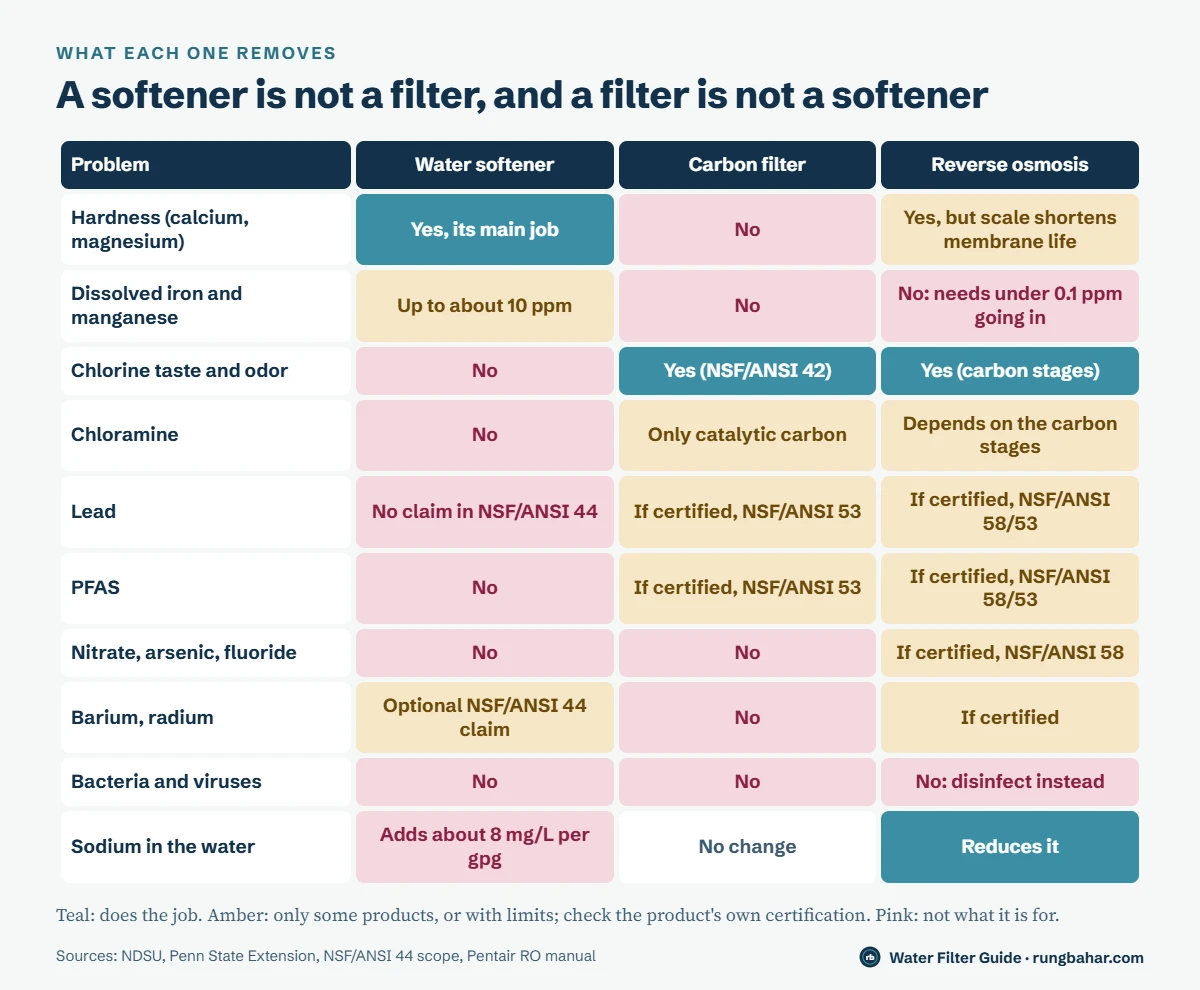
Two rows deserve a second look. First, a softener is not a health device. It can be certified for barium and radium, but its listing will not say anything about lead or PFAS, so do not buy one for those. Second, a filter is not a scale fix. Pitcher, faucet and whole-house carbon filters leave calcium and magnesium in the water, which is why a house can have an expensive filter and still have a crusted water heater.
Water softener vs whole house filter
This is the comparison people most often get wrong, because both are big tanks in the garage or basement. A whole-house filter is usually a large carbon or sediment unit at the main line. It treats every tap, so it is the choice when chlorine or chloramine bothers you in the shower as well as the glass, or when sediment is fouling fixtures. It does nothing for hardness.
A softener also sits at the main line, but its job is hardness. If you have both problems, you can install both, usually with sediment or iron treatment first so the softener resin stays clean. Follow the order in each maker’s installation manual, because some carbon media and some resins have their own limits on chlorine, iron and pressure. If chlorine taste is only a drinking-water issue, a point-of-use carbon filter at the kitchen tap is a cheaper answer than a whole-house filter. For renters, who usually cannot install either, see renter-friendly water filters.
Water softener vs reverse osmosis
Reverse osmosis is the one filter that does remove hardness, which is why the two get compared. But RO and a softener are rarely alternatives. An RO system makes a few gallons a day at one tap, and it is there for drinking and cooking water. A softener treats every gallon the house uses.
Hard water is actually a problem for RO. The membrane scales up the same way a kettle does. One example: Pentair’s FreshPoint GRO-575 under-sink RO manual says the system is not recommended on water above 10 gpg (171 mg/L) of hardness, and it also wants iron, manganese and sulfide below 0.1 ppm going in. On very hard water, a softener ahead of the RO protects the membrane, and the RO then takes most of the added sodium back out at the drinking tap. That pairing is common in hard-water areas. Check your own RO manual’s feed-water limits before you buy. Our guide to what reverse osmosis removes lists its certified claims, and whether RO water is good for you covers the mineral question.
Softened water and sodium
Because a softener swaps hardness for sodium, softened water carries more sodium than the water that went in. Using NDSU’s figure of about 8 mg/L per grain removed:
- At 5 gpg of hardness, softening adds about 40 mg/L of sodium.
- At 10 gpg, about 80 mg/L.
- At 20 gpg, about 160 mg/L.
For comparison, the US EPA’s drinking water advisory on sodium recommends keeping sodium between 30 and 60 mg/L for taste, and sets a guidance level of 20 mg/L for people on a very low sodium diet of 500 mg a day. The 20 mg/L figure is meant for that group, not for everyone. A liter of water at 80 mg/L adds 80 mg of sodium to the day, which is small next to food for most people, but it is not nothing if your doctor has you on a strict limit.
There are three simple answers. Leave the kitchen cold tap unsoftened, which NDSU suggests for drinking and cooking. Put an RO system at the kitchen tap. Or regenerate with potassium chloride instead of salt; NDSU notes it costs more and the softener needs about 10 percent more of it. People on sodium-restricted diets should ask their physician. Our salt-free vs salt softener guide looks at the no-salt alternatives.
When you need both, and in what order
Plenty of homes have hard water and a drinking-water concern at the same time. The usual layout treats the house for hardness and the drinking tap for contaminants.
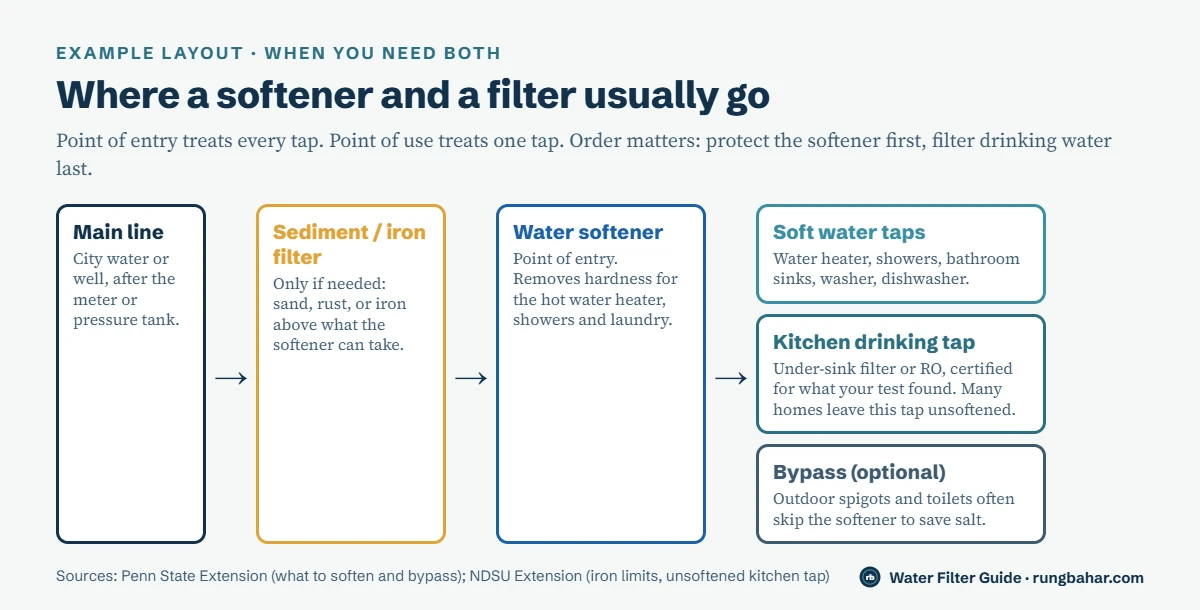
Penn State Extension suggests softening the water that goes to showers, sinks and laundry, and bypassing toilets, outdoor spigots and some basement taps, which saves salt and water. A softener is normally sized for the whole house; our water softener size calculator works out the grain capacity from your hardness and household size.
Two worked examples
Example only: a private well at 18 gpg hardness, 2 ppm iron and nitrate at 6 mg/L. The hardness and the dissolved iron are both within what a standard softener handles (iron under about 10 ppm), so a softener at the pressure tank deals with scale and staining. The softener does nothing for nitrate. At 6 mg/L the nitrate is under the 10 mg/L federal limit, but if the household wants it lower at the drinking tap, an under-sink RO system certified under NSF/ANSI 58 for nitrate is the tool, fed with softened water so the membrane is not scaling. The family retests after installation. See well water test results explained for how to read a lab report like this one.
Example only: city water at 12 gpg, disinfected with chloramine, in a house with an older service line. A softener handles the scale on fixtures and the water heater. For drinking water, the household picks a point-of-use filter certified under NSF/ANSI 53 for lead, and if the chloramine taste bothers them, one also certified for chloramine. A whole-house catalytic carbon filter is only worth it if they also mind chloramine in the shower. While waiting for the service line to be replaced, they follow the steps in lead in tap water.
What about salt-free conditioners, descalers and shower filters?
Three other devices get sold as “alternatives” to both, and none of them is a filter or a true softener.
- Salt-free conditioners (often called salt-free softeners) leave calcium and magnesium in the water and try to change them into a form that is less likely to stick as scale. They do not soften, and they are not filters. Our salt-free vs salt softener comparison covers what the research shows.
- Electronic and magnetic descalers clamp onto a pipe and claim to change how scale forms. They remove nothing from the water. Look for independent evidence before spending money on one.
- Shower filters are usually small carbon or KDF cartridges for chlorine. The relevant standard is NSF/ANSI 177, which covers free chlorine reduction. They do not soften water, so they will not fix dry, tight-feeling skin if hardness is the cause.
Which one do you need?
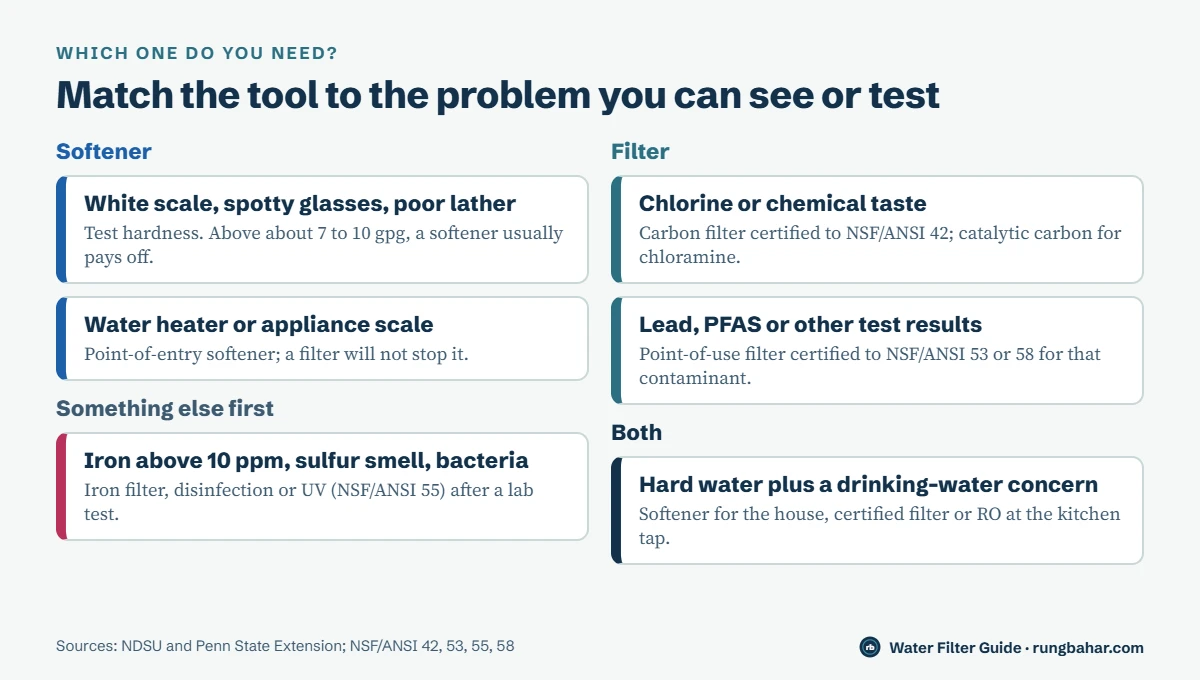
- Softener only: scale, spots and poor lather; city water that tests fine otherwise.
- Filter only: soft or moderately hard water with a taste problem or a contaminant on your report.
- Both: hard water plus a taste or health concern, or a well with hardness and a health contaminant.
- Something else first: bacteria (disinfection), iron above about 10 ppm or rusty water (iron filter), or no test at all yet.
For hardness
A softener certified to NSF/ANSI 44
- Certification: NSF/ANSI 44 (hardness; optional barium and radium)
- Best for: Scale, spots and lather on hard water
- Skip if: your problem is taste, lead or PFAS
For contaminants
A filter certified for your contaminant
- Certification: NSF/ANSI 42 (taste), 53 (lead, PFAS) or 58 (RO)
- Best for: Drinking-water concerns from a test or report
- Skip if: scale is your only problem
Before you buy anything
- Test hardness. A test strip gives gpg in a minute; your utility report also lists hardness.
- Read your water quality report or get a lab test if you are on a well. Use our ZIP code tap-water check to start.
- Name the problem you want gone: scale, taste, a contaminant, or more than one.
- Check the certification of any product against that problem: NSF/ANSI 44 for softeners, 42, 53, 58 or 401 for filters. Our guide to checking a certification shows how.
- Ask about upkeep: salt use and regeneration water for a softener, cartridge and membrane schedules for a filter.
- Be wary of free “water tests” from sellers. Penn State Extension recommends an independent lab instead.
Still not sure? Answer three questions in our filter finder or start with the step-by-step guide to choosing a water filter.
Water softener vs filter: 14 common questions, answered
These are the questions people search most when choosing between a softener and a filter.
What is the difference between a water softener and a water filter?
A softener removes hardness (calcium and magnesium) by ion exchange, which stops scale and spots. A filter removes the contaminants it is certified for, such as chlorine, lead or PFAS. A softener does not make water safer to drink, and most filters do not soften.
Does a water softener filter water?
Not in the usual sense. It removes hardness and some dissolved iron and manganese, and it can be certified for barium and radium, but it has no claims for chlorine, lead, PFAS, nitrate or germs.
Does a water softener remove lead?
Softeners are not certified for lead under NSF/ANSI 44. For lead, use a filter certified under NSF/ANSI 53 or 58 for lead at the tap you drink from.
Does a water softener remove chlorine?
No. Chlorine taste and odor need activated carbon certified under NSF/ANSI 42, and chloramine needs carbon certified for chloramine.
Can a water filter soften water?
Only reverse osmosis meaningfully removes hardness, and it does so at one tap. Carbon pitchers, faucet filters and whole-house carbon filters leave hardness in the water.
Water softener vs whole house filter: which do I need?
A whole-house filter treats chlorine, chloramine or sediment at every tap. A softener treats hardness at every tap. If you have both problems, many homes install both, with sediment or iron treatment first.
Water softener vs reverse osmosis: which is better?
They do different jobs. RO purifies drinking water at one tap; a softener treats the whole house for hardness. On very hard water, a softener ahead of the RO protects the membrane.
Do I need a water softener if I have reverse osmosis?
Not for drinking water. You may still want one for the water heater, showers and appliances if your water is hard, and some RO systems are not recommended above about 10 gpg of hardness.
Water softener vs water conditioner: what is the difference?
A softener removes calcium and magnesium. A salt-free conditioner leaves them in the water and tries to reduce how much scale they form. Only the softener gives you soft water.
Water softener vs water purifier: what is the difference?
A purifier is meant to make unsafe water safe, usually by removing or killing germs, for example with UV or RO plus disinfection. A softener does neither; it only removes hardness.
Is softened water safe to drink?
For most people, yes. It contains extra sodium, about 8 mg/L per grain of hardness removed. People on sodium-restricted diets should ask their doctor and can keep an unsoftened tap or use RO for drinking.
Which comes first, the filter or the softener?
Usually sediment or iron treatment comes first to protect the softener, then the softener, then any drinking-water filter or RO at the kitchen tap. Follow each maker’s installation order.
Do Brita or PUR filters soften water?
No. Pitcher and faucet filters are carbon filters for taste and certified contaminants. They do not remove hardness in a way that prevents scale.
Is a shower filter the same as a water softener?
No. Most shower filters reduce chlorine (NSF/ANSI 177 covers this) and do not remove calcium and magnesium.
Sources and how we checked this page
Every claim on this page comes from university extension services, NSF/ANSI standard scopes, the US EPA, the US Geological Survey and a manufacturer’s installation manual, checked on October 14, 2026. We do not test softeners or filters, and we have no commercial relationship with any maker named here. Product limits vary, so check the manual and certification for the exact unit you buy.
- NDSU Extension: Water softening (ion exchange), WQ1031 (sodium per grain, iron limits, unsoftened kitchen tap)
- Penn State Extension: Water softening (regeneration water, what to soften and bypass, testing)
- NSF/ANSI 44: residential cation exchange water softeners, scope (PDF preview)
- US Geological Survey: Hardness of water (classification)
- US EPA: Drinking water advisory on sodium, EPA 822-R-03-006 (PDF)
- Pentair FreshPoint GRO-575 reverse osmosis manual: feed-water limits (PDF)
- NSF: certified drinking water treatment unit listings