Updated October 17, 2026, by the RB Water Desk. How we research.
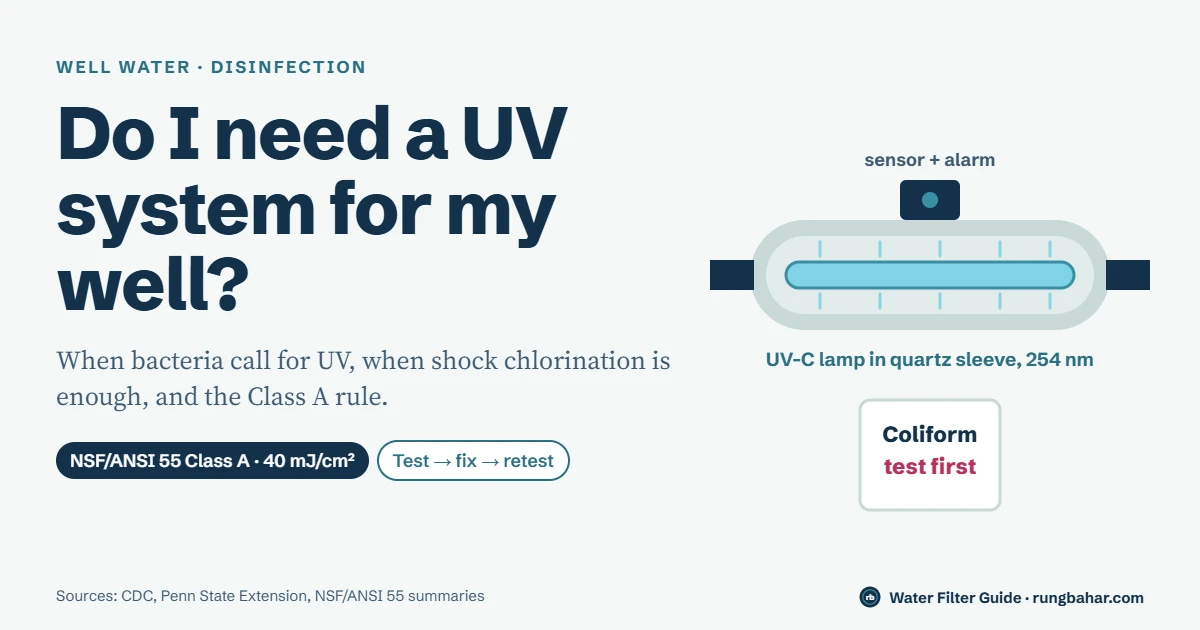
The short answer: You need a UV system for your well if bacteria keep coming back: a positive coliform test that returns after you have fixed the well and shock-chlorinated it, or a spring or well that cannot be sealed. A single positive test usually calls for finding the cause and shock chlorination first, not new equipment. If you do install UV, choose an NSF/ANSI 55 Class A system with a UV sensor and alarm, put a 5-micron sediment filter (and a softener or iron filter if needed) in front of it, and remember that UV only kills germs: it does nothing for nitrate, arsenic, lead or hardness.
Quick check
What did your last well water test show?
When a well needs UV, and when it does not
Private wells are not regulated under the federal Safe Drinking Water Act, and most states do not regulate them either. About 15 percent of the US population, more than 43 million people, rely on private wells, and each owner is responsible for the safety of the water. Nobody will tell you that your well has bacteria unless you test it, which is why the UV question always starts with a test result.
Bacteria tests for wells usually report total coliform and E. coli. Total coliform bacteria are indicator organisms: most are not harmful themselves, but their presence shows that surface water or soil is getting into the well. E. coli is much more serious because it comes from human or animal waste. Our guide to reading well water test results covers the rest of the report.
The table shows the usual next step for each kind of result:
| Test result | What it usually means | What to do |
|---|---|---|
| Coliform negative | No indicator bacteria in that sample | No UV needed now; test every year |
| Coliform positive, first time | An opening, a recent repair or a one-off event | Confirm, fix the cause, shock-chlorinate, retest twice |
| Coliform back after shocking | A persistent source the well cannot be sealed against | Continuous disinfection: UV or chlorination |
| E. coli positive | Waste is reaching the water | Stop drinking it untreated; find and fix the source with a professional |
| Spring water with repeat positives | Springs are hard to shock-chlorinate | Continuous disinfection is often the practical answer |
Penn State Extension notes that shock chlorination of springs is difficult and rarely successful, which is why spring water systems are a common UV case. For drilled wells, the cause is often fixable: a missing or loose well cap or a cracked casing.
Why shock chlorination comes first
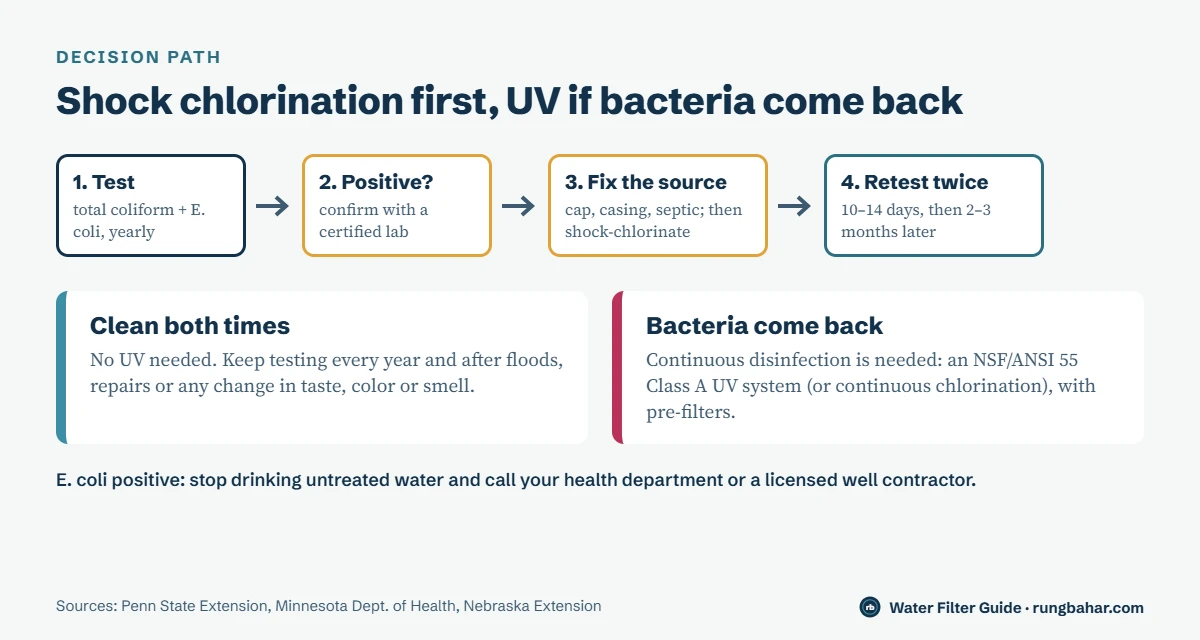
Shock chlorination means putting a strong dose of chlorine into the well and plumbing, letting it sit, and then flushing it out. It is the standard response to a first positive coliform test, and it is also recommended after a new well is drilled or after the pump or well is worked on. It needs no new equipment.
The Minnesota Department of Health and Penn State Extension describe the same sequence:
- Confirm the result with a state-certified lab and ask for an E. coli test if it was not included.
- Use bottled water for drinking and cooking until the water tests clean. Boiling kills bacteria, but it concentrates nitrate and arsenic, so it is not a long-term fix if those are also present.
- Find and fix the source: a sanitary (vermin-proof) well cap, a cracked casing, animals or debris in the well, a leaking septic system nearby if E. coli was found.
- Shock-chlorinate the well and plumbing, ideally using a licensed well contractor.
- Retest 10 to 14 days later, then again 2 to 3 months after that.
If the bacteria come back in either retest, Penn State says a continuous disinfection system will be necessary. That is the point where UV makes sense. Their research also gives a reason not to expect too much from shocking: in one study, shock chlorination plus a sanitary well cap kept bacteria away for a full year in only 15 percent of wells, and it worked best when counts were low (fewer than 10 colonies per 100 mL) and no E. coli was present. Wisconsin’s DNR adds that no amount of disinfection will help until a physical breach in the well is fixed, and that frequent shock chlorination can itself be a sign of a more serious problem.
If you are not sure what else your well needs, our water filter buying guide explains how to match treatment to a test result in five steps.
What UV does and does not do
A UV system is a chamber with a UV lamp inside a clear quartz sleeve. Water flows around the sleeve, and ultraviolet light at about 254 nanometers damages the DNA of bacteria, viruses and protozoa so they cannot reproduce and cause infection. Nothing is added to the water, so it does not change taste or smell.
That simplicity has limits worth knowing before you buy:
- No chemical removal. The Water Quality Association notes that UV is not used to remove chemical contaminants. Nitrate, arsenic, lead, PFAS, iron and hardness pass straight through.
- No residual. UV only treats water inside the chamber. It leaves no disinfectant in the pipes, so bacteria already in the plumbing, or entering after the unit, are not treated.
- No improvement in taste, odor or clarity. Sulfur smell, cloudy water or stains need other equipment.
- Needs clear water and constant power. Light only reaches germs it can shine on. Cloudy, colored or mineral-heavy water shields them, and a power cut means untreated water.
Health agencies also set limits on when UV is appropriate. Penn State Extension does not recommend UV for water where total coliform exceeds 1,000 colonies per 100 mL, and Connecticut’s Department of Public Health advises against relying on UV where raw water has confirmed E. coli or fecal coliform, high total coliform or a lot of color or solids, and says UV is not a substitute for repairing a defective well.
On parasites, UV has an advantage over chlorine. Cryptosporidium has a tough outer shell that makes it very resistant to chlorine, while federal drinking water rules credit low UV doses (12 mJ/cm² for 3-log, or 99.9 percent, inactivation) against it. If your well is influenced by surface water, that matters.
NSF/ANSI 55: Class A vs Class B
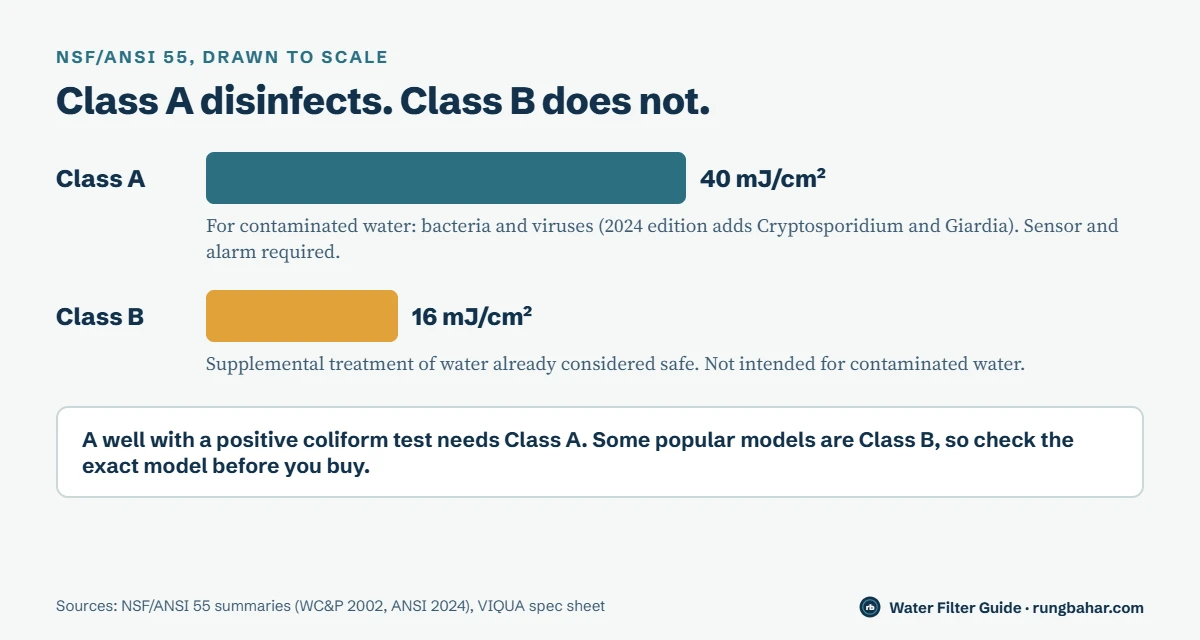
The NSF/ANSI 55 standard is the certification to look for on a home UV system, and it has two classes that are easy to confuse. For a well with a bacteria problem, only one of them is the right choice.
| Class A | Class B | |
|---|---|---|
| Purpose | Disinfect contaminated water, including bacteria and viruses (the 2024 edition adds Cryptosporidium and Giardia) | Supplemental treatment of water that is already treated and considered safe |
| Minimum UV dose | 40 mJ/cm² at 254 nm | 16 mJ/cm² |
| Sensor and alarm | Required; dose is measured at the alarm set point | Dose measured at 70% of normal lamp output or at the alarm set point |
| Right for a well with coliform? | Yes | No: not intended for contaminated water |
The difference matters because some widely sold models are Class B. VIQUA’s spec sheet for its VH200-V, VH410-V and D4-V systems, for example, lists them as NSF Class B and states that Class B systems are not intended for treatment of contaminated water. That does not make them bad products, but it makes them the wrong product for a well that tested positive. Some states and counties require Class A outright: Wisconsin requires Class A criteria with a 254 nm UV monitor and automatic shutdown, and Chautauqua County, New York, requires NSF/ANSI 55 Class A with an audible alarm.
Before buying, confirm the exact model is listed as certified to NSF/ANSI 55 Class A, the same way you would check a drinking water filter. Our guide to water filter certifications explains how the NSF standards fit together.
Water quality limits UV needs
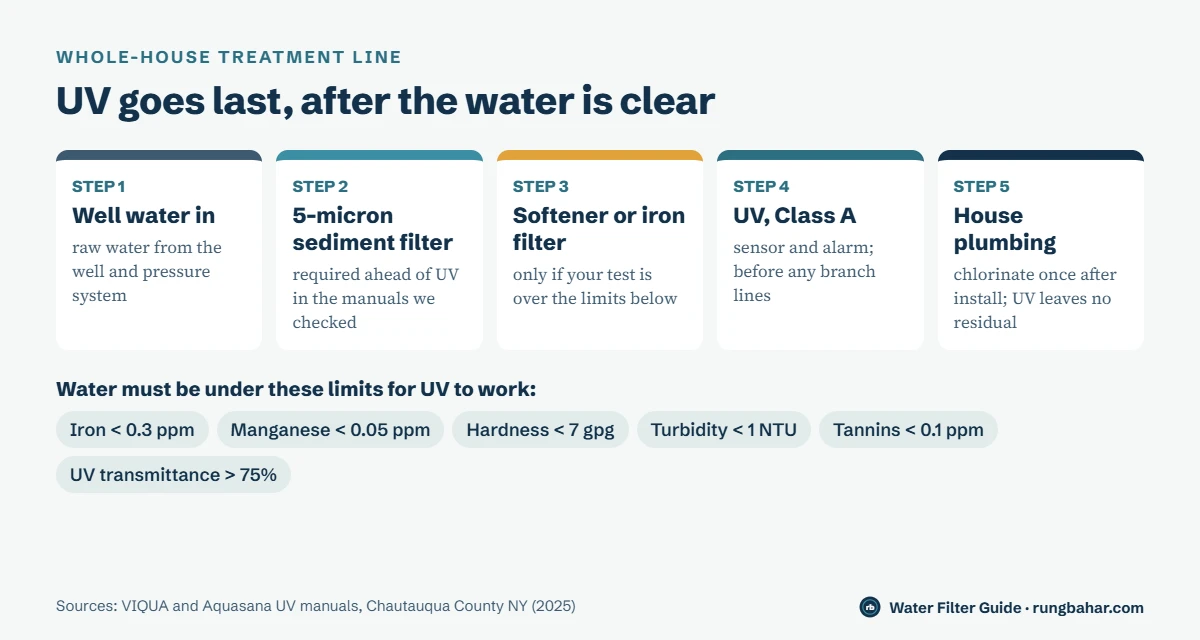
UV works only if the light can get through the water and the quartz sleeve stays clean. Manufacturers publish the water quality their units need. VIQUA’s owner manual and Aquasana’s UV manual list the same core limits, and county rules use similar numbers:
| Measure | Limit for UV | If you are over it |
|---|---|---|
| Iron | under 0.3 ppm (mg/L) | Iron filter before the UV |
| Manganese | under 0.05 ppm | Iron/manganese filter before the UV |
| Hardness | under 7 grains per gallon (120 mg/L) | Water softener before the UV |
| Turbidity | under 1 NTU | Sediment filtration |
| Tannins | under 0.1 ppm | Tannin filter |
| UV transmittance | above 75% (Aquasana recommends above 85%) | Find out what is absorbing the light |
Hardness and iron are the usual problems. Minerals coat the quartz sleeve and block the light, so a unit that was working can quietly stop protecting you between cleanings. If your test shows hardness above 7 grains per gallon, read hard water vs soft water and size a softener with our water softener calculator before adding UV. VIQUA’s manual and county rules such as Chautauqua County’s also require a 5-micron sediment filter ahead of the UV unit.
Where UV goes in the treatment line
UV is the last step in a whole-house treatment line, because everything before it is there to give the light clear water to work on. The manuals we checked say to install it on the cold water line after other treatment equipment (sediment filter, softener, iron filter) and before any branch lines, so every tap in the house receives treated water.
- Well and pressure system. Raw water from the well.
- Sediment filter, 5 micron. Required by VIQUA’s manual and some county rules.
- Softener or iron filter, if your test calls for it. Brings hardness, iron and manganese under the UV limits.
- UV chamber with sensor and alarm. Class A for a well with a bacteria history.
- Household plumbing. Disinfect it once with chlorine right after the UV goes in, because UV leaves no residual to clean pipes that were already contaminated.
Placing UV on a single kitchen tap only protects that tap, while showers and other faucets still deliver untreated water. For bacteria, whole-house placement is the norm.
Sizing by flow rate
UV units are sized by flow, in gallons per minute, not by the size of the house. The faster water moves through the chamber, the less light each drop receives. Manufacturer ratings show this directly: Aquasana rates its AQ-UV-10C at 10 gallons per minute at a 30 mJ/cm² dose, but only 7 gallons per minute at the 40 mJ/cm² dose that Class A requires. VIQUA notes that its units need a flow restrictor so water cannot pass faster than the rated flow.
Chautauqua County’s rules, for example, size the unit to the pump’s capacity, not to typical use, because the pump sets the highest flow that can ever pass through the chamber. Find your pump’s flow rate on its label or ask your well contractor, then choose a unit rated at or above that flow at 40 mJ/cm², not at a lower dose.
Maintenance and retesting
UV is low-maintenance, not no-maintenance. The manuals and extension guides agree on these tasks:
- Replace the lamp every year. VIQUA says lamps must be replaced after 9,000 hours of continuous use, about a year. Replace it on schedule even if it still lights. UMass notes a new lamp can lose about 20 percent of its intensity in its first 100 hours.
- Clean the quartz sleeve. Mineral film blocks light. VIQUA suggests a mild acid such as CLR or vinegar. Clean it at each lamp change, or more often if the sensor reading drops.
- Leave it on. The lamp runs all the time. Penn State estimates the electricity at about $2 to $4 a month. After a power cut, follow the manual before drinking the water.
- Watch the alarm. A Class A unit’s sensor warns when the dose falls too low. Stop drinking untreated water until you fix the cause.
- Keep a log and a spare lamp. Record lamp changes, sleeve cleanings and test results.
Testing does not stop once UV is installed. Wisconsin requires a test at startup, two weeks later and then every year, with samples taken before and after the unit; UMass suggests monthly coliform tests for the first six months. Keep the annual test for nitrate and other chemicals too, since UV does nothing about them.
Alternatives to UV
UV is a common continuous disinfection choice for homes, but not the only one. Penn State Extension and Nebraska Extension list these alternatives:
- Continuous chlorination. Leaves a residual that keeps protecting the plumbing after the point of treatment, which UV cannot do. It needs more maintenance, the chemicals must be handled carefully, and a carbon filter may be needed afterward for taste.
- Ozone. A strong oxidant that also helps with iron and manganese, but Penn State says it is generally not recommended for home disinfection because it costs much more than chlorination or UV.
- Distillation. Listed by Nebraska Extension as an option for recurring contamination.
- Fixing or replacing the well. When the source is a defective well, repair or a new, properly constructed well can end the problem instead of treating it forever.
If your test also shows chemical problems, a point-of-use filter for drinking water may be needed alongside UV. Our 15-second filter finder matches the problems on your test to the right type of treatment.
UV for well water: 14 common questions, answered
These are the questions people search most about UV systems and bacteria in wells, answered from health department, extension service and manufacturer sources.
Do I need a UV light for my well water?
Only if bacteria are a recurring problem: coliform that returns after you fix the well and shock-chlorinate it, or a spring or well that cannot be sealed. A single positive test usually calls for finding the cause and shock chlorination first. A clean coliform test means no UV is needed now.
Does UV light kill bacteria in well water?
Yes. UV light at about 254 nm damages the DNA of bacteria, viruses and protozoa so they cannot reproduce. It only works on water passing through the chamber, and only if the water is clear enough for the light to reach the germs.
What is NSF 55 Class A for UV systems?
NSF/ANSI 55 Class A UV systems are designed to disinfect contaminated water, including bacteria and viruses. They must deliver at least 40 mJ/cm² at the alarm set point and have a UV sensor and alarm. Class B systems (16 mJ/cm²) are only for supplemental treatment of water that is already safe.
Is a Class B UV system okay for a well?
Not for a well with a bacteria problem. Class B systems are not intended for treating contaminated water. Some popular models are Class B, so check the certification before buying.
Does UV light remove iron, nitrate or arsenic?
No. UV does not remove chemical contaminants. Iron and hardness also block UV light, so they need treating before the UV unit. Nitrate and arsenic need separate treatment such as reverse osmosis.
Does a UV system need a pre-filter?
Yes. VIQUA’s manual requires a 5-micron sediment filter ahead of the unit, plus a softener or iron filter if hardness is above about 7 grains per gallon or iron above 0.3 ppm.
How often do you change a UV bulb for well water?
About once a year. VIQUA says the lamp must be replaced after 9,000 hours of continuous use. Replace it on schedule even if it still lights.
Does a UV light work if the power goes out?
No. With no power there is no treatment, and untreated water can enter the plumbing. Follow the manufacturer’s restart instructions after a power cut.
What causes bacteria in well water?
Usually surface water or soil getting into the well through a loose or missing cap, a cracked casing, a poorly sealed well or a nearby septic system, or contamination after a flood or repair. Finding and fixing the cause is the first step.
What are the symptoms of bacteria in well water?
You usually cannot see, smell or taste coliform bacteria, so a lab test is the only reliable check. Do not wait for symptoms; test every year.
Is shock chlorination better than a UV system?
They do different jobs. Shock chlorination is a one-time treatment for a one-off problem. If bacteria come back after shocking and fixing the well, Penn State Extension says continuous disinfection, such as UV or continuous chlorination, is needed.
Does UV kill Giardia and Cryptosporidium?
Yes. Federal drinking water rules credit relatively low UV doses against both, and the 2024 edition of NSF/ANSI 55 Class A covers them. Cryptosporidium is very resistant to chlorine, which is one advantage of UV.
Should I retest my well after installing UV?
Yes. Disinfect the plumbing after installation, then test. Wisconsin requires tests at startup, two weeks later and every year; UMass suggests monthly coliform tests for the first six months.
What size UV system do I need for my well?
Size it to your pump’s maximum flow rate in gallons per minute, using the unit’s rating at 40 mJ/cm². Ratings at lower doses are higher, so read the right column.
Sources and how we checked this page
Every statement on this page comes from US agencies, state health departments, university extension services, the federal drinking water rules or UV manufacturers’ manuals and spec sheets, checked on October 17, 2026. We do not sell or test UV systems and have no commercial relationship with any brand named here. Manuals change, so read the one for the model you consider.
- EPA: Private drinking water wells
- CDC: Guidelines for testing well water
- Minnesota Department of Health: Bacteria in well water
- Penn State Extension: Coliform bacteria
- Penn State Extension: Shock chlorination of wells and springs
- Nebraska Extension: publication G1761 on well water disinfection
- Wisconsin DNR: Bacteriological contamination of drinking water wells (PUB-DG-120, PDF)
- Water Quality Association: Ultraviolet (UV) light
- UMass Amherst: Ultraviolet radiation treatment of drinking water supplies
- Connecticut DPH: Ultraviolet radiation treatment of private wells (PDF)
- Greene County (OH) Public Health: UV fact sheet (PDF)
- Water Conditioning & Purification: The new NSF/ANSI Standard 55
- ANSI blog: NSF/ANSI 55-2024 ultraviolet water treatment
- VIQUA: VH410-V spec sheet (PDF)
- VIQUA: Sterilight Silver owner’s manual (PDF)
- Aquasana: UV system installation manual (PDF)
- Wisconsin DSPS: Ultraviolet treatment requirements (PDF)
- Chautauqua County, NY: UV disinfection system requirements 2025 (PDF)
- eCFR: 40 CFR 141.720, UV dose table
- Oklahoma DEQ: Cryptosporidium fact sheet (PDF)