Updated October 16, 2026, by the RB Water Desk. How we research.
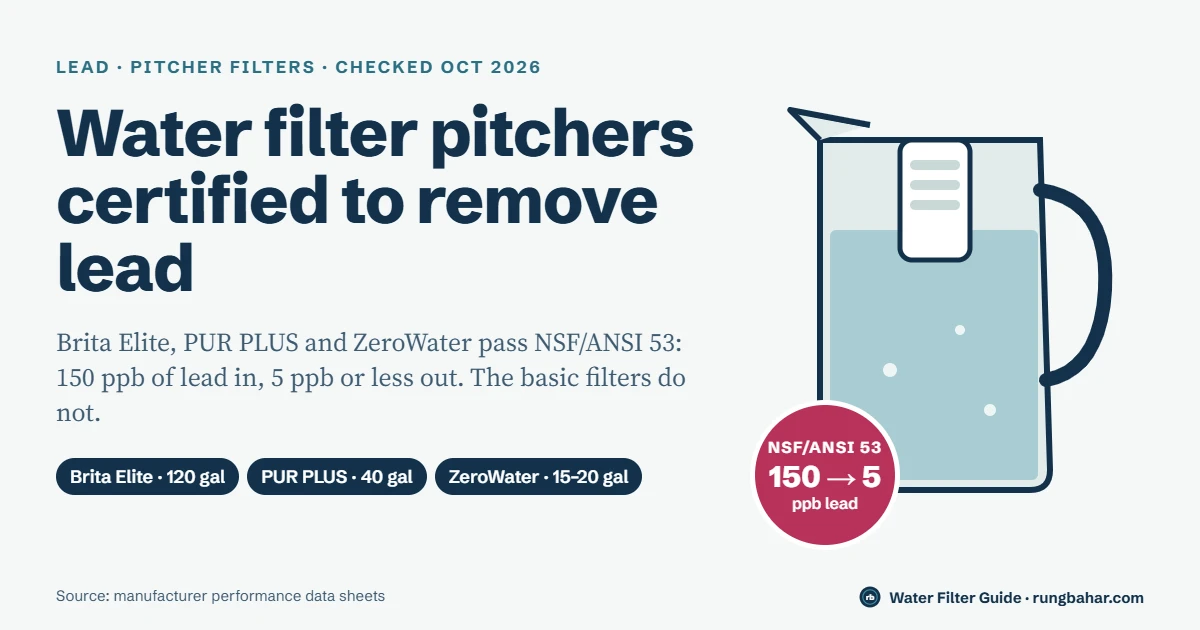
The short answer: Three pitcher filter families on US shelves are certified under NSF/ANSI 53 to cut lead from 150 parts per billion to 5 ppb or less: the Brita Elite (99.5 to 99.6 percent, 120 gallons), the PUR PLUS (99.2 to 99.9 percent, 40 gallons) and ZeroWater, both the 5-stage and the newer Culligan filter (98.8 to 98.9 percent, 15 or 20 gallons). The basic Brita Standard and blue PUR filters are not certified for lead. Pick among the certified three by what else you need and how often you want to change filters.
Quick pick
Besides lead, what matters most to you?
The certified lead pitchers at a glance
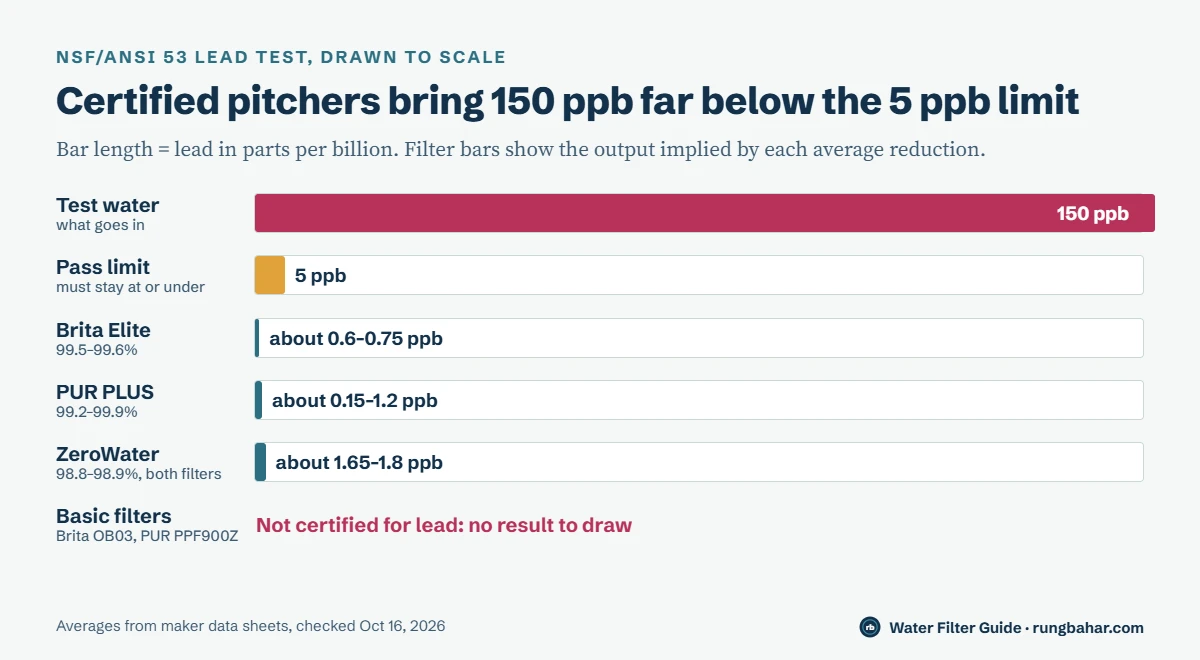
A pitcher filter only counts as a lead filter if it is certified to NSF/ANSI 53 for lead by an accredited certifier. In that test, water spiked with about 150 ppb of lead runs through the filter for its whole rated life, at two pH levels, and the filtered water must stay at or below 5 ppb. The US EPA points consumers to exactly this certification, together with Class I particulate reduction, in its consumer tool for choosing lead filters.
We checked the current performance data sheet for each filter below on October 16, 2026. A data sheet is the leaflet (also posted online) that lists every certified claim, the test concentration and the result. We have not lab-tested any of these filters ourselves, and we have no commercial relationship with Brita, PUR, ZeroWater or Culligan.
| Filter (model) | Lead result, NSF/ANSI 53 | Also certified for | Rated life | Certifier on data sheet |
|---|---|---|---|---|
| Brita Elite (OB06) | 99.5% (pH 6.5), 99.6% (pH 8.5) | Microplastics 99.6%, chlorine taste 97.4%, many chemicals | 120 gallons or about 6 months | WQA (lead); NSF for the Pacifica pitcher system |
| PUR PLUS (PPF951K) | 99.9% (pH 6.5), 99.2% (pH 8.5) | Total PFAS 99.75%, microplastics 99.8%, chlorine taste 97.5% | 40 gallons or 2 months | IAPMO R&T |
| ZeroWater 5-stage (ZR-001 / ZF-201) | 98.9% (pH 6.5), 98.8% (pH 8.5) | PFOA/PFOS 99.8%, chromium, mercury, chlorine taste | 15 gallons | IAPMO R&T |
| Culligan with ZeroWater Technology (ZEROF01) | 98.9% (pH 6.5), 98.8% (pH 8.5) | Fluoride 99.7%, total PFAS 99.7% | 20 gallons | Tested to NSF/ANSI 42, 53, 401 (Culligan names IAPMO on its product page) |
| Brita Standard (OB03) | Not certified | Chlorine taste, copper, cadmium, mercury, zinc | 40 gallons or about 2 months | — |
| PUR blue filter (PPF900Z) | Not certified | Chlorine taste, some metals and chemicals | 40 gallons or 2 months | IAPMO R&T (other claims) |
Every certified filter in that table lands far below the 5 ppb pass line in testing, so the choice between them is not really about lead percentages. It comes down to three practical questions: what else is in your water, how much you drink each day, and how often you are willing to change the filter. The sections below take each filter in turn, then the ones that look similar on the shelf but carry no lead claim.
Brita Elite: the fewest filter changes
Best for: city water where lead is the main worry, and people who forget to change filters.
The Brita Elite (model OB06, sold for years as Longlast+) is the lead-certified pitcher filter with the longest rated life: 120 gallons, which Brita says is about 6 months for an average family. On the data sheet it averaged 99.5 percent lead reduction at pH 6.5 and 99.6 percent at pH 8.5 from a 150 ppb challenge. It is also certified for microplastics (99.6 percent of 0.5 to 1 micron particles under NSF/ANSI 401), chlorine taste and odor, mercury, cadmium, asbestos and a list of pesticides and solvents.
Two details on the data sheet matter. First, Brita caps use at 2 gallons a day “for maximum efficiency”. A family that filters more than that should look at a faucet or under-sink filter instead. Second, the lead certification is tied to the pitchers listed on the sheet; Brita’s lead page says the NSF lead certification applies “when used with” its Pacifica pitcher, and the sheet lists the compatible systems. If you put an Elite filter in an older or third-party pitcher, check that the pitcher model is on the sheet.
On PFAS, the record is mixed. One current Brita Elite data sheet on brita.com lists PFOA and PFOS reduction (98.1 percent) certified by IAPMO R&T, but Brita’s Elite product page makes no PFAS claim, and our full breakdown of what Brita filters remove found no PFAS row on the sheet we read earlier this month. If PFAS matters to you, read the leaflet that comes in your box rather than relying on either.
PUR PLUS: lead, PFAS and microplastics in one pitcher filter
Best for: households that want one pitcher filter covering lead, PFAS and microplastics.
The PUR PLUS pitcher and dispenser filter (model PPF951K) is certified by IAPMO R&T under NSF/ANSI 53 for lead, with 99.9 percent average reduction at pH 6.5 and 99.2 percent at pH 8.5. It also carries a total PFAS claim (99.75 percent, from a mix of seven PFAS compounds) and a microplastics claim (99.8 percent). That combination of lead, total PFAS and microplastics on one pitcher data sheet is what PUR has been advertising since September 2026.
The trade-off is filter life. PUR rates both of its pitcher filters for 40 gallons or 2 months, whichever comes first, at up to 2 gallons a day, so you will change it about three times as often as a Brita Elite. PUR rates the filter for water between 34°F and 82°F; never run hot water through it.
Watch the model number. The same PUR pitchers also take the cheaper blue filter (PPF900Z), which is not certified for lead, PFAS or microplastics. A PUR pitcher on a shelf can hold either. Our page on what PUR filters remove lists every claim for all four PUR cartridges.
ZeroWater: lead plus fluoride or PFAS, at the cost of filter life
Best for: soft or low-mineral city water, and people who also want fluoride (Culligan filter) or PFOA/PFOS reduced.
Both ZeroWater filters on US shelves are certified under NSF/ANSI 53 for lead: 98.9 percent at pH 6.5 and 98.8 percent at pH 8.5. The standard 5-stage filter’s April 2026 data sheet names IAPMO R&T as the certifier, adds PFOA/PFOS (99.8 percent), chromium and mercury, and gives a rated life of 15 gallons. The newer Culligan with ZeroWater Technology filter (ZEROF01) keeps the same lead result and adds certified fluoride (99.7 percent) and total PFAS (99.7 percent) claims, with a rated life of 20 gallons. It only fits the newer Culligan ZeroWater pitchers.
ZeroWater works differently from Brita and PUR. Its large ion exchange stage removes nearly all dissolved minerals, which is why the bundled meter reads 000. The catch is that the same resin is used up by harmless calcium and magnesium, so on hard water the filter can run out well before its rated gallons, and on any water you will change it far more often than a carbon pitcher filter. If you want lead covered for the whole rated life, change it at the rated gallons rather than waiting for the meter to read 006. Our ZeroWater vs Brita comparison goes into the meter, the taste and the filter count.
Fewest changes
Brita Elite pitcher filter (OB06)
- Certification: NSF/ANSI 53 lead, 401 microplastics, 42 chlorine
- Best for: 1 gallon a day or less, forgetful filter-changers
- Skip if: you need more than 2 gallons a day
Lead + PFAS + microplastics
PUR PLUS pitcher filter (PPF951K)
- Certification: NSF/ANSI 53 lead and total PFAS, 401 microplastics (IAPMO R&T)
- Best for: one filter for the three most-searched worries
- Skip if: you want to change filters only twice a year
Lead + fluoride
Culligan with ZeroWater Technology (ZEROF01)
- Certification: NSF/ANSI 53 lead, fluoride and total PFAS
- Best for: soft water, fluoride removal in a pitcher
- Skip if: your water is hard or you drink 2+ gallons a day
Popular pitchers that are not certified for lead
Several pitchers that rank in shopping results either have no lead claim or describe lead results without a named certification. That does not prove they remove nothing. It means nobody has certified a lead result you can check.
- Brita Standard (OB03). The basic white Brita filter. Its data sheet covers chlorine taste and some metals (copper, cadmium, mercury, zinc), but not lead. It is often the default filter in a new Brita pitcher, so check what came in the box.
- PUR blue pitcher filter (PPF900Z). Certified for chlorine taste and a few metals, marked “not certified” for lead on PUR’s own data sheet.
- LifeStraw Home pitcher. LifeStraw’s product page says the pitcher “meets NSF 53 standards” for PFOA and PFOS and lists lead among the metals its carbon filter reduces, based on independent lab tests. It does not name a certifier or listing for lead. “Meets the standard” in a lab report is not the same as a certification with ongoing audits.
- Clearly Filtered pitcher. Clearly Filtered’s help center says it is moving its NSF/ANSI 42 and 372 certifications from WQA to NSF and is “pursuing” new NSF/ANSI 53 and 401 certifications with NSF. Until a lead listing appears, treat its lead numbers as the brand’s own lab results.
Brands can and do add certifications, so this list can change. The point is the method: if you cannot find lead on the data sheet with a standard, a result and a certifier, and you cannot find the model in a certifier’s directory, it is not a certified lead filter.
How many filters a year each one needs
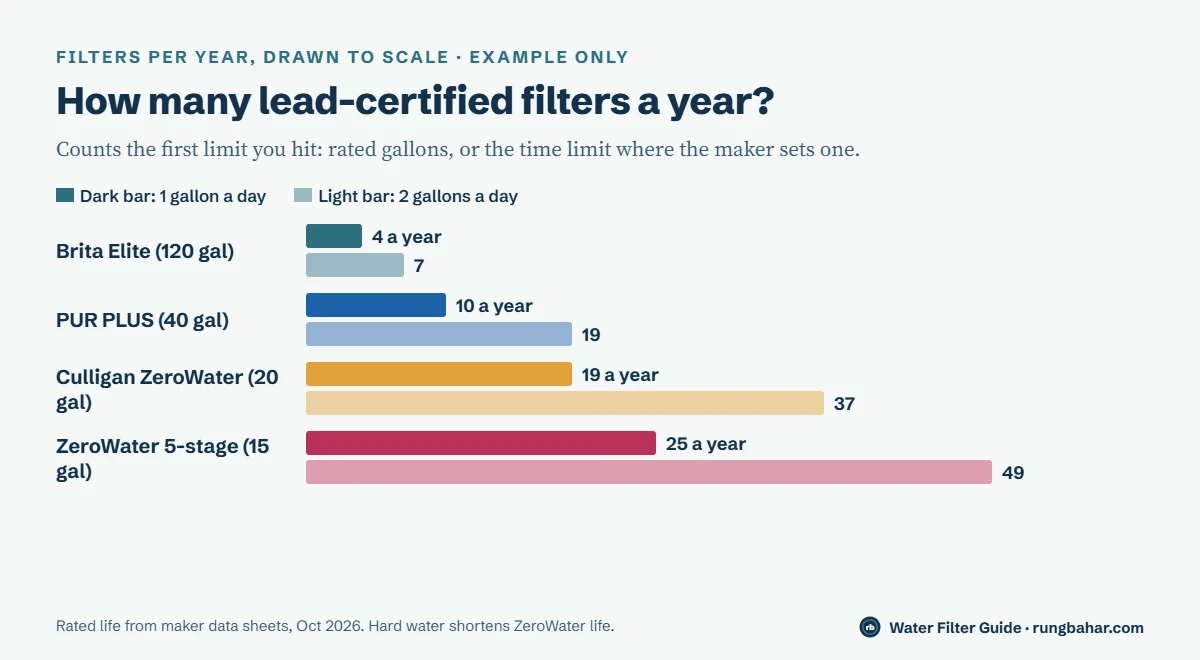
Rated life decides how often you shop for cartridges, and the totals differ by a factor of ten. The table counts whichever limit you hit first: gallons, or the time limit where the maker gives one (6 months for Brita Elite, 2 months for PUR). ZeroWater gives a gallon rating only. These are examples, not predictions; ZeroWater on hard water will need more.
| Filtered water per day | Brita Elite | PUR PLUS | ZeroWater 5-stage | Culligan ZeroWater |
|---|---|---|---|---|
| Half a gallon (182 gal/yr) | 2 | 6 | 13 | 10 |
| 1 gallon (365 gal/yr) | 4 | 10 | 25 | 19 |
| 2 gallons (730 gal/yr) | 7 | 19 | 49 | 37 |
As a worked example, a couple filtering a gallon a day for drinking, coffee and cooking would buy about 4 Brita Elite filters, 10 PUR PLUS filters or 19 to 25 ZeroWater filters a year. To compare cost, multiply your count by the price per filter you see for the pack size you would buy; we do not quote prices because they change every week. For a household at 2 gallons a day, the pitcher itself becomes the bottleneck, which is the point where a faucet filter makes more sense.
How to confirm the lead claim on the box in two minutes
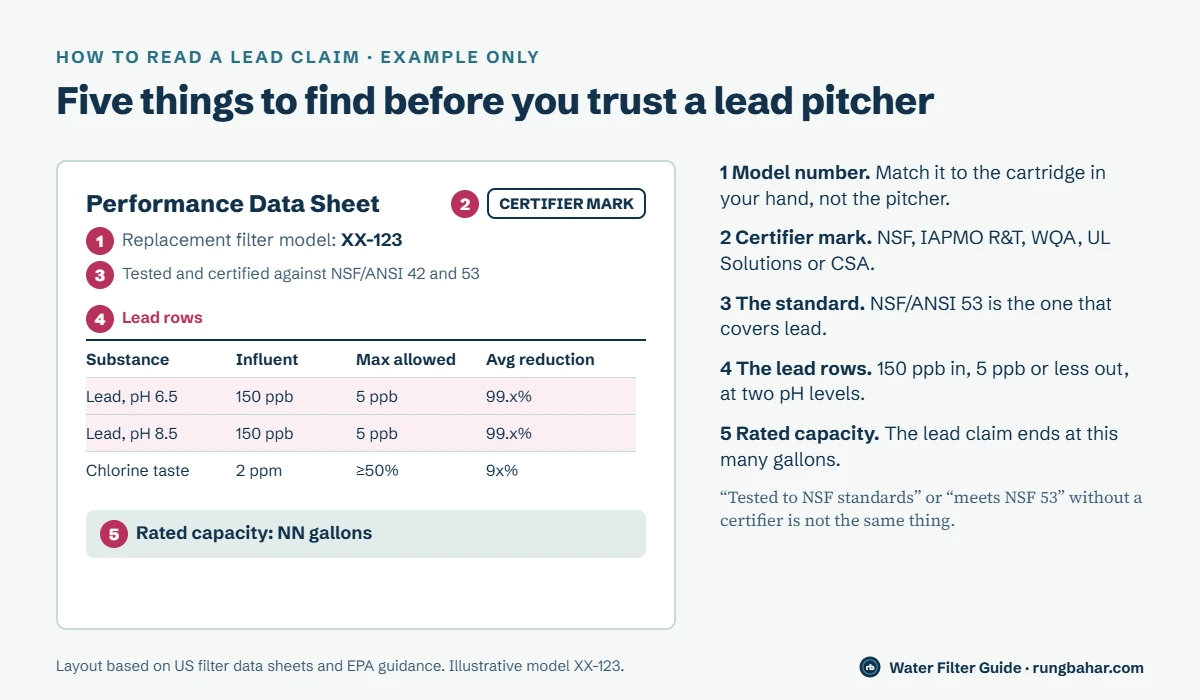
The EPA’s guide to identifying lead-certified filters says the certification mark and the standards appear on the filter, its packaging or the smallest box it comes in, and that the specific lead claim is often on the performance data sheet, in the certifier’s online directory or on the maker’s website. In practice:
- Find the model number on the cartridge or box (OB06, PPF951K, ZR-001, ZEROF01 and so on).
- Look for a certification mark from NSF, IAPMO R&T, WQA, UL Solutions or CSA, next to wording such as “tested and certified against NSF/ANSI 53”.
- Open the performance data sheet and find the row that says lead, pH 6.5 and pH 8.5, with a 150 ppb challenge and a 5 ppb limit.
- Check the rated capacity on the same sheet. The lead result only covers that many gallons.
- Search the model in the certifier’s directory. Our step-by-step guide to checking whether a filter is really NSF certified shows where each directory lives.
Watch for three weaker phrases: “tested to NSF standards”, “meets NSF 53” and “reduces up to 99% of lead” with no standard named. None of them tells you an accredited certifier checked that model. Our guide to NSF 53 vs NSF 58 explains what each standard covers.
Using a pitcher for lead: the rules that matter
A certified pitcher only protects you if it is used the way it was tested. The EPA’s filter maintenance sheet and utility guidance for lead line replacements agree on a short list:
- Use cold water only. Run the tap until the water is cold before filling the pitcher, and never filter hot water. Heat filtered water afterwards if you need it hot.
- Filter all water you drink or cook with, including water for coffee, tea, soup, pasta, pet bowls and infant formula. Showers and dishes do not need it.
- Change the cartridge on time. Reset the indicator light every time you fit a new filter, or track the date and gallons yourself if there is no light.
- Do not overfill or pour early. Let the reservoir drain fully through the filter before you tip the pitcher, so unfiltered water does not slip past.
- Flush first after water has sat. If no one has used the tap for 6 hours or more, run it (not through the filter) before filling the pitcher.
- Do not boil to remove lead. Boiling does not remove lead. Our page on what boiling water does and does not remove covers this.
Some water utilities hand out certified pitchers when they replace a lead service line. Pennsylvania American Water, for example, supplies a pitcher and cartridges free for the first 6 months after a replacement and cites the EPA recommendation to use a filter for 6 months afterwards. Ask your utility before you buy.
When a pitcher is not enough
A lead-certified pitcher is a good stopgap and a reasonable long-term answer for one or two people. It is the wrong tool in a few cases:
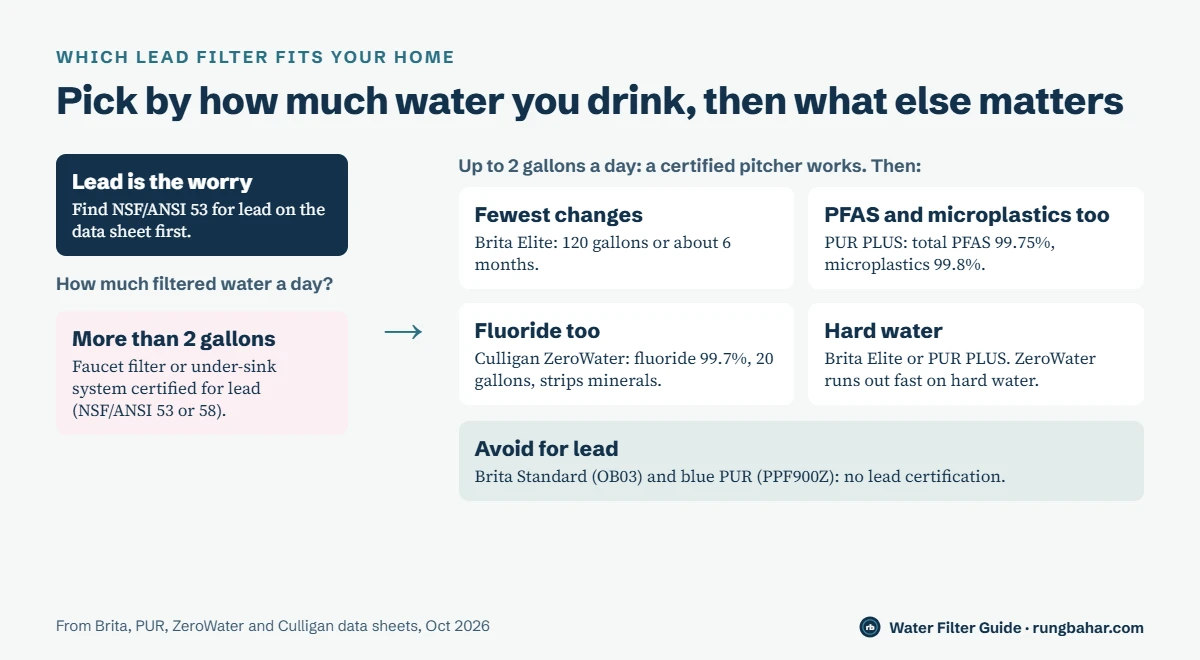
- You need more than 2 gallons a day. Both Brita and PUR set that daily limit. A faucet-mount filter certified for lead, or an under-sink carbon or reverse osmosis system certified under NSF/ANSI 53 or 58, handles more water with fewer changes.
- You do not know your lead level. Test first. A pitcher handles a 150 ppb challenge in certification, but you should still know what you are dealing with, and testing again through the filter confirms it works in your home.
- The lead comes from a service line you can replace. The filter treats the symptom. Our guide to lead in tap water covers testing, flushing, utility inventories and replacement programs.
- Your water is from a private well with other problems. Bacteria, nitrate or arsenic need different treatment, chosen after a lab test.
Not sure a pitcher is the right type for your home at all? Answer three questions in the filter finder, or look up what your utility reports with the ZIP code tap-water check. If you also worry about PFAS, our guide to finding out whether your tap water has PFAS shows the free sources.
Lead pitcher filters: 15 common questions, answered
These are the questions people search most about pitchers and lead, answered from the data sheets and US agency guidance.
Do water filter pitchers remove lead?
Only some do. Pitcher filters certified under NSF/ANSI 53 for lead, such as the Brita Elite, PUR PLUS and both ZeroWater filters, reduced lead from about 150 ppb to under 5 ppb in testing. Basic filters such as the Brita Standard and the blue PUR filter are not certified for lead.
What is the best water filter pitcher that removes lead?
There is no single best one. Among certified filters, the Brita Elite needs the fewest changes (120 gallons), the PUR PLUS adds total PFAS and microplastics, and the Culligan ZeroWater filter adds fluoride. All three pass the same lead test.
Does the Brita pitcher remove lead?
Only with the Brita Elite filter (OB06), which is certified to reduce lead 99.5 to 99.6 percent under NSF/ANSI 53. The Brita Standard filter has no lead claim.
Does the PUR pitcher remove lead?
Yes with the PUR PLUS filter (PPF951K), certified at 99.2 to 99.9 percent. The blue PUR filter (PPF900Z) is marked not certified for lead on PUR’s data sheet.
Does ZeroWater remove lead?
Yes. Both the ZeroWater 5-stage filter and the Culligan ZeroWater filter are certified under NSF/ANSI 53 for lead, at 98.8 to 98.9 percent, for 15 and 20 gallons respectively.
Do water filter jugs remove lead?
A jug is the same thing as a pitcher. Look for the same NSF/ANSI 53 lead certification on the filter cartridge.
Is 99 percent lead removal enough?
In the NSF/ANSI 53 test, the filtered water must stay at or below 5 ppb throughout the rated life, starting from about 150 ppb. All certified pitchers above passed that, with averages well below the limit.
How often should I change a lead pitcher filter?
At the rated life on the data sheet: 120 gallons or about 6 months for Brita Elite, 40 gallons or 2 months for PUR PLUS, 15 gallons for ZeroWater 5-stage and 20 gallons for the Culligan ZeroWater filter. The lead claim does not cover water filtered after that.
Can I use a lead pitcher filter for baby formula?
Utility guidance for homes with lead lines says to use filtered water for drinking, cooking and preparing infant formula. Use cold water, filter it, then heat it. Ask your pediatrician about formula water in general.
Does boiling water remove lead?
No. Boiling does not remove lead, so a boiled pot of water has as much lead as before. Use a certified filter or bottled water instead.
Do pitcher filters remove lead from well water?
A certified pitcher reduces lead regardless of source, but well water often has other problems, such as bacteria, that a pitcher does not treat. Test the well first.
Is a pitcher or a faucet filter better for lead?
Both can be certified for lead. A pitcher suits up to about 2 gallons a day; a faucet filter handles more water and needs fewer changes, if it fits your tap.
What does “meets NSF 53 standards” mean?
It usually means the brand had a lab run the test, not that an accredited certifier lists the product. Look for a certifier mark and a directory listing for the model.
Should I test my water after using a lead filter?
It is a good idea. Testing filtered water once confirms the filter works in your home, especially if your unfiltered water showed high lead.
Does a water softener remove lead?
No. Softeners are not designed or certified for lead. Use a filter certified under NSF/ANSI 53 or 58 for lead.
Sources and how we checked this page
Every claim on this page comes from the filter makers’ performance data sheets and product pages, the US EPA and a water utility’s lead program page, checked on October 16, 2026. We do not test filters in a lab, and we have no commercial relationship with any brand named here. Data sheets change, so check the one in the box you buy.
- Brita: Elite filter (OB06) performance data sheet (PDF)
- Brita: Elite replacement filters product page
- Brita: Lead reduction page
- PUR: Pitcher filters PPF951K and PPF900Z performance data sheet (PDF)
- ZeroWater: 5-stage filter performance data sheet, April 2026 (PDF)
- Culligan: ZeroWater Technology filter performance data (PDF)
- LifeStraw: Home pitcher product page
- Clearly Filtered: Are Clearly Filtered products certified?
- US EPA: Consumer tool for identifying filters certified to reduce lead
- US EPA: How to identify filters certified to reduce lead (PDF, June 2024)
- US EPA: Learn how to maintain your water filter (PDF, August 2025)
- Pennsylvania American Water: Pitcher filter FAQs