Updated October 17, 2026, by the RB Water Desk. How we research.
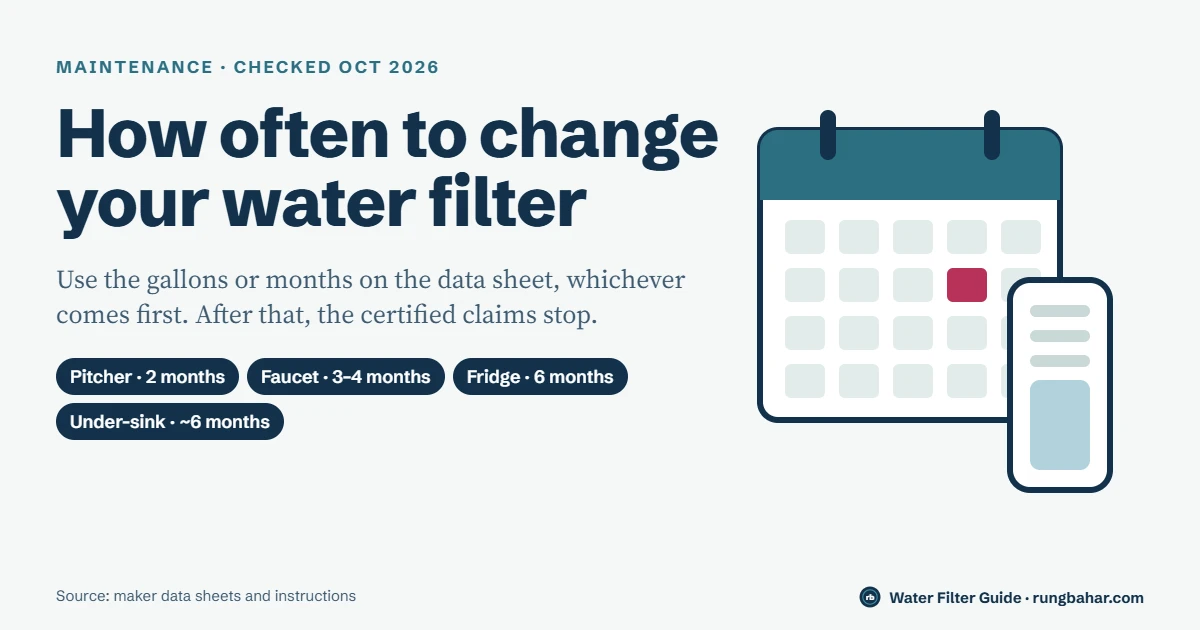
The short answer: Change a filter at the gallons or months printed on its performance data sheet, whichever comes first. Typical ratings: pitcher filters every 2 months (40 gallons), long-life pitchers such as Brita Elite every 6 months (120 gallons), faucet filters every 3 to 4 months (100 gallons), refrigerator filters every 6 months, under-sink carbon cartridges about every 6 months, and whole-house carbon tanks after years. Change sooner if flow drops or the taste comes back.
Filter change calculator
Which filter do you have?
Replacement chart by filter type
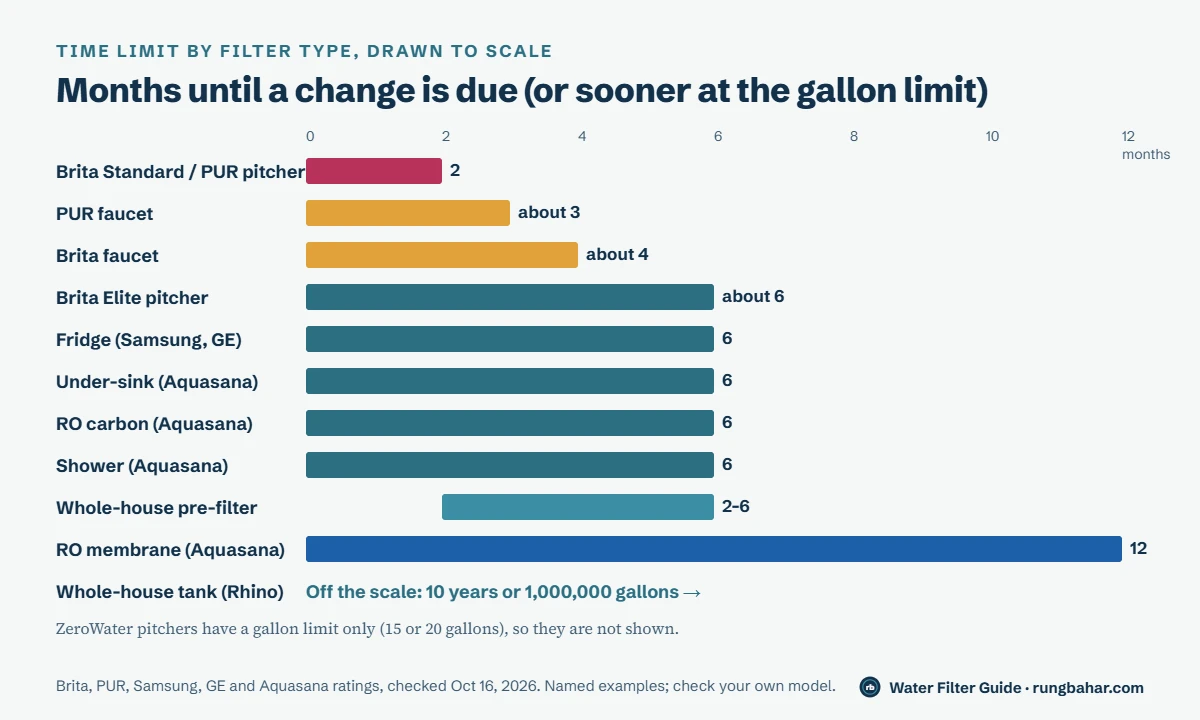
Every certified filter has a rated capacity: the number of gallons it was tested to treat, often paired with a time limit. The table uses real ratings from current data sheets and maker pages, checked on October 16, 2026. Where a category has many brands, we show one named example; your own model’s sheet is the number that counts.
| Filter | Rated life (example) | At 1 gallon a day | Source |
|---|---|---|---|
| Brita Standard pitcher | 40 gallons or about 2 months | Every 40 days | Brita |
| Brita Elite pitcher | 120 gallons or about 6 months (max 2 gal/day) | About every 4 months | Brita data sheet |
| PUR / PUR PLUS pitcher | 40 gallons or 2 months | Every 40 days | PUR data sheet |
| ZeroWater 5-stage pitcher | 15 gallons | Every 15 days | ZeroWater data sheet, April 2026 |
| Culligan ZeroWater pitcher | 20 gallons | Every 20 days | Culligan data sheet |
| Brita faucet filter | 100 gallons or about 4 months | About every 3 months | Brita |
| PUR faucet filter | 100 gallons or about 3 months | About every 3 months | PUR |
| Refrigerator (GE XWFE) | 170 gallons or 6 months | Every 6 months | GE instructions |
| Refrigerator (Samsung) | At least every 6 months | Every 6 months | Samsung support |
| Under-sink carbon (Aquasana Claryum 2-stage) | 500 gallons or 6 months | Every 6 months | Aquasana |
| Reverse osmosis (Aquasana SmartFlow) | Carbon: 365 gal or 6 months. Membrane: 12 months | Carbon every 6 months | Aquasana |
| Whole-house tank (Aquasana Rhino) | 1,000,000 gallons or 10 years; pre-filter 2 to 6 months | Years | Aquasana |
| Shower filter (Aquasana) | 6 months | Every 6 months | Aquasana |
Why the date matters more than the taste
Most people change a filter when the water starts to taste off or the flow slows down. That works for taste filters, but it is the wrong signal for anything you cannot taste, such as lead or PFAS.
NSF, the largest US filter certifier, explains why. A clogged filter is easy to spot because the water slows to a trickle. A saturated filter is not: once the surface of the media is full, it stops removing contaminants, but the water still flows and may still taste fine. That is why certification tests run a filter for its whole rated capacity and stop there. A lead or PFAS claim on a data sheet covers the water filtered within that capacity and says nothing about the water after it.
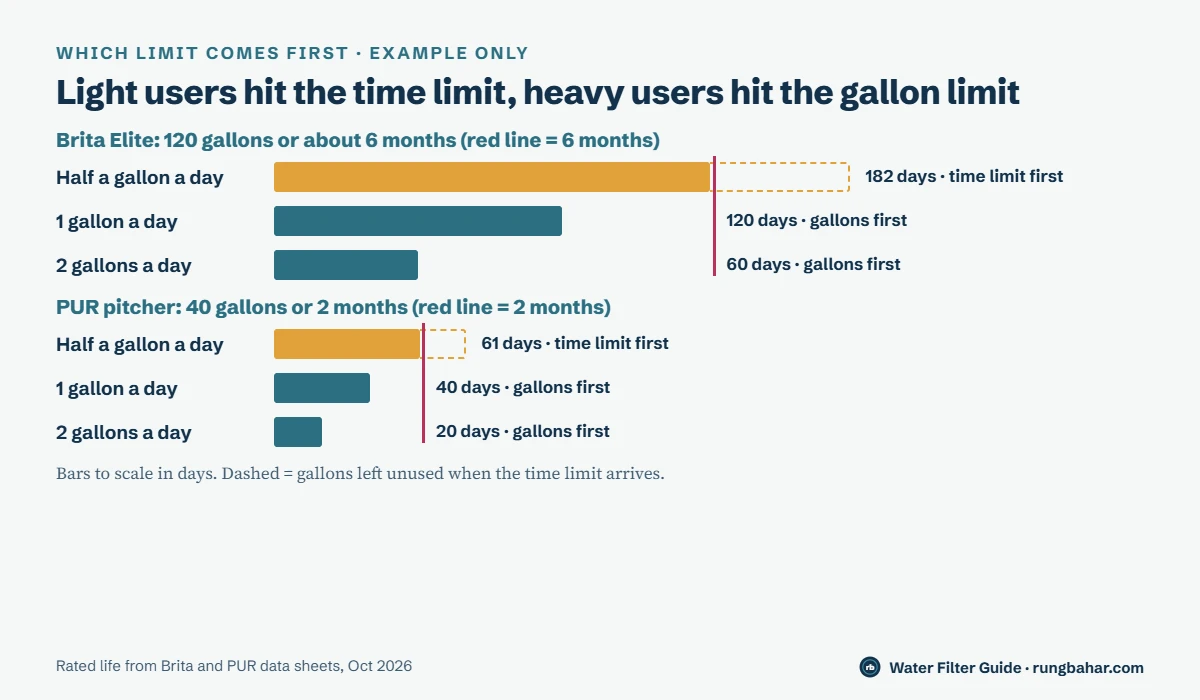
So the rule is simple. The rated gallons or months on the sheet are the end of the guarantee. Use whichever limit you reach first. If you filter more water than the maker assumed, you will hit the gallon limit before the calendar date; if you filter very little, the time limit comes first. Our guide to checking whether a filter is really certified shows where to find the rated capacity for any model.
How often to change a pitcher filter (Brita, PUR, ZeroWater)
Pitcher filters have the shortest lives, because the cartridge is small. The four you are most likely to own:
- Brita Standard: 40 gallons or about 2 months. Brita says hard water may mean changing more often.
- Brita Elite: 120 gallons or about 6 months, and Brita asks you to filter no more than 2 gallons a day for maximum efficiency. It is the longest-lasting mainstream pitcher filter.
- PUR and PUR PLUS: 40 gallons or 2 months, whichever comes first, at up to 2 gallons a day.
- ZeroWater: 15 gallons (5-stage) or 20 gallons (Culligan ZeroWater) on the data sheets. ZeroWater’s own signal is the bundled meter reading 006, but on soft water that can come well after the rated gallons, and on hard water well before.
The gallon figure is easier to track than it sounds. A 10-cup pitcher holds a little over half a gallon of filtered water, so if you fill it twice a day you are filtering about a gallon a day, and a 40-gallon filter lasts about 40 days. Pitchers with an electronic light count fills or days; reset the light every time you fit a new filter, or the count is wrong from the start.
If you bought a pitcher for lead, check which cartridge you are changing to. Both Brita and PUR sell a basic filter and an upgraded one that fit the same pitcher, and only the upgraded ones carry a lead claim. Our guide to pitchers certified to remove lead lists the models, and what Brita filters remove and what PUR filters remove cover every claim. For ZeroWater, our page on TDS in water explains what the meter reading does and does not tell you.
How often to change a refrigerator water filter
Almost every refrigerator maker gives the same answer: every 6 months. Samsung says to change its filters at least every six months, and its filter light runs on a six-month timer. GE’s XWFE instructions say every six months or sooner if the flow to the dispenser or ice maker drops, and rate the filter for 170 gallons.
The six-month timer is not a gallon counter. A large family drawing a lot of water and ice can reach the gallon rating first, so check the rated gallons on your filter’s sheet if you use the dispenser heavily. Samsung also says to replace early if water dispenses noticeably slower with the filter than without it.
After fitting a new fridge filter, flush it. GE says to run 2 gallons, about 5 minutes, through the dispenser to clear the system, and to discard the first batch of ice on ice-maker-only models. Then reset the filter light, usually by holding a Filter Reset button for about three seconds. If you are relying on a fridge filter for lead or PFAS, check that its data sheet actually lists them; many do not. Our page on whether refrigerator filters remove PFAS and lead explains how to tell.
How often to change faucet and under-sink filters
Faucet-mount filters sit between pitchers and under-sink systems. Brita rates its faucet filter for 100 gallons or about 4 months for most households, and PUR rates its faucet filters for 100 gallons or about 3 months. Most faucet units have a light that counts water through the filter, which makes them easier to track than a pitcher.
Under-sink carbon systems hold larger cartridges and usually run about 6 months. Aquasana’s Claryum systems, as an example, are rated for 6 months or 500 to 800 gallons depending on the model. There is no industry-wide number, so look up the cartridge model printed on the housing. Under-sink systems rarely have a light, so put a date on the cartridge with a marker when you install it and set a phone reminder.
One renter-specific note: a faucet filter is usually the easiest certified option when you cannot drill or plumb, and our guide to water filters for apartments compares the choices.
How often to change reverse osmosis filters
A reverse osmosis (RO) system has several parts on different schedules. Aquasana’s SmartFlow RO, as one example, asks for its carbon block cartridges every 6 months or 365 gallons, its remineralizer every 6 months and its membrane every 12 months. Other brands set different intervals, especially for the membrane, so follow your own manual.
The order matters. The carbon pre-filters protect the membrane from chlorine, which damages the thin-film membranes used in most home RO systems. Letting the pre-filters run long can shorten the life of the more expensive membrane. Some RO systems can be checked with a TDS meter: if the reading of RO water rises well above what it was when the system was new, the membrane is due. Our page on what reverse osmosis removes explains how the stages work together.
How often to change whole-house and shower filters
Whole-house systems are built for volume. Aquasana rates its Rhino carbon tanks for 10 years or 1,000,000 gallons, but the small sediment pre-filter in front of the tank needs changing every 2 months (standard 20-inch) or 6 months (low-maintenance version). The pre-filter is the part people forget, and a clogged one cuts water pressure throughout the house.
Well water with sand or sediment can clog a pre-filter faster than city water, which is one reason to watch the pressure rather than only the calendar. Shower filters are simpler: Aquasana says to replace its shower filter every 6 months. If you are weighing a whole-house filter against a softener, our comparison of water softeners and water filters explains what each does, and hard water vs soft water covers why hardness shortens some filters’ lives.
Signs a filter needs changing early
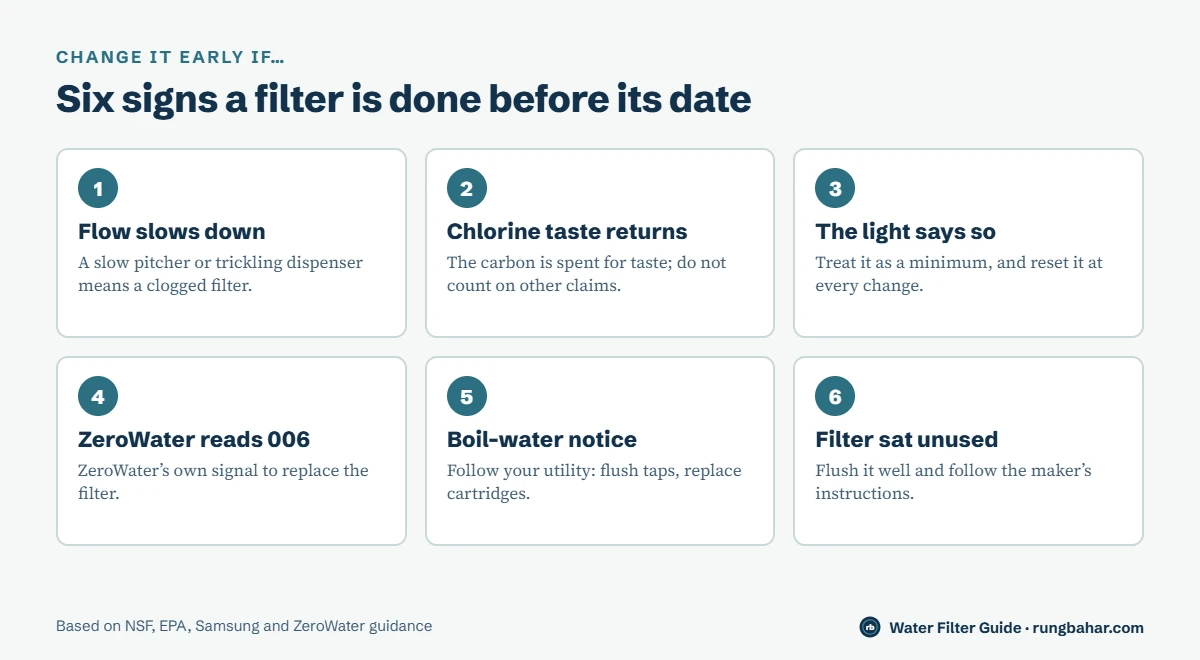
The rated life is the latest you should change a filter, not a target to stretch. Change it sooner if any of these happen:
- Flow slows down. A pitcher that takes much longer to fill, or a fridge dispenser that trickles, usually means a clogged filter. NSF names slowed flow as the clearest sign of clogging.
- The taste or smell of chlorine returns. If the swimming-pool taste you bought the filter to fix comes back, the carbon is used up for taste, and you should not assume it still handles anything else.
- The indicator light says so. Treat the light as a minimum, and reset it at every change.
- A ZeroWater meter reads 006 or more. That is ZeroWater’s own replace signal, even if you have not reached the rated gallons.
- You had a boil-water notice or a plumbing repair. Follow your utility’s instructions after the notice ends; utilities commonly tell households to flush taps and replace filter cartridges.
- The filter sat unused for weeks. If a pitcher or fridge filter has been idle while you were away, flush it well, and follow the maker’s instructions for a filter left dry.
How to change a filter and reset the light
- Buy the exact replacement model printed on your old filter or in your manual. NSF warns that a cartridge that does not fit exactly can let water bypass the media, and a non-certified knock-off may not be made from materials checked as safe for drinking water.
- Use cold water only. Run the tap until it is cold before filtering, and never filter hot water.
- Pre-soak or flush the new cartridge as the instructions say. Pitcher filters often need a rinse or a soak; GE says to run 2 gallons through a new fridge filter.
- Reset the indicator light or note the date and, if you can, the gallons.
- Wash the pitcher reservoir or housing with mild soap while the filter is out. Do not wash the cartridge.
Want to budget for a year of filters? Multiply the filters per year from the calculator above by the price per cartridge in the pack size you would buy. We do not list prices because they change every week. If you are choosing a new system rather than maintaining an old one, the 15-second filter finder narrows it down, and the ZIP code tap-water check shows what your utility reports, so you only filter for what is actually there.
Changing water filters: 15 common questions, answered
These are the questions people search most about how often to change a water filter, answered from maker instructions and NSF guidance.
How often should you change your water filter?
At the gallons or months on the filter’s data sheet, whichever comes first: about every 2 months for most pitcher filters, 6 months for Brita Elite and refrigerator filters, 3 to 4 months for faucet filters and about 6 months for under-sink cartridges.
How often should you change the water filter in your refrigerator?
Every 6 months for most brands, including Samsung and GE, or sooner if the dispenser slows down or you reach the rated gallons.
How often should I change my Brita filter?
Brita Standard filters every 40 gallons or about 2 months; Brita Elite filters every 120 gallons or about 6 months; Brita faucet filters every 100 gallons or about 4 months.
How often should I change a PUR filter?
PUR pitcher filters every 40 gallons or 2 months, and PUR faucet filters every 100 gallons or about 3 months.
How often should I change a ZeroWater filter?
At the rated 15 gallons (5-stage) or 20 gallons (Culligan ZeroWater) for the certified claims, or when the meter reads 006, whichever comes first.
How often should you change an under-sink water filter?
Usually about every 6 months, but it depends on the cartridge. Aquasana’s Claryum cartridges, for example, are rated for 6 months or 500 to 800 gallons.
How often do you change reverse osmosis filters?
Pre-filters are often every 6 to 12 months and membranes every 1 year or more, depending on the brand. Aquasana’s SmartFlow uses 6 months for carbon and 12 months for the membrane.
How often should you change a whole-house water filter?
The sediment pre-filter every 2 to 6 months and the main carbon tank after years; Aquasana rates its Rhino tanks for 10 years or 1,000,000 gallons.
What happens if you do not change your water filter?
The filter eventually clogs or its media fills up. A full filter stops removing contaminants, and certified claims such as lead or PFAS no longer apply beyond the rated capacity.
Can an old water filter make water worse?
A saturated filter stops removing contaminants. NSF also warns that ill-fitting or non-certified replacement cartridges can let water bypass the media or add impurities. Change filters on time with the correct model.
Is the filter light accurate?
It is a reminder, not a measurement. Many fridge lights run on a six-month timer and many pitcher lights count fills or days. Reset it at every change and change early if flow drops.
How often should you change your water filter for well water?
Follow the rated life, but expect sediment pre-filters to clog faster on wells with sand or silt. Watch the water pressure and test the well regularly.
Do I need to flush a new water filter?
Usually yes. Follow the instructions: GE, for example, says to run 2 gallons through a new refrigerator filter. Pitcher cartridges often need a rinse or soak first.
Can I use cheaper off-brand replacement filters?
Only if the replacement is certified for the claims you need and fits exactly. Check its own data sheet and certifier listing, not the original brand’s.
Does hard water make filters wear out faster?
It can. Brita says hard water may mean changing filters more often, and ion exchange filters such as ZeroWater are used up faster by calcium and magnesium.
Sources and how we checked this page
Every interval on this page comes from the makers’ performance data sheets, instructions and support pages, plus NSF and US EPA guidance, checked on October 16, 2026. We do not test filters in a lab, and we have no commercial relationship with any brand named here. Ratings change, so check the sheet for your exact model.
- NSF: Changing water filters
- US EPA: Learn how to maintain your water filter (PDF, August 2025)
- Brita: Elite filter (OB06) performance data sheet (PDF)
- Brita: Elite replacement filters
- Brita: Elite water filter faucet system
- PUR: Pitcher filters performance data sheet (PDF)
- PUR: Performance data sheets
- ZeroWater: 5-stage filter performance data sheet, April 2026 (PDF)
- Culligan: ZeroWater Technology filter performance data (PDF)
- Samsung: How to replace the water filter in a Samsung refrigerator
- GE Appliances: XWFE installation instructions (PDF)
- Aquasana: How often should I change my water filter?