Published October 3, 2026. Every claim is checked against the sources listed at the end of this page. How we research.
The short answer: Find the exact model number of the filter or replacement cartridge, then search it in the public database of the certifier named on the box: NSF, WQA, IAPMO R&T, UL Solutions or CSA Group. A real certification shows the same model, the NSF/ANSI standard and your contaminant listed by name. If the model is not in any of the five databases, treat the claim as unproven. The whole check takes about two to five minutes.
Quick check
What certification mark or wording is on the box or listing?
Why the logo on the box is not enough
There is no federal requirement for a home water filter to be certified. NSF says so plainly. That means certification is a voluntary claim made by the seller, and claims can be wrong in several ways. A logo can be years old. It can belong to a different model in the same product line. It can refer to a standard that has nothing to do with what you want removed. Or it can be wording that sounds like certification but is not.
The public listing is the only proof that counts. Accredited certifiers publish every product they certify, the standard it meets and each contaminant claim it earned. Certified products also stay under watch: WQA, for example, requires annual audits of the manufacturing facility for every product in its listing. If the product fails or the manufacturer stops taking part, it drops out of the listing.
Certification is also specific. A filter is certified for particular contaminants, not for “clean water” in general. Our guide to water filter certifications explained covers what NSF/ANSI 42, 53, 58, 401 and 372 each mean. This page is about the practical part: proving that a specific filter really holds the certification it claims.
The five places to check
NSF is the best-known name, but it is not the only certifier. The EPA lists five accredited certification bodies for drinking water filters and links to each one’s product directory. All five certify to the same NSF/ANSI standards, so a listing from any of them is valid.
| Certifier | Mark you may see | Where to search | Search tips |
|---|---|---|---|
| NSF | Blue circle with “NSF” | info.nsf.org/Certified/DWTU | Manufacturer needs at least 3 letters; filter by standard and reduction claim |
| Water Quality Association (WQA) | Gold Seal | find.wqa.org | Search brand or model; filter by standard or contaminant |
| IAPMO R&T | IAPMO R&T mark | pld.iapmo.org | Search manufacturer or model, then open the listing |
| UL Solutions | UL mark | UL Product iQ | May ask you to sign up for free access |
| CSA Group | CSA mark | CSA product listing | Search manufacturer name or file number |
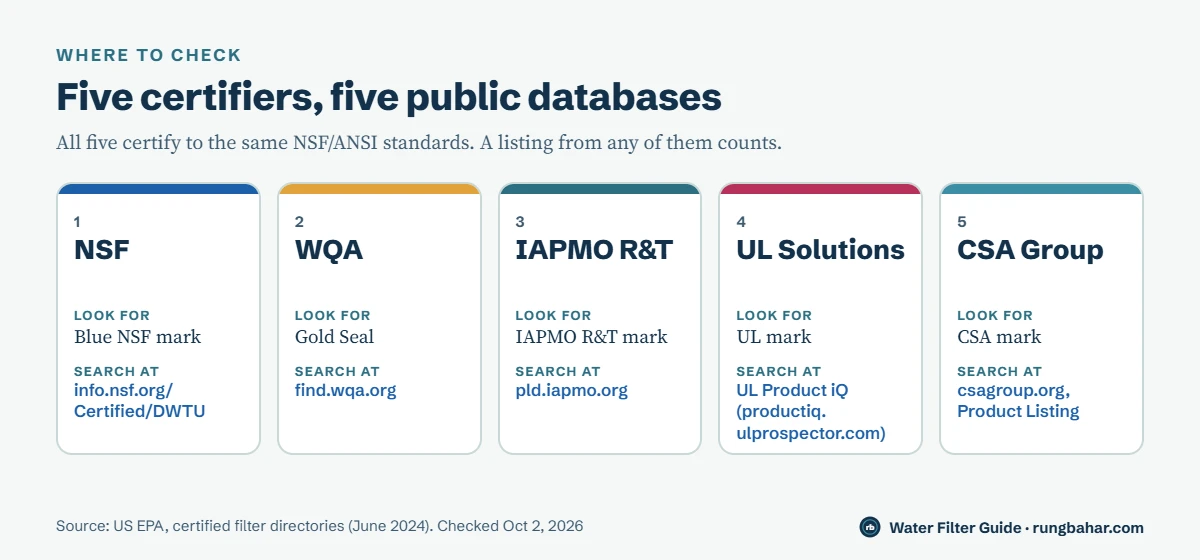
Start with the certifier named on the box or on the performance data sheet. If none is named, search NSF first, then WQA and IAPMO, which together cover most pitcher, faucet, fridge and under-sink filters sold in the US.
How to check if a water filter is NSF certified, step by step
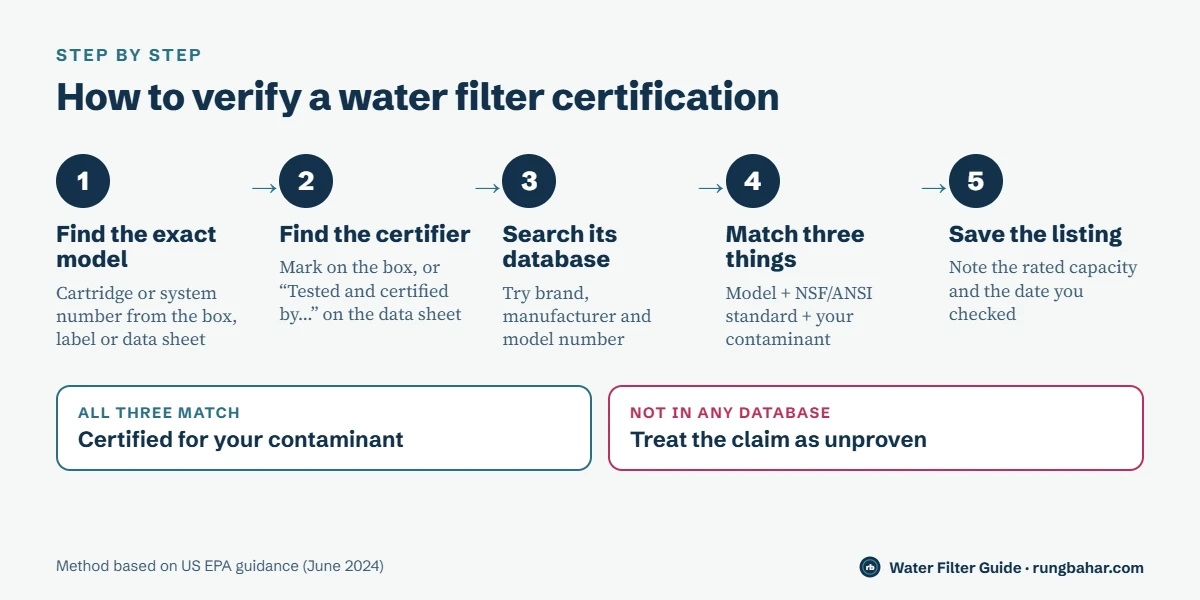
Step 1: Find the exact model number
Certification belongs to a model, not a brand. Find the model number of the filter cartridge or system on the box, the cartridge itself, the manual or the performance data sheet. For a pitcher or a fridge, the number you need is usually the replacement cartridge model, because that is the part doing the filtering. Write it down exactly, including letters and dashes.
Step 2: Find the certifier’s name
Look for a certification mark on the packaging, and for the certifier statement on the performance data sheet. The EPA describes the wording to look for: a product should say it was “Tested and Certified by” a named certification body “against NSF/ANSI Standards 42 and 53 for the claims specified on the Performance Data Sheet.” That sentence tells you both who to check with and which standards to look for.
Step 3: Search the certifier’s database
Open that certifier’s directory. On NSF’s site, type at least three letters of the manufacturer name and, if you like, the brand or model. You can also choose a product standard, such as NSF 53, and a reduction claim, such as lead, then search for products certified to any or all of the claims you select. That second route is useful when you want a list of options rather than a single check.
One trap: the manufacturer in a listing is often not the brand on the box. When we searched NSF’s database for “Brita” on October 2, 2026, the Brita Total360 and Brita Pro home systems appeared under EcoWater Systems LLC and Water Channel Partners. If a manufacturer search finds nothing, try the brand or trade name and the model number instead.
Step 4: Match the model, the standard and your contaminant
Open the listing and check three things in order. Is the model number exactly the one you have or plan to buy? Is the standard the right one for your concern, such as NSF/ANSI 53 for lead or NSF/ANSI 58 for a reverse osmosis system? And is your contaminant named as a reduction claim? If all three match, the filter is certified for what you need.
Step 5: Note the capacity and save the link
The listing or data sheet also shows the rated capacity, in gallons or months. Certification only covers the filter up to that capacity, so it tells you how often to replace the cartridge. Save the listing link or take a screenshot with the date. Listings change, and it helps to know what you checked.
How to read a listing or performance data sheet
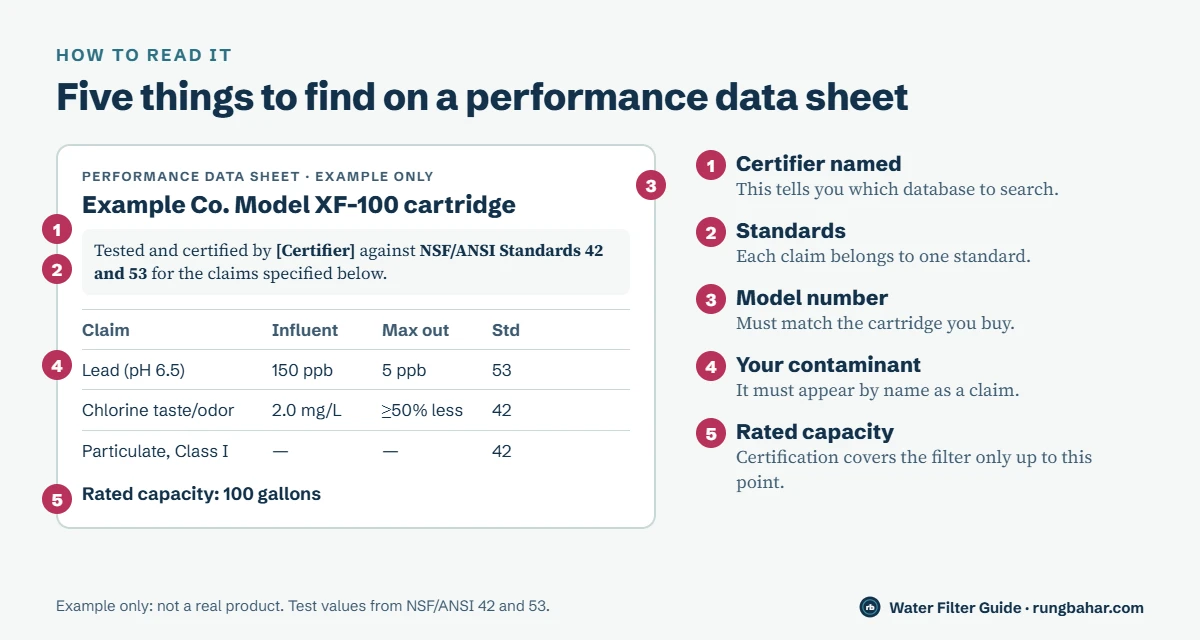
A listing and a performance data sheet (PDS) say the same things in different layouts. The PDS is the document the manufacturer publishes with the product, and it should match what the certifier lists. Here is what each part means.
- Certifier statement: names who certified the product and against which standards. “Tested and certified by” a named body is what you want to see.
- Model numbers: the exact systems and cartridges covered. A pitcher listing may name both the pitcher and the filter that goes in it.
- Standard: 42, 53, 58, 401 and so on. Each claim belongs to one standard.
- Reduction claims: each contaminant the product is certified to reduce. Your contaminant must appear by name.
- Influent and effluent: on a PDS, the challenge level used in testing and the maximum allowed in filtered water. For lead under NSF/ANSI 53, that is 150 ppb in and no more than 5 ppb out.
- Rated capacity: how many gallons, or how many months, the cartridge is certified for.
If the PDS and the certifier’s listing disagree, trust the certifier’s listing. It is the independent record, and it is updated when claims change.
A real example: one pitcher filter, three certifiers
Brita’s published performance data sheet for its Elite filter (model OB06) shows why you should read the certifier statement line by line. On the version we checked on October 2, 2026, the sheet says:
- The Elite filter is certified by WQA against NSF/ANSI 42, 53 and 401 for the claims listed on the sheet.
- The Elite filter is certified by IAPMO R&T against NSF/ANSI 53 for PFOA/PFOS reduction.
- The Pacifica pitcher (model OB41) with the Elite filter is tested and certified by NSF against NSF/ANSI 53 for lead reduction.
The same sheet reports the lead test at two pH levels, starting from 150 ppb (plus or minus 15) with a 5 ppb maximum allowed in the filtered water, and gives a rated capacity of 120 gallons, about six months for an average family according to Brita.
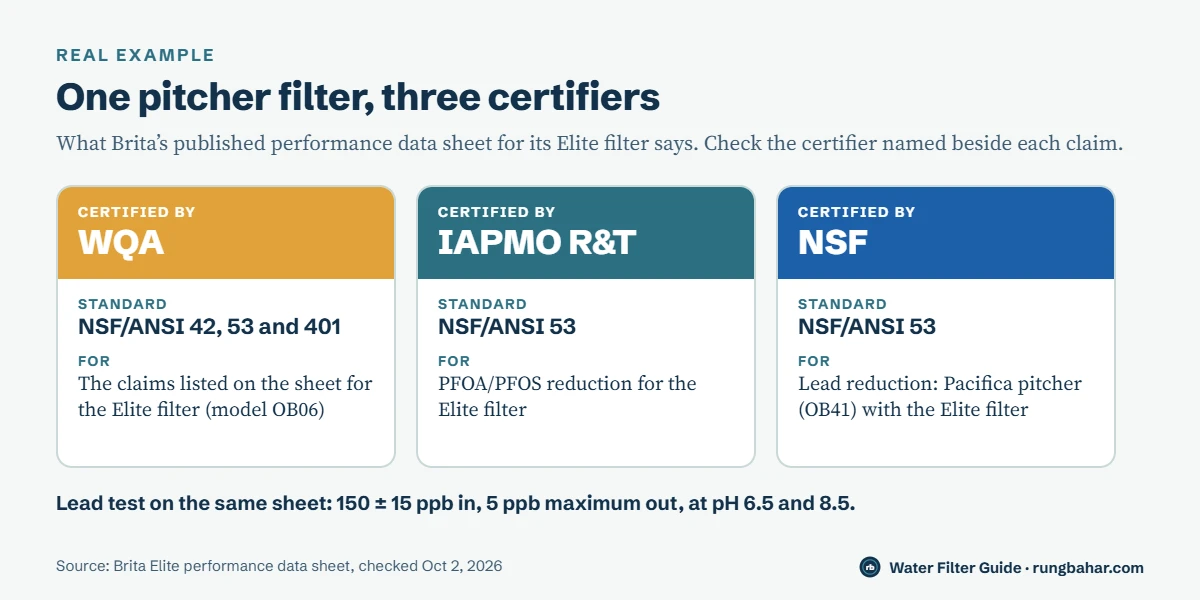
The lesson is simple. One product can hold different claims from different certifiers. If you only searched one database, you could wrongly conclude a claim is missing. Match each claim you care about to the certifier named beside it, then check that certifier’s listing.
Is Brita NSF 53 certified? Is Berkey NSF certified?
These are two of the most searched versions of this question, so we checked both on October 2, 2026.
Brita: it depends on the filter. Brita says its Elite filter is certified to NSF/ANSI 53 for lead reduction, and its data sheet lists the certifiers above. Brita’s standard pitcher filter is a different product, and Brita’s own lead page does not name it as certified for lead. Always check the exact cartridge model you are buying, and see how Brita and PUR compare on certified claims if you are choosing between the two. Our Brita certification check compares what the Standard and Elite filters are certified to reduce.
Berkey: NSF’s database lists the Big Berkey, Royal Berkey and Travel Berkey from New Millennium Concepts under NSF/ANSI 42, for chlorine reduction and taste and odor reduction, when fitted with Phoenix Gravity New Millennium Edition filter elements (model PGF9-2). We did not find an NSF/ANSI 53 or 58 health-effects listing for Berkey in NSF’s database. A 42 listing covers taste and chlorine, not lead or PFAS. If a seller says otherwise, ask which certifier lists the health claim and search that database yourself.
Red flags on boxes and product pages
Most misleading certification claims fall into a few patterns. Watch for these on boxes and online listings:
- “Tested to NSF standards” or “meets NSF standards.” This can mean a single lab test with no factory audits and no public listing. Certification is the stronger claim.
- “Made with NSF-certified materials” or “certified components.” Parts can be certified for material safety without the finished filter being certified to reduce anything.
- A logo with no standard number. Certification is to a specific standard. Look for “NSF/ANSI 53” or similar, not just a mark.
- A standard with no contaminant. “NSF 53 certified” does not tell you whether lead, PFAS or something else is covered.
- A lab report PDF instead of a listing. Third-party lab results can be useful information, but they are not the same as certification.
- The wrong model. The certification may belong to a sibling product, an older version or a different cartridge size.
None of these automatically means a product is bad. It means the claim is not proven until you find a listing that names the model, the standard and the contaminant.
Replacement and refrigerator cartridges
Every replacement cartridge needs its own certification. This matters most for refrigerator filters, where many low-cost cartridges are sold as “compatible with” a brand-name model. Compatible means it fits; it does not mean it carries the original’s certifications. Search the replacement cartridge’s own model number in the databases before you assume it reduces lead or PFAS.
The same applies when a brand updates a product. A new cartridge version may have different claims from the old one, so check the model printed on the cartridge you actually receive.
What to do if you cannot find the filter
- Search all five databases, using the brand, the manufacturer and the model number in turn.
- Look at the performance data sheet for the certifier’s name and check that certifier again.
- Ask the seller or manufacturer for a direct link to the certifier’s listing. A certified brand can send one quickly.
- If no listing turns up, choose a filter that is listed for your contaminant instead.
If you need a starting point, our 15-second filter finder suggests a filter type and the certification to look for, and our NSF 53 vs 58 guide explains when a carbon filter is enough and when reverse osmosis makes sense. All our guides are on the water filter guides page.
Filter types that are easy to verify
Each card links to certified listings, so you can search for models that carry the claim you need.
Lowest cost
Pitcher or faucet filter
- Certification: NSF/ANSI 53 for lead, plus 42 for taste
- Best for: Renters and small households
- Skip if: you need fluoride or nitrate reduced
Most households
Under-sink carbon filter
- Certification: NSF/ANSI 53 for lead and PFOA/PFOS
- Best for: Lead plus PFAS without wastewater
- Skip if: your report shows high TDS or fluoride
Widest coverage
Reverse osmosis system
- Certification: NSF/ANSI 58 with your contaminant named
- Best for: Fluoride, nitrate, arsenic, high TDS
- Skip if: you cannot install under the sink
Checking a filter’s certification: 15 common questions, answered
These are the questions people search most when they try to verify a water filter, including the ones most guides skip.
How do I check if a water filter is NSF certified?
Find the exact model number, then search it at info.nsf.org/Certified/DWTU. Confirm the listing shows the same model, the right NSF/ANSI standard and your contaminant as a reduction claim. If NSF does not list it, check WQA, IAPMO R&T, UL Solutions and CSA Group, which certify to the same standards.
Is there an NSF certified water filters list?
Yes. NSF’s public database at info.nsf.org/Certified/DWTU lists every product it certifies. You can filter it by standard (such as NSF 53) and by reduction claim (such as lead or PFOA/PFOS) to see all certified models for that claim. WQA and IAPMO R&T publish similar lists.
Is Brita NSF 53 certified?
Some Brita filters are. Brita says its Elite filter is certified to NSF/ANSI 53 for lead, and its data sheet names WQA, IAPMO R&T and NSF as certifiers for different claims. Brita’s standard filter is a separate product. Check the exact cartridge model.
Is the Berkey water filter NSF certified?
When we checked on October 2, 2026, NSF listed the Big, Royal and Travel Berkey under NSF/ANSI 42 for chlorine and taste and odor reduction, fitted with Phoenix Gravity New Millennium Edition elements (PGF9-2). We found no NSF/ANSI 53 or 58 health-effects listing in NSF’s database.
What is the difference between NSF certified and third-party tested?
Third-party testing usually means a lab ran a test, often once. Certification adds factory audits, periodic retesting, a public listing and the right to use the certifier’s mark. Test reports can be informative, but only certification is independently maintained over time.
Is WQA Gold Seal certification legit?
Yes. The Water Quality Association is one of the five certification bodies the EPA lists for drinking water filters. Products in its Gold Seal listing passed testing to industry standards and are subject to annual manufacturing audits.
What does IAPMO certified mean on a water filter?
It means IAPMO R&T, an accredited certifier, certified the product, usually to an NSF/ANSI standard. Search the model in IAPMO’s product listing directory at pld.iapmo.org to see which standard and claims it covers.
Can a company fake NSF certification?
A box or web page can show a mark or wording the product has not earned, which is exactly why the public database matters. If the model is not in the certifier’s listing, the certification claim is not proven.
Does NSF certification expire?
A certification stays valid while the manufacturer keeps meeting the program’s requirements, including audits and retesting. Products that no longer comply drop out of the listing, so check the database rather than relying on old packaging.
Do replacement filters need their own certification?
Yes. Each cartridge model is certified separately. “Compatible with” means the cartridge fits, not that it carries the original’s claims. Search the replacement cartridge’s own model number.
What is a performance data sheet?
It is the manufacturer’s summary of a filter’s certified claims, test conditions, results and rated capacity. It should name the certifier. If it disagrees with the certifier’s listing, trust the listing.
Where is the model number on a water filter?
Usually on the cartridge label, the box, the manual and the performance data sheet. For pitchers and fridges, use the replacement cartridge number, since that is what is certified to reduce contaminants.
Does NSF 61 or NSF 372 mean a filter removes lead?
No. NSF/ANSI/CAN 372 checks that the product’s own parts are low in lead, and NSF/ANSI/CAN 61 covers materials that touch drinking water. For lead removal, look for NSF/ANSI 53 or 58 with a lead reduction claim.
An online listing says the filter is certified. Is that enough?
No. Retailer pages are written by sellers and can mix up models. Use the listing to get the model number, then confirm it in the certifier’s database yourself.
How long does it take to check a filter’s certification?
About two to five minutes once you have the model number. Searching the certifier named on the box is fastest. Checking all five databases takes a little longer.
Sources and how we checked this page
Every fact on this page comes from the certifiers, the US EPA or manufacturer performance data sheets, checked on October 2, 2026. We searched the NSF database ourselves for the Brita and Berkey examples. We do not test filters in a lab.
- US EPA: How to identify filters certified to reduce lead (June 2024, PDF)
- NSF: What does water filter certification mean?
- NSF certified drinking water treatment unit listings
- NSF listings search: Berkey (checked October 2, 2026)
- NSF listings search: Brita (checked October 2, 2026)
- WQA: Find certified products
- IAPMO R&T product listing directory
- NSF: Stricter requirements for lead reduction certification (2019)
- Brita Elite performance data sheet (PDF)
- Brita: Lead reduction information
- NSF: NSF/ANSI 42, 53 and 401 filtration standards