Published October 9, 2026. Every claim is checked against the sources listed at the end of this page. How we research.
The short answer: For most renters the best water filter is one that needs no drilling and no landlord approval: a certified pitcher, a faucet-mount filter if your faucet has a standard threaded tip, or a plug-in countertop reverse osmosis unit for the widest removal. Under-sink filters that connect to the existing cold line are an option if your landlord agrees. Whatever you pick, check that it is certified to NSF/ANSI 53 or 58 for the contaminants actually in your water.
Quick picker
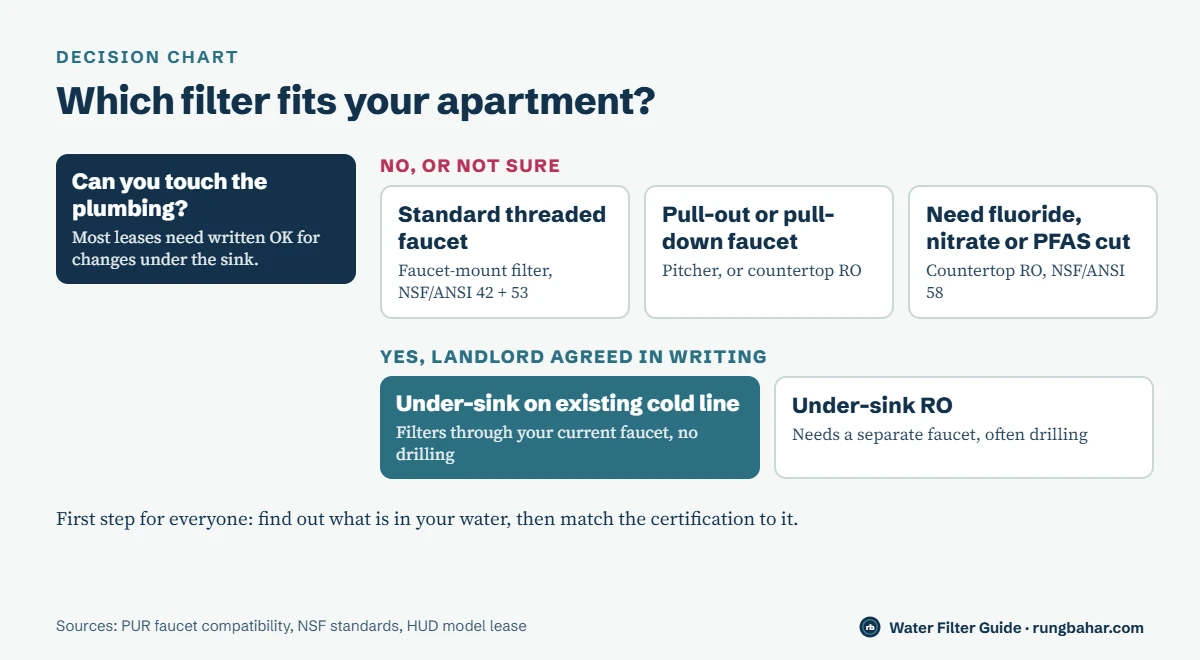
Which fits your apartment?
Start with what is in your water
A filter only helps if it targets what is in your tap. Renters often skip this step because the water bill goes to the landlord, but the information is still yours to get.
- Your utility’s water quality report. Every community water system must deliver an annual Consumer Confidence Report to its consumers, and the EPA’s rules require a good-faith effort to reach people who do not pay the bill, such as tenants. Larger systems serving 50,000 or more people must post reports online. Search your utility’s name plus “water quality report.”
- Your water system’s name. If you do not know which utility serves your building, our ZIP code water check shows the system, its source and its recent lead results from EPA records.
- Your building’s plumbing. The utility’s report describes water leaving the treatment plant. Lead usually enters later, from service lines, lead solder and older brass fixtures. The EPA says lead pipes are more likely in older cities and in homes built before 1986.
Three common renter situations, and what they point to:
- Water tastes or smells like a swimming pool: chlorine or chloramine. A filter certified to NSF/ANSI 42 for chlorine (or chloramine) taste and odor fixes it. Our guide to filters that remove chloramine explains why chloramine needs more carbon contact.
- Building from before 1986, or a utility notice about lead: you want NSF/ANSI 53 with lead listed. See our guide to lead in tap water for testing.
- Report shows PFAS, nitrate or fluoride you want lower: look at reverse osmosis (NSF/ANSI 58) or a filter certified for those exact claims. Our PFAS lookup guide shows where to find PFAS results.
5 renter-friendly filter types
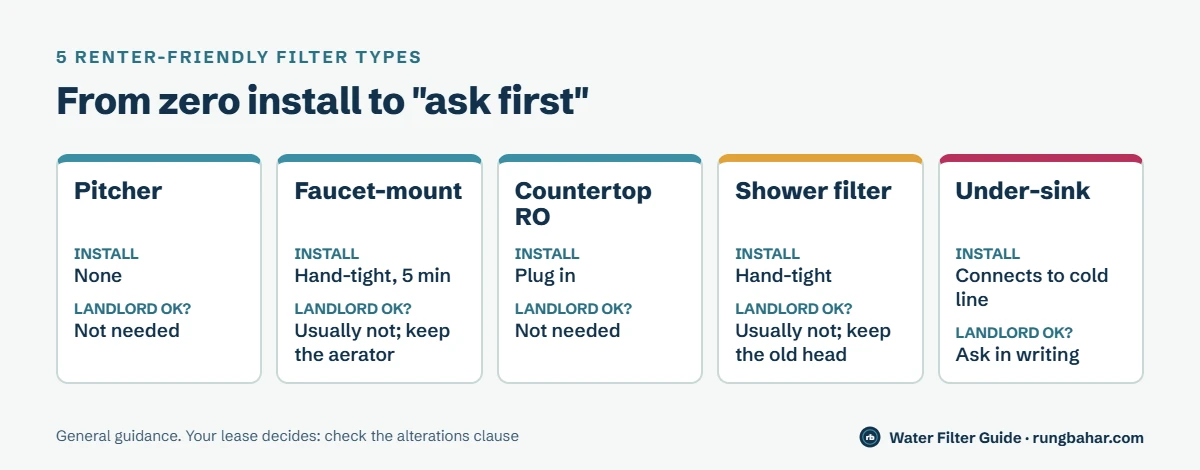
These are ordered from least to most involved. None of the first three touches your plumbing.
1. Pitcher or dispenser filter
No installation at all. You fill it, wait, and keep it in the fridge. A typical pitcher holds 8 to 10 cups: Brita lists 10 cups for its Tahoe pitcher and ZeroWater lists 8 cups for its round pitcher. Cartridge certifications vary a lot. Brita says its Elite filter is certified to NSF/ANSI 42, 53 and 401, including lead and PFOA/PFOS, and rates it at 120 gallons, about 6 months for an average family. ZeroWater says its 5-stage filter is IAPMO certified for lead, chromium and PFOA/PFOS, but its rated capacity is only 15 gallons, and it is replaced when its meter reads 006. Our page on what Brita filters remove compares the cartridges.
Best for: one or two people, tight budgets, no counter space. Downside: small batches and constant refilling.
2. Faucet-mount filter
It replaces your faucet’s aerator, the small screen at the tip, and has a lever to switch between filtered and unfiltered water. No tools: Brita’s instructions are to unscrew the aerator and screw on the base, with an adapter for some threads. PUR includes adapters for both internal and external threads. The catch for renters is the faucet itself. PUR states that pull-out and handheld faucets are not compatible with its systems. Faucet filters are also cold-water only; PUR rates its cartridges for 34 to 82°F.
PUR’s performance data sheet for its PLUS faucet filter lists certification by IAPMO R&T to NSF/ANSI 42, 53 and 401, including lead, total PFAS and microplastics, with a 100-gallon or 3-month cartridge life.
Best for: standard faucets, households drinking more than a pitcher can keep up with. Downside: slows the flow and makes the faucet bulkier.
3. Countertop reverse osmosis
The renter’s answer to under-sink RO. You fill a tank, plug it in, and the unit pushes water through carbon and an RO membrane into a clean-water tank. AquaTru describes its Classic as needing no installation or plumbing and says it is certified by IAPMO to NSF/ANSI 42, 53, 58 and 401. Waterdrop says its K19-S system is certified by IAPMO R&T to NSF/ANSI 58 for the claims on its performance data sheet. Read that sheet: a system can be certified under one standard while other claims on the box are only “tested.”
RO removes more than carbon: fluoride, nitrate, arsenic and most PFAS, along with lead. See what reverse osmosis removes for the full list, and whether RO water is good for you if you worry about minerals.
Best for: renters who want the widest removal and have counter space and an outlet. Downside: takes counter space, needs manual refilling and produces some wastewater you pour out.
4. Under-sink filter on the existing cold line
Some under-sink carbon filters connect to the cold-water supply line and send filtered water through your existing faucet, so no countertop hole is needed. Aquasana says its Claryum Direct Connect works with any existing faucet and is IAPMO certified to NSF/ANSI 42, 53 and 401, with a rated 784 gallons or 6 months. Traditional under-sink and RO systems usually need a separate faucet, which can mean drilling the countertop or sink. That is an alteration most leases restrict.
Best for: longer leases, larger households, landlords who say yes. Downside: needs basic plumbing confidence and written permission.
5. Shower filter
A filter that screws in between the shower arm and the head, or a filtered showerhead. It swaps out in minutes and comes off when you leave. Expectations matter here; see the shower section below.
Side-by-side comparison
| Type | Install | Landlord OK needed? | Rated life (example) | Certifications to look for |
|---|---|---|---|---|
| Pitcher | None | No | 15 gal (ZeroWater) to 120 gal (Brita Elite) | NSF/ANSI 42, 53, 401 |
| Faucet-mount | Hand-tight, 5 minutes | Usually no; keep the aerator | 100 gal or 3 months (PUR) | NSF/ANSI 42, 53, 401 |
| Countertop RO | Plug in | No | Up to 1,100 gal or 12 months (Waterdrop K19-S filter) | NSF/ANSI 58, plus 53 for named claims |
| Under-sink, existing faucet | Connects to cold line | Usually yes | 784 gal or 6 months (Aquasana Claryum DC) | NSF/ANSI 42, 53, 401 |
| Shower filter | Hand-tight | Usually no; keep the old head | Varies by model | NSF/ANSI 177 (free chlorine only) |
Rated life comes from the manufacturers’ own pages, checked October 7, 2026. Replace at whichever limit comes first, gallons or months. The certification only applies up to the rated capacity.
No install
Certified pitcher filter
- Certification: NSF/ANSI 53 with lead or PFAS listed if you need them
- Best for: 1 to 2 people, small kitchens, short leases
- Skip if: you drink and cook with a lot of water
5-minute install
Faucet-mount filter
- Certification: NSF/ANSI 42, 53 and 401
- Best for: Standard threaded faucets, everyday cooking water
- Skip if: your faucet is pull-out or pull-down
Widest removal
Countertop reverse osmosis
- Certification: NSF/ANSI 58 for the system
- Best for: Fluoride, nitrate, PFAS or lead, no plumbing
- Skip if: you have no spare counter space
Your lease, your landlord and your deposit
Read the alterations clause in your lease before anything touches the plumbing. Many leases require the landlord’s written consent for changes to the unit. HUD’s model lease for subsidized housing, for example, says no alteration, addition or improvement may be made without the landlord’s prior written consent. Leases differ, so yours is what counts.
Deposit rules matter too. Landlords can generally deduct for damage beyond normal wear and tear. New York’s attorney general describes exactly that rule and requires landlords to itemize deductions within 14 days. A cracked countertop from drilling, or a leak from a loose fitting under the sink, is the kind of damage that ends up on that list.
A simple way to think about it:
- Generally fine without asking: pitchers, countertop RO units, and swapping an aerator or showerhead for a filter as long as you keep the original and put it back.
- Ask first, in writing: anything that connects to the supply line under the sink, even if no drilling is involved.
- Usually a no for renters: drilling the sink or countertop, whole-house filters, and anything installed at the main water line.
When you ask, keep it short: name the product, say it attaches to the existing cold line with no drilling, offer to have it installed by a plumber if they prefer, and promise to remove it and restore the original setup when you move out. Ask the landlord to reply by email so you have a record. And if you suspect lead, it is reasonable to ask whether the building has a lead service line. Your utility’s service line inventory may also tell you.
How much filtered water you need
Size the filter to your household, or you will be refilling a pitcher all evening. Mayo Clinic Health System puts daily fluid needs at about 11.5 cups for women and 15.5 cups for men, with roughly 20% coming from food. Here is a worked example.
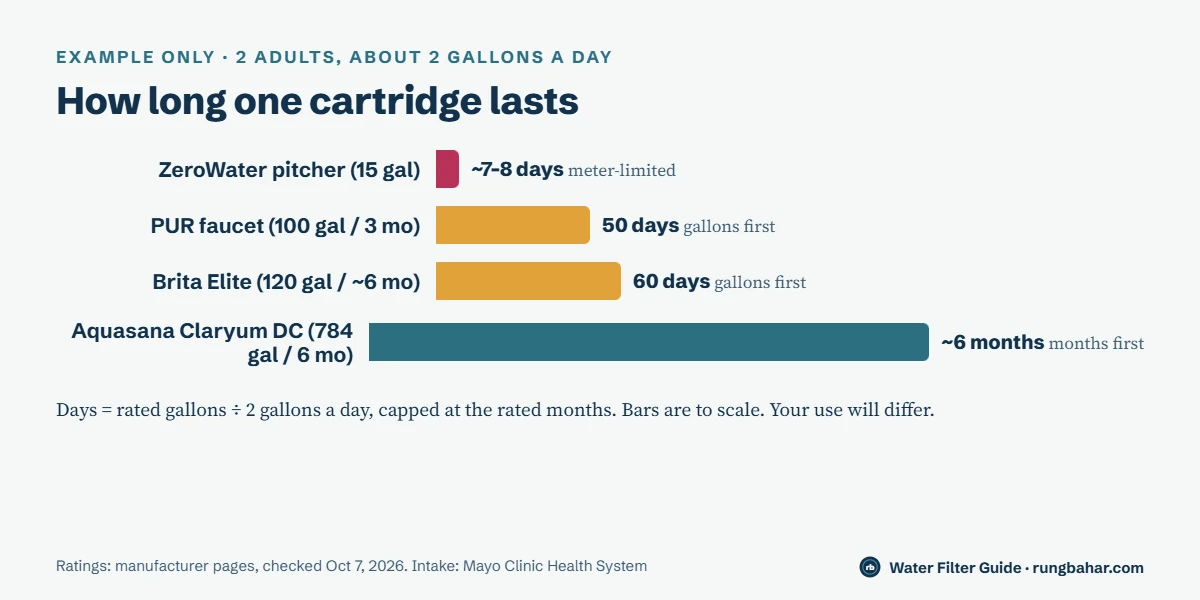
- Two adults drinking about 80% of 11.5 + 15.5 cups from beverages: about 21.6 cups, or roughly 1.4 gallons a day.
- Add a pot of pasta, rice, coffee and tea: call it about 2 gallons a day of filtered water.
- A 10-cup pitcher holds 0.625 gallons, so this household refills it about 3 times a day.
| Filter (example) | Rated life | Days at 2 gal/day | What ends it first |
|---|---|---|---|
| ZeroWater pitcher filter | 15 gallons | About 7 to 8 days* | Gallons |
| PUR faucet filter | 100 gallons or 3 months | 50 days | Gallons |
| Brita Elite pitcher filter | 120 gallons or about 6 months | 60 days | Gallons |
| Aquasana Claryum Direct Connect | 784 gallons or 6 months | About 6 months | Months |
*ZeroWater cartridges end when the meter reads 006, which depends on your water’s dissolved solids, so the real life can be shorter or longer. Example only: your use will differ. The point is that a pitcher’s “6 months” assumes lighter use than many households have. For two or more people who cook with filtered water, a faucet filter, countertop RO or under-sink filter usually costs fewer cartridges per gallon and far less refilling.
Certified vs “tested to”: read the fine print
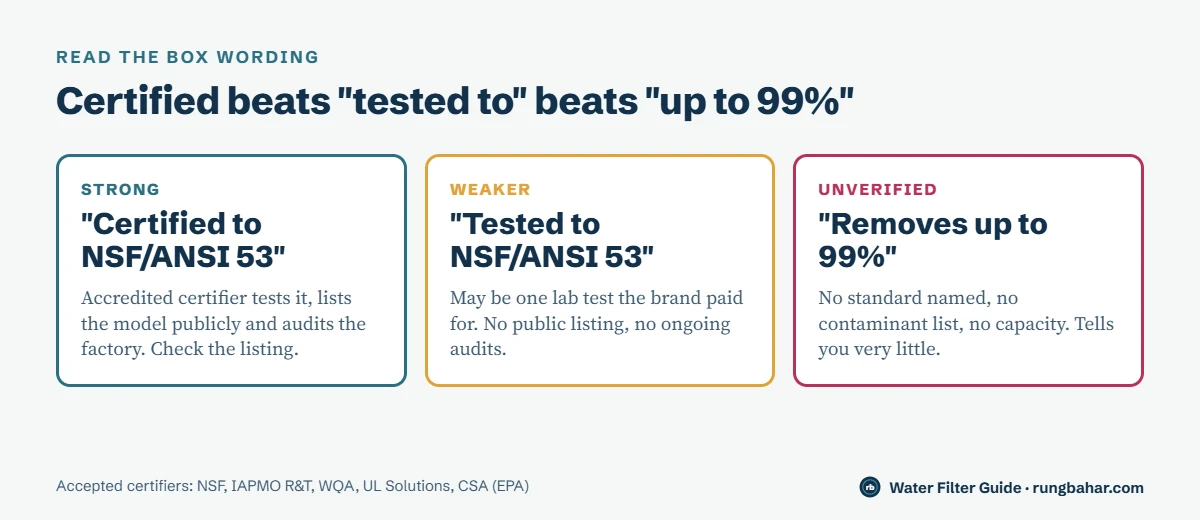
Filter boxes use several kinds of wording, and only one is strong. Certified means an accredited certifier, such as NSF, IAPMO R&T, WQA, UL Solutions or CSA, tested the product, lists it publicly and audits the factory. Tested to or meets the standard may mean one lab test the brand paid for, with no listing and no audits. Removes up to 99% with no standard named tells you almost nothing.
The standards you will see most:
- NSF/ANSI 42: taste and odor, including chlorine and chloramine, and particulates.
- NSF/ANSI 53: health contaminants such as lead, PFOA/PFOS, cysts and VOCs. Over 50 possible claims.
- NSF/ANSI 58: reverse osmosis systems.
- NSF/ANSI 401: up to 15 emerging contaminants, such as some pharmaceuticals and pesticides.
- NSF/ANSI 177: shower filters, free chlorine only.
A certification covers specific claims, not the whole box. Always check that the contaminant you care about appears on the listing for that exact model. Our step-by-step guide shows how to check if a filter is really NSF certified, and the certifications explainer covers each standard in depth.
Shower filters for apartments: what they can promise
Shower filters are popular with renters because they are easy to install and remove. Set expectations first. NSF says its shower filter standard, NSF/ANSI 177, certifies shower filters to reduce free available chlorine only. No NSF/ANSI standard for shower filters covers chloramine, lead, hardness or PFAS. If your utility uses chloramine, which many large systems do, a chlorine claim may not match your water.
Certified products exist but are few. NSF’s NSF/ANSI 177 listing, checked October 7, 2026, includes products such as The Jolie filtered showerhead, all certified for free available chlorine reduction. Many popular shower filters are only “tested to” the standard. For hard-water problems like scale and dry skin, a shower filter is not a water softener, and softeners are rarely an option for renters.
Install tip: wrap the shower arm threads with fresh plumber’s tape, hand-tighten, and store the original showerhead in a labeled bag for move-out day.
Moving out with a filter
- Remove faucet and shower filters and reinstall the original aerator and showerhead. Run the water to check for drips.
- Under-sink units: shut off the cold valve, disconnect, reconnect the original supply line, and check for leaks for a day before the walk-through.
- Take spare cartridges with you, but check they fit the next apartment’s faucet first.
- Countertop RO and pitchers just move with you. Drain and dry the tanks for the move.
Still deciding? The filter finder narrows the options in a few clicks, and our guide to choosing a water filter works through the full decision step by step.
Water filters for apartments: 14 renter questions
Short answers to what renters search most, based on manufacturer, NSF, EPA and tenant-law sources checked October 7, 2026.
What is the best water filter for an apartment?
One that needs no drilling and is certified for your water’s contaminants: a certified pitcher, a faucet-mount filter, or a countertop reverse osmosis unit for the widest removal.
Can I install a water filter in my apartment?
Pitchers, countertop units and faucet-mount filters usually need no permission. Anything connected to the plumbing under the sink usually needs your landlord’s written consent. Check your lease.
Can you install a reverse osmosis filter in an apartment?
Yes, as a countertop RO unit that plugs in with no plumbing. Under-sink RO usually needs a separate faucet and drilling, so ask your landlord first.
Can you install a whole-house water filter in an apartment?
Rarely. It connects at the main water line, which is a building alteration. Filter at the tap you drink from instead.
Do faucet filters fit every faucet?
No. PUR says its faucet systems do not fit pull-out or handheld faucets. They fit most standard faucets with threaded tips, using the included adapters.
What is the best water filter for an apartment sink?
For a standard faucet, a certified faucet-mount filter. For a pull-out faucet, a countertop RO unit or a no-drill under-sink filter with landlord approval.
Do apartment shower filters work?
Certified ones reduce free chlorine. NSF/ANSI 177 covers only that, so do not expect chloramine, lead or hardness removal.
Can a shower filter fix hard water in an apartment?
Not really. Shower filters are not water softeners. They may change how water feels, but no certification covers hardness reduction for them.
Will a water filter affect my security deposit?
Not if you remove it cleanly and restore the original parts. Damage beyond normal wear and tear, such as drilling or leaks, can be deducted.
Do renters get a water quality report?
Yes. Utilities must deliver reports to all consumers and make a good-faith effort to reach people who do not pay the bill. Larger systems post them online.
Is apartment tap water safe to drink?
Usually, but your building’s plumbing can add lead. Read your utility’s report, and test or use a filter certified for lead in older buildings.
Who replaces the fridge filter in a rental?
It depends on your lease. Ask your landlord, and check whether the cartridge is certified for the contaminants you care about.
How often should I change a pitcher filter?
At the rated gallons or months, whichever comes first. Brita Elite: 120 gallons, about 6 months. ZeroWater: when the meter reads 006.
Is a countertop RO unit worth it for renters?
If you need fluoride, nitrate, PFAS or arsenic reduced and have counter space, yes. For chlorine taste alone, a pitcher or faucet filter is enough.
Sources and how we checked this page
Facts on this page come from the EPA, NSF, HUD, the New York Attorney General, Mayo Clinic Health System and manufacturer pages and performance data sheets, checked on October 7, 2026. We do not test filters in a lab, and this is not legal advice; check your own lease and local tenant law.
- EPA: Consumer Confidence Report rule revisions FAQ (Dec 2024)
- EPA: Basic information about lead in drinking water
- NSF: NSF/ANSI 42, 53 and 401 filtration standards
- NSF: Standards for water treatment systems
- NSF: NSF/ANSI 177 shower filter certification
- NSF: NSF/ANSI 177 certified product listing
- HUD: Model lease for subsidized programs (Form HUD-90105a)
- New York Attorney General: Residential tenants’ rights guide
- Mayo Clinic Health System: Tips for drinking more water
- PUR: Faucet compatibility and filter replacement
- PUR: Performance data sheet, PLUS faucet filter (PDF)
- Brita: Faucet system support
- Brita: Elite filter performance data sheet (PDF)
- Brita: Tahoe pitcher with Elite filter
- ZeroWater: 8-cup pitcher
- ZeroWater: Certified results
- AquaTru: Classic countertop reverse osmosis
- Waterdrop: K19-S countertop RO
- Aquasana: Claryum Direct Connect
- NSF: Certified drinking water treatment units listing