Published October 8, 2026. Every claim is checked against the sources listed at the end of this page. How we research.
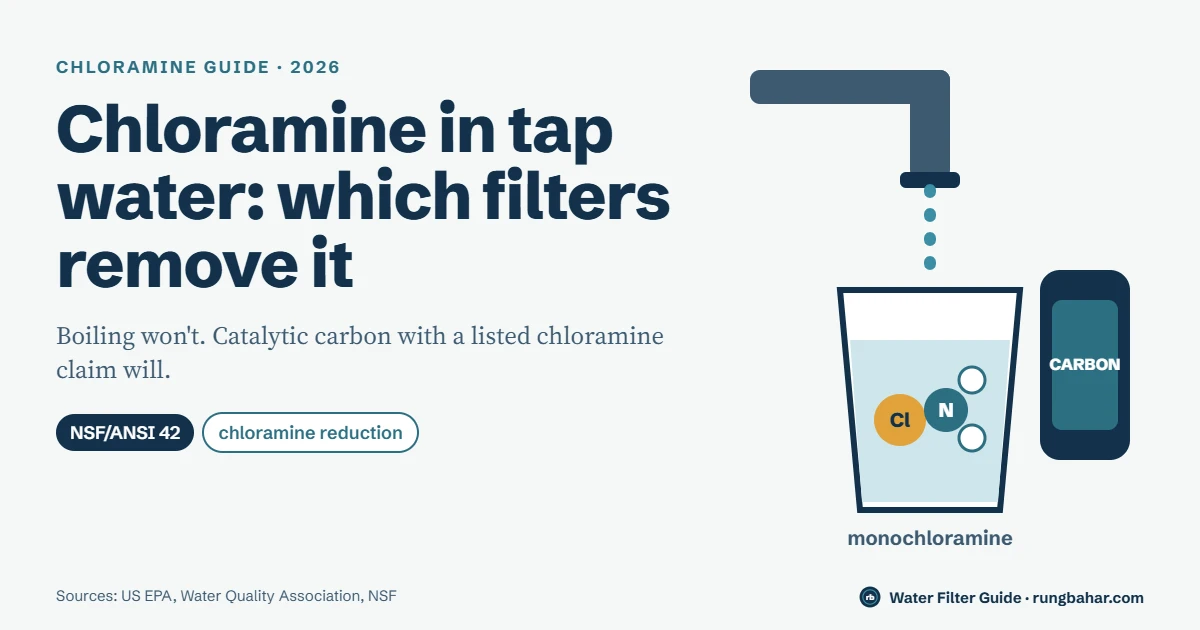
The short answer: Chloramine is harder to remove than chlorine. Boiling does not remove it and letting water sit can take weeks. The filters that work use activated carbon, usually catalytic carbon, with enough contact time. For drinking water, look for a filter whose NSF/ANSI 42 listing names chloramine reduction, not just “chlorine taste and odor.” For aquariums and home dialysis, chloramine must be fully removed or neutralized.
Quick check
Where do you want chloramine out of your water?
What chloramine is and why cities use it
Chloramine is a disinfectant made by adding a small amount of ammonia to chlorine at the treatment plant. The form used in drinking water is called monochloramine. It kills germs more slowly than chlorine, but it lasts much longer, so it keeps protecting the water as it travels through miles of pipes to your tap.
It is common. The US EPA and the Water Quality Association both say that more than one in five Americans uses drinking water treated with chloramines. Many large cities switched to it over the past few decades.
Why switch? The EPA lists three reasons. First, its rules limit the disinfection byproducts that form when chlorine reacts with natural organic matter in water. Chloramine is less reactive, so it forms lower amounts of those regulated byproducts. Second and third, utilities that switch usually get fewer complaints about the taste and the smell of their water.
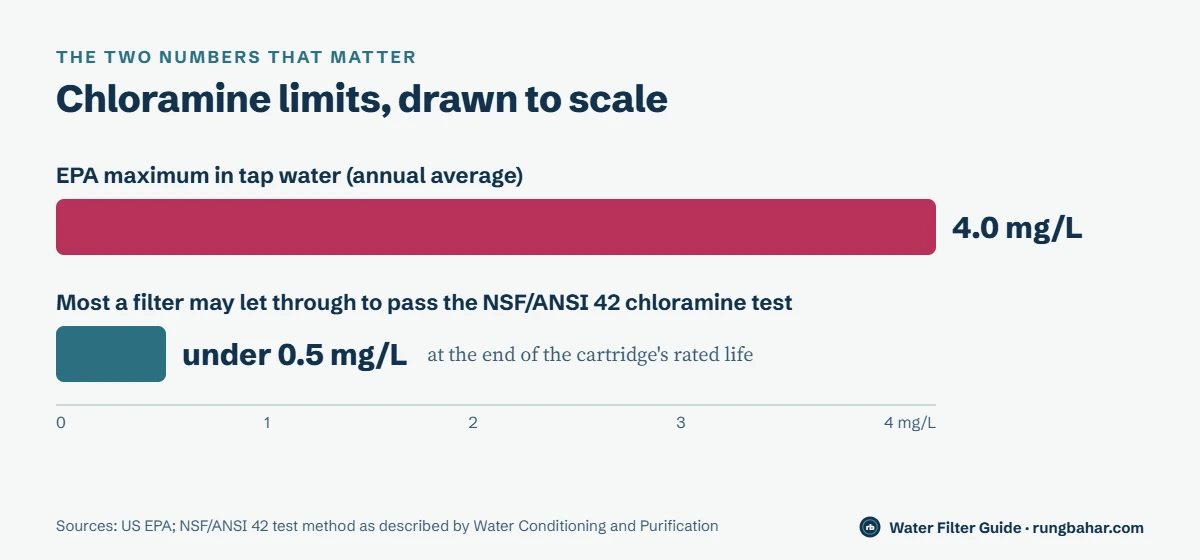
Is it safe to drink? The EPA says chloraminated water that meets its standards is safe for drinking, cooking and showering. The legal limit is 4 parts per million (4 mg/L), measured as an annual average. In its answer to whether monochloramine causes cancer, the EPA says water that meets the rules poses “no known or anticipated adverse health effects, including cancer.” It also notes that chloraminated water may contain more of some unregulated byproducts than chlorinated water, and that research on those continues.
So for most people, removing chloramine is about taste, smell, skin and hair preferences, or the plumbing of a specific appliance. For two groups it is not optional at all: people on home kidney dialysis, and anyone keeping fish. More on both below.
How to tell if your water has chloramine
Before you buy anything, confirm what your utility uses. You can do it in a few minutes, and it decides which filter you need.
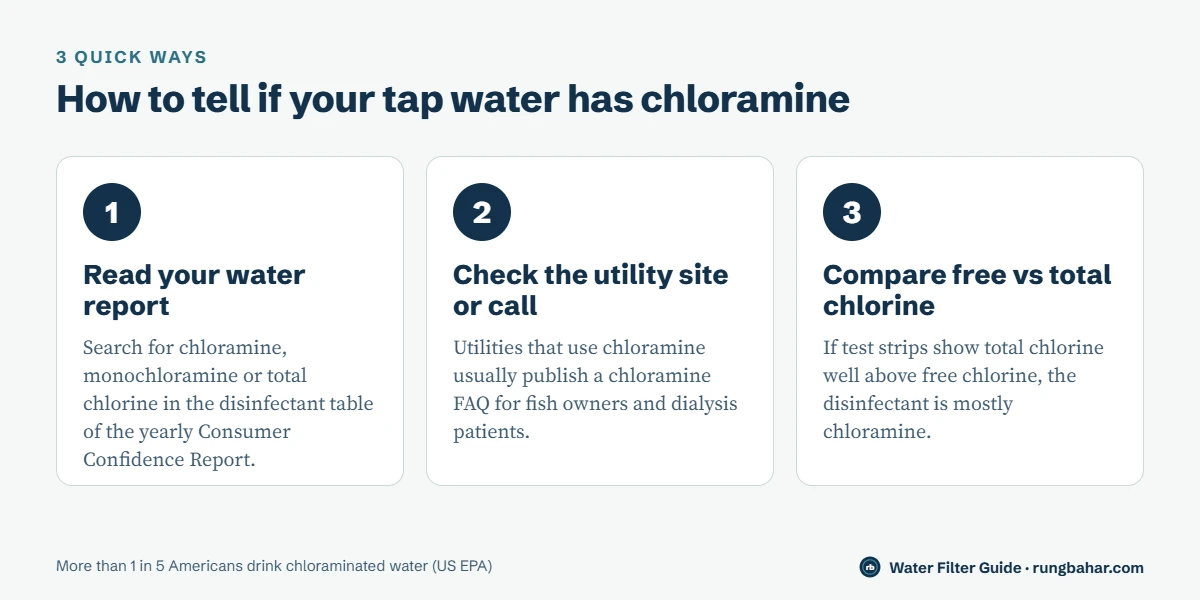
- Read your water quality report. Every US community water system publishes a yearly Consumer Confidence Report. Look for “chloramine,” “monochloramine” or “total chlorine” in the table of disinfectants. Our homepage ZIP tap-water check helps you find the right report.
- Check the utility’s website or call. Utilities that use chloramine usually have a chloramine FAQ page, often with advice for fish owners and dialysis patients.
- Use test strips if you are unsure. Pool and aquarium strips that read both “free chlorine” and “total chlorine” give a hint. If total chlorine is clearly higher than free chlorine, most of the disinfectant is in combined form, which usually means chloramine.
One more thing: some utilities switch to free chlorine for a few weeks each year to clean out their pipes. During that “free chlorine burnout” (St. Johns County, Florida, ran one from June 1 to 21, 2026), the water may smell more like a pool. Your utility will announce it.
Chlorine vs chloramine: why filters treat them differently
The property that makes chloramine useful to a utility is the same one that makes it annoying to remove at home: it is stable. Chlorine is volatile and reactive. Chloramine is neither.
| Question | Chlorine | Chloramine |
|---|---|---|
| Does boiling remove it? | Yes, slowly | No (EPA) |
| Does letting water sit work? | Over a few days | Can take weeks |
| Basic carbon (short contact) | Works well | Partial at best |
| Catalytic carbon, longer contact | Works well | The usual fix |
| Vitamin C (ascorbic acid) | Neutralizes | Neutralizes |
| Certification claim | NSF/ANSI 42 chlorine taste and odor | NSF/ANSI 42 chloramine reduction |
Here is the practical problem. A small pitcher or faucet filter can be very good at chlorine, because ordinary activated carbon grabs and breaks down chlorine almost instantly. Chloramine needs a chemical reaction on the carbon surface, and that reaction is slower. The Water Quality Association notes that a carbon bed contact time of 10 minutes or more can be required for complete removal, and that newer “catalytic” carbons were developed to speed it up.
That is why a box that says “reduces chlorine” tells you nothing about chloramine. The two are different claims, tested separately.
What removes chloramine (and what does not)
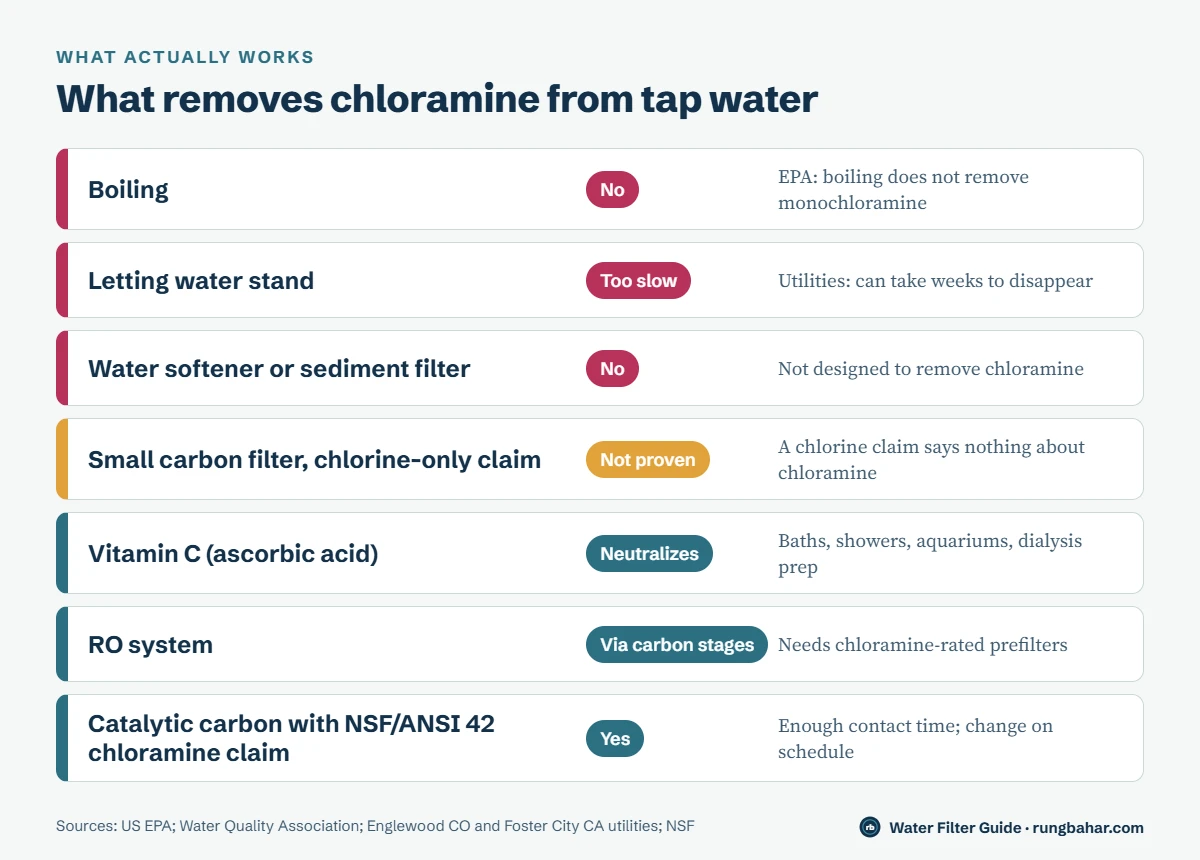
Boiling: no
The EPA states plainly that boiling water does not remove monochloramine. Utilities say the same. If you boil tap water for tea, the chloramine is still there. Our guide to what boiling water removes covers the other contaminants people ask about.
Letting water stand: too slow
The old trick of leaving a jug open overnight works for chlorine because it escapes into the air. Chloramine does not. The City of Englewood, Colorado, notes that chloramines may take weeks to disappear. Foster City, California, says chloramine cannot be removed by boiling, adding salt or letting water stand.
Activated carbon, especially catalytic carbon: yes
The WQA calls activated carbon the most effective non-chemical way to remove chloramines. The two things that matter are the type of carbon and how long the water stays in contact with it. Catalytic carbon is processed to speed up the breakdown of chloramine, and the WQA notes it works better at higher pH. A large carbon block or a big tank of granular carbon gives more contact time than a small pitcher cartridge.
When carbon breaks down monochloramine, it produces small amounts of ammonia, chloride and nitrogen gas, according to the WQA. That matters mostly for fish tanks, where ammonia is a concern, and is covered below.
Vitamin C (ascorbic acid): neutralizes it
Ascorbic acid reacts with chloramine and neutralizes it. Utilities list it, along with granular activated carbon, as one of the two ways to treat water for home dialysis machines and fish. The US Forest Service also uses vitamin C to dechlorinate water and notes it is not toxic to aquatic life at the levels used. At home, vitamin C is most useful for a bath, a shower or a bucket of water, not as a whole-house drinking water solution.
Softeners and sediment filters: no
A water softener removes hardness minerals, and a sediment filter catches particles. Neither is designed to remove chloramine. If a product makes a chloramine claim, check that claim on a certifier’s listing.
The certification to look for
For drinking water filters, the claim you want is chloramine reduction under NSF/ANSI 42. Standard 42 covers “aesthetic” effects such as taste and odor, and it has a separate test for chloramine. In that test, described in Water Conditioning and Purification magazine, the lab makes chloramine in the challenge water and the filter must keep the output below 0.5 mg/L monochloramine at the end of its rated life.
Two cautions. First, NSF/ANSI 42 for “chlorine taste and odor” is a different claim. Many filters have that one and not the chloramine one. Second, a certification is tied to a specific model and cartridge, and to its rated capacity. Once the cartridge passes that capacity, the claim no longer applies. Our guide to checking whether a filter is really NSF certified shows how to look up an exact model in about two minutes.
NSF’s own listings show chloramine reduction claims across many product types, including countertop filters, under-sink systems with a separate faucet, refrigerator filters, and commercial units. The list changes, so check the current listing rather than trusting old reviews. For a wider view of what each NSF standard covers, read water filter certifications explained.
Filter types compared
| Type | Chloramine | Best for | Watch out for |
|---|---|---|---|
| Pitcher | Only if the listing names chloramine | Renters, small households | Short contact time; many pitchers are certified for chlorine only |
| Faucet-mount | Only if listed | Quick, no plumbing | Slow flow, small cartridge |
| Refrigerator filter | Some models are listed | Fridge water and ice | Compatible “generic” cartridges may not carry the same claim |
| Under-sink carbon block | Common on listings | Cooking and drinking water | Change the cartridge on schedule |
| Under-sink reverse osmosis | Depends on the carbon stages | Several contaminants at once | Prefilter life; see the RO section |
| Whole-house catalytic carbon | Designed for it | Showers, laundry and every tap | Sizing to your flow rate; professional install |
If chloramine is your only concern, an under-sink carbon block or a pitcher with a listed chloramine claim is usually enough for drinking water. If you also want lead or PFAS out, look for a filter that carries those claims too, under NSF/ANSI 53 or 58. Our NSF 53 vs 58 guide explains the difference, and this guide to refrigerator filters covers what fridge cartridges can and cannot do.
Drinking and cooking water
Under-sink carbon block with a chloramine claim
- Certification: NSF/ANSI 42 with chloramine reduction listed
- Best for: Homeowners who want chloramine out of the kitchen tap with good flow
- Skip if: you cannot connect anything under the sink
Renters and small spaces
Pitcher or countertop filter with a chloramine claim
- Certification: NSF/ANSI 42 chloramine reduction on the exact cartridge
- Best for: Apartments, dorms, a quick fix with no tools
- Skip if: the listing only says “chlorine taste and odor”
Every tap and shower
Whole-house catalytic carbon system
- Certification: look for a certified chloramine claim and a flow rating that fits your home
- Best for: Homeowners bothered by chloramine in showers and laundry
- Skip if: you only care about drinking water
Shower filters and chloramine
This is where many buyers get misled. The only NSF standard written for shower filters, NSF/ANSI 177, tests free chlorine reduction in hot water. It does not test chloramine. Products certified to it must even carry a statement that the system “has not been evaluated for free available chlorine reduction performance in the presence of chloramines.”
In other words, a certified shower filter can be a fine product for a chlorinated city and still do little for a chloraminated one. A small cartridge in a shower head also has only a second or two of contact time with hot water flowing fast.
If chloramine in the shower bothers your skin or hair, your realistic options are a vitamin C shower filter, which neutralizes chloramine chemically rather than filtering it, or a whole-house catalytic carbon system sized for your flow. Ask any seller for test data that names chloramine specifically, and treat claims without data with care.
Aquariums, ponds and home dialysis
Fish. The EPA explains that chlorine and monochloramine can harm fish because they enter the bloodstream directly through the gills. Every drop of tap water that goes into a tank or pond needs a water conditioner that says it handles chloramine, or a carbon filter specified for it. Because breaking chloramine apart releases ammonia, many conditioners also bind ammonia. Read the label.
Home dialysis. The EPA says chlorine and monochloramine must be removed before water is used in kidney dialysis machines, because that water comes into direct contact with blood. The WQA adds that chloramines can damage red blood cells in this situation. Dialysis centers already treat their water. If you dialyze at home, talk to your care team and your equipment supplier about chloramine before any change in your water supply. This is not a job for a pitcher filter.
Drinking chloraminated water is a different matter. In normal drinking, digestion breaks chloramine down before it reaches the blood, which is why the same water is considered safe to drink.
Reverse osmosis and chloramine
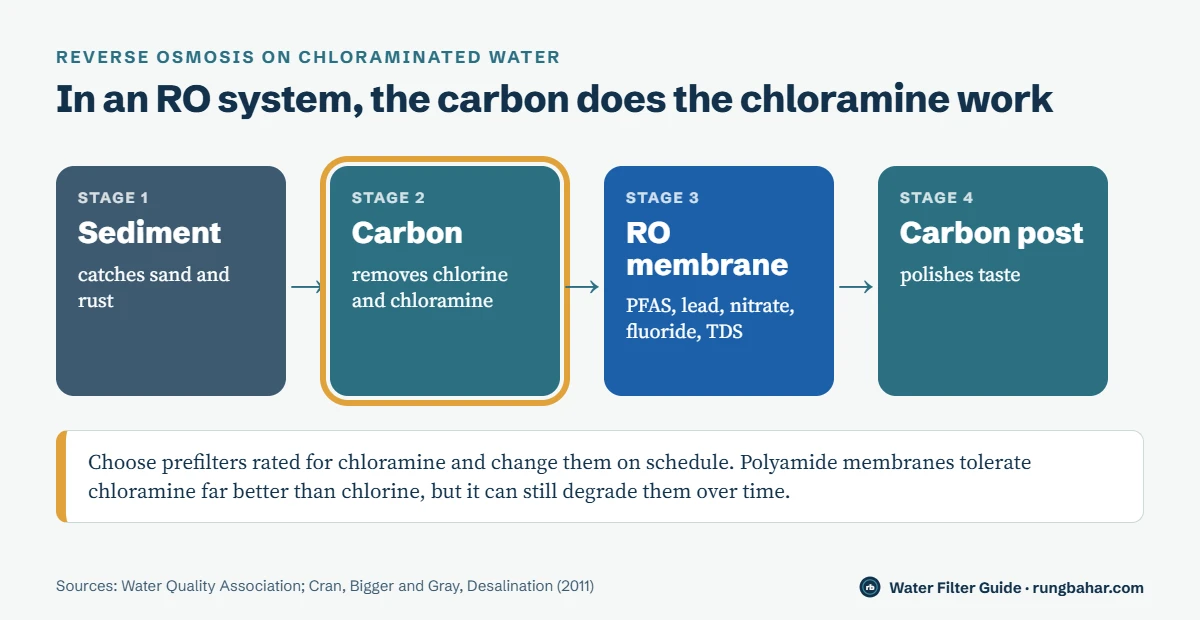
An under-sink reverse osmosis system is a good choice when you want many things out at once, such as PFAS, fluoride, nitrate and dissolved solids. Our guide to what reverse osmosis removes goes through them one by one. For chloramine, though, the work is done by the carbon stages, not mainly by the membrane.
Carbon prefilters also protect the membrane. Research on the polyamide membranes used in most home RO systems found that they tolerate chloramine much better than they tolerate chlorine, but that chloramine can still degrade them over time, faster when certain metals are present (Cran, Bigger and Gray, Desalination, 2011). On a chloraminated supply, that means two practical rules: choose a system whose prefilters are rated for chloramine, and replace them on schedule.
A simple plan
- Confirm it. Check your water report or the ZIP tap-water check. If your utility uses free chlorine, a filter certified for chlorine taste and odor is enough.
- Decide where. Drinking water only, or showers and laundry too? That decides between a point-of-use filter and a whole-house system.
- Check the exact claim. Look up the model on the NSF listing and make sure “chloramine reduction” appears, not just “chlorine.”
- Add other claims you need. If you also worry about lead or PFAS, the same filter should list those under NSF/ANSI 53 or 58. Our water filter buying guide walks through matching a filter to your water.
- Change cartridges on time. A certified claim holds only up to the rated capacity.
Not sure which type fits your home? The 15-second filter finder on our homepage asks a few quick questions and points you to the right type and certification.
Chloramine in tap water: 14 common questions
Short answers to what people search most. Each answer matches the sources listed at the bottom of the page.
What filters remove chloramine from tap water?
Activated carbon filters, especially catalytic carbon with enough contact time. For drinking water, choose a model whose NSF/ANSI 42 listing names chloramine reduction. Reverse osmosis systems remove it through their carbon stages.
Does boiling water remove chloramine?
No. The EPA says boiling does not remove monochloramine. Utilities say the same.
Does a Brita or other pitcher filter remove chloramine?
Only if the exact cartridge is certified for chloramine reduction. Many pitcher cartridges are certified for chlorine taste and odor only. Look up the model on the NSF listing before you buy. Our Brita guide covers what its filters are certified for.
How do I know if my tap water has chloramine?
Check your utility’s yearly water quality report or website, or call them. Test strips that read free and total chlorine can also hint at it: if total chlorine is much higher than free chlorine, chloramine is likely.
Is chloramine in drinking water safe?
The EPA says chloraminated water that meets its standards is safe for drinking, cooking and bathing. The limit is 4 mg/L as an annual average. Home dialysis and fish tanks are the exceptions.
Does chloramine cause cancer?
The EPA says water disinfected with monochloramine that meets its rules poses no known or anticipated adverse health effects, including cancer. It notes some unregulated byproducts are still being studied.
Does chloramine evaporate from tap water?
Very slowly. Chlorine can escape in a few days, but chloramines may take weeks, according to utility guidance.
Does vitamin C remove chloramine?
Yes, vitamin C (ascorbic acid) neutralizes chloramine. Utilities list it for home dialysis and fish. It is mainly practical for baths, showers and buckets of water.
Do shower filters remove chloramine?
Most are not tested for it. NSF/ANSI 177, the shower filter standard, covers free chlorine only. Vitamin C shower filters neutralize chloramine; ask for test data that names chloramine.
Does reverse osmosis remove chloramine?
An RO system removes it mainly through its carbon pre- and post-filters. Choose prefilters rated for chloramine and replace them on schedule to protect the membrane.
Does chloramine kill fish?
It can. The EPA says chloramine enters fish through their gills. Treat all tap water with a conditioner labeled for chloramine before adding it to a tank or pond.
What is the difference between chlorine and chloramine?
Chloramine is chlorine combined with a little ammonia. It lasts longer in pipes and forms fewer regulated byproducts, but it does not boil off and needs more carbon contact time to remove.
Does a water softener remove chloramine?
No. A softener removes hardness minerals. Chloramine needs carbon or vitamin C treatment.
Why did my city switch to chloramine?
The EPA says utilities switch to meet byproduct rules, since chloramine forms fewer regulated disinfection byproducts, and because it usually brings fewer taste and odor complaints.
Sources and how we checked this page
Every fact on this page comes from the US EPA, the Water Quality Association, NSF, US water utilities, the US Forest Service, a trade publication describing the NSF/ANSI 42 and 177 test methods, and a peer-reviewed study, checked on October 6, 2026. We do not test water or filters in a lab, and we do not name products unless we have checked their certification listing.
- US EPA: Chloramines in drinking water
- US EPA chloramine questions and answers (as republished by the Town of Hanover, MA)
- US EPA: Does monochloramine cause cancer? (PDF)
- US EPA: Why are water utilities switching to monochloramine? (PDF)
- Water Quality Association: Chloramine fact sheet
- Water Conditioning and Purification: How NSF/ANSI 42 tests chloramine reduction
- Plumbing and Mechanical: NSF/ANSI 177 and shower filter claims
- NSF listings: products certified for chloramine reduction
- City of Englewood, CO: Chloramine FAQs
- Foster City, CA: Chloramine FAQ (PDF)
- Foster City, CA: Chloramine and dialysis fact sheet (PDF)
- US Forest Service: Dechlorination with vitamin C
- St. Johns County, FL: Free chlorine burnout, June 2026
- Cran, Bigger and Gray: Degradation of polyamide RO membranes in the presence of chloramine, Desalination (2011)