Published October 3, 2026. Every claim is checked against the sources listed at the end of this page. How we research.
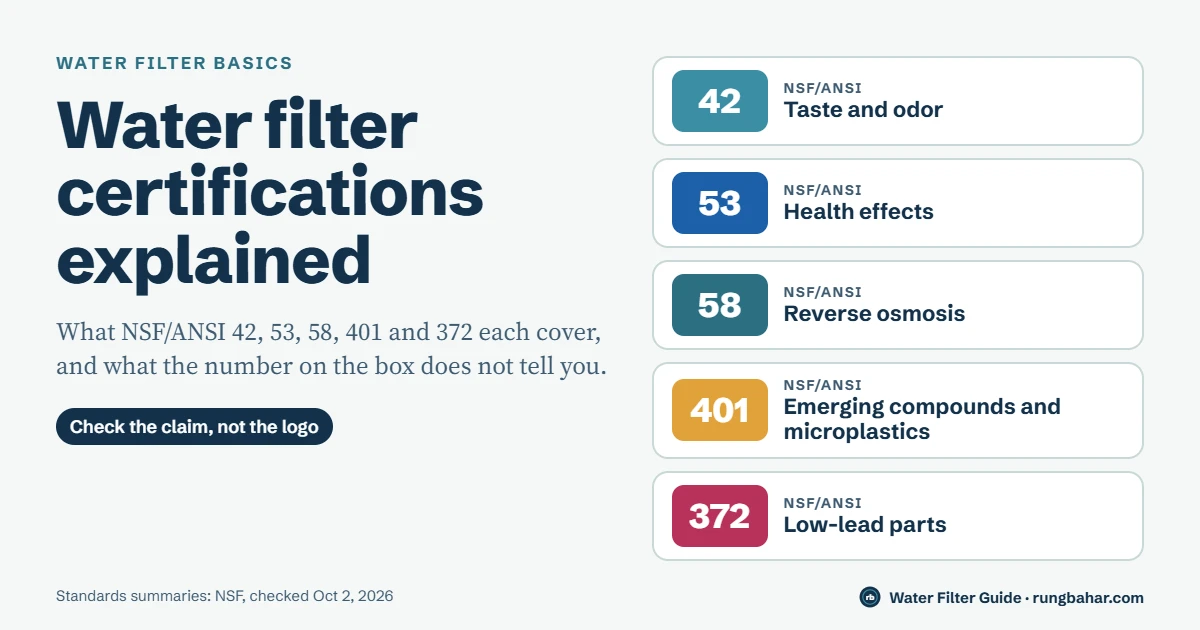
The short answer: NSF/ANSI 42 covers taste and odor, mainly chlorine. NSF/ANSI 53 covers contaminants that affect health, such as lead, cysts and PFAS. NSF/ANSI 58 is only for reverse osmosis systems. NSF/ANSI 401 covers emerging compounds and microplastics. NSF/ANSI/CAN 372 checks that the product itself is low in lead. None of these numbers tells you what a filter removes on its own: a product is certified only for the specific contaminants named on its public listing.
Quick check
Which number is on your filter’s box? Tap it to see what it means.
What a water filter certification actually is
The numbers on a filter box refer to American National Standards for home drinking water treatment. They are written by a joint committee of manufacturers, regulators, certifiers and public health and consumer representatives. NSF says that committee had 28 voting members and 80 observers from the US and Canada when it lowered the lead limit in 2019. Each standard sets out how a product must be tested: what goes into the challenge water, how much must come out, how long the test runs and what the materials may leach.
A standard is only a rulebook. A product becomes certified when an accredited certification body tests it against that rulebook, audits the factory and publishes the result in a public listing. The EPA names five such bodies for drinking water filters: NSF, IAPMO R&T, the Water Quality Association (WQA), UL Solutions and CSA Group. All five certify to the same NSF/ANSI standards, so a WQA or IAPMO listing for NSF/ANSI 53 counts just as much as one from NSF itself.
Certification is voluntary. NSF points out that there is no federal requirement for home water filters to be certified. The CDC and state health departments still recommend certified products, because certification is the only independent check that a filter does what its box says. Our guide on how to check if a water filter is really NSF certified shows how to find any model in the five public databases in a few minutes.
Every certification covers three things. First, material safety: the filter must not add harmful substances to your water. Second, structural integrity: it must not burst or leak under pressure. Third, contaminant reduction: it must cut each claimed contaminant to the level the standard requires, over the full rated life of the cartridge. Only the third part varies from product to product, and it is the part most people care about.
The five standards at a glance
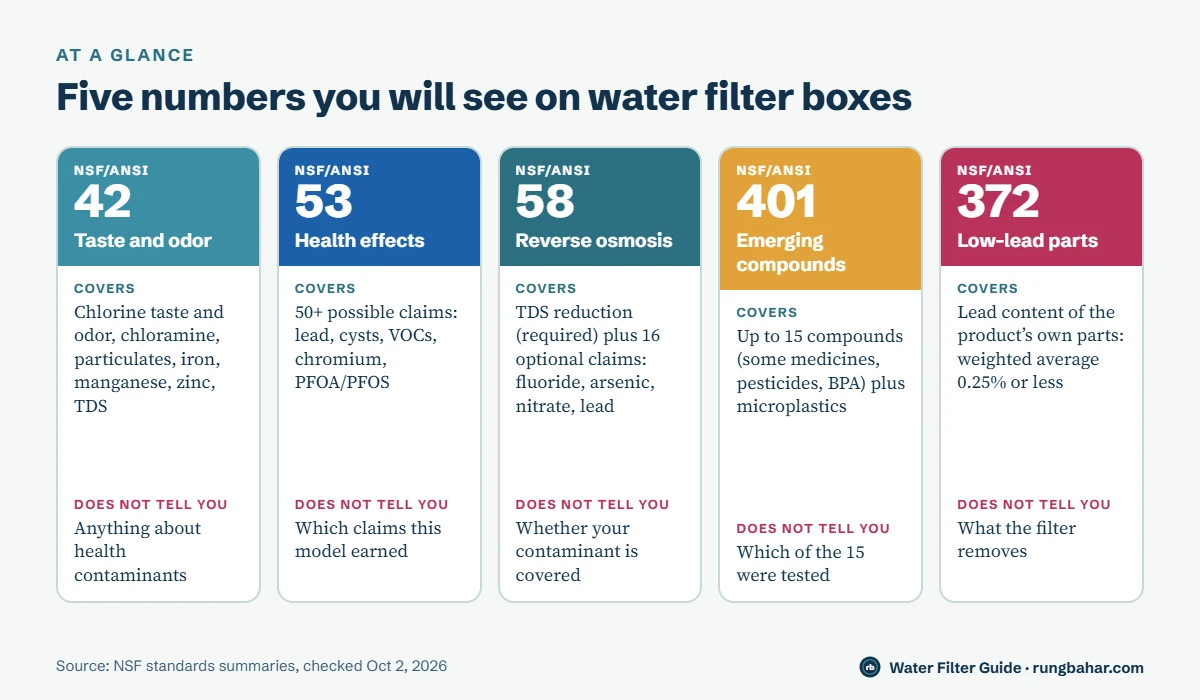
Most home filters sold in the US carry one or more of these five numbers. The table shows what each one is for and, just as important, what it does not tell you.
| Standard | What it certifies | Typical products | What it does not tell you |
|---|---|---|---|
| NSF/ANSI 42 | Aesthetic effects: chlorine taste and odor, chloramine, particulates, iron, manganese, zinc, TDS | Pitchers, faucet filters, fridge filters, whole-house carbon | Anything about health contaminants such as lead or PFAS |
| NSF/ANSI 53 | Health effects: more than 50 possible claims, including lead, cysts, VOCs, chromium and PFOA/PFOS | Pitchers, faucet and fridge filters, under-sink carbon systems | Which of the 50+ claims a model actually earned |
| NSF/ANSI 58 | Reverse osmosis systems: TDS reduction is required; 16 other claims are optional | Under-sink and countertop RO systems | Whether fluoride, arsenic or nitrate is covered for that model |
| NSF/ANSI 401 | Up to 15 emerging compounds, plus a microplastics claim | Carbon block filters, some pitchers, RO systems | Which of the 15 compounds were tested |
| NSF/ANSI/CAN 372 | Low lead content in the product’s own parts | Almost any plumbing or filter product | Anything about what the filter removes from water |
Products often carry several of these at once. A typical pitcher filter might be certified to 42 for chlorine taste, to 53 for lead and to 401 for microplastics, all on one listing. The listing, not the logo, tells you which claims apply.
NSF/ANSI 42: taste, odor and chlorine
NSF/ANSI 42 is the aesthetic standard. NSF lists its possible claims as chlorine, taste and odor, chloramine, particulates, iron, manganese, zinc and total dissolved solids. These change how water looks, smells or tastes, but at normal tap water levels they are not treated as health risks by this standard.
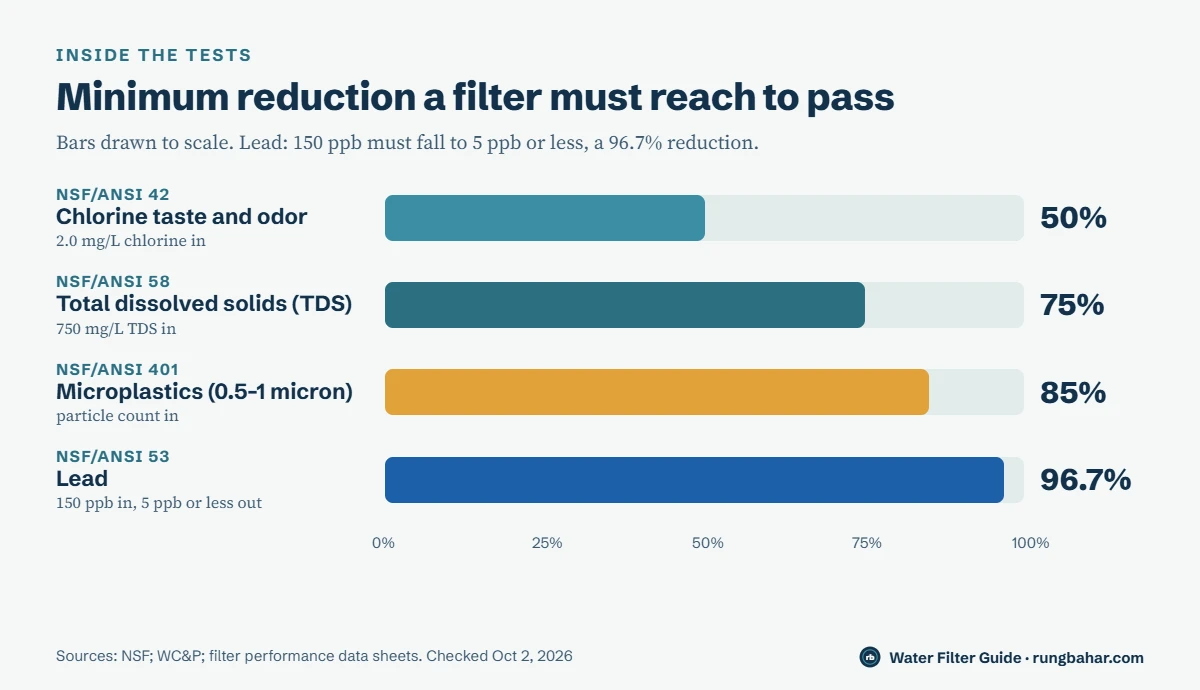
The most common claim is chlorine taste and odor. Performance data sheets for certified filters show how it is tested: the challenge water contains 2.0 mg/L of chlorine, and the filter must reduce it by at least 50 percent. Many filters do far better than that minimum, and the data sheet shows the measured result.
Another useful 42 claim is particulate reduction, Class I. It shows the filter traps very fine particles between 0.5 and 1 micron. The EPA asks people who are filtering for lead to look for this particulate claim alongside the NSF/ANSI 53 lead claim, because some lead in tap water travels as tiny particles rather than in dissolved form.
What NSF 42 does not do is make any health claim. A pitcher certified only to NSF/ANSI 42 may make water taste much better, but it is not certified to reduce lead, PFAS, cysts or any other health-related contaminant. If you search “nsf 42 vs 53”, that is the whole difference: 42 is about taste; 53 is about health.
NSF/ANSI 53: health effects
NSF/ANSI 53 is the standard for contaminants that can affect health. NSF says it covers more than 50 possible reduction claims, with lead, Cryptosporidium (a cyst), volatile organic compounds (VOCs) and chromium among the most common. Most products certified to it use activated carbon, sometimes combined with ion exchange media.
There is no single pass mark for NSF 53. A manufacturer chooses which claims to test, and the product earns only those claims. One filter can be certified to NSF/ANSI 53 for lead but not PFAS; another can be certified for PFAS but not lead. Both can print “NSF 53” on the box. That is why “what does nsf 53 mean” has no short answer beyond “it depends on the listing”. For the claim-by-claim detail, see what NSF/ANSI 53 covers and how it compares with NSF 58.
How the lead test works
The lead claim shows how demanding the tests are. Since December 2019, NSF/ANSI 53 and 58 require a lead-reduction filter to take challenge water containing 150 parts per billion (ppb) of lead and bring it down to 5 ppb or less. The old limit was 10 ppb. NSF chose a challenge level ten times the 15 ppb federal action level of the time, so a filter that passes is tested against water much worse than most homes have. Brita’s published data sheet for its Elite filter, for example, reports the test at two pH levels, 6.5 and 8.5, each starting at 150 ppb.
PFAS claims under NSF 53
PFAS claims also live in NSF/ANSI 53 (and 58). NSF first wrote PFOA and PFOS test methods as a separate protocol, P473, and moved them into the two standards in 2017. In 2022 the claim was tightened to reduce PFOA and PFOS to 20 parts per trillion combined, and a “total PFAS” claim was added that also covers PFHpA, PFHxS, PFNA and PFBS.
In April 2024 the EPA set drinking water limits of 4 parts per trillion each for PFOA and PFOS. NSF has said work is under way to align its standards with the new EPA levels. For now, read the exact PFAS wording on a product’s listing: “PFOA/PFOS reduction” and “total PFAS reduction” are different claims.
NSF/ANSI 58: reverse osmosis systems
NSF/ANSI 58 applies only to point-of-use reverse osmosis (RO) systems. RO pushes water through a membrane fine enough to hold back dissolved salts and metals, then usually polishes it with carbon. Our page on NSF 53 vs 58 compares the two standards side by side.
Every certified RO system must pass one required test: total dissolved solids (TDS) reduction. The challenge water is made up to 750 mg/L of TDS, and the system must achieve an average reduction of at least 75 percent. That single test also works as a check that the membrane is intact.
On top of TDS, NSF lists 16 optional claims a manufacturer can add: cysts, hexavalent and trivalent chromium, arsenic (including pentavalent arsenic), nitrate/nitrite, cadmium, lead, barium, turbidity, fluoride, copper, VOCs, asbestos, perchlorate, radium 226/228 and selenium. As with NSF 53, a model has only the claims shown on its listing.
NSF/ANSI 58 also reports an efficiency rating and a recovery rating. Both describe how much of the incoming water ends up as drinking water rather than going to the drain. Those numbers matter for your water bill and, on a private well, for your septic system, so compare them when you shortlist RO systems.
NSF/ANSI 401: emerging compounds and microplastics
NSF/ANSI 401 covers “incidental” contaminants that are not yet regulated by the EPA but have turned up in drinking water. It lists 15 compounds: meprobamate, phenytoin, atenolol, carbamazepine, TCEP, TCPP, DEET, metolachlor, trimethoprim, ibuprofen, naproxen, estrone, bisphenol A (BPA), linuron and nonylphenol. A manufacturer can test for any or all of them, so check which ones a model actually earned.
NSF/ANSI 401 is also where the microplastics claim lives. The claim was added in an update published in December 2021. It reuses the fine-particle test from NSF/ANSI 42: a certified filter must reduce the number of particles between 0.5 and 1 micron by at least 85 percent. Plastic particles from 1 to 5,000 microns are larger than that test range, so a filter that traps the smaller particles is expected to trap the larger ones too.
If a product claims to remove microplastics but shows no NSF/ANSI 401 microplastics claim on a listing, treat the claim as unverified. The same goes for marketing that lists “pharmaceuticals” in general: 401 covers 15 named compounds, not every medicine.
NSF/ANSI/CAN 372: low-lead parts, not lead removal
NSF/ANSI/CAN 372 is easy to misread. It checks the product’s own wetted parts for lead content: to comply, the weighted average lead content must be no more than 0.25 percent. NSF’s filtration standards point to 372 for their material safety requirements, so most certified filters meet it anyway.
What 372 does not do is say anything about removing lead from your water. A faucet, a fitting or a filter housing can all be “372 certified”. If you want lead reduction, you need NSF/ANSI 53 or 58 with a lead claim. That is the answer to the common search “nsf 42 vs 53 vs 372”: 42 is taste, 53 is health contaminants, and 372 is the product’s own lead content.
Other numbers you may see
NSF’s certified product database lists several more drinking water standards. You will see these less often on filters, but they matter for some homes.
- NSF/ANSI 44: cation exchange water softeners that reduce hardness from calcium and magnesium.
- NSF/ANSI 55: ultraviolet (UV) systems. Class A systems deliver a UV dose of 40 mJ/cm² and are meant to disinfect water that may carry bacteria, viruses and cysts, such as well water. Class B systems deliver 16 mJ/cm² and are only for water that is already treated.
- NSF/ANSI 62: distillation systems, which boil and condense water. NSF notes that some volatile organic chemicals can carry over with the vapor.
- NSF/ANSI 177: shower filters. They are certified only to reduce free available chlorine.
- NSF/ANSI 244: products that protect against occasional microbiological contamination of water that is normally safe and treated, with claims for bacteria, viruses and cysts.
- NSF P231: microbiological water purifiers, tested under EPA guidelines.
- CSA B483.1: the Canadian standard for drinking water treatment systems, also listed in NSF’s database.
Notice what is missing from the list: none of the common filter standards, 42, 53, 58 or 401, certifies a product to make untreated water microbiologically safe. Cyst reduction under 53 and 58 covers organisms such as Cryptosporidium and Giardia, not bacteria or viruses. For a private well with bacteria concerns, look at NSF/ANSI 55 Class A and test the well first.
How long a certified filter keeps working
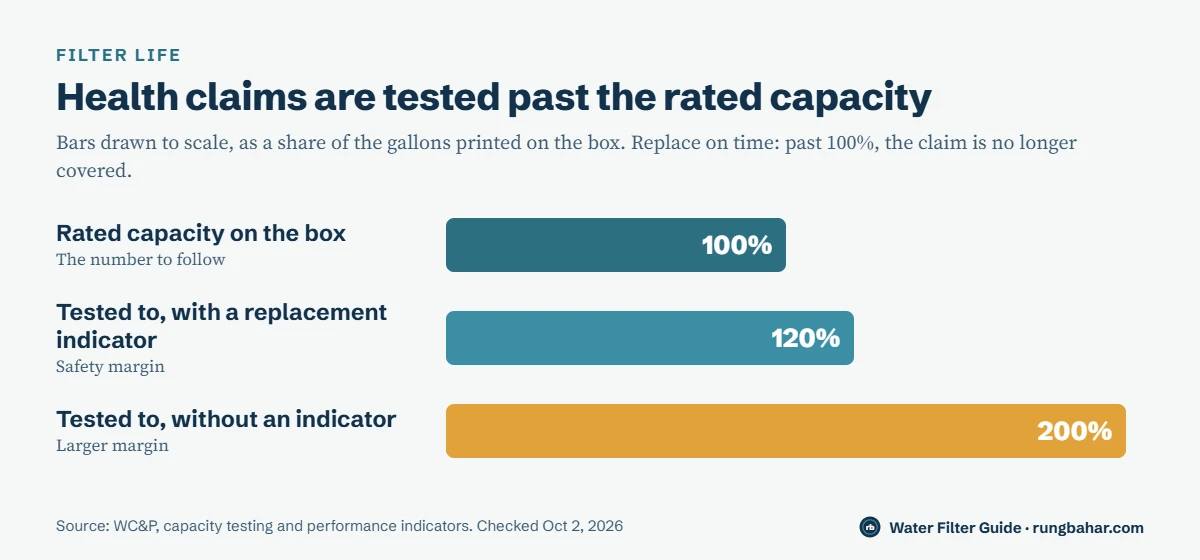
Certification also covers the life of the cartridge. Health claims are tested past the rated capacity printed on the box: to 120 percent of that capacity when the filter has a replacement indicator, and to 200 percent when it does not. The extra margin protects people who change filters a little late.
That margin is not permission to stretch a cartridge. The rated capacity, in gallons or months, is the number to follow. Once a filter passes it, nothing guarantees the claims still hold. If you are unsure how often your type needs changing, check the capacity on its listing or performance data sheet.
Which certification do you need?
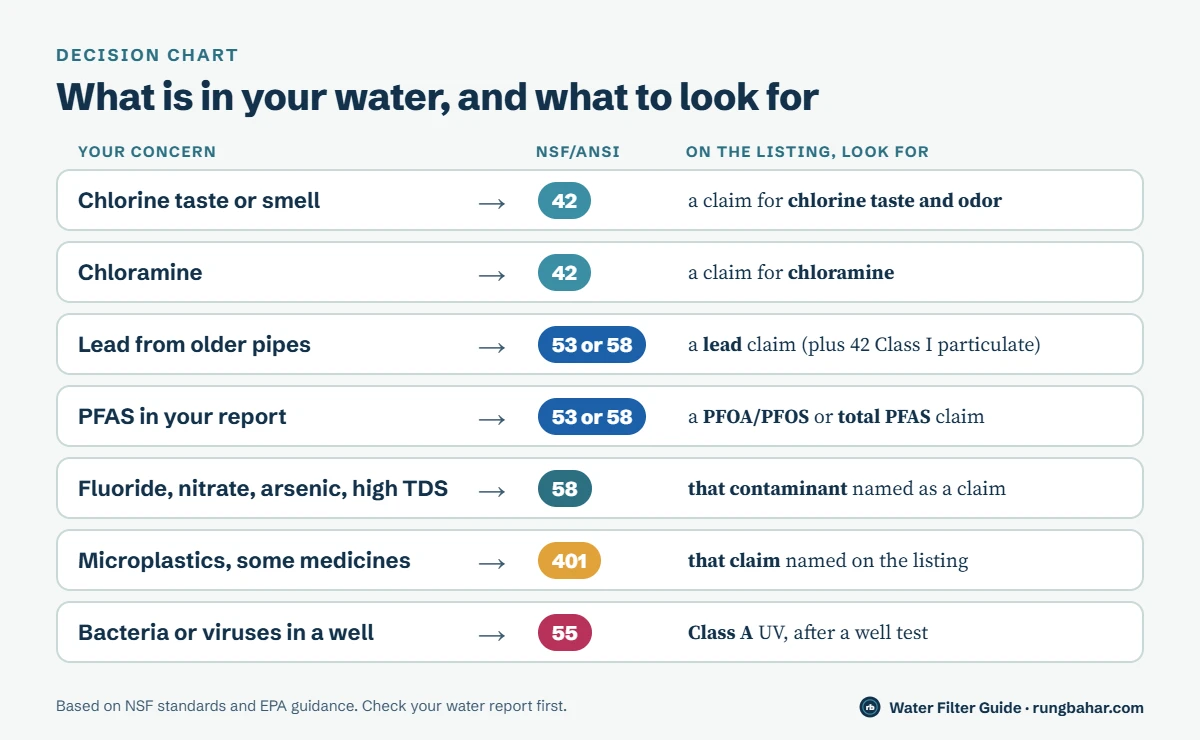
Start with what is in your water, then match the standard and the specific claim (our 5-step guide to choosing a water filter walks through it). Your utility publishes a yearly water quality report (Consumer Confidence Report). Private well owners should test with a state-certified lab. Then use this list:
- Chlorine taste or smell only: NSF/ANSI 42 with a chlorine taste and odor claim.
- Chloramine (many cities use it): NSF/ANSI 42 with a specific chloramine claim.
- Lead from older pipes: NSF/ANSI 53 or 58 with a lead claim, ideally plus NSF/ANSI 42 Class I particulate reduction.
- PFAS reported by your utility: NSF/ANSI 53 or 58 with a PFOA/PFOS or total PFAS claim. For fridge cartridges, see whether refrigerator filters remove PFAS.
- Fluoride, nitrate, arsenic or high TDS: usually an RO system certified to NSF/ANSI 58 for that contaminant (see filters that remove fluoride).
- Microplastics or specific medicines and pesticides: NSF/ANSI 401 with that claim named.
- Bacteria or viruses in a well: NSF/ANSI 55 Class A UV, after testing.
If you are still not sure, our 15-second filter finder turns a few answers about your home and water into a filter type and the certification to look for. You can also browse every guide on our water filter guides page.
Three filter types and the certifications to expect
Each card below links to the certifier’s public listings, so you can check the claims for a specific model before you buy.
Lowest cost
Pitcher or faucet filter
- Certification: NSF/ANSI 42 plus 53 for lead; 401 if you want microplastics
- Best for: Renters, small households, lead from older plumbing
- Skip if: you need fluoride, nitrate or arsenic reduced
Most households
Under-sink carbon filter
- Certification: NSF/ANSI 53 for lead and PFOA/PFOS, plus 42
- Best for: Lead plus PFAS with no wastewater and a fast flow
- Skip if: your report shows fluoride, nitrate or high TDS
Widest coverage
Reverse osmosis system
- Certification: NSF/ANSI 58 with your contaminant listed
- Best for: Fluoride, nitrate, arsenic, high TDS
- Skip if: you rent and cannot install under the sink
Whichever type you choose, do the two-minute listing check before you buy. Our step-by-step guide to checking a filter’s certification walks through the NSF, WQA, IAPMO, UL and CSA databases, and the NSF 53 vs 58 guide explains when reverse osmosis is worth it.
Water filter certifications: 16 common questions, answered
These are the questions people search most about filter certifications, including the ones most guides leave out.
What does NSF certified mean for a water filter?
It means an accredited certifier tested the product against an NSF/ANSI standard, audits the factory, and lists the product in a public database. The certification covers only the contaminants named on that product’s listing, so “NSF certified” alone does not tell you whether a filter reduces lead, PFAS or anything else.
What is the difference between NSF 42 and NSF 53?
NSF/ANSI 42 covers aesthetic effects such as chlorine taste and odor. NSF/ANSI 53 covers contaminants with health effects, such as lead, cysts, VOCs and PFOA/PFOS. Many filters carry both: 42 for taste and 53 for one or more health claims.
What does NSF 53 mean?
It is the American National Standard for drinking water filters that reduce health-related contaminants. It offers more than 50 possible claims. A product certified to NSF/ANSI 53 has earned only the claims shown on its listing.
NSF 42 vs 53 vs 401: which is best?
None is “best” on its own, because they cover different things. 42 is taste and odor, 53 is health contaminants, and 401 is emerging compounds and microplastics. A filter that carries all three, with the specific claims you need, covers the most ground.
NSF 42 vs 53 vs 372: what is 372?
NSF/ANSI/CAN 372 checks that the product’s own parts are low in lead (a weighted average of no more than 0.25 percent). It is about the materials, not about removing anything from water. For lead removal you need NSF/ANSI 53 or 58 with a lead claim.
Is NSF 42 enough for drinking water?
If your water is safe and you only dislike the chlorine taste, yes. If your utility report or a lab test shows lead, PFAS or another health contaminant, NSF 42 is not enough, because it makes no health claims.
Which certification removes PFAS?
Look for NSF/ANSI 53 or 58 with a PFOA/PFOS reduction claim or a total PFAS claim on the listing. Since 2022 those claims require reduction to 20 parts per trillion combined for PFOA and PFOS. The EPA’s 2024 limits are lower, and NSF has said it is working to align its standards.
Does NSF 401 mean a filter removes microplastics?
Only if the listing shows the microplastics claim. NSF/ANSI 401 covers up to 15 emerging compounds plus microplastics, and a manufacturer can certify any combination. The microplastics claim requires at least 85 percent reduction of particles between 0.5 and 1 micron.
Which certification should a lead filter have?
NSF/ANSI 53 (or 58 for reverse osmosis) with a lead reduction claim. Since December 2019, that claim means the filter reduced 150 ppb of lead to 5 ppb or less in testing. The EPA also suggests looking for NSF/ANSI 42 Class I particulate reduction.
Is a WQA Gold Seal the same as NSF certification?
For these standards, yes in practice. WQA, IAPMO R&T, UL Solutions and CSA Group certify products to the same NSF/ANSI standards as NSF does. The Gold Seal is WQA’s certification mark. What matters is the standard and the claim, not which accredited body did the certifying.
Are water filters required to be certified?
No. NSF notes there is no federal requirement for home water filters to be certified. Certification is voluntary, which is why checking a listing is worth the two minutes.
What does “tested to NSF standards” mean?
It usually means a lab ran the standard’s test at least once. It does not mean the product is certified, which adds ongoing factory audits, retesting and a public listing. Search for the model in a certifier’s database to be sure.
Does a certified filter remove 100 percent of a contaminant?
No. Certification means the filter reduced the contaminant to the level the standard allows, under test conditions, over its rated life. For lead that is 5 ppb or less from a 150 ppb challenge; for chlorine taste it is at least a 50 percent reduction.
Do certifications cover bacteria and viruses?
Not the common filter standards. NSF/ANSI 53 and 58 can include cyst claims (such as Cryptosporidium and Giardia), but bacteria and virus claims come from NSF/ANSI 55 Class A UV systems, NSF/ANSI 244 or NSF P231 purifiers.
What is NSF 58?
NSF/ANSI 58 is the standard for reverse osmosis drinking water systems. Every certified system reduces total dissolved solids by at least 75 percent on average in testing. Claims like fluoride, arsenic, nitrate and lead are optional and listed per model.
What is NSF 177?
NSF/ANSI 177 is the standard for shower filters. It certifies them only to reduce free available chlorine, so it is not a drinking water standard and does not cover lead or PFAS.
Sources and how we checked this page
Every fact on this page comes from the certifiers, the US EPA, published performance data sheets or water industry trade publications, checked on October 2, 2026. We read standards summaries and listings; we do not test filters in a lab ourselves.
- NSF: NSF/ANSI 42, 53 and 401 filtration standards
- NSF: NSF/ANSI 58 reverse osmosis systems
- NSF: Standards for water treatment systems
- NSF: What does water filter certification mean?
- NSF: Stricter requirements for lead reduction certification (2019)
- NSF: Forever chemicals and filtration standards
- US EPA: How to identify filters certified to reduce lead (June 2024, PDF)
- NSF certified drinking water treatment unit listings
- WC&P: Update on microplastics reduction claims (NSF/ANSI 401)
- WC&P: TDS reduction testing under NSF/ANSI 42 and 58
- WC&P: Capacity testing and performance indicators
- WC&P: NSF/ANSI/CAN 372 low-lead certification
- WaterWorld: The 15 NSF/ANSI 401 emerging compounds
- Fresh Water Systems: NSF/ANSI 55 Class A and Class B UV doses
- 3M performance data sheet (NSF/ANSI 42 chlorine test conditions, PDF)
- Brita Elite performance data sheet (lead test at pH 6.5 and 8.5, PDF)