Published October 5, 2026. Every claim is checked against the sources listed at the end of this page. How we research.
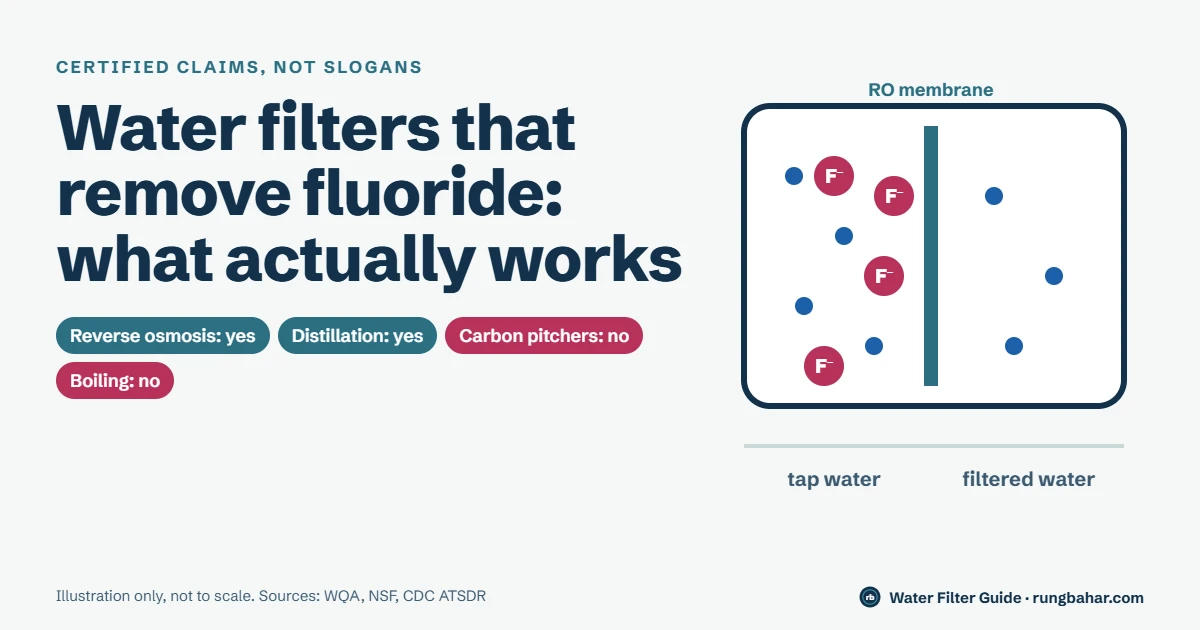
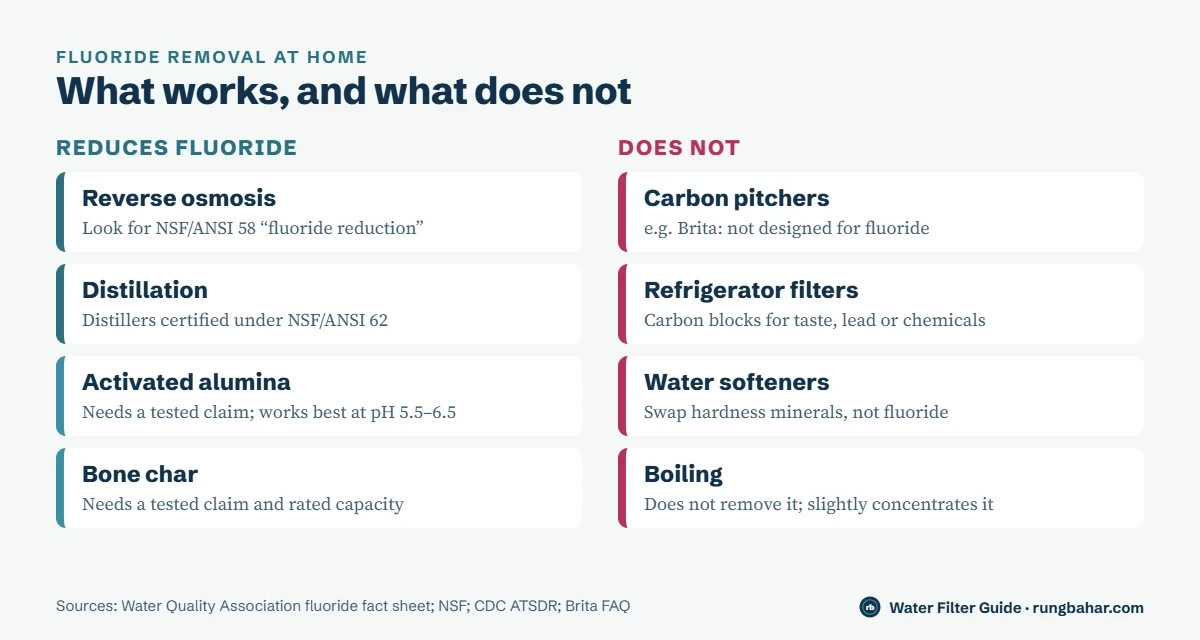
The short answer: The home filters that reliably remove fluoride are reverse osmosis systems certified for fluoride under NSF/ANSI 58, water distillers, and filters using activated alumina or bone char that carry a tested fluoride claim. Standard carbon pitchers, refrigerator filters, water softeners and boiling do not remove fluoride. Check your water’s fluoride level first, then choose a system whose data sheet lists fluoride reduction.
Quick check
What best describes your situation?
Step 1: know your fluoride level
Before you shop, find out how much fluoride is in your water. The number decides whether you need a filter at all and which one makes sense.
- City water: your utility’s annual water quality report, called a Consumer Confidence Report, lists fluoride. Utilities that add fluoride aim for the level the US Public Health Service recommended in 2015: 0.7 milligrams per liter (mg/L). Utilities in Utah and Florida stopped adding it after both states banned the practice in 2025.
- Private well: fluoride occurs naturally in some groundwater, sometimes at high levels. Nobody tests a private well for you, so order a test from a certified lab. Your state or county health department can point you to one.
- Bottled water: the CDC notes that bottled water labeled deionized, purified, demineralized or distilled contains no or only trace amounts of fluoride unless fluoride is listed as an added ingredient.
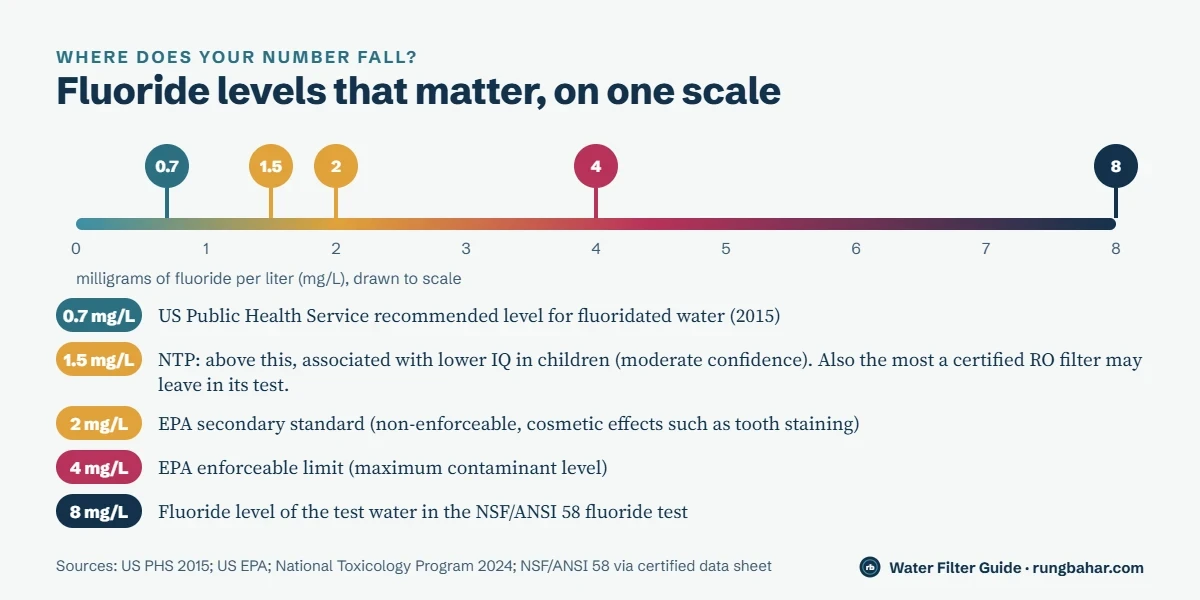
Put your number on the scale above. The EPA’s enforceable limit, the maximum contaminant level, is 4.0 mg/L. Its secondary standard, a non-enforceable guideline aimed at cosmetic effects such as tooth staining, is 2.0 mg/L. The National Toxicology Program concluded in August 2024, with moderate confidence, that drinking water above 1.5 mg/L is associated with lower IQ in children, and it said there was not enough data to determine whether 0.7 mg/L has an effect. We do not give medical advice here; if you have a health question about fluoride, ask your doctor or dentist.
If you are on fluoridated city water and simply prefer less fluoride, that is a personal choice and the filter options below all apply. If your well is above 2.0 or 4.0 mg/L, treatment is more pressing, and the certified test numbers matter more.
Filters that actually remove fluoride
Fluoride is a small, dissolved ion. That is why ordinary carbon filters, which are good at grabbing chlorine and many organic chemicals, are not a fluoride treatment. The Water Quality Association lists these methods as effective:
Reverse osmosis (the most common home choice)
A reverse osmosis (RO) membrane lets water molecules through and holds back most dissolved ions, including fluoride. WQA puts typical fluoride rejection at 80 to 90 percent for older cellulose membranes and up to 95 percent for the thin-film composite membranes in most current systems. Under-sink RO systems often carry a certified fluoride reduction claim under NSF/ANSI 58. The tradeoffs: you need space under the sink, a drain connection, periodic filter changes, and RO sends some water to the drain. Our guide to what reverse osmosis removes covers the full list and the wastewater question.
Distillation
A distiller boils water and condenses the steam, leaving fluoride and most other dissolved solids behind. Countertop distillers need no plumbing, which suits renters, but they are slow, use electricity, and produce flat-tasting water. Distillers are certified under NSF/ANSI 62.
Activated alumina
Activated alumina is a porous aluminum oxide medium that adsorbs fluoride. It is widely used in municipal treatment and appears in some home cartridges and pitchers. WQA notes it works best when the water’s pH is held between 5.5 and 6.5, and its capacity drops as it fills up. That makes the rated capacity on the data sheet especially important: an exhausted cartridge removes little fluoride.
Bone char
Bone char is charcoal made from animal bone. WQA describes it as an effective fluoride reduction medium through adsorption and ion exchange. As with activated alumina, look for real test data: the starting fluoride level, the ending level and the number of gallons tested.
Anion exchange
WQA also lists anion exchange as a fluoride option, for both whole-house and single-tap use. These systems need regeneration or tank exchange.
Fluoride removal methods compared
| Method | Removes fluoride? | Certification to look for | Main drawbacks |
|---|---|---|---|
| Under-sink reverse osmosis | Yes, up to about 95% | NSF/ANSI 58, fluoride reduction | Install, drain line, wastewater |
| Countertop reverse osmosis | Yes, if certified | NSF/ANSI 58, fluoride reduction | Counter space, small batches |
| Water distiller | Yes | NSF/ANSI 62 | Slow, uses electricity |
| Activated alumina cartridge or pitcher | Yes, within capacity | Tested fluoride claim on the data sheet | Works best at pH 5.5–6.5, exhausts quickly |
| Bone char filter | Yes, within capacity | Tested fluoride claim on the data sheet | Capacity limits, fewer certified products |
| Carbon pitcher (e.g. Brita) | No | — | Not designed for fluoride |
| Refrigerator filter | No (as a rule) | — | Carbon-based |
| Water softener | No | — | Exchanges hardness ions, not fluoride |
| Boiling | No, it concentrates fluoride | — | Water evaporates, fluoride stays |
For most households on city water, an under-sink RO system with a certified fluoride claim is the most practical option: it covers fluoride, often PFAS and lead too, and runs from a dedicated faucet. Renters usually choose between countertop RO and a distiller.
Most common choice
Under-sink reverse osmosis
- Certification: NSF/ANSI 58 with fluoride reduction listed
- Best for: Homeowners on city or well water
- Skip if: you cannot add a drain connection
No plumbing
Countertop reverse osmosis
- Certification: NSF/ANSI 58 (confirm fluoride on the listing)
- Best for: Renters, small kitchens
- Skip if: you need a lot of water every day
Simple and thorough
Countertop water distiller
- Certification: NSF/ANSI 62
- Best for: Renters who want very low TDS
- Skip if: you dislike flat-tasting water or slow output
What does not remove fluoride
A lot of money is wasted on filters that were never designed for fluoride. Here is what does not work, and why:
- Standard carbon pitchers. Brita says its cartridges are not designed to remove fluoride, and fluoride is not on its data sheets. The same applies to most carbon pitcher and faucet filters. See does Brita remove fluoride, lead and PFAS for the details.
- Refrigerator filters. These are carbon blocks built mainly for chlorine taste and, on some models, lead or other chemicals. Fluoride is not a typical refrigerator filter claim.
- Water softeners. A softener swaps calcium and magnesium for sodium or potassium. It is not a fluoride treatment.
- Boiling. The CDC’s Agency for Toxic Substances and Disease Registry states plainly that heating or boiling water does not remove fluoride. Because some water evaporates, boiling slightly raises the concentration.
- Letting water sit or freezing it. Fluoride is dissolved and does not settle out or evaporate.
If a product claims fluoride reduction but shows no performance data sheet, no starting and ending levels, and no certifier, treat the claim as unproven. Our guide on how to check if a water filter is really NSF certified shows how to confirm a listing by model number.
How fluoride claims are tested
A certified fluoride claim tells you more than a marketing percentage, because the test conditions are fixed. Under NSF/ANSI 58, the reverse osmosis standard, the system is challenged with water containing 8.0 mg/L of fluoride, plus or minus 10 percent, and the treated water must contain no more than 1.5 mg/L. That starting level is about eleven times the 0.7 mg/L used in community fluoridation, so a system that passes has headroom for typical city water.
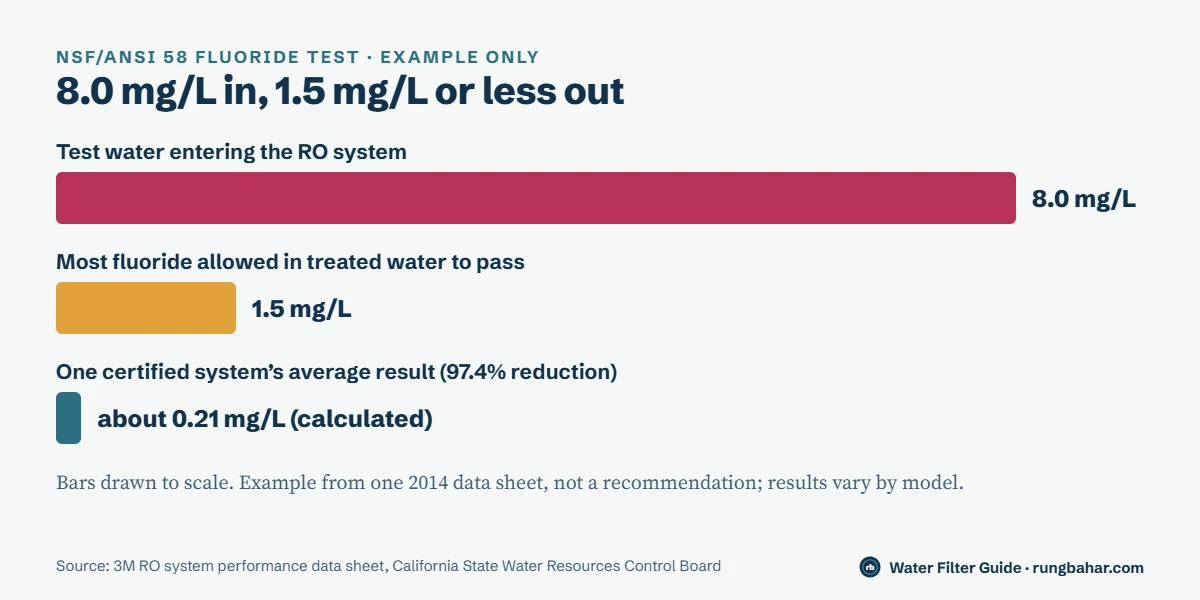
As an example only, the performance data sheet for one NSF-certified under-sink RO system, filed with California’s State Water Resources Control Board, shows 97.4 percent average fluoride reduction from the 8.0 mg/L challenge. The same sheet shows an efficiency rating of about 13 percent, which means most of the water entering that system went to the drain under test conditions. Newer systems vary widely, so compare efficiency ratings if wastewater matters to you.
The Water Quality Association lists NSF/ANSI 53, 58 and 62 and its own WQAS-200 standard as the ones that can cover fluoride reduction. In practice, most certified fluoride claims you will find are on NSF/ANSI 58 reverse osmosis systems. NSF’s public listings let you filter by “Fluoride Reduction” and see every certified model. For a refresher on what each standard number means, see water filter certifications explained and NSF 53 vs 58.
Fluoride plus PFAS, chlorine or microplastics
Many people searching for a fluoride filter also want something else removed. Here is how the combinations usually work:
- Fluoride and PFAS: reverse osmosis is the natural fit. The EPA says RO membranes are typically more than 90 percent effective across a wide range of PFAS. Confirm that the same model lists both fluoride and PFOA/PFOS or total PFAS reduction on its NSF/ANSI 58 listing.
- Fluoride and chlorine: RO systems include carbon stages that remove chlorine before it reaches the membrane, so you get both. Look for an NSF/ANSI 42 chlorine claim alongside the fluoride claim. If your utility uses chloramine, look for a chloramine claim specifically.
- Fluoride and microplastics: an RO membrane holds back particles far smaller than microplastics, but a certified microplastics claim falls under NSF/ANSI 401. Check for it if microplastics are a priority.
- Fluoride and heavy metals: many RO systems also list lead, arsenic and other metals under NSF/ANSI 58. Each one must be named on the listing to count.
Can you remove fluoride without a filter?
Not reliably. Boiling does not remove fluoride, and freezing or letting water stand will not either, because fluoride stays dissolved. Online “natural” methods generally lack test data. The practical non-filter option is bottled water that is labeled distilled, purified, deionized or demineralized, which the CDC says contains little or no fluoride unless it is added. That works for drinking and formula, but it is costly and creates plastic waste over time.
Fluoride removal also does not need to be whole-house. Concerns about fluoride center on water you drink and cook with. Showering and washing are not usually the reason people seek fluoride treatment, and a whole-house system costs much more to install and run than one under-sink RO unit.
Fluoride and infant formula
This is one of the most common reasons parents look for a fluoride filter. The CDC says that formula mixed with fluoridated water may increase the chance of dental fluorosis, faint white marks on the teeth, if formula is the baby’s main source of food. The CDC suggests parents can use low-fluoride bottled water some of the time to mix formula to lessen that risk. Bottled water labeled distilled, purified, deionized or demineralized fits that description, and water from a certified RO system or distiller is also low in fluoride.
Every baby is different, and we are not medical advisors. Ask your pediatrician or dentist what is right for your child, especially if you use well water with naturally high fluoride.
Why more people are asking in 2026
Interest in fluoride filters has climbed with the policy debate. In 2025, Utah and Florida became the first states to ban adding fluoride to public water systems, and bills have been introduced in many other states. In April 2025, the EPA said it would review new science on fluoride’s health risks, and in August 2026 it published the protocol for an expedited fluoride health assessment under the Safe Drinking Water Act. The current federal limits, 4.0 mg/L enforceable and 2.0 mg/L secondary, remain in place while that review continues.
We do not take a side in the fluoridation debate. Our job is to help you match a filter to your goal and your water. Whatever you decide, a certified claim is the only way to know a filter does what it says.
How to choose a fluoride filter, in 4 steps
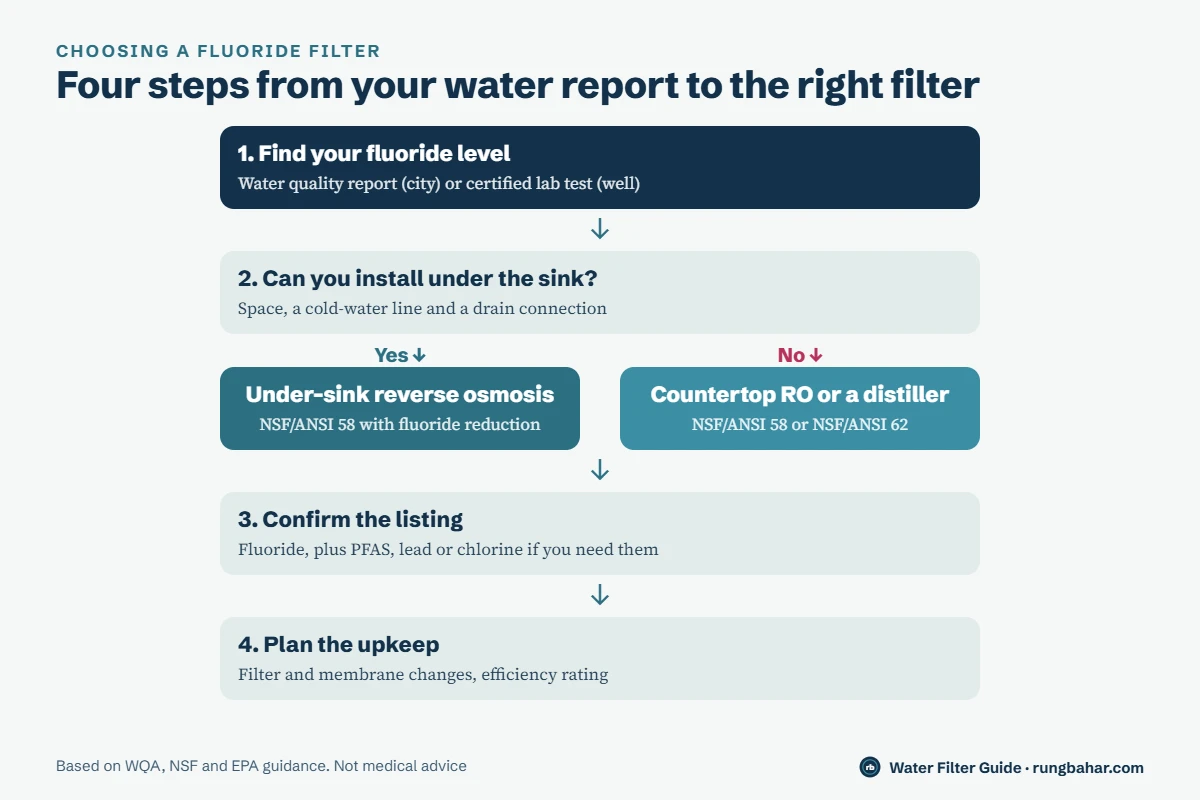
- Find your fluoride level in your water quality report or a certified lab test.
- Decide on the setup: under-sink RO if you can install it, countertop RO or a distiller if you cannot.
- Check the certification: the model’s listing must name fluoride reduction, and any other contaminants you care about, such as PFAS or lead.
- Plan the upkeep: note filter and membrane change intervals and the efficiency rating before you buy.
Not sure whether fluoride is your biggest priority? Our guide to choosing a water filter in 5 steps helps you rank what is in your water, and the 15-second filter finder suggests a filter type from three quick answers.
Fluoride filters: 14 common questions, answered
These are the questions people search most about removing fluoride, including the ones most product pages skip.
What type of water filter removes fluoride?
Reverse osmosis systems certified for fluoride under NSF/ANSI 58 are the most common choice. Distillers, activated alumina and bone char also reduce fluoride. Carbon pitchers, refrigerator filters and softeners do not.
Do Brita filters remove fluoride?
No. Brita says its filters are not designed to remove fluoride, and fluoride is not on the Brita Standard or Brita Elite data sheets.
Does reverse osmosis remove fluoride?
Yes. WQA puts RO fluoride rejection at up to about 95 percent with modern thin-film membranes. Certified systems must cut 8.0 mg/L to 1.5 mg/L or less under NSF/ANSI 58. Check that the exact model lists fluoride.
Does NSF 53 remove fluoride?
NSF/ANSI 53 certification alone does not mean fluoride is covered. Only the contaminants named on a product’s listing count. Most certified fluoride claims are found on NSF/ANSI 58 reverse osmosis systems.
Does boiling water remove fluoride?
No. The CDC’s ATSDR states that heating or boiling water does not remove fluoride. Boiling slightly concentrates it as water evaporates.
How can I remove fluoride from water at home?
Use a certified reverse osmosis system, a water distiller, or an activated alumina or bone char filter with a tested fluoride claim. Bottled water labeled distilled or purified is a non-filter alternative.
Is there a water filter that removes fluoride and chlorine?
Yes. Reverse osmosis systems include carbon stages for chlorine and a membrane for fluoride. Check for NSF/ANSI 42 chlorine and NSF/ANSI 58 fluoride claims on the same model.
Is there a water filter that removes fluoride and PFAS?
Reverse osmosis systems often list both. Confirm the NSF/ANSI 58 listing names fluoride and PFOA/PFOS or total PFAS reduction for the same model.
Do refrigerator filters remove fluoride?
As a rule, no. Refrigerator filters are carbon-based and aimed at chlorine taste and sometimes lead or other chemicals. Fluoride is not a typical claim.
Do water softeners remove fluoride?
No. A softener exchanges calcium and magnesium for sodium or potassium. It does not treat fluoride.
How much fluoride is in tap water?
Utilities that fluoridate aim for 0.7 mg/L, the level the US Public Health Service recommended in 2015. Natural levels in well water vary and can be much higher. Your water quality report or a lab test gives your number.
What is the legal limit for fluoride in drinking water?
The EPA’s enforceable limit is 4.0 mg/L and its secondary, non-enforceable standard is 2.0 mg/L. In August 2026 the EPA published the protocol for a new fluoride health assessment that could lead to changes.
Does a whole-house filter remove fluoride?
Most whole-house filters are carbon or sediment systems and do not. Whole-house fluoride treatment exists but is costly, and most people treat only their drinking water with an under-sink system.
Should I use fluoride-free water for baby formula?
The CDC says parents can use low-fluoride bottled water some of the time to mix formula to lower the chance of mild dental fluorosis. Ask your pediatrician what is right for your baby.
Sources and how we checked this page
Every fact on this page comes from the US EPA, the CDC and its ATSDR, the National Toxicology Program, NSF, the Water Quality Association, NCSL, state health and water agencies, and manufacturer data sheets, checked on October 4, 2026. We do not test filters in a lab. The RO data sheet shown is an example, not a recommendation.
- Water Quality Association: Fluoride fact sheet (PDF)
- NSF listings: NSF/ANSI 58 systems with fluoride reduction
- CDC: Community water fluoridation FAQ
- CDC ATSDR: Health consultation noting that boiling does not remove fluoride (PDF)
- National Toxicology Program: Fluoride and neurodevelopment monograph (2024)
- Missouri DHSS: Federal regulation of fluoride in drinking water (fact sheet, PDF)
- WaterWorld: EPA advances expedited fluoride health assessment (Aug 2026)
- NCSL: State of the tap, policy actions on fluoride in drinking water
- 3M RO system performance data sheet (California State Water Resources Control Board, PDF)
- Brita: FAQ on filters and fluoride
- US EPA: Reducing PFAS in drinking water with treatment technologies
- US EPA: Protect your home’s water (private wells)