Published October 4, 2026. Every claim is checked against the sources listed at the end of this page. How we research.
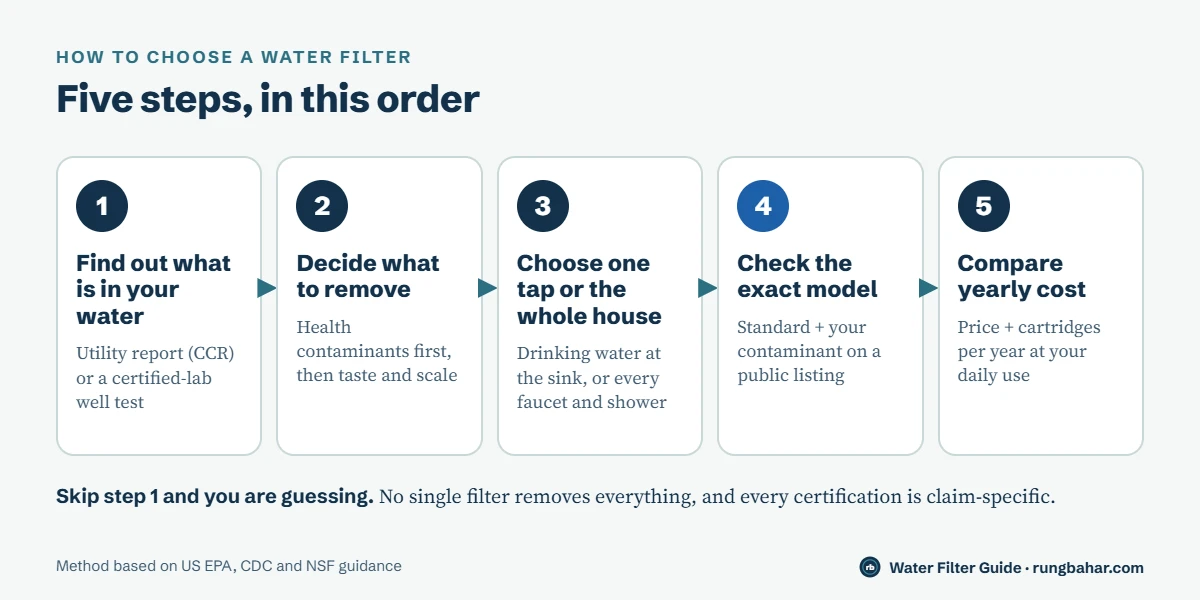
The short answer: To choose a water filter, first find out what is in your water from your utility’s yearly water quality report or a certified-lab well test. Then pick the contaminants you want reduced, decide whether you need filtered water at one tap or the whole house, and buy a model whose public certification listing names those contaminants. Finally, compare the yearly cost of replacement cartridges, not just the sticker price.
Quick check
What is the main reason you want a water filter?
Why one filter does not fit every home
There is no single “best” water filter, because there is no single kind of tap water. One home has a chlorine taste and nothing else. Another has old lead plumbing. A third is on a private well with nitrate from nearby farms. A filter that is excellent for the first home can do nothing useful for the other two.
The CDC’s guide to household water treatment makes the same point in a different way. It describes each technology separately, by what it removes and what it does not. Carbon filters are good at many chemicals but are not designed to make microbiologically unsafe water safe. Reverse osmosis removes far more dissolved substances but costs more, uses more water and needs installation. Water softeners deal with hardness but, as the CDC notes, do not protect against protozoa, bacteria and viruses.
Certification works the same way. A filter is certified for specific contaminants listed on its public listing, not for “clean water” in general. Our guide to water filter certifications explained covers what NSF/ANSI 42, 53, 58, 401 and 372 each mean. This guide is the practical side: how to go from “I want a filter” to one model that fits your water, your home and your budget.
The five steps below take about 20 minutes the first time. Most of that is finding your water report. Once you have it, the rest is matching.
Step 1: Find out what is in your water
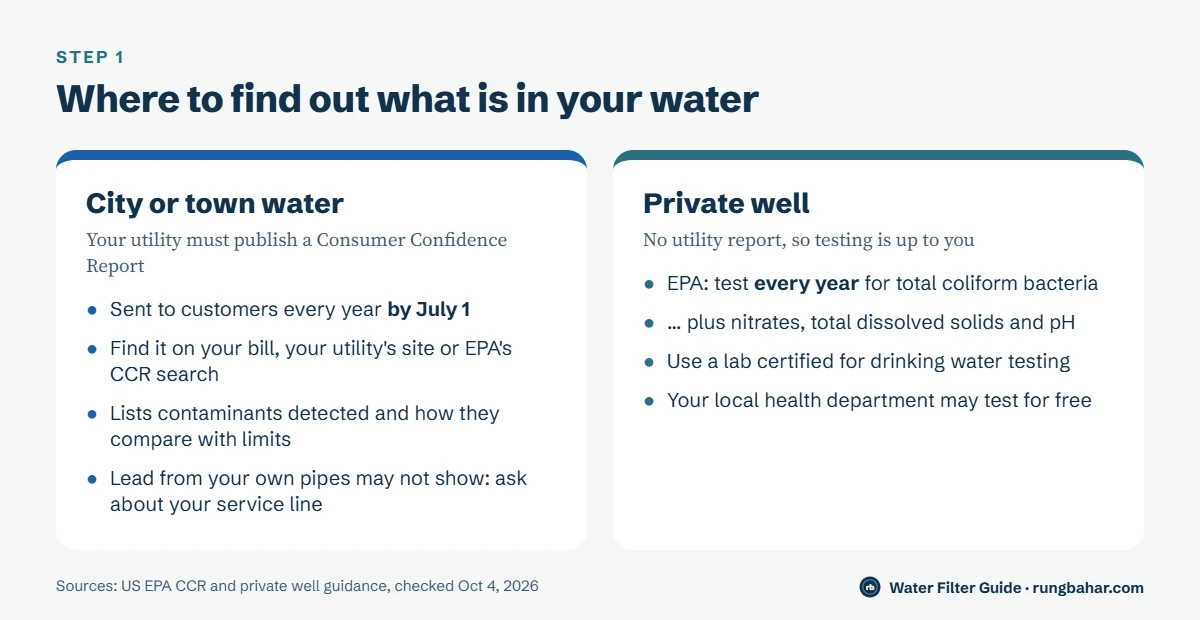
Everything else depends on this step, so do not skip it. Where you get the data depends on who supplies your water.
If you are on city or town water
Community water systems must send customers a Consumer Confidence Report (CCR) every year. EPA says the report must reach you by July 1. It lists the contaminants the utility detected, the levels found and how they compare with federal limits. You can find it on your water bill, on your utility’s website or through EPA’s CCR search tool.
Read the CCR for three things. First, anything listed with a violation or above a health-based level. Second, contaminants you care about even when they are within limits, such as PFAS, nitrate or disinfection byproducts. Third, which disinfectant the utility uses: chlorine or chloramine. That last detail decides which taste-and-odor claim you need, because a filter certified only for chlorine is not automatically certified for chloramine.
A CCR has one blind spot. Lead usually enters water from service lines, solder and fixtures between the water main and your faucet, so the utility’s average results cannot tell you what comes out of your own tap. If your home is older, ask your utility whether your service line is lead, and consider a lead test at the tap.
If you are on a private well
No utility tests a private well for you, so there is no CCR. EPA’s advice is direct: test your private well every year for total coliform bacteria, nitrates, total dissolved solids and pH, and use a laboratory certified for drinking water testing. Your local health department can often point you to a certified lab and may offer testing itself. Add other tests, such as arsenic or uranium, if your state flags them in your area.
Step 2: Decide what you want removed
Now turn your report into a short list. Split it into two groups, because the certification you need is different for each.
- Health contaminants such as lead, PFAS, arsenic, nitrate, cysts or volatile organic compounds (VOCs). These are covered by NSF/ANSI 53 for most filters and NSF/ANSI 58 for reverse osmosis systems, each with a named claim per contaminant.
- Aesthetic issues such as chlorine taste and odor, chloramine, iron or particles. These are covered by NSF/ANSI 42.
Put health contaminants first. A filter that makes water taste great but is not certified for the lead in your pipes has solved the wrong problem. If you only have a taste or smell complaint and your report is clean, a simple NSF/ANSI 42 filter may be all you need, and spending more buys you nothing.
Be honest about what you do not need, too. Reverse osmosis removes minerals along with contaminants, wastes some water and needs space under the sink. If your list has nothing that only RO handles, a certified carbon filter is often the simpler choice. Our comparison of NSF 53 vs 58 explains where that line falls.
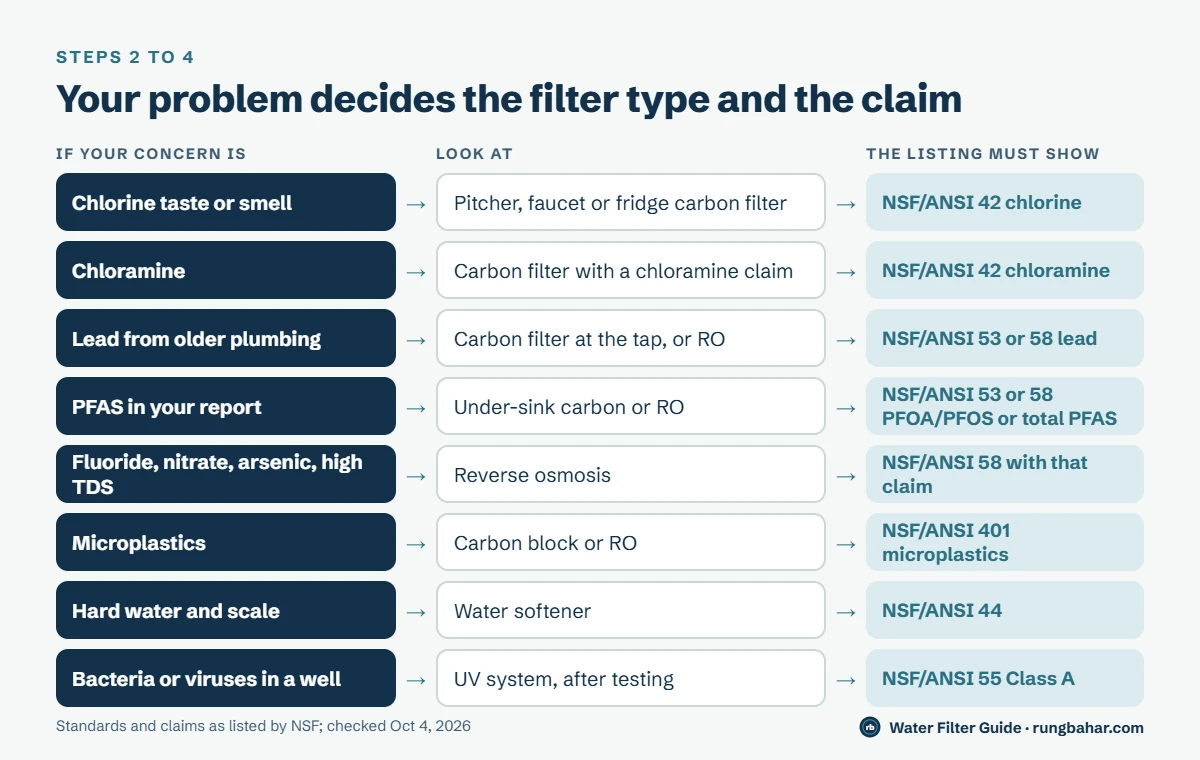
| If your list includes | Filter type to consider | Certification claim to look for |
|---|---|---|
| Chlorine taste or smell | Carbon pitcher, faucet, fridge or under-sink filter | NSF/ANSI 42, chlorine taste and odor |
| Chloramine | Carbon filter with a chloramine claim | NSF/ANSI 42, chloramine |
| Lead | Carbon filter at the tap, or RO | NSF/ANSI 53 or 58, lead (plus 42 Class I particulate) |
| PFAS | Under-sink carbon or RO | NSF/ANSI 53 or 58, PFOA/PFOS or total PFAS |
| Fluoride, nitrate, arsenic or high TDS | Reverse osmosis | NSF/ANSI 58 with that contaminant named |
| Microplastics | Carbon block or RO | NSF/ANSI 401, microplastics |
| Hardness and scale | Water softener | NSF/ANSI 44 |
| Bacteria or viruses (well) | UV system after testing | NSF/ANSI 55 Class A |
Step 3: Decide whether you need one tap or the whole house
Filters are installed in one of two places. Point-of-use filters treat water at a single tap: pitchers, faucet-mount filters, fridge filters, countertop units and under-sink systems. Point-of-entry (whole-house) systems treat all the water as it enters the home, so every faucet, shower and appliance gets the same water.
For drinking water concerns, point-of-use is usually the better fit. You only drink and cook with a few gallons a day, so a smaller filter can be much more thorough on that water. Lead is the clearest example: because it often comes from plumbing inside the home, filtering at the tap you drink from catches lead picked up along the way, while a filter where water enters the house cannot treat what the pipes add after it.
Whole-house treatment makes sense when the problem affects the whole house. Hard water scales up every fixture and water heater, so a softener belongs at the point of entry. A strong chlorine smell in the shower, sediment, or iron staining are other whole-house problems. Many homes end up with both: a softener or sediment filter for the house, plus a certified drinking water filter at the kitchen sink.
Renters have fewer options for permanent installs. A pitcher, a faucet-mount filter or a countertop unit can be certified for the same claims as larger systems and needs no plumbing work. Check your lease before fitting anything under the sink. Our renter-friendly water filter guide compares the no-install options.
Step 4: Check the certification for the exact model
This is the step that protects your money. There is no federal requirement for a home water filter to be certified, so certification is a voluntary claim by the seller, and claims can be out of date, belong to a different model or use wording that only sounds like certification.
The fix takes two minutes. Find the exact model number of the filter or replacement cartridge. Then search it in the public database of the certifier named on the box: NSF, the Water Quality Association (WQA), IAPMO R&T, UL Solutions or CSA Group. The EPA recognizes all five, and all certify to the same NSF/ANSI standards. A real certification shows the same model, the right standard and your contaminant listed by name.
Treat phrases like “tested to NSF standards” or “meets NSF standards” as unverified until you find a listing. Our step-by-step guide on how to check if a water filter is really NSF certified walks through each database.
While you are on the listing or the performance data sheet, note two more numbers: the rated capacity in gallons and, if given, the rated life in months. You need both for the next step.
Step 5: Compare the real yearly cost
The sticker price is the smallest part of what many filters cost. EPA’s PFAS filter fact sheet puts home filters at anywhere from under $20 to over $1,000, depending on type, brand and installation. The ongoing cost is the replacement cartridges, and that depends on how fast you use them up.
Here is the simple way to compare two filters fairly:
- Find the rated capacity (gallons) and rated life (months) on the listing or data sheet.
- Estimate how many gallons you filter a day. Count drinking, coffee, cooking and pet water, not showers or dishes, unless it is a whole-house system.
- Divide capacity by daily gallons to get days per cartridge. If a month limit comes first, use that instead.
- Divide 365 by the days per cartridge to get cartridges per year, then multiply by the current cartridge price.
- Add the upfront price spread over the years you expect to keep the system.
Small cartridges look cheap but can need replacing often in a busy household. Larger under-sink cartridges cost more each but may last many months. Use the calculator below with the numbers from any listing you are considering.
Calculator
How often would you replace the cartridge?
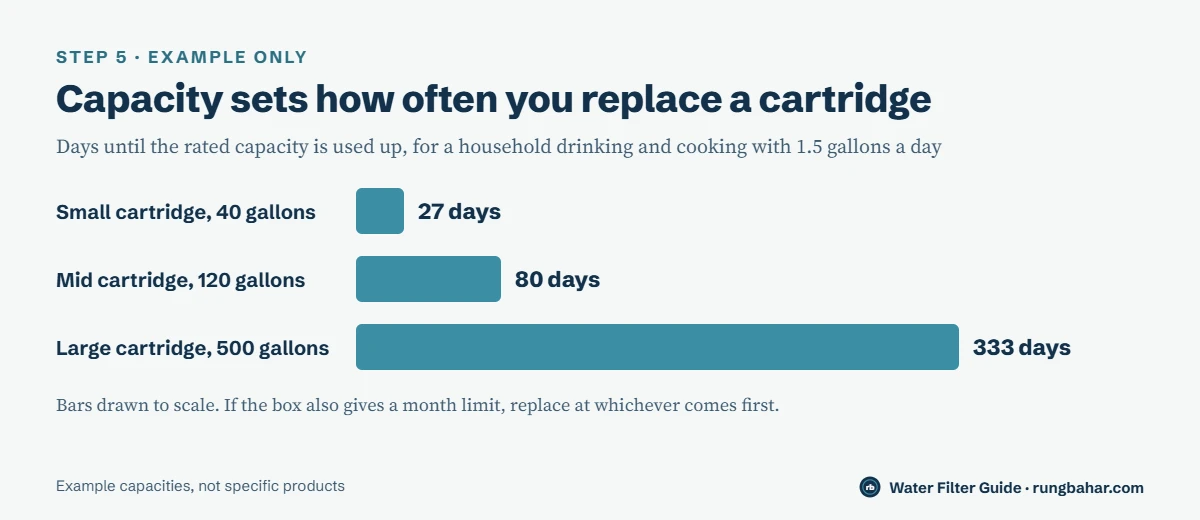
Do not stretch cartridges past their rating to save money. Certifiers test health claims somewhat past the rated capacity as a safety margin, but nothing guarantees the claims hold once the cartridge is used up. EPA warns that a filter that is not replaced on schedule can increase your exposure rather than reduce it.
Water filter types compared
Here is how the common types line up. Certification claims vary by model, so use this table to shortlist a type, then check the listing for each product.
| Type | Where it goes | Typical certifications | Good for | Limits |
|---|---|---|---|---|
| Pitcher or dispenser | Fridge or counter | NSF/ANSI 42, 53, 401 | Renters, small households, taste, some lead and PFAS claims | Slow, small cartridges, frequent changes |
| Faucet-mount | On the kitchen faucet | NSF/ANSI 42, 53 | Renters who want filtered water on tap | Does not fit every faucet; slows flow |
| Refrigerator filter | Inside the fridge | NSF/ANSI 42, 53, 401 | Chilled water and ice | Claims vary widely by cartridge |
| Under-sink carbon | Below the kitchen sink | NSF/ANSI 42, 53, 401 | Lead, PFAS and taste with a steady flow and no wastewater | Needs space and a separate faucet or connection |
| Reverse osmosis | Under the sink or countertop | NSF/ANSI 58 (plus 42, 53, 401) | Fluoride, nitrate, arsenic, high TDS, broad coverage | Sends some water to the drain; removes minerals; more upkeep |
| Whole-house filter | Where water enters the home | NSF/ANSI 42 (some 53 claims) | Chlorine, sediment and taste at every tap | Not a substitute for a lead filter at the tap |
| Water softener | Where water enters the home | NSF/ANSI 44 | Hard water and scale | Not a drinking water filter |
| UV system | Where water enters the home | NSF/ANSI 55 | Bacteria and viruses in well water | Does nothing for chemicals; needs clear water |
A note on shower filters: they are certified under NSF/ANSI 177, which covers only the reduction of free available chlorine. If a shower filter claims more than that, look for the listing behind the claim.
Which filter for common situations
Most people fall into one of a handful of situations. These are starting points, not final answers: always confirm the claim on the exact model.
- City water, tastes of chlorine, clean report: an NSF/ANSI 42 carbon pitcher, faucet or fridge filter. No need to spend more.
- Older home, possible lead pipes: a filter at the kitchen tap certified to NSF/ANSI 53 or 58 for lead, ideally with a Class I particulate claim. Run your own lead test if you can.
- PFAS in the CCR: an under-sink carbon or RO system listed for PFOA/PFOS or total PFAS reduction. EPA notes that current certification levels do not yet guarantee reduction to its 2024 PFAS limits, so read the exact claim. Start with how to find out if your tap water has PFAS.
- Fluoride, nitrate or arsenic: a reverse osmosis system certified to NSF/ANSI 58 for that contaminant. See which filters remove fluoride.
- Private well: test first. Treat bacteria with disinfection (such as NSF/ANSI 55 Class A UV) and chemicals with a filter certified for them. Do not use RO or carbon alone on water that is microbiologically unsafe.
- Hard water only: a water softener at the point of entry, plus a drinking water filter only if your report shows a separate concern.
Not sure which group you are in? Our 15-second filter finder asks a few questions about your home and water and returns a filter type and the certification to look for. You can also browse all of our water filter guides.
Each card below links to certified listings, so you can find models that carry the claims you need.
Lowest cost
Pitcher or faucet filter
- Certification: NSF/ANSI 42, plus 53 for lead or PFAS
- Best for: Renters, small households, taste
- Skip if: you need fluoride, nitrate or arsenic reduced
Most households
Under-sink carbon filter
- Certification: NSF/ANSI 53 for lead and PFOA/PFOS, plus 42
- Best for: Lead and PFAS with no wastewater
- Skip if: your report shows fluoride, nitrate or high TDS
Widest coverage
Reverse osmosis system
- Certification: NSF/ANSI 58 with your contaminant listed
- Best for: Fluoride, nitrate, arsenic, high TDS
- Skip if: you rent and cannot install under the sink
Mistakes to avoid when choosing a water filter
- Buying before testing. Without a CCR or a well test, you cannot tell whether a filter is solving a real problem.
- Trusting the brand instead of the model. Certification belongs to a specific model or cartridge. Two filters from the same brand can carry very different claims.
- Reading the logo, not the listing. “NSF 53” on a box does not say which of more than 50 possible claims the product earned.
- Expecting a whole-house filter to fix lead at the tap. Lead often comes from plumbing after the point of entry.
- Using a softener as a filter. Softeners treat hardness. They are not certified to make water safe to drink.
- Putting carbon or RO on untreated well water with bacteria. Disinfect first. RO data sheets typically warn against use with water that is microbiologically unsafe or of unknown quality.
- Ignoring replacement schedules. A used-up cartridge is no longer covered by its certification, however good the filter was.
Get those right and almost any certified filter of the right type will do the job you bought it for.
Choosing a water filter: 15 common questions, answered
These are the questions people search most when they choose a water filter, including the ones most buying guides skip.
How do I choose a water filter for my home?
Start with your water report (city water) or a certified-lab test (well). List the contaminants you want reduced, decide between one tap and the whole house, then pick a model whose certification listing names those contaminants. Compare yearly cartridge costs before you buy.
What water filter do I need?
It depends on what is in your water. Chlorine taste needs an NSF/ANSI 42 filter; lead or PFAS need NSF/ANSI 53 or 58 with that claim; fluoride, nitrate and arsenic usually need reverse osmosis certified to NSF/ANSI 58; hard water needs a softener; well bacteria needs disinfection such as NSF/ANSI 55 Class A UV.
What is the best type of water filter for home use?
There is no single best type. For most city homes with a lead or PFAS concern, a certified under-sink carbon filter or reverse osmosis system at the kitchen tap covers the most ground. For taste alone, a certified pitcher or faucet filter is enough.
How do I choose a water filter pitcher?
Check the replacement cartridge model on NSF, WQA or IAPMO listings and confirm it names your contaminant, such as lead or PFOA/PFOS. Then compare the rated capacity in gallons, because small cartridges may need replacing often in a busy household.
How do I choose a refrigerator water filter?
Use the cartridge model number for your fridge and search it in the certifier databases. Fridge cartridges vary widely: some are certified only for chlorine taste under NSF/ANSI 42, others also for lead or other claims under NSF/ANSI 53 or 401.
How do I choose a shower water filter?
Look for NSF/ANSI 177 certification. That standard covers only the reduction of free available chlorine, so be skeptical of shower filters that claim to remove much more without a listing to back it up.
What is the difference between a water filter and a water purifier?
In marketing there is no fixed difference. In certification terms, “purifier” usually refers to products tested to make water microbiologically safe, such as under NSF P231 or UV systems under NSF/ANSI 55 Class A. Most home filters are not certified for bacteria and viruses.
Do I need a water filter if my tap water meets EPA standards?
Not necessarily. If your report is clean and you have no lead plumbing, a filter is mainly about taste. Many people still filter for lead from older pipes, for PFAS below the reporting level of their utility, or for chlorine taste.
Is reverse osmosis the best water filter?
RO reduces the widest range of dissolved contaminants, including fluoride, nitrate and arsenic when certified for them. It also sends some water to the drain, removes minerals and needs installation and upkeep. If your water does not need RO, a certified carbon filter is often the simpler choice.
Should I get a whole-house filter or an under-sink filter?
For drinking water concerns like lead and PFAS, an under-sink or other point-of-use filter at the kitchen tap is usually better and cheaper. Whole-house systems suit whole-house problems like hardness, sediment or chlorine smell in the shower.
Do water filters remove bacteria?
Most do not, and are not certified to. Cyst claims under NSF/ANSI 53 and 58 cover organisms such as Cryptosporidium and Giardia, not bacteria and viruses. For bacteria in a well, use disinfection such as an NSF/ANSI 55 Class A UV system, after testing.
How do I know if a water filter is good?
A good filter is certified by NSF, WQA, IAPMO R&T, UL Solutions or CSA Group for the contaminants in your water, the listing matches the exact model, and you can afford to replace the cartridge on schedule.
How much should I spend on a water filter?
Spend what it takes to get the right certified claims for your water, and no more. EPA puts home filters from under $20 to over $1,000. Always compare the yearly cartridge cost, which can exceed the purchase price within a year or two.
How often should I replace a water filter cartridge?
Follow the rated capacity in gallons or the rated life in months, whichever comes first. Divide the capacity by your daily use to estimate the schedule, as in the calculator on this page.
What is the most important thing to check before buying?
That the exact model is listed in a certifier database for the contaminant you care about. Everything else, from brand to price, comes second to that match.
Sources and how we checked this page
Every fact on this page comes from the US EPA, the CDC and the certifiers, checked on October 4, 2026. We do not test filters in a lab and we do not accept payment for rankings.
- US EPA: Consumer Confidence Report information for consumers
- US EPA: Protect your home’s water (private wells)
- US EPA: Reducing PFAS in your drinking water with a home filter (fact sheet, PDF)
- US EPA: How to identify filters certified to reduce lead (PDF)
- CDC: About home water treatment systems
- NSF: NSF/ANSI 42, 53 and 401 filtration systems standards
- NSF: What does water filter certification mean?
- NSF certified drinking water treatment unit listings
- WQA: Find certified products
- IAPMO R&T product listing directory